
keyword
multimodal translation
Multimodal translation is a machine learning process that converts or maps information from one modality into another while preserving the underlying semantic content. Rather than simply fusing different data types together, this task takes an input representation in a source modality, such as text, audio, or visual data, and generates a coherent, corresponding output in a different target modality. Common examples include image captioning, text-to-image synthesis, and speech-to-text generation. A primary challenge in multimodal translation is handling the open-ended and often subjective nature of cross-modal mapping, where a single input can have multiple valid representations in the target modality.
2 items
Multimodal Deep Learning
Cem Akkus, Luyang Chu, Vladana Djakovic, Steffen Jauch-Walser, Philipp Koch, Giacomo Loss, Christopher Marquardt, Marco Moldovan, Nadja Sauter, Maximilian Schneider, Rickmer Schulte, Karol Urbanczyk, Jann Goschenhofer, Christian Heumann, Rasmus Hvingelby, Daniel Schalk, Matthias Aßenmacher
This book is the result of a seminar in which we reviewed multimodal approaches and attempted to create a solid overview of the field, starting with the current state-of-the-art approaches in the two subfields of Deep Learning individually. Further, modeling frameworks are discussed where one modality is transformed into the other, as well as models in which one modality is utilized to enhance representation learning for the other. To conclude the second part, architectures with a focus on handling both modalities simultaneously are introduced. Finally, we also cover other modalities as well as general-purpose multi-modal models, which are able to handle different tasks on different modalities within one unified architecture. One interesting application (Generative Art) eventually caps off this booklet.
Added
2026-09-12

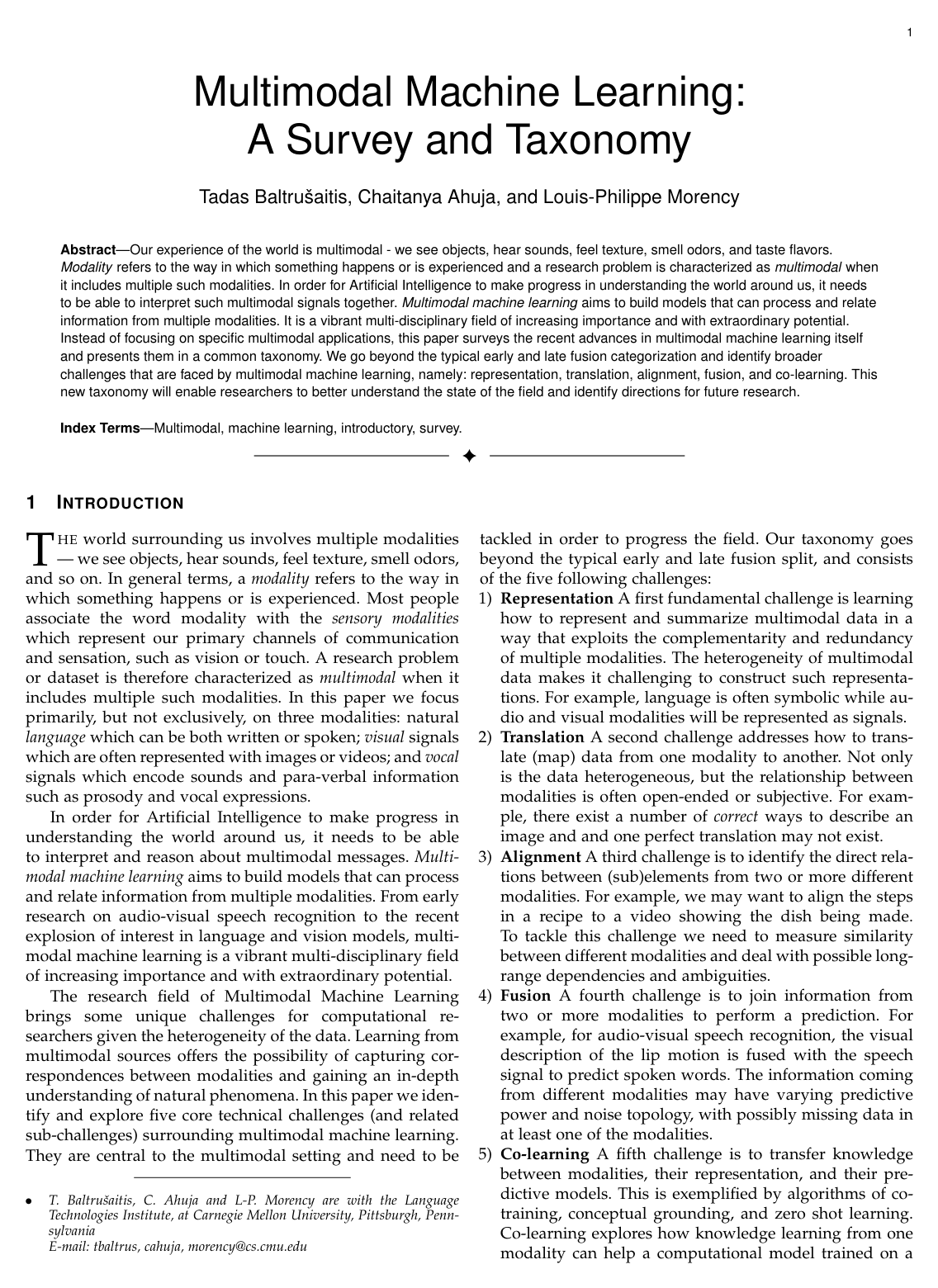
Multimodal Machine Learning: A Survey and Taxonomy
Tadas Baltrušaitis, Chaitanya Ahuja, Louis-Philippe Morency
Why you should read this
Establishes a comprehensive taxonomy for multimodal machine learning by structuring the field around five fundamental technical challenges: representation, translation, alignment, fusion, and co-learning.
Our experience of the world is multimodal - we see objects, hear sounds, feel texture, smell odors, and taste flavors. Modality refers to the way in which something happens or is experienced and a research problem is characterized as multimodal when it includes multiple such modalities. In order for Artificial Intelligence to make progress in understanding the world around us, it needs to be able to interpret such multimodal signals together. Multimodal machine learning aims to build models that can process and relate information from multiple modalities. It is a vibrant multi-disciplinary field of increasing importance and with extraordinary potential. Instead of focusing on specific multimodal applications, this paper surveys the recent advances in multimodal machine learning itself and presents them in a common taxonomy. We go beyond the typical early and late fusion categorization and identify broader challenges that are faced by multimodal machine learning, namely: representation, translation, alignment, fusion, and co-learning. This new taxonomy will enable researchers to better understand the state of the field and identify directions for future research.
Added
2026-09-10