
keyword
multimodal representations
Multimodal representations are mathematical feature encodings in machine learning that capture, integrate, and structure information derived from multiple distinct data types, such as text, images, video, and audio. These representations map heterogeneous data streams into coordinated, joint, or factorized feature spaces, enabling computational models to capture both shared patterns that overlap across modalities and unique attributes specific to an individual input stream. By establishing semantic alignment and facilitating information fusion across disparate sensory domains, multimodal representations allow systems to understand complex cross-modal relationships and perform downstream tasks such as cross-modal retrieval, automated report generation, sentiment analysis, and visual question answering.
4 items
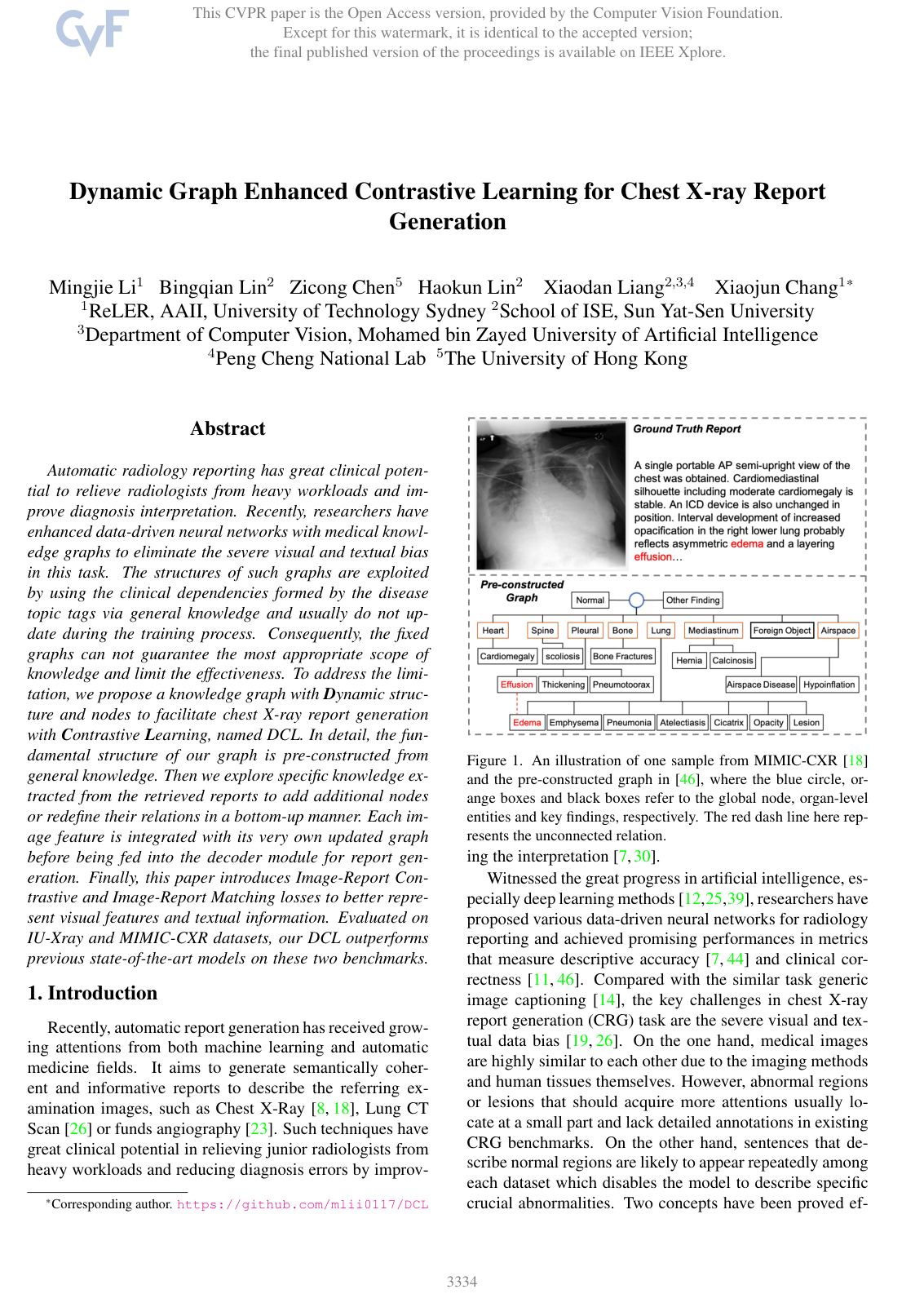
Dynamic Graph Enhanced Contrastive Learning for Chest X-Ray Report Generation
Mingjie Li, Bingqian Lin, Zicong Chen, Haokun Lin, Xiaodan Liang, Xiaojun Chang
Why you should read this
Proposes a dynamic knowledge graph framework combined with cross-modal contrastive learning that tailors graph structures to individual chest X-rays using retrieved reports to achieve state-of-the-art automated radiology report generation.
Automatic radiology reporting has great clinical potential to relieve radiologists from heavy workloads and improve diagnosis interpretation. Recently, researchers have enhanced data-driven neural networks with medical knowledge graphs to eliminate the severe visual and textual bias in this task. The structures of such graphs are exploited by using the clinical dependencies formed by the disease topic tags via general knowledge and usually do not update during the training process. Consequently, the fixed graphs can not guarantee the most appropriate scope of knowledge and limit the effectiveness. To address the limitation, we propose a knowledge graph with Dynamic structure and nodes to facilitate chest X-ray report generation with Contrastive Learning, named DCL. In detail, the fundamental structure of our graph is pre-constructed from general knowledge. Then we explore specific knowledge extracted from the retrieved reports to add additional nodes or redefine their relations in a bottom-up manner. Each image feature is integrated with its very own updated graph before being fed into the decoder module for report generation. Finally, this paper introduces Image-Report Contrastive and Image-Report Matching losses to better represent visual features and textual information. Evaluated on IU-Xray and MIMIC-CXR datasets, our DCL outperforms previous state-of-the-art models on these two benchmarks.
Added
2026-10-05
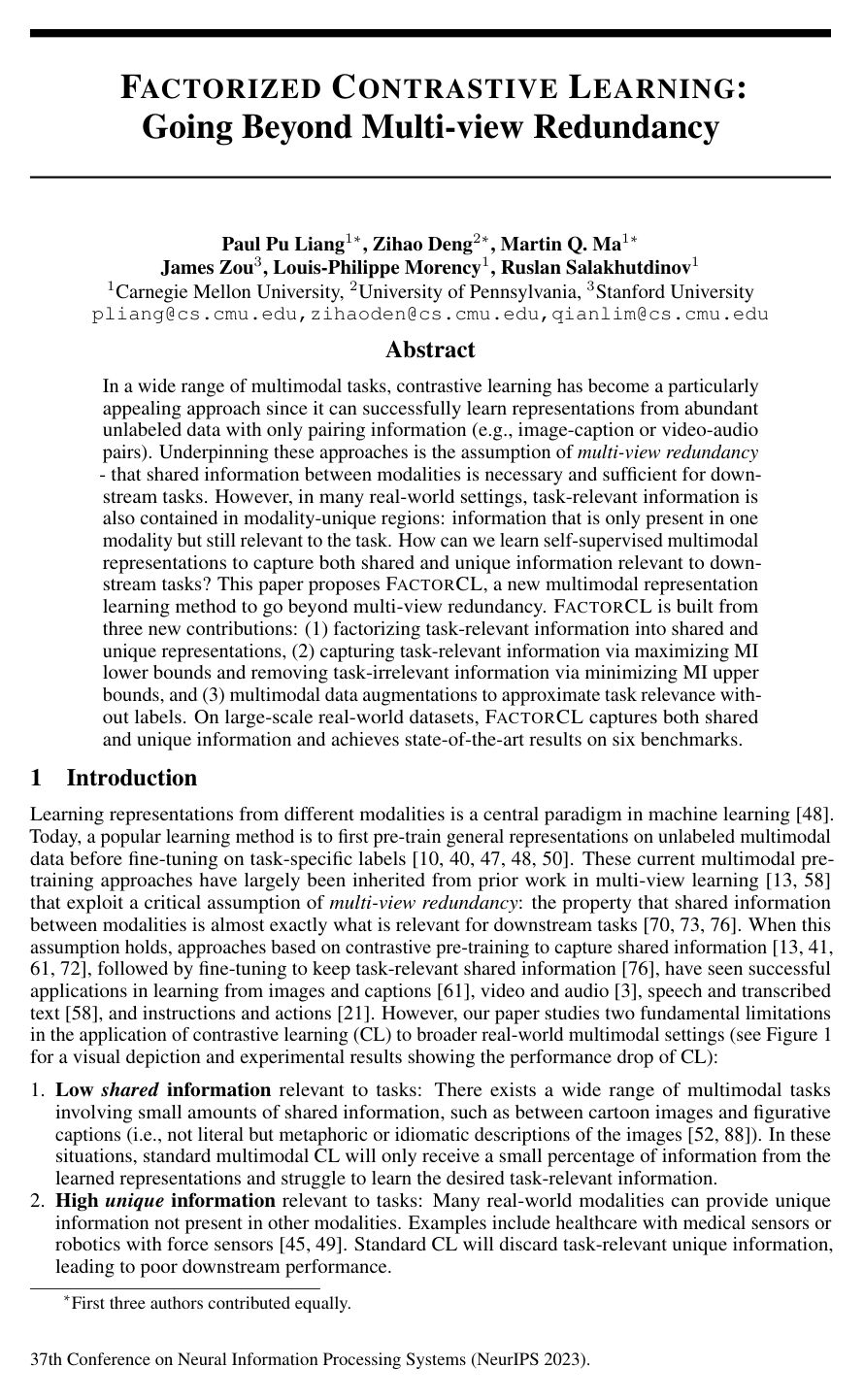
Factorized Contrastive Learning: Going Beyond Multi-view Redundancy
Paul Pu Liang, Zihao Deng, Martin Q. Ma, James Y. Zou, Louis-Philippe Morency, Ruslan Salakhutdinov
Why you should read this
Proposes FACTORCL, a multimodal contrastive learning framework that overcomes standard multi-view redundancy limitations by factorizing representations into task-relevant shared and unique information via conditional mutual information bounds and multimodal augmentations.
In a wide range of multimodal tasks, contrastive learning has become a particularly appealing approach since it can successfully learn representations from abundant unlabeled data with only pairing information (e.g., image-caption or video-audio pairs). Underpinning these approaches is the assumption of multi-view redundancy - that shared information between modalities is necessary and sufficient for downstream tasks. However, in many real-world settings, task-relevant information is also contained in modality-unique regions: information that is only present in one modality but still relevant to the task. How can we learn self-supervised multimodal representations to capture both shared and unique information relevant to downstream tasks? This paper proposes FACTORCL, a new multimodal representation learning method to go beyond multi-view redundancy. FACTORCL is built from three new contributions: (1) factorizing task-relevant information into shared and unique representations, (2) capturing task-relevant information via maximizing MI lower bounds and removing task-irrelevant information via minimizing MI upper bounds, and (3) multimodal data augmentations to approximate task relevance without labels. On large-scale real-world datasets, FACTORCL captures both shared and unique information and achieves state-of-the-art results on six benchmarks.
Added
2026-09-26
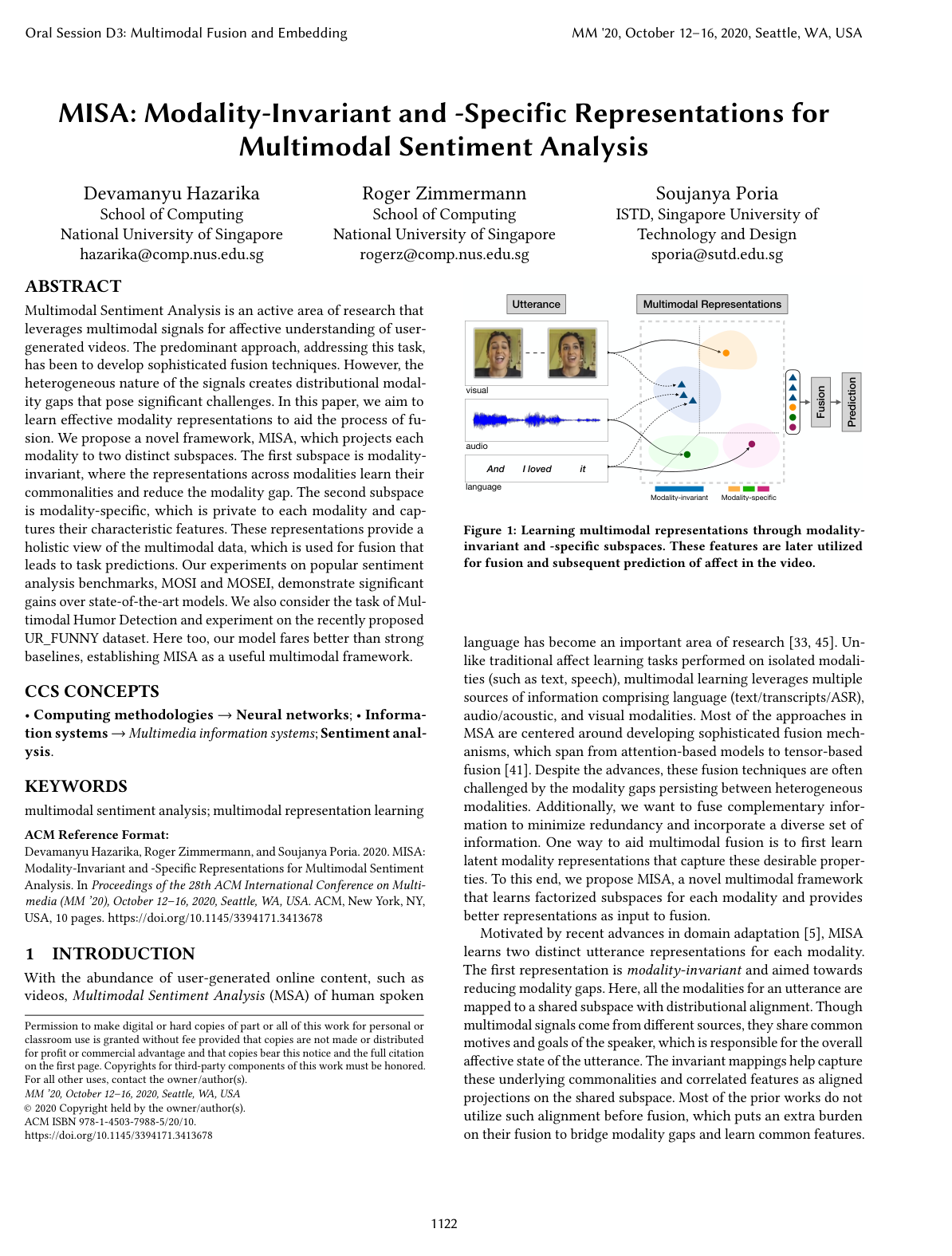
MISA: Modality-Invariant and -Specific Representations for Multimodal Sentiment Analysis
Devamanyu Hazarika, Roger Zimmermann, Soujanya Poria
Why you should read this
Proposes a multimodal representation framework, MISA, that factorizes signals into invariant and modality-specific subspaces, effectively resolving heterogeneous modality gaps to achieve state-of-the-art performance in sentiment analysis and humor detection.
Multimodal Sentiment Analysis is an active area of research that leverages multimodal signals for affective understanding of user-generated videos. The predominant approach, addressing this task, has been to develop sophisticated fusion techniques. However, the heterogeneous nature of the signals creates distributional modality gaps that pose significant challenges. In this paper, we aim to learn effective modality representations to aid the process of fusion. We propose a novel framework, MISA, which projects each modality to two distinct subspaces. The first subspace is modality-invariant, where the representations across modalities learn their commonalities and reduce the modality gap. The second subspace is modality-specific, which is private to each modality and captures their characteristic features. These representations provide a holistic view of the multimodal data, which is used for fusion that leads to task predictions. Our experiments on popular sentiment analysis benchmarks, MOSI and MOSEI, demonstrate significant gains over state-of-the-art models. We also consider the task of Multimodal Humor Detection and experiment on the recently proposed UR_FUNNY dataset. Here too, our model fares better than strong baselines, establishing MISA as a useful multimodal framework.
Added
2026-09-25
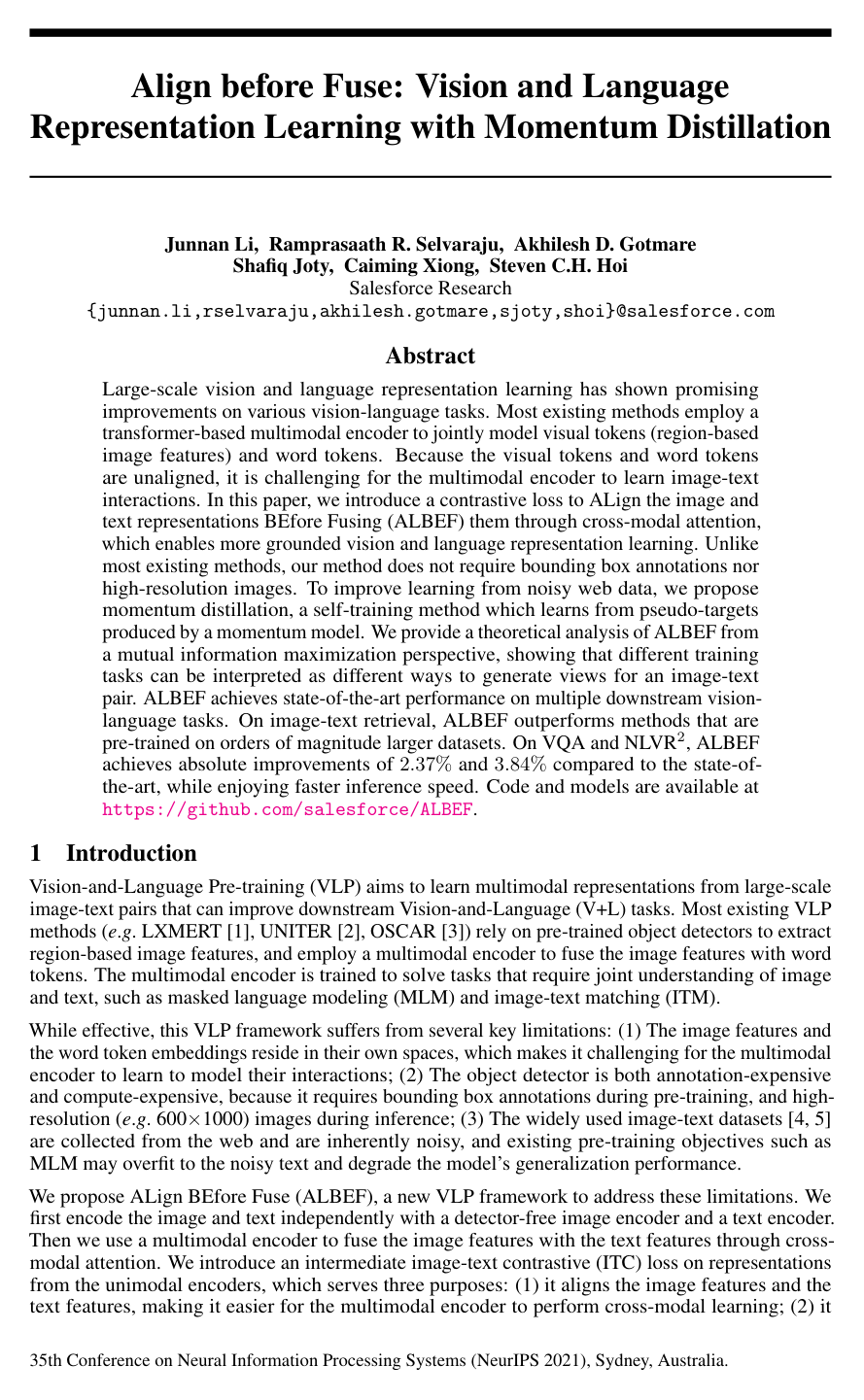
Align before Fuse: Vision and Language Representation Learning with Momentum Distillation
Junnan Li, Ramprasaath R. Selvaraju, Akhilesh Deepak Gotmare, Shafiq Joty, Caiming Xiong, Steven Hoi
Why you should read this
Presents a novel "Align before Fuse" (ALBEF) framework that achieves state-of-the-art performance in vision-language tasks with faster inference and without needing costly bounding box annotations, demonstrating a more efficient and effective approach to multimodal representation learning.
Large-scale vision and language representation learning has shown promising improvements on various vision-language tasks. Most existing methods employ a transformer-based multimodal encoder to jointly model visual tokens (region-based image features) and word tokens. Because the visual tokens and word tokens are unaligned, it is challenging for the multimodal encoder to learn image-text interactions. In this paper, we introduce a contrastive loss to ALign the image and text representations BEfore Fusing (ALBEF) them through cross-modal attention, which enables more grounded vision and language representation learning. Unlike most existing methods, our method does not require bounding box annotations nor high-resolution images. In order to improve learning from noisy web data, we propose momentum distillation, a self-training method which learns from pseudo-targets produced by a momentum model. We provide a theoretical analysis of ALBEF from a mutual information maximization perspective, showing that different training tasks can be interpreted as different ways to generate views for an image-text pair. ALBEF achieves state-of-the-art performance on multiple downstream vision-language tasks. On image-text retrieval, ALBEF outperforms methods that are pre-trained on orders of magnitude larger datasets. On VQA and NLVR, ALBEF achieves absolute improvements of 2.37% and 3.84% compared to the state-of-the-art, while enjoying faster inference speed. Code and pre-trained models are available at this https URL.
Added
2026-01-28
