
keyword
multimodal LLMs
Multimodal large language models are artificial intelligence systems that extend traditional text-based large language models to process, interpret, and generate content across multiple data modalities, such as images, video, audio, and text. These architectures typically connect pre-trained language model backbones with specialized modality encoders through cross-modal projection modules, mapping non-textual features into a shared representation space that the language model can interpret. By leveraging large-scale cross-modal alignment and instruction tuning, multimodal large language models apply their core linguistic reasoning capabilities to complex perceptual tasks, enabling functions such as visual question answering, fine-grained image and video analysis, and cross-modal reasoning.
4 items
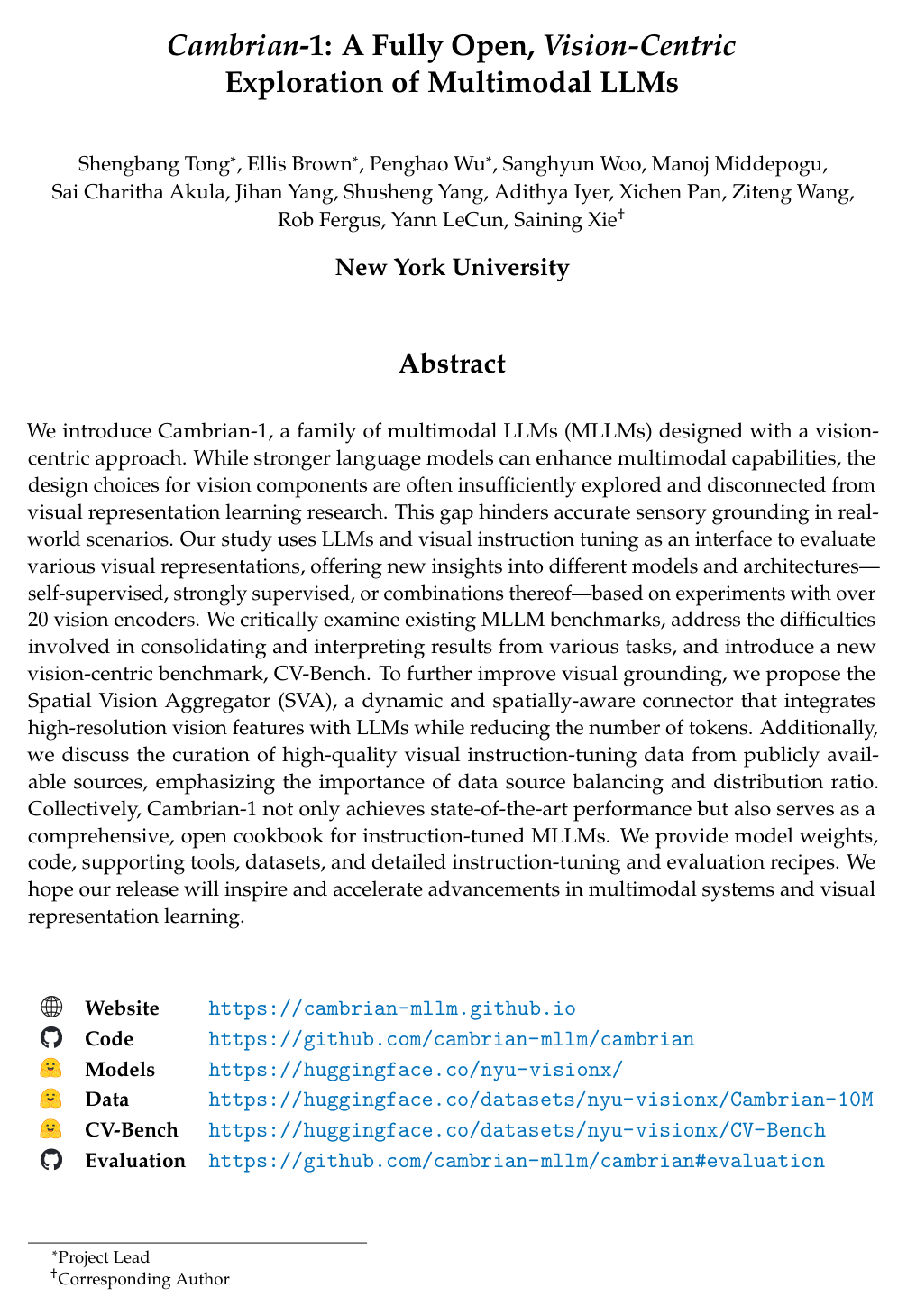
Cambrian-1: A Fully Open, Vision-Centric Exploration of Multimodal LLMs
Peter Tong, Ellis Brown, Penghao Wu, Sanghyun Woo, Adithya Iyer, Sai Charitha Akula, Shusheng Yang, Jihan Yang, Manoj Middepogu, Ziteng Wang, Xichen Pan, Rob Fergus, Yann LeCun, Saining Xie
Why you should read this
Presents a fully open, vision-centric suite of multimodal language models backed by systematic evaluations of over twenty vision encoders, a token-reducing spatial aggregator, and complete open-source training recipes and benchmarks.
We introduce Cambrian-1, a family of multimodal LLMs (MLLMs) designed with a vision-centric approach. While stronger language models can enhance multimodal capabilities, the design choices for vision components are often insufficiently explored and disconnected from visual representation learning research. This gap hinders accurate sensory grounding in real-world scenarios. Our study uses LLMs and visual instruction tuning as an interface to evaluate various visual representations, offering new insights into different models and architectures -- self-supervised, strongly supervised, or combinations thereof -- based on experiments with over 20 vision encoders. We critically examine existing MLLM benchmarks, address the difficulties involved in consolidating and interpreting results from various tasks, and introduce a new vision-centric benchmark, CV-Bench. To further improve visual grounding, we propose the Spatial Vision Aggregator (SVA), a dynamic and spatially-aware connector that integrates high-resolution vision features with LLMs while reducing the number of tokens. Additionally, we discuss the curation of high-quality visual instruction-tuning data from publicly available sources, emphasizing the importance of data source balancing and distribution ratio. Collectively, Cambrian-1 not only achieves state-of-the-art performance but also serves as a comprehensive, open cookbook for instruction-tuned MLLMs. We provide model weights, code, supporting tools, datasets, and detailed instruction-tuning and evaluation recipes. We hope our release will inspire and accelerate advancements in multimodal systems and visual representation learning.
Added
2026-10-05
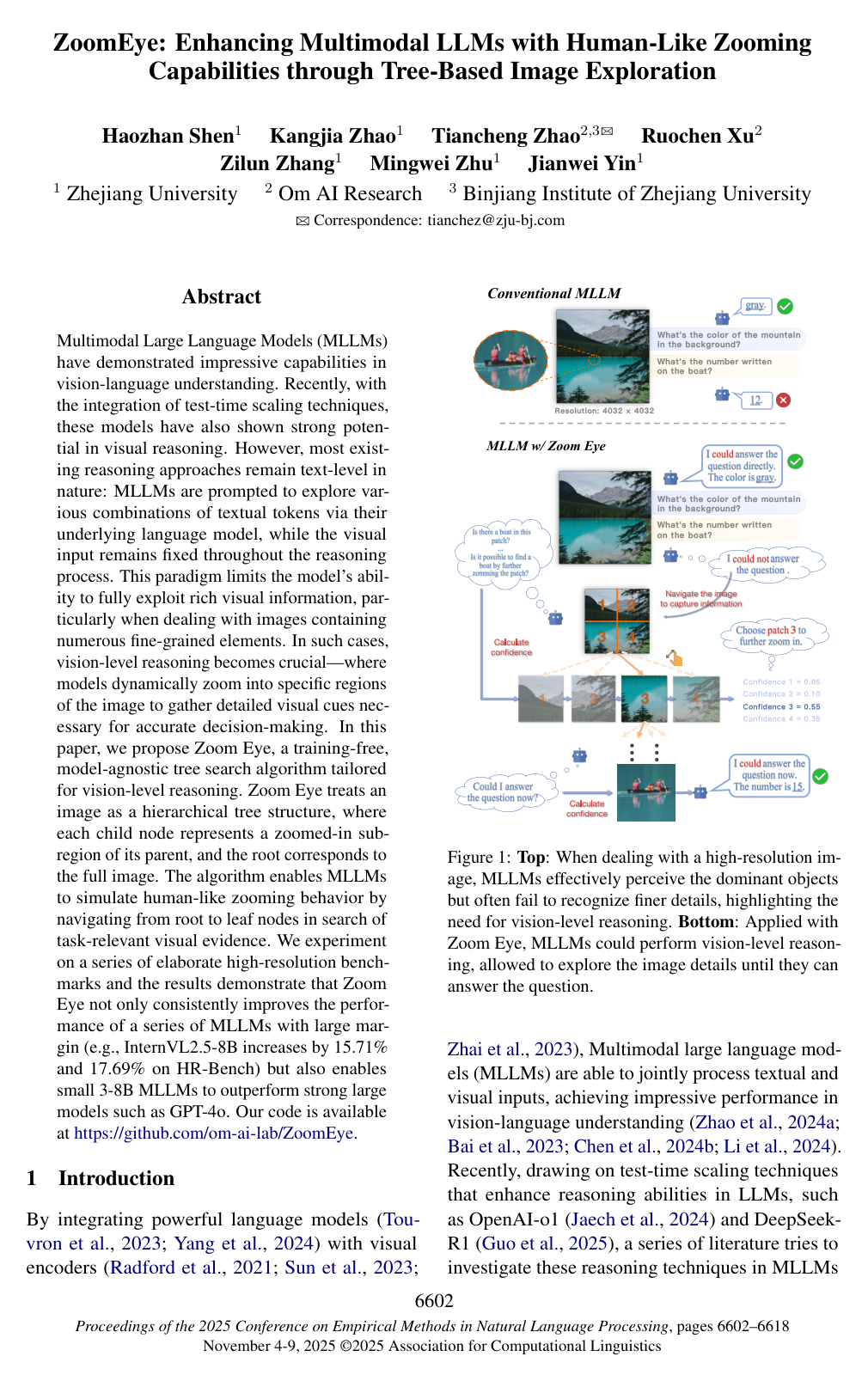
ZoomEye: Enhancing Multimodal LLMs with Human-Like Zooming Capabilities through Tree-Based Image Exploration
Haozhan Shen, Kangjia Zhao, Tiancheng Zhao, Ruochen Xu, Zilun Zhang, Mingwei Zhu, Jianwei Yin
Why you should read this
Presents a training-free, tree-based search algorithm that allows multimodal LLMs to dynamically zoom in and backtrack across high-resolution image regions during test-time inference, enabling smaller open-source models to surpass much larger systems on fine-grained visual reasoning tasks.
Multimodal Large Language Models (MLLMs) have demonstrated impressive capabilities in vision-language understanding. Recently, with the integration of test-time scaling techniques, these models have also shown strong potential in visual reasoning. However, most existing reasoning approaches remain text-level in nature: MLLMs are prompted to explore various combinations of textual tokens via their underlying language model, while the visual input remains fixed throughout the reasoning process. This paradigm limits the model’s ability to fully exploit rich visual information, particularly when dealing with images containing numerous fine-grained elements. In such cases, vision-level reasoning becomes crucial—where models dynamically zoom into specific regions of the image to gather detailed visual cues necessary for accurate decision-making. In this paper, we propose Zoom Eye, a training-free, model-agnostic tree search algorithm tailored for vision-level reasoning. Zoom Eye treats an image as a hierarchical tree structure, where each child node represents a zoomed-in sub-region of its parent, and the root corresponds to the full image. The algorithm enables MLLMs to simulate human-like zooming behavior by navigating from root to leaf nodes in search of task-relevant visual evidence. We experiment on a series of elaborate high-resolution benchmarks and the results demonstrate that Zoom Eye not only consistently improves the performance of a series of MLLMs with large margin (e.g., InternVL2.5-8B increases by 15.71% and 17.69% on HR-Bench) but also enables small 3-8B MLLMs to outperform strong large models such as GPT-4o. Our code is available at https://github.com/om-ai-lab/ZoomEye.
Added
2026-09-26
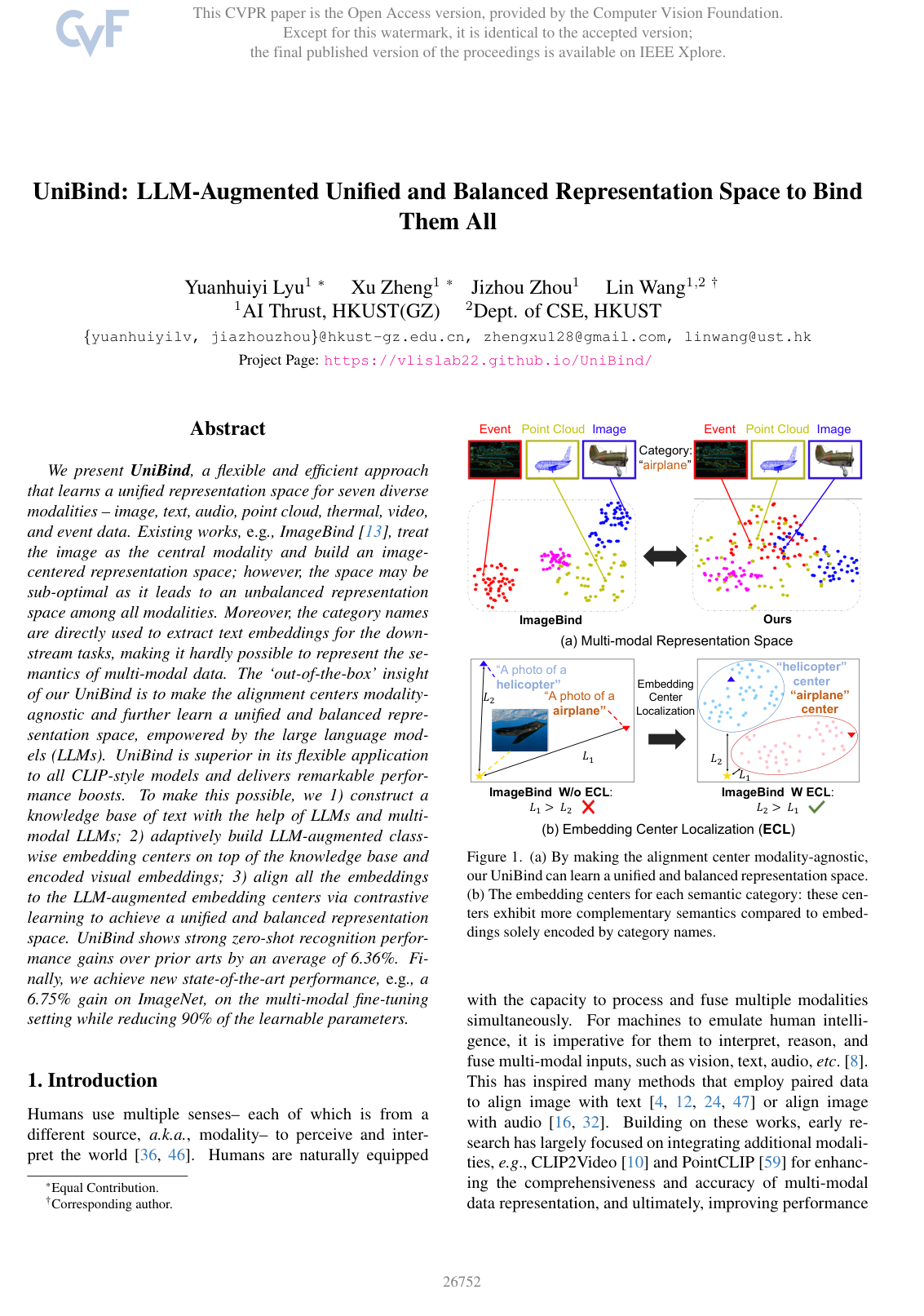
UniBind: LLM-Augmented Unified and Balanced Representation Space to Bind Them All
Yuanhuiyi Lyu, Xu Zheng, Jiazhou Zhou, Lin Wang
Why you should read this
Presents UniBind, a framework that uses large language models and multi-modal LLMs to construct modality-agnostic text embedding centers, overcoming single-modality bias to unify seven distinct sensory modalities while reducing learnable fine-tuning parameters by 90%.
We present UniBind, a flexible and efficient approach that learns a unified representation space for seven diverse modalities – image, text, audio, point cloud, thermal, video, and event data. Existing works, e.g., ImageBind [13], treat the image as the central modality and build an image-centered representation space; however, the space may be sub-optimal as it leads to an unbalanced representation space among all modalities. Moreover, the category names are directly used to extract text embeddings for the downstream tasks, making it hardly possible to represent the semantics of multi-modal data. The ‘out-of-the-box’ insight of our UniBind is to make the alignment centers modality-agnostic and further learn a unified and balanced representation space, empowered by the large language models (LLMs). UniBind is superior in its flexible application to all CLIP-style models and delivers remarkable performance boosts. To make this possible, we 1) construct a knowledge base of text with the help of LLMs and multi-modal LLMs; 2) adaptively build LLM-augmented class-wise embedding centers on top of the knowledge base and encoded visual embeddings; 3) align all the embeddings to the LLM-augmented embedding centers via contrastive learning to achieve a unified and balanced representation space. UniBind shows strong zero-shot recognition performance gains over prior arts by an average of 6.36%. Finally, we achieve new state-of-the-art performance, e.g., a 6.75% gain on ImageNet, on the multi-modal fine-tuning setting while reducing 90% of the learnable parameters.
Added
2026-09-26
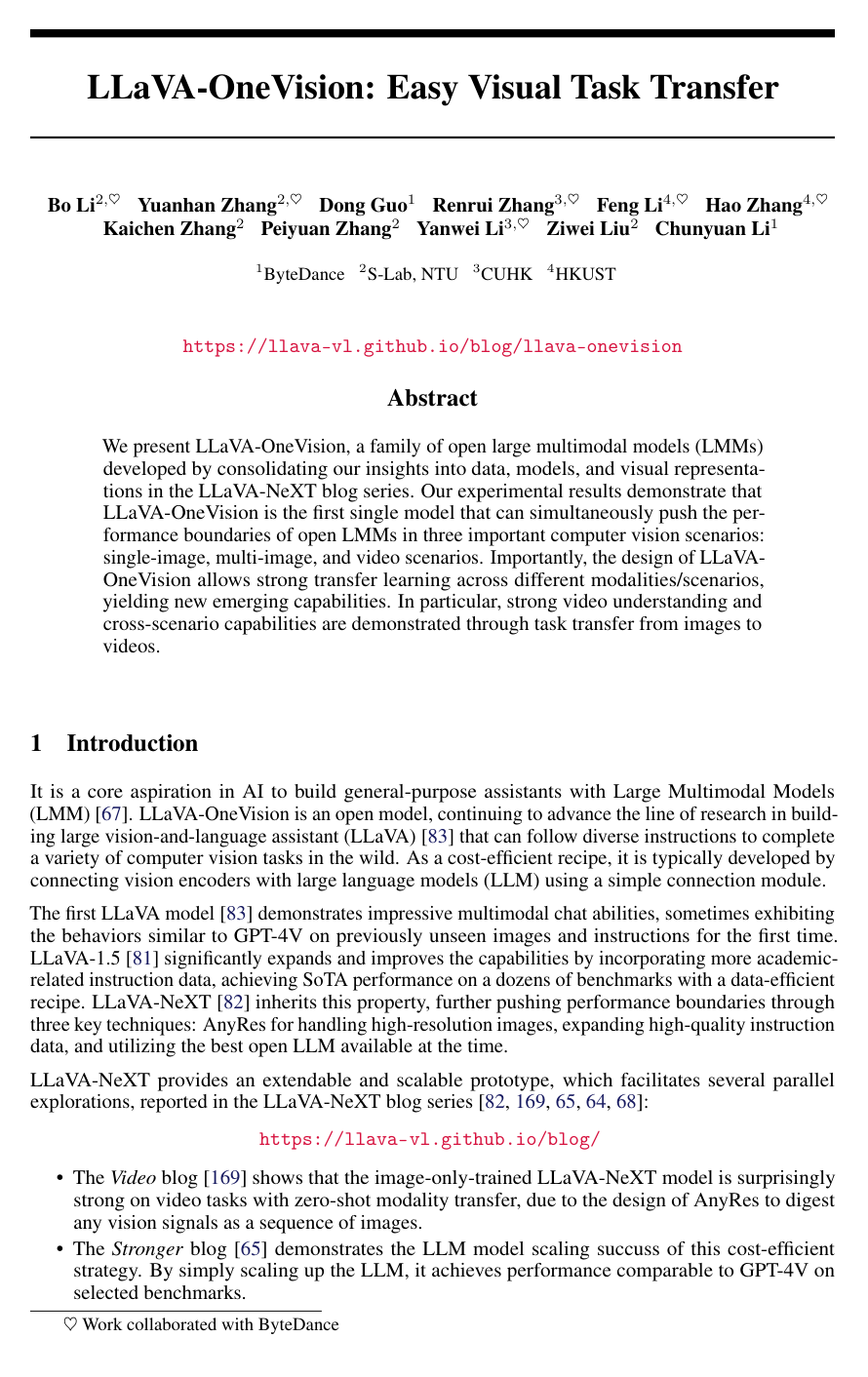
LLaVA-OneVision: Easy Visual Task Transfer
Bo Li, Yuanhan Zhang, Dong Guo, Renrui Zhang, Feng Li, Hao Zhang, Kaichen Zhang, Pei-Yuan Zhang, Yanwei Li, Ziwei Liu, Chunyuan Li
Why you should read this
Presents LLaVA-OneVision, an open multimodal model that advances performance across single-image, multi-image, and video scenarios simultaneously through visual task transfer from images to videos.
We present LLaVA-OneVision, a family of open large multimodal models (LMMs) developed by consolidating our insights into data, models, and visual representations in the LLaVA-NeXT blog series. Our experimental results demonstrate that LLaVA-OneVision is the first single model that can simultaneously push the performance boundaries of open LMMs in three important computer vision scenarios: single-image, multi-image, and video scenarios. Importantly, the design of LLaVA-OneVision allows strong transfer learning across different modalities/scenarios, yielding new emerging capabilities. In particular, strong video understanding and cross-scenario capabilities are demonstrated through task transfer from images to videos.
Added
2026-09-15