
keyword
multimodal learning
Multimodal learning is a subfield of machine learning where computational models are trained to process, integrate, and relate information from multiple distinct data modalities, such as text, images, audio, video, and sensory signals. By learning shared representations or aligning features across diverse input types, multimodal systems exploit the complementary strengths of different data sources to achieve a more comprehensive understanding than unimodal approaches allow. This paradigm supports a broad range of applications, including visual question answering, cross-modal retrieval, image captioning, and robotic perception, while addressing technical challenges such as modality alignment, representation fusion, and handling missing or imbalanced inputs.
7 items
Calibrating Multimodal Learning
Huan Ma, Qingyang Zhang, Changqing Zhang, Bingzhe Wu, Huazhu Fu, Joey Tianyi Zhou, Qinghua Hu
Why you should read this
Proposes a lightweight regularization method that prevents multimodal classifiers from becoming spuriously more confident when modalities are removed or corrupted, ensuring trustworthy uncertainty estimation across diverse architectures.
Multimodal machine learning has achieved remarkable progress in a wide range of scenarios. However, the reliability of multimodal learning remains largely unexplored. In this paper, through extensive empirical studies, we identify current multimodal classification methods suffer from unreliable predictive confidence that tend to rely on partial modalities when estimating confidence. Specifically, we find that the confidence estimated by current models could even increase when some modalities are corrupted. To address the issue, we introduce an intuitive principle for multimodal learning, i.e., the confidence should not increase when one modality is removed. Accordingly, we propose a novel regularization technique, i.e., Calibrating Multimodal Learning (CML) regularization, to calibrate the predictive confidence of previous methods. This technique could be flexibly equipped by existing models and improve the performance in terms of confidence calibration, classification accuracy, and model robustness.
Added
2026-10-05
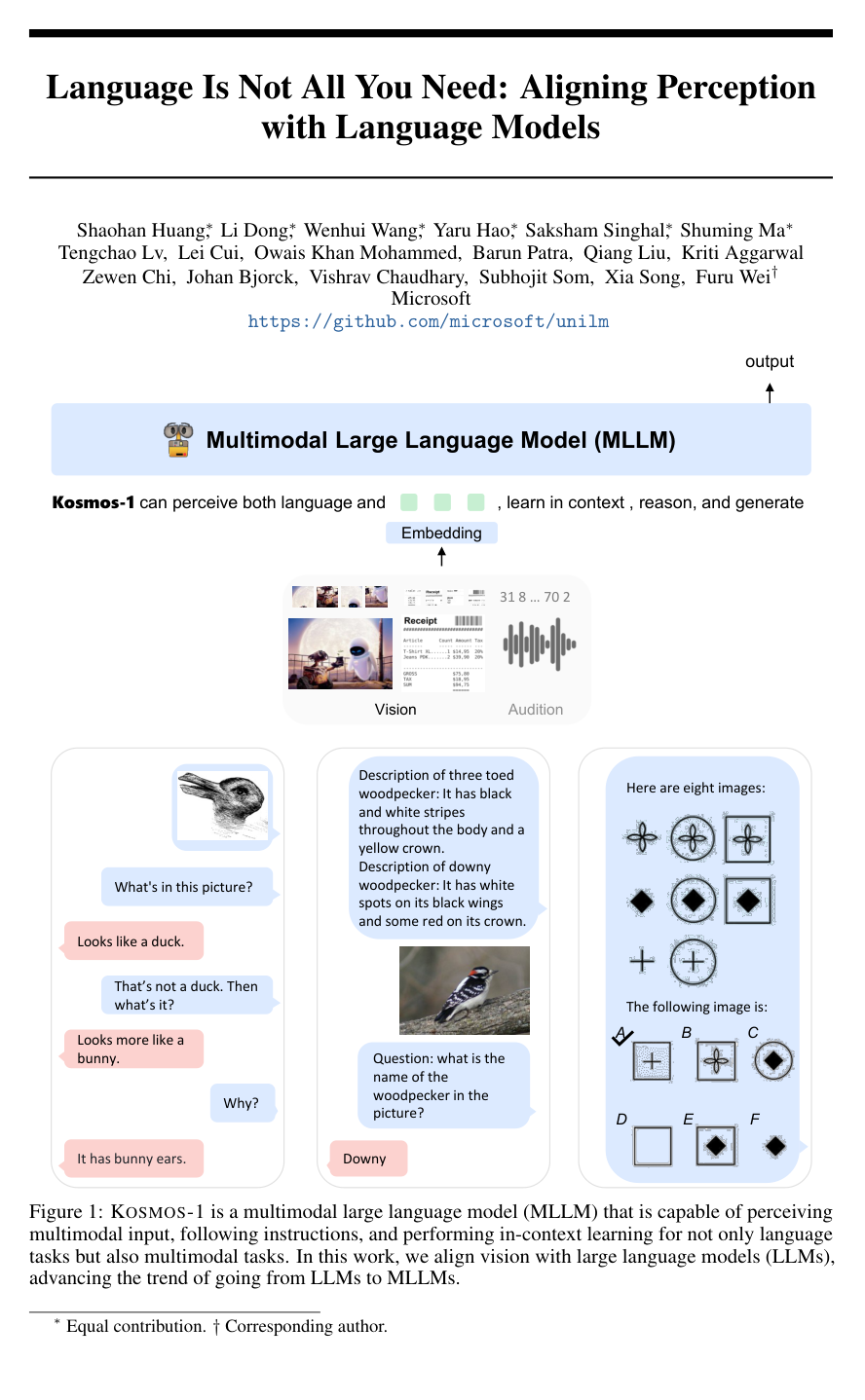
Language Is Not All You Need: Aligning Perception with Language Models
Shaohan Huang, Li Dong, Wenhui Wang, Yaru Hao, Saksham Singhal, Shuming Ma, Tengchao Lv, Lei Cui, Owais Khan Mohammed, Barun Patra, Qiang Liu, Kriti Aggarwal, Zewen Chi, Nils Johan Bertil Bjorck, Vishrav Chaudhary, Subhojit Som, Xia Song, Furu Wei
Why you should read this
Presents Kosmos-1, a multimodal language model trained from scratch on interleaved text and image data that aligns visual perception with language generation to perform zero-shot multimodal dialogue, OCR-free reading, and nonverbal reasoning without task-specific fine-tuning.
A big convergence of language, multimodal perception, action, and world modeling is a key step toward artificial general intelligence. In this work, we introduce Kosmos-1, a Multimodal Large Language Model (MLLM) that can perceive general modalities, learn in context (i.e., few-shot), and follow instructions (i.e., zero-shot). Specifically, we train Kosmos-1 from scratch on web-scale multimodal corpora, including arbitrarily interleaved text and images, image-caption pairs, and text data. We evaluate various settings, including zero-shot, few-shot, and multimodal chain-of-thought prompting, on a wide range of tasks without any gradient updates or finetuning. Experimental results show that Kosmos-1 achieves impressive performance on (i) language understanding, generation, and even OCR-free NLP (directly fed with document images), (ii) perception-language tasks, including multimodal dialogue, image captioning, visual question answering, and (iii) vision tasks, such as image recognition with descriptions (specifying classification via text instructions). We also show that MLLMs can benefit from cross-modal transfer, i.e., transfer knowledge from language to multimodal, and from multimodal to language. In addition, we introduce a dataset of Raven IQ test, which diagnoses the nonverbal reasoning capability of MLLMs.
Added
2026-10-05
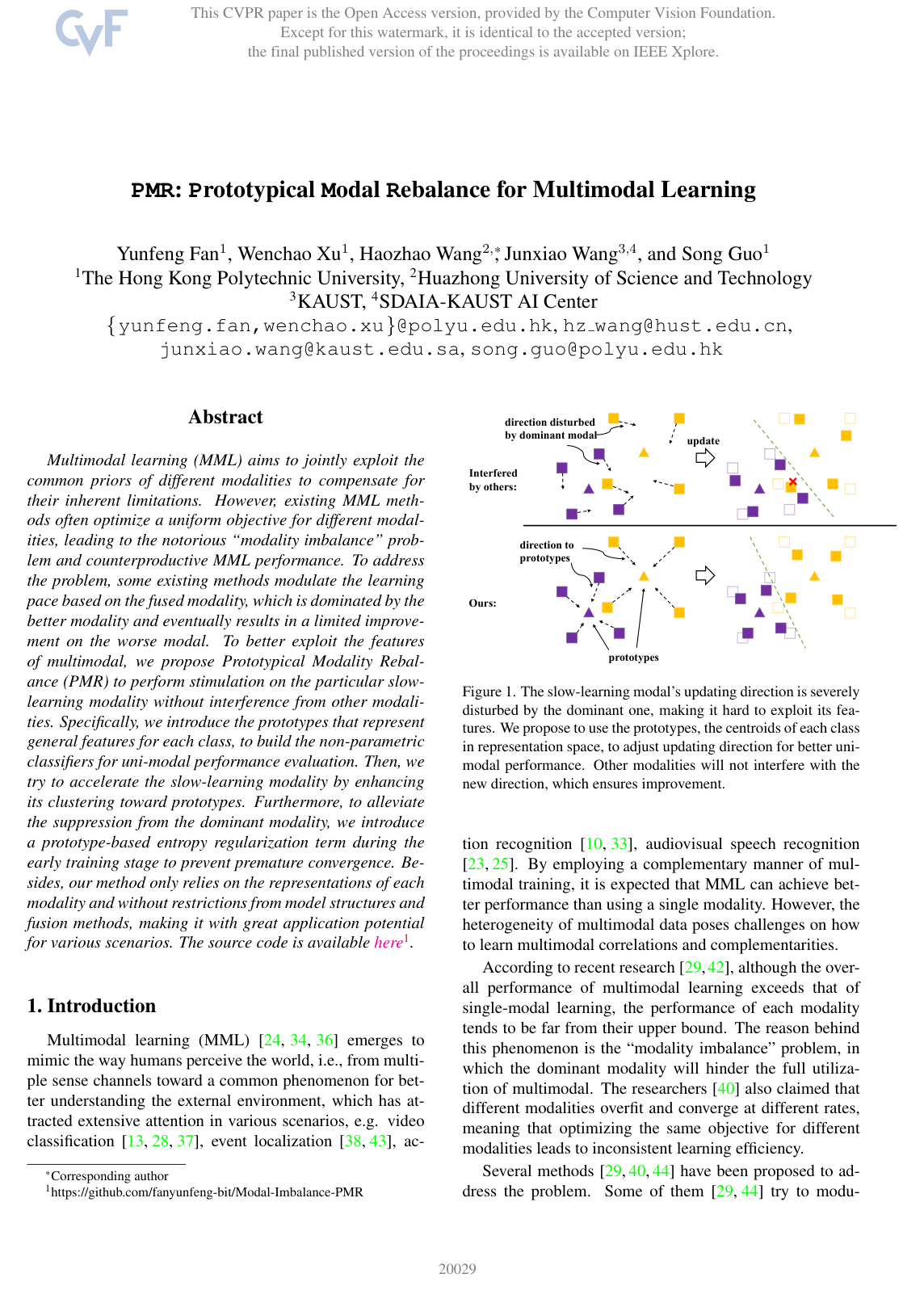
PMR: Prototypical Modal Rebalance for Multimodal Learning
Yunfeng Fan, Wenchao Xu, Haozhao Wang, Junxiao Wang, Song Guo
Why you should read this
Proposes a model-agnostic strategy called Prototypical Modal Rebalance that uses class prototypes to actively guide the representation learning of underperforming modalities while preventing dominant modalities from prematurely converging.
Multimodal learning (MML) aims to jointly exploit the common priors of different modalities to compensate for their inherent limitations. However, existing MML methods often optimize a uniform objective for different modalities, leading to the notorious “modality imbalance” problem and counterproductive MML performance. To address the problem, some existing methods modulate the learning pace based on the fused modality, which is dominated by the better modality and eventually results in a limited improvement on the worse modal. To better exploit the features of multimodal, we propose Prototypical Modality Rebalance (PMR) to perform stimulation on the particular slow-learning modality without interference from other modalities. Specifically, we introduce the prototypes that represent general features for each class, to build the non-parametric classifiers for uni-modal performance evaluation. Then, we try to accelerate the slow-learning modality by enhancing its clustering toward prototypes. Furthermore, to alleviate the suppression from the dominant modality, we introduce a prototype-based entropy regularization term during the early training stage to prevent premature convergence. Besides, our method only relies on the representations of each modality and without restrictions from model structures and fusion methods, making it with great application potential for various scenarios. The source code is available here¹.
Added
2026-09-26
DataComp: In search of the next generation of multimodal datasets
Samir Yitzhak Gadre, Gabriel Ilharco, Alex Fang, Jonathan Hayase, Georgios Smyrnis, Thao Nguyen, Ryan Marten, Mitchell Wortsman, Dhruba Ghosh, Jieyu Zhang, Eyal Orgad, Rahim Entezari, Giannis Daras, Sarah M. Pratt, Vivek Ramanujan, Yonatan Bitton, Kalyani Marathe, Stephen Mussmann, Richard Vencu, Mehdi Cherti, Ranjay Krishna, Pang Wei Koh, Olga Saukh, Alexander J. Ratner, Shuran Song, Hannaneh Hajishirzi, Ali Farhadi, Romain Beaumont, Sewoong Oh, Alex Dimakis, Jenia Jitsev, Yair Carmon, Vaishaal Shankar, Ludwig Schmidt
Why you should read this
Introduces DataComp, a standardized benchmark centered on 12.8 billion candidate image-text pairs that allows researchers to rigorously evaluate multimodal dataset filtering methods across multiple compute scales and produce CLIP models that surpass OpenAI's original zero-shot ImageNet accuracy.
Multimodal datasets are a critical component in recent breakthroughs such as Stable Diffusion and GPT-4, yet their design does not receive the same research attention as model architectures or training algorithms. To address this shortcoming in the ML ecosystem, we introduce DataComp, a testbed for dataset experiments centered around a new candidate pool of 12.8 billion image-text pairs from Common Crawl. Participants in our benchmark design new filtering techniques or curate new data sources and then evaluate their new dataset by running our standardized CLIP training code and testing the resulting model on 38 downstream test sets. Our benchmark consists of multiple compute scales spanning four orders of magnitude, which enables the study of scaling trends and makes the benchmark accessible to researchers with varying resources. Our baseline experiments show that the DataComp workflow leads to better training sets. In particular, our best baseline, DataComp-1B, enables training a CLIP ViT-L/14 from scratch to 79.2% zero-shot accuracy on ImageNet, outperforming OpenAI's CLIP ViT-L/14 by 3.7 percentage points while using the same training procedure and compute. We release DataComp and all accompanying code at this http URL.
Added
2026-09-26
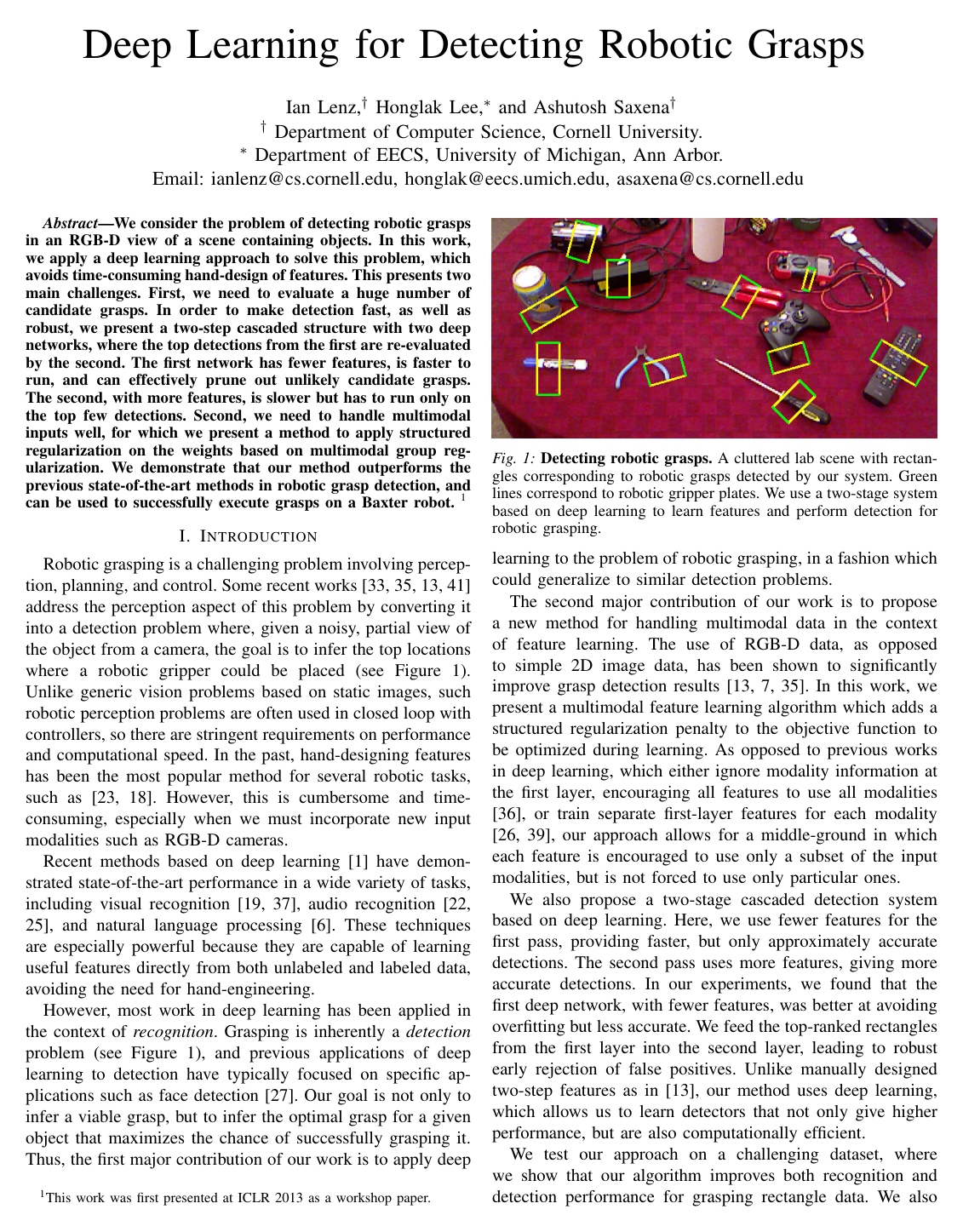
Deep learning for detecting robotic grasps
Ian Lenz, Honglak Lee, Ashutosh Saxena
Why you should read this
Presents a two-step cascaded deep learning architecture combined with multimodal group regularization to achieve fast and accurate robotic grasp detection directly from RGB-D data on real physical platforms.
We consider the problem of detecting robotic grasps in an RGB-D view of a scene containing objects. In this work, we apply a deep learning approach to solve this problem, which avoids time-consuming hand-design of features. This presents two main challenges. First, we need to evaluate a huge number of candidate grasps. In order to make detection fast, as well as robust, we present a two-step cascaded structure with two deep networks, where the top detections from the first are re-evaluated by the second. The first network has fewer features, is faster to run, and can effectively prune out unlikely candidate grasps. The second, with more features, is slower but has to run only on the top few detections. Second, we need to handle multimodal inputs well, for which we present a method to apply structured regularization on the weights based on multimodal group regularization. We demonstrate that our method outperforms the previous state-of-the-art methods in robotic grasp detection, and can be used to successfully execute grasps on two different robotic platforms.
Added
2026-09-20
Multimodal learning with deep Boltzmann machines
Nitish Srivastava, Ruslan Salakhutdinov
Why you should read this
Proposes a Multimodal Deep Boltzmann Machine that learns a joint generative model across disparate modalities like images and text, enabling effective classification, cross-modal retrieval, and the reconstruction of missing inputs.
A Deep Boltzmann Machine is described for learning a generative model of data that consists of multiple and diverse input modalities. The model can be used to extract a unified representation that fuses modalities together. We find that this representation is useful for classification and information retrieval tasks. The model works by learning a probability density over the space of multimodal inputs. It uses states of latent variables as representations of the input. The model can extract this representation even when some modalities are absent by sampling from the conditional distribution over them and filling them in. Our experimental results on bi-modal data consisting of images and text show that the Multimodal DBM can learn a good generative model of the joint space of image and text inputs that is useful for information retrieval from both unimodal and multimodal queries. We further demonstrate that this model significantly outperforms SVMs and LDA on discriminative tasks. Finally, we compare our model to other deep learning methods, including autoencoders and deep belief networks, and show that it achieves noticeable gains.
Added
2026-09-18
Challenges in representation learning: A report on three machine learning contests
Ian J. Goodfellow, Dumitru Erhan, Pierre Luc Carrier, Aaron Courville, Mehdi Mirza, Ben Hamner, Will Cukierski, Yichuan Tang, David Thaler, Dong-Hyun Lee, Yingbo Zhou, Chetan Ramaiah, Fangxiang Feng, Ruifan Li, Xiaojie Wang, Dimitris Athanasakis, John Shawe-Taylor, Maxim Milakov, John Park, Radu Ionescu, Marius Popescu, Cristian Grozea, James Bergstra, Jingjing Xie, Lukasz Romaszko, Bing Xu, Zhang Chuang, Yoshua Bengio
Why you should read this
Examines the top-performing representation learning methods across three machine learning competitions—covering black-box, facial expression, and multimodal data—while providing actionable insights on algorithm performance and effective benchmark design.
The ICML 2013 Workshop on Challenges in Representation Learning focused on three challenges: the black box learning challenge, the facial expression recognition challenge, and the multimodal learning challenge. We describe the datasets created for these challenges and summarize the results of the competitions. We provide suggestions for organizers of future challenges and some comments on what kind of knowledge can be gained from machine learning competitions.
Added
2026-09-16