
keyword
multimodal large language models
Multimodal large language models are artificial intelligence systems that extend the reasoning and conversational capabilities of text-based large language models to process, interpret, and generate information across multiple sensory data types, such as text, images, video, audio, and 3D spatial representations. These systems typically integrate specialized perception encoders with a core transformer language backbone using cross-modal adapter layers, mapping non-text inputs into a shared token space that allows the central model to perform joint cross-modal reasoning. By leveraging large-scale pre-training and instruction tuning across diverse modalities, multimodal large language models enable a wide range of complex tasks, including visual question answering, detailed media captioning, spatial and contextual reasoning, embodied agent planning, and any-to-any cross-modal generation.
39 items
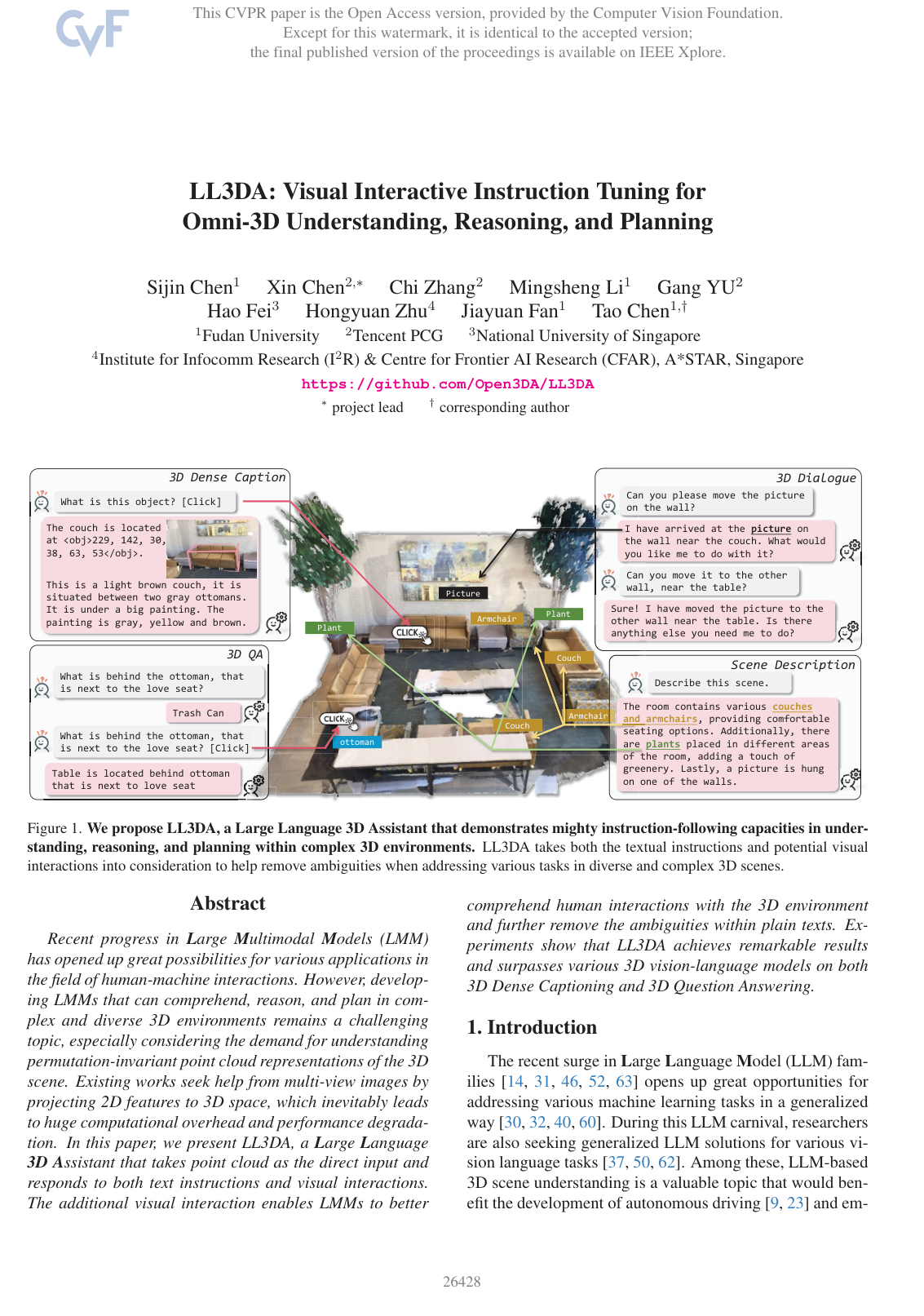
LL3DA: Visual Interactive Instruction Tuning for Omni-3D Understanding, Reasoning, and Planning
Sijin Chen, Xin Chen, Chi Zhang, Mingsheng Li, Gang Yu, Hao Fei, Hongyuan Zhu, Jiayuan Fan, Tao Chen
Why you should read this
Presents LL3DA, a large multimodal 3D assistant that processes raw point clouds alongside visual prompts and text instructions to eliminate ambiguity and achieve state-of-the-art results in 3D dense captioning and question answering.
Recent progress in Large Multimodal Models (LMM) has opened up great possibilities for various applications in the field of human-machine interactions. However, developing LMMs that can comprehend, reason, and plan in complex and diverse 3D environments remains a challenging topic, especially considering the demand for understanding permutation-invariant point cloud representations of the 3D scene. Existing works seek help from multi-view images by projecting 2D features to 3D space, which inevitably leads to huge computational overhead and performance degradation. In this paper, we present LL3DA, a Large Language 3D Assistant that takes point cloud as the direct input and responds to both text instructions and visual interactions. The additional visual interaction enables LMMs to better comprehend human interactions with the 3D environment and further remove the ambiguities within plain texts. Experiments show that LL3DA achieves remarkable results and surpasses various 3D vision-language models on both 3D Dense Captioning and 3D Question Answering.
Added
2026-10-05
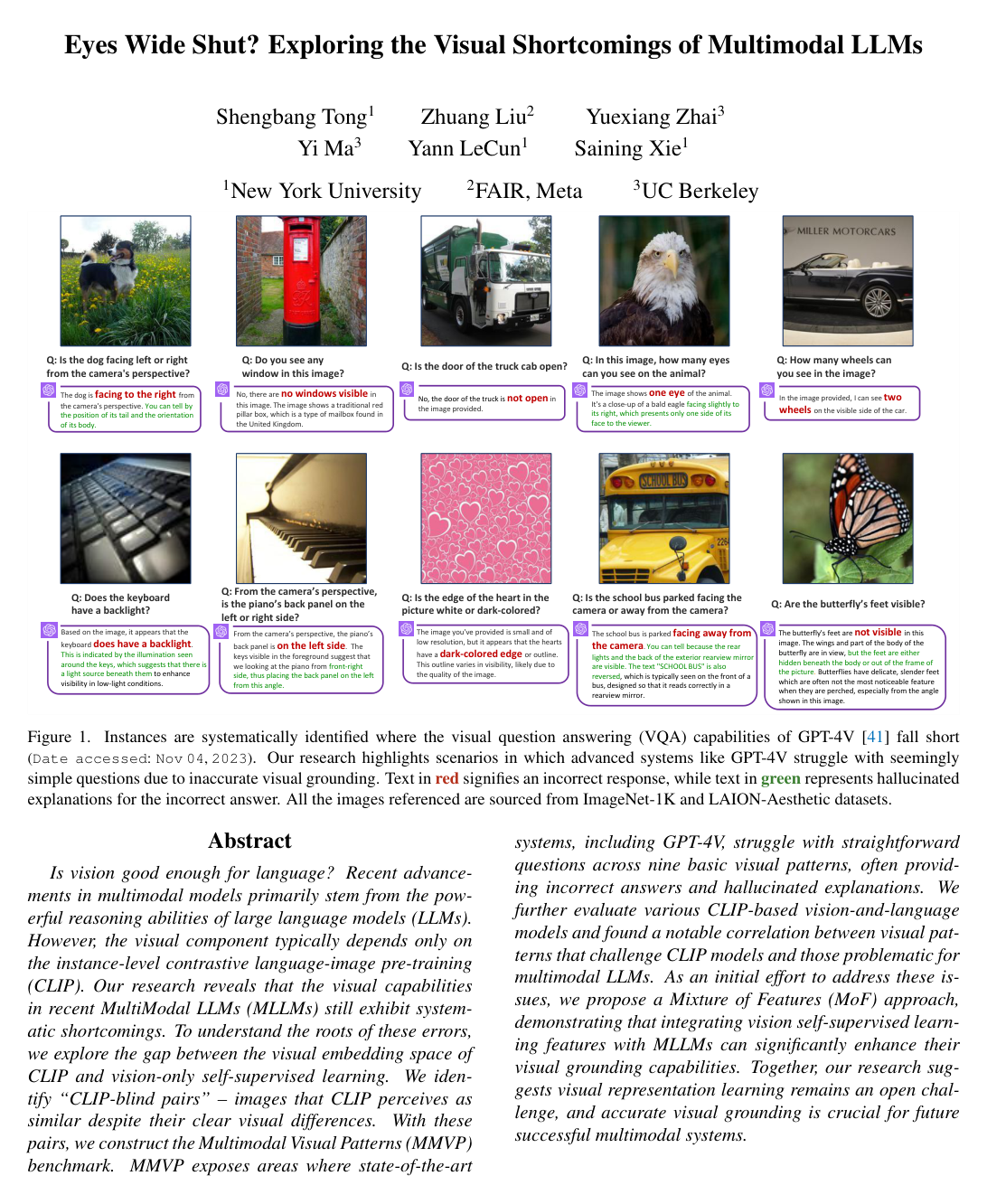
Eyes Wide Shut? Exploring the Visual Shortcomings of Multimodal LLMs
Shengbang Tong, Zhuang Liu, Yuexiang Zhai, Yi Ma, Yann LeCun, Saining Xie
Why you should read this
Reveals systematic visual failures in state-of-the-art multimodal models like GPT-4V caused by CLIP blind spots, introducing the Multimodal Visual Patterns benchmark to diagnose these errors and a Mixture of Features method combining self-supervised vision representations to correct them.
Is vision good enough for language? Recent advancements in multimodal models primarily stem from the powerful reasoning abilities of large language models (LLMs). However, the visual component typically depends only on the instance-level contrastive language-image pre-training (CLIP). Our research reveals that the visual capabilities in recent multimodal LLMs (MLLMs) still exhibit systematic shortcomings. To understand the roots of these errors, we explore the gap between the visual embedding space of CLIP and vision-only self-supervised learning. We identify ''CLIP-blind pairs'' - images that CLIP perceives as similar despite their clear visual differences. With these pairs, we construct the Multimodal Visual Patterns (MMVP) benchmark. MMVP exposes areas where state-of-the-art systems, including GPT-4V, struggle with straightforward questions across nine basic visual patterns, often providing incorrect answers and hallucinated explanations. We further evaluate various CLIP-based vision-and-language models and found a notable correlation between visual patterns that challenge CLIP models and those problematic for multimodal LLMs. As an initial effort to address these issues, we propose a Mixture of Features (MoF) approach, demonstrating that integrating vision self-supervised learning features with MLLMs can significantly enhance their visual grounding capabilities. Together, our research suggests visual representation learning remains an open challenge, and accurate visual grounding is crucial for future successful multimodal systems.
Added
2026-10-05
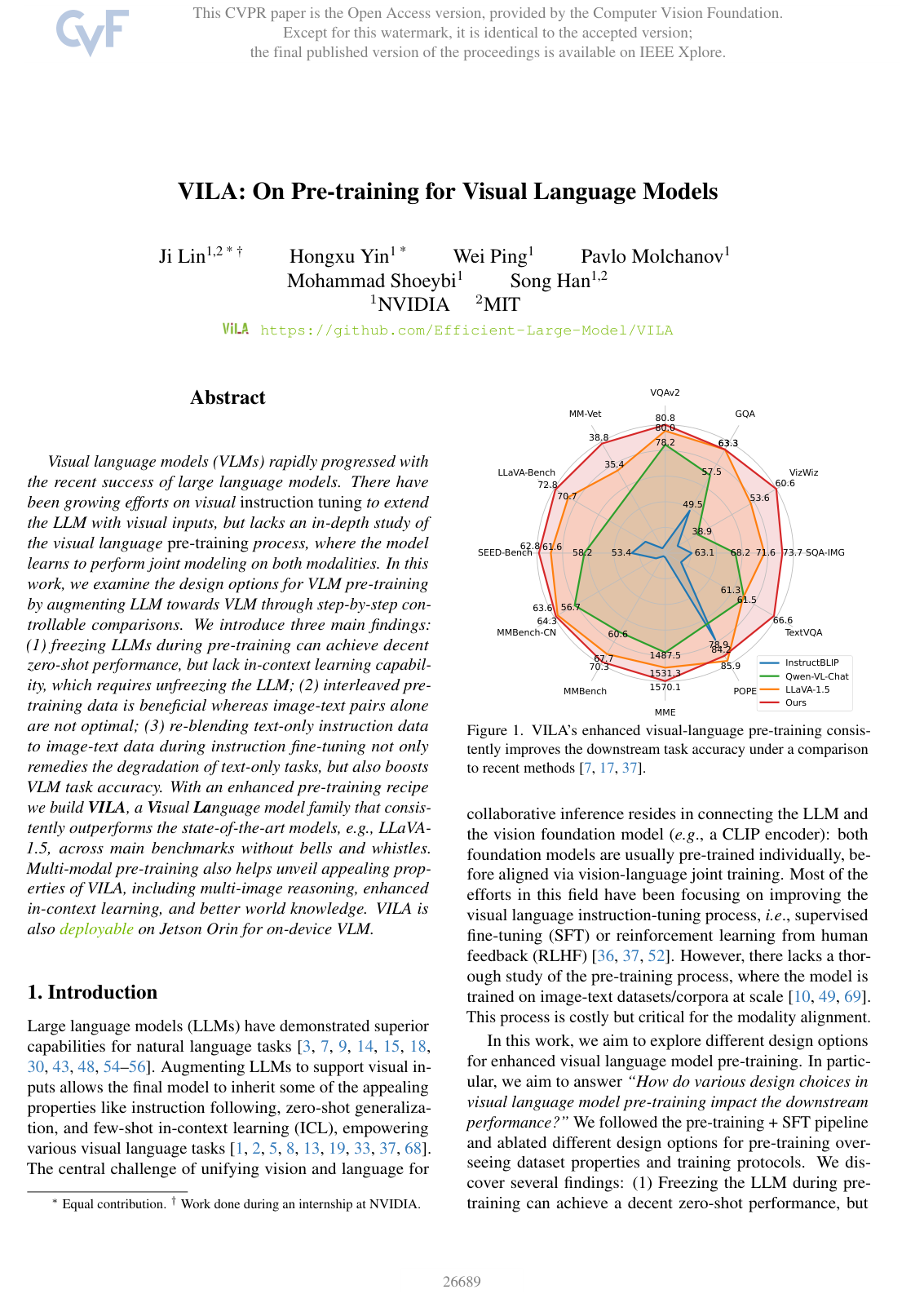
VILA: On Pre-training for Visual Language Models
Ji Lin, Hongxu Yin, Wei Ping, Pavlo Molchanov, Mohammad Shoeybi, Song Han
Why you should read this
Presents an effective pre-training recipe for vision-language models that unfreezes the base language model on interleaved multi-modal data, producing models that outperform LLaVA-1.5 in multi-image reasoning and in-context learning.
Visual language models (VLMs) rapidly progressed with the recent success of large language models. There have been growing efforts on visual instruction tuning to extend the LLM with visual inputs, but lacks an in-depth study of the visual language pre-training process, where the model learns to perform joint modeling on both modalities. In this work, we examine the design options for VLM pre-training by augmenting LLM towards VLM through step-by-step controllable comparisons. We introduce three main findings: (1) freezing LLMs during pre-training can achieve decent zero-shot performance, but lack in-context learning capability, which requires unfreezing the LLM; (2) interleaved pre-training data is beneficial whereas image-text pairs alone are not optimal; (3) re-blending text-only instruction data to image-text data during instruction fine-tuning not only remedies the degradation of text-only tasks, but also boosts VLM task accuracy. With an enhanced pre-training recipe we build VILA, a Visual Language model family that consistently outperforms the state-of-the-art models, e.g., LLaVA-1.5, across main benchmarks without bells and whistles. Multi-modal pre-training also helps unveil appealing properties of VILA, including multi-image reasoning, enhanced in-context learning, and better world knowledge. VILA is also deployable on Jetson Orin for on-device VLM.
Added
2026-10-05
Context-Aware RL for Agentic and Multimodal LLMs
Peiyang Xu Bangzheng Li Sijia Liu Xingyu Fu
Why you should read this
Proposes ContextRL, an auxiliary reinforcement learning method that improves fine-grained evidence grounding in coding agents and visual reasoning by training models to identify the correct supporting context among highly similar alternatives.
Large language models (LLMs) often fail when answering requires identifying a small but decisive piece of evidence within a long or complex context, such as a single line in a tool trace or a subtle detail in an image. We propose ContextRL, a context-aware reinforcement learning (RL) method that improves long-horizon reasoning and multimodal performance through an \emph{indirect} auxiliary objective. Instead of supervising only the final answer, ContextRL presents the model with a query, an answer, and two highly similar contexts, and rewards it for selecting the context that supports the query--answer pair, thereby encouraging fine-grained grounding. We construct contrastive context data in two domains: for coding agents, trajectories serve as contexts, yielding 1k pairs built via condition filtering; for multimodal reasoning, images serve as contexts, yielding 7K pairs built via generative editing and similarity search. ContextRL achieves average gains of +2.2% over standard GRPO on 5 long-horizon benchmarks, and +1.8% across 12 diverse visual question answering benchmarks. To disentangle the effect of the proposed objective from that of additional data, we compare against data-augmentation baselines that repurpose the same contrastive contexts as standard query--context--answer examples. These baselines provide little to no improvement, showing that the gains arise from the proposed context-selection objective rather than from the contrastive data alone.
Added
2026-10-04
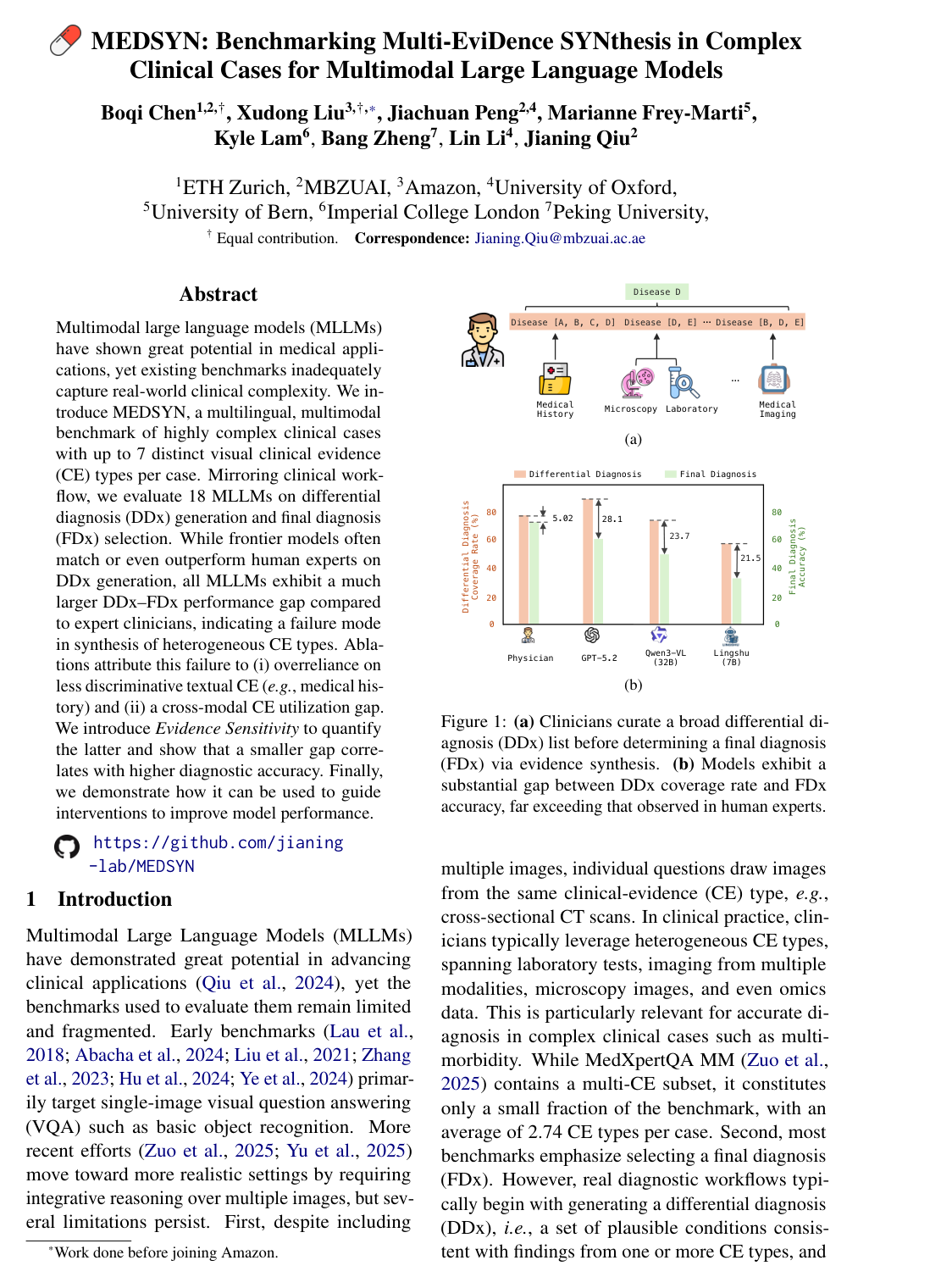
MEDSYN: Benchmarking Multi-EviDence SYNthesis in Complex Clinical Cases for Multimodal Large Language Models
Boqi Chen, Xudong Liu, Jiachuan Peng, Marianne Frey-Marti, Bang Zheng, Kyle Lam, Lin Li, Jianing Qiu
Why you should read this
Introduces MEDSYN, a multimodal benchmark that reveals critical failures in how large language models synthesize heterogeneous visual evidence for clinical diagnoses, alongside an Evidence Sensitivity metric to guide performance improvements.
Multimodal large language models (MLLMs) have shown great potential in medical applications, yet existing benchmarks inadequately capture real-world clinical complexity. We introduce MEDSYN, a multilingual, multimodal benchmark of highly complex clinical cases with up to 7 distinct visual clinical evidence (CE) types per case. Mirroring clinical workflow, we evaluate 18 MLLMs on differential diagnosis (DDx) generation and final diagnosis (FDx) selection. While top models often match or even outperform human experts on DDx generation, all MLLMs exhibit a much larger DDx--FDx performance gap compared to expert clinicians, indicating a failure mode in synthesis of heterogeneous CE types. Ablations attribute this failure to (i) overreliance on less discriminative textual CE (, medical history) and (ii) a cross-modal CE utilization gap. We introduce Evidence Sensitivity to quantify the latter and show that a smaller gap correlates with higher diagnostic accuracy. Finally, we demonstrate how it can be used to guide interventions to improve model performance. We will open-source our benchmark and code.
Added
2026-10-04
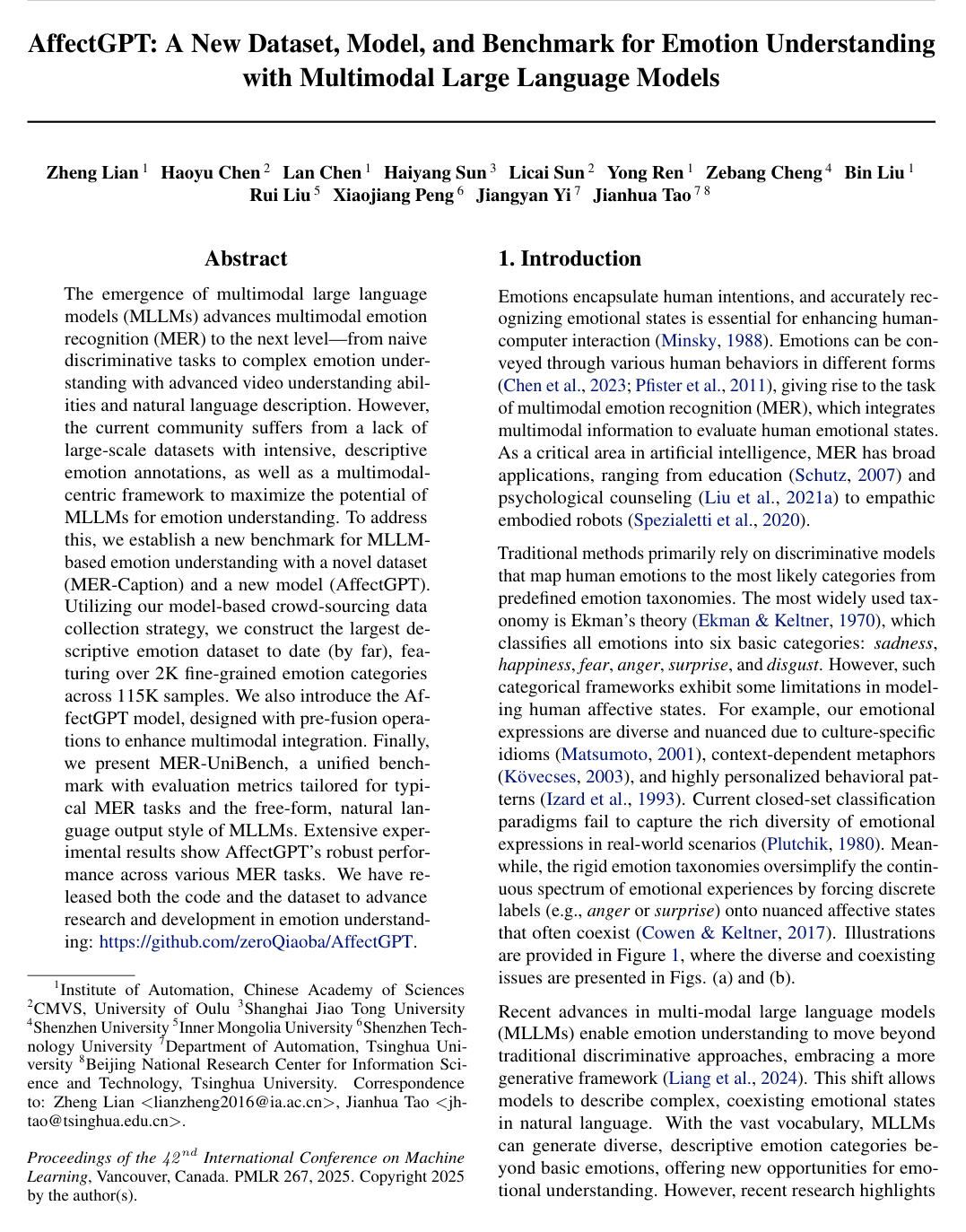
AffectGPT: A New Dataset, Model, and Benchmark for Emotion Understanding with Multimodal Large Language Models
Zheng Lian, Haoyu Chen, Lan Chen, Haiyang Sun, Licai Sun, Yong Ren, Zebang Cheng, Bin Liu, Rui Liu, Xiaojiang Peng, Jiangyan Yi, Jianhua Tao
Why you should read this
Presents AffectGPT alongside MER-Caption, a 115K-sample descriptive video emotion dataset spanning over 2,000 fine-grained categories, and the MER-UniBench benchmark to improve complex, open-ended emotion recognition using multimodal large language models.
The emergence of multimodal large language models (MLLMs) advances multimodal emotion recognition (MER) to the next level—from naive discriminative tasks to complex emotion understanding with advanced video understanding abilities and natural language description. However, the current community suffers from a lack of large-scale datasets with intensive, descriptive emotion annotations, as well as a multimodal-centric framework to maximize the potential of MLLMs for emotion understanding. To address this, we establish a new benchmark for MLLM-based emotion understanding with a novel dataset (MER-Caption) and a new model (AffectGPT). Utilizing our model-based crowd-sourcing data collection strategy, we construct the largest descriptive emotion dataset to date (by far), featuring over 2K fine-grained emotion categories across 115K samples. We also introduce the AffectGPT model, designed with pre-fusion operations to enhance multimodal integration. Finally, we present MER-UniBench, a unified benchmark with evaluation metrics tailored for typical MER tasks and the free-form, natural language output style of MLLMs. Extensive experimental results show AffectGPT’s robust performance across various MER tasks. We have released both the code and the dataset to advance research and development in emotion understanding: https://github.com/zeroQiaoba/AffectGPT.
Added
2026-10-04
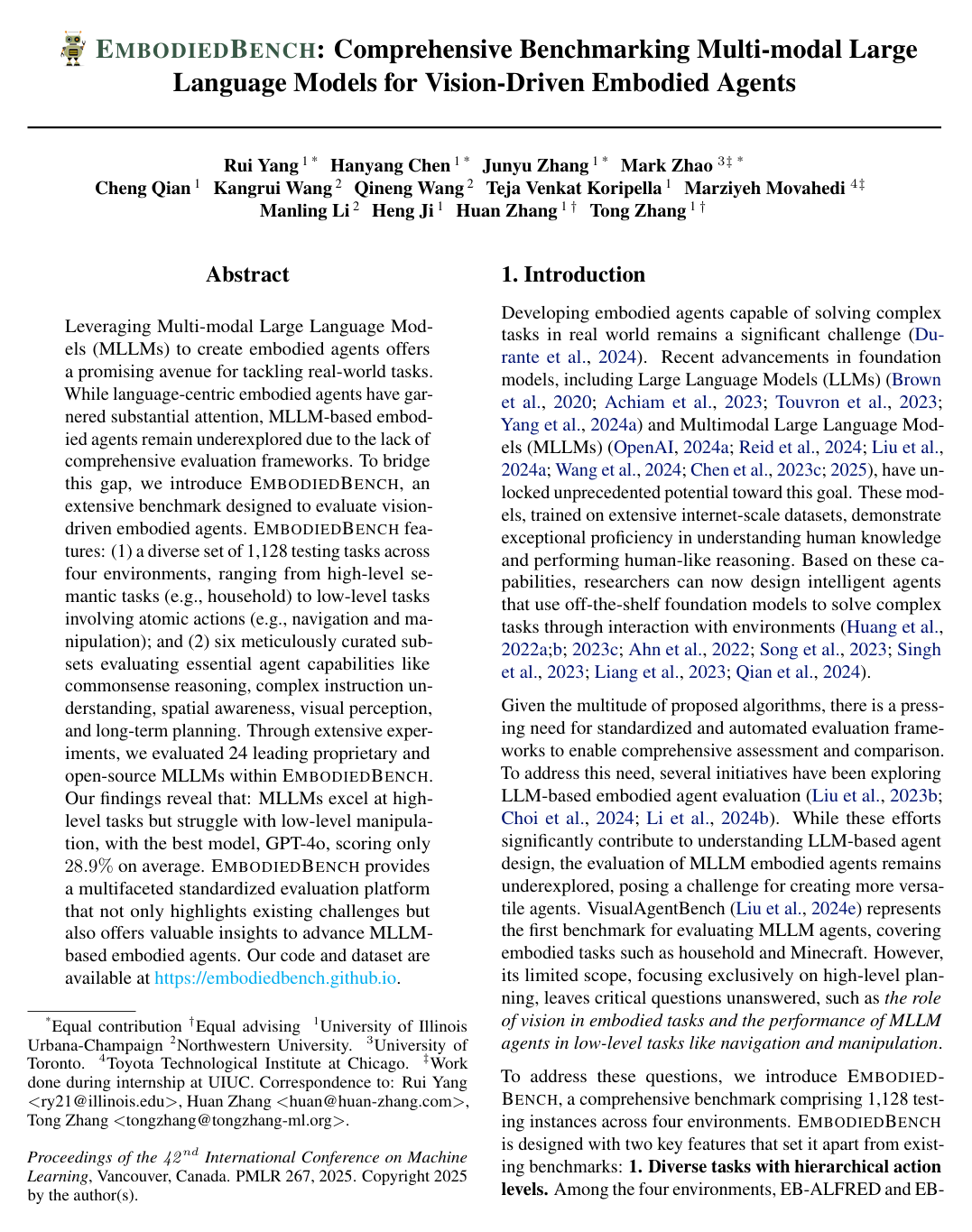
EmbodiedBench: Comprehensive Benchmarking Multi-modal Large Language Models for Vision-Driven Embodied Agents
Rui Yang, Hanyang Chen, Junyu Zhang, Mark Zhao, Cheng Qian, Kangrui Wang, Qineng Wang, Teja Venkat Koripella, Marziyeh Movahedi, Manling Li, Heng Ji, Huan Zhang, Tong Zhang
Why you should read this
Presents EmbodiedBench, a multi-environment benchmark spanning high-level semantic planning to low-level physical manipulation across 1,128 tasks, revealing that leading multimodal models still fail at fine-grained control despite strong high-level reasoning.
Leveraging Multi-modal Large Language Models (MLLMs) to create embodied agents offers a promising avenue for tackling real-world tasks. While language-centric embodied agents have garnered substantial attention, MLLM-based embodied agents remain underexplored due to the lack of comprehensive evaluation frameworks. To bridge this gap, we introduce EmbodiedBench, an extensive benchmark designed to evaluate vision-driven embodied agents. EmbodiedBench features: (1) a diverse set of 1,128 testing tasks across four environments, ranging from high-level semantic tasks (e.g., household) to low-level tasks involving atomic actions (e.g., navigation and manipulation); and (2) six meticulously curated subsets evaluating essential agent capabilities like commonsense reasoning, complex instruction understanding, spatial awareness, visual perception, and long-term planning. Through extensive experiments, we evaluated 24 leading proprietary and open-source MLLMs within EmbodiedBench. Our findings reveal that: MLLMs excel at high-level tasks but struggle with low-level manipulation, with the best model, GPT-4o, scoring only 28.9% on average. EmbodiedBench provides a multifaceted standardized evaluation platform that not only highlights existing challenges but also offers valuable insights to advance MLLM-based embodied agents. Our code and dataset are available at https://embodiedbench.github.io.
Added
2026-10-01
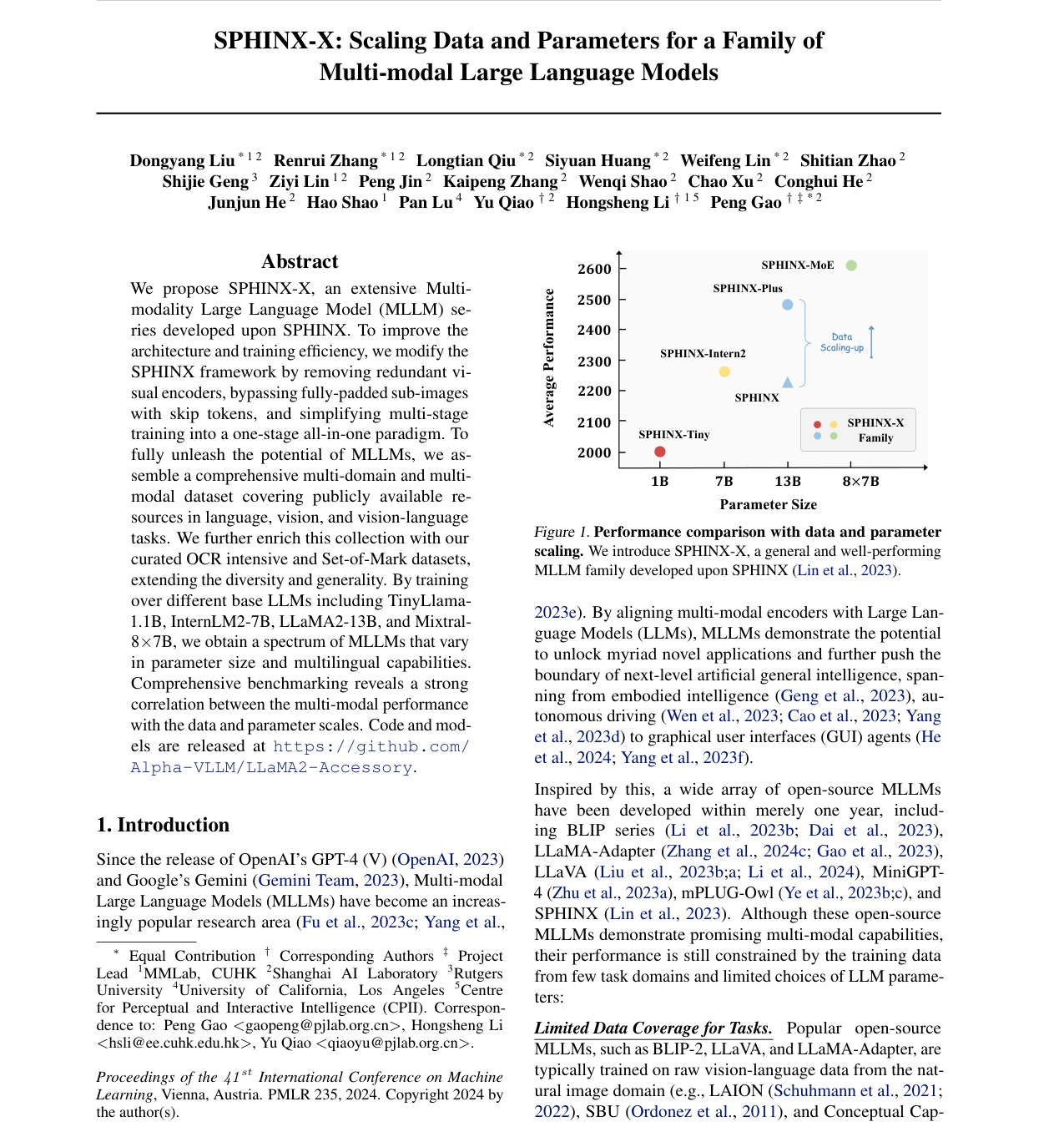
SPHINX-X: Scaling Data and Parameters for a Family of Multi-modal Large Language Models
Dongyang Liu, Renrui Zhang, Longtian Qiu, Siyuan Huang, Weifeng Lin, Shitian Zhao, Shijie Geng, Ziyi Lin, Peng Jin, Kaipeng Zhang, Wenqi Shao, Chao Xu, Conghui He, Junjun He, Hao Shao, Pan Lu, Yu Qiao, Hongsheng Li, Peng Gao
Why you should read this
Presents an efficient multimodal architecture and a unified one-stage training framework across multiple base language models ranging from 1.1B to 8×7B parameters, demonstrating how systematic scaling of both training data and model capacity boosts multimodal performance across diverse visual-language tasks.
We propose SPHINX-X, an extensive Multi-modality Large Language Model (MLLM) series developed upon SPHINX. To improve the architecture and training efficiency, we modify the SPHINX framework by removing redundant visual encoders, bypassing fully-padded sub-images with skip tokens, and simplifying multi-stage training into a one-stage all-in-one paradigm. To fully unleash the potential of MLLMs, we assemble a comprehensive multi-domain and multi-modal dataset covering publicly available resources in language, vision, and vision-language tasks. We further enrich this collection with our curated OCR intensive and Set-of-Mark datasets, extending the diversity and generality. By training over different base LLMs including TinyLlama-1.1B, InternLM2-7B, LLaMA2-13B, and Mixtral-8×7B, we obtain a spectrum of MLLMs that vary in parameter size and multilingual capabilities. Comprehensive benchmarking reveals a strong correlation between the multi-modal performance with the data and parameter scales. Code and models are released at https://github.com/Alpha-VLLM/LLaMA2-Accessory.
Added
2026-10-01
STRIVE: Structured Spatiotemporal Exploration for Reinforcement Learning in Video Question Answering
Emad Bahrami, Olga Zatsarynna, Parth Pathak, Sunando Sengupta, Juergen Gall, Mohsen Fayyaz
Why you should read this
Introduces STRIVE, a reinforcement learning framework that resolves weak policy optimization in video question answering by jointly evaluating generated text alongside importance-sampled visual variants to enrich reward signals across multimodal reasoning benchmarks.
We introduce STRIVE (SpatioTemporal Reinforcement with Importance-aware Variant Exploration), a structured reinforcement learning framework for video question answering. While group-based policy optimization methods have shown promise in large multimodal models, they often suffer from low reward variance when responses exhibit similar correctness, leading to weak or unstable advantage estimates. STRIVE addresses this limitation by constructing multiple spatiotemporal variants of each input video and performing joint normalization across both textual generations and visual variants. By expanding group comparisons beyond linguistic diversity to structured visual perturbations, STRIVE enriches reward signals and promotes more stable and informative policy updates. To ensure exploration remains semantically grounded, we introduce an importance-aware sampling mechanism that prioritizes frames most relevant to the input question while preserving temporal coverage. This design encourages robust reasoning across complementary visual perspectives rather than overfitting to a single spatiotemporal configuration. Experiments on six challenging video reasoning benchmarks including VideoMME, TempCompass, VideoMMMU, MMVU, VSI-Bench, and PerceptionTest demonstrate consistent improvements over strong reinforcement learning baselines across multiple large multimodal models. Our results highlight the role of structured spatiotemporal exploration as a principled mechanism for stabilizing multimodal reinforcement learning and improving video reasoning performance.
Added
2026-09-29
GeoVision Labeler: Zero-Shot Geospatial Classification with Vision and Language Models
Gilles Quentin Hacheme, Girmaw Abebe Tadesse, Caleb Robinson, Akram Zaytar, Rahul Dodhia, Juan M. Lavista Ferres
Why you should read this
Introduces GeoVision Labeler, a strictly zero-shot framework that pairs vision-language model descriptions with hierarchical LLM reasoning to classify complex satellite imagery without domain-specific training or labeled data.
Classifying geospatial imagery remains a major bottleneck for applications such as disaster response and land-use monitoring-particularly in regions where annotated data is scarce or unavailable. Existing tools (e.g., RS-CLIP) that claim zero-shot classification capabilities for satellite imagery nonetheless rely on task-specific pretraining and adaptation to reach competitive performance. We introduce GeoVision Labeler (GVL), a strictly zero-shot classification framework: a vision Large Language Model (vLLM) generates rich, human-readable image descriptions, which are then mapped to user-defined classes by a conventional Large Language Model (LLM). This modular, and interpretable pipeline enables flexible image classification for a large range of use cases. We evaluated GVL across three benchmarks-SpaceNet v7, UC Merced, and RESISC45. It achieves up to 93.2% zero-shot accuracy on the binary Buildings vs. No Buildings task on SpaceNet v7. For complex multi-class classification tasks (UC Merced, RESISC45), we implemented a recursive LLM-driven clustering to form meta-classes at successive depths, followed by hierarchical classification-first resolving coarse groups, then finer distinctions-to deliver competitive zero-shot performance. GVL is open-sourced at this https URL to catalyze adoption in real-world geospatial workflows.
Added
2026-09-29
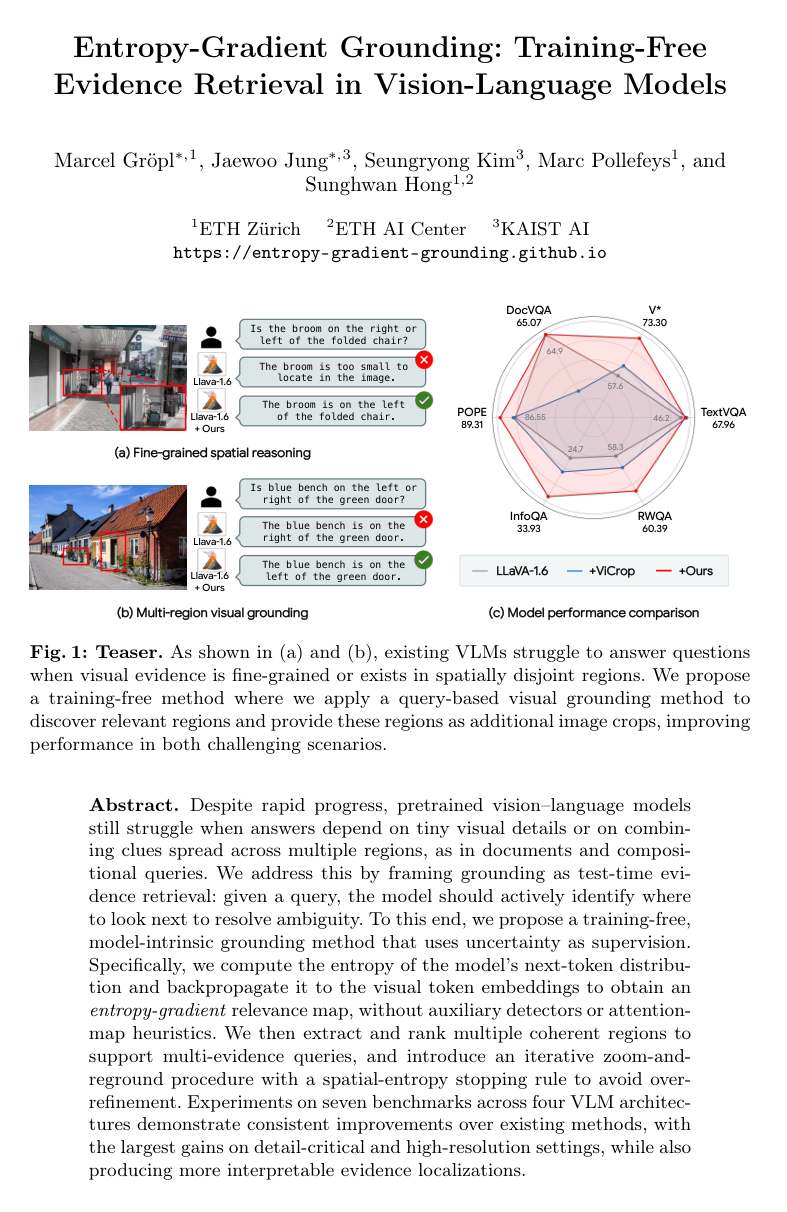
Entropy-Gradient Grounding: Training-Free Evidence Retrieval in Vision-Language Models
Marcel Gropl, Jaewoo Jung, Seungryong Kim, Marc Pollefeys, Sung‐Jin Hong
Why you should read this
Proposes a training-free evidence retrieval method for vision-language models that backpropagates next-token prediction entropy into visual tokens to iteratively locate and zoom in on fine visual details.
Despite rapid progress, pretrained vision-language models still struggle when answers depend on tiny visual details or on combining clues spread across multiple regions, as in documents and compositional queries. We address this by framing grounding as test-time evidence retrieval: given a query, the model should actively identify where to look next to resolve ambiguity. To this end, we propose a training-free, model-intrinsic grounding method that uses uncertainty as supervision. Specifically, we compute the entropy of the model's next-token distribution and backpropagate it to the visual token embeddings to obtain an entropy-gradient relevance map, without auxiliary detectors or attention-map heuristics. We then extract and rank multiple coherent regions to support multi-evidence queries, and introduce an iterative zoom-and-reground procedure with a spatial-entropy stopping rule to avoid over-refinement. Experiments on seven benchmarks across four VLM architectures demonstrate consistent improvements over existing methods, with the largest gains on detail-critical and high-resolution settings, while also producing more interpretable evidence localizations.
Added
2026-09-29
NExT-GPT: Any-to-Any Multimodal LLM
Shengqiong Wu, Hao Fei, Leigang Qu, Wei Ji, Tat-Seng Chua
Why you should read this
Presents an end-to-end multimodal language model that accepts and generates arbitrary combinations of text, image, video, and audio by tuning just one percent of projection parameters between an existing core model and specialized diffusion decoders.
While recently Multimodal Large Language Models (MM-LLMs) have made exciting strides, they mostly fall prey to the limitation of only input-side multimodal understanding, without the ability to produce content in multiple modalities. As we humans always perceive the world and communicate with people through various modalities, developing any-to-any MM-LLMs capable of accepting and delivering content in any modality becomes essential to human-level AI. To fill the gap, we present an end-to-end general-purpose any-to-any MM-LLM system, NExT-GPT. We connect an LLM with multimodal adaptors and different diffusion decoders, enabling NExT-GPT to perceive inputs and generate outputs in arbitrary combinations of text, image, video, and audio. By leveraging the existing well-trained high-performing encoders and decoders, NExT-GPT is tuned with only a small amount of parameter (1%) of certain projection layers, which not only benefits low-cost training but also facilitates convenient expansion to more potential modalities. Moreover, we introduce a modality-switching instruction tuning (MosIT) and manually curate a high-quality dataset for MosIT, based on which NExT-GPT is empowered with complex cross-modal semantic understanding and content generation. Overall, our research showcases the promising possibilities of building a unified AI agent capable of modeling universal modalities, paving the way for more human-like AI research in the community. Project website: https://next-gpt.github.io/
Added
2026-09-28
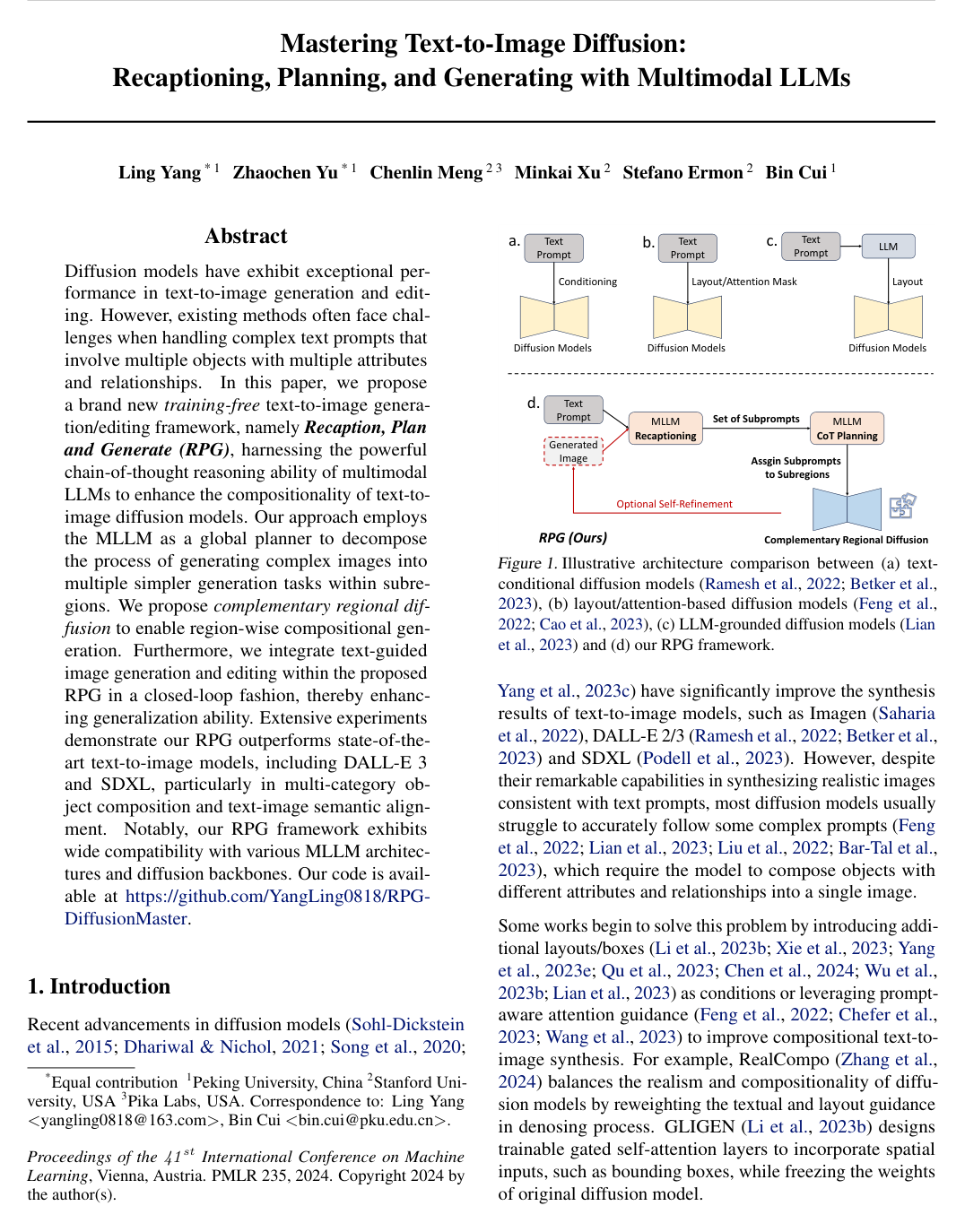
Mastering Text-to-Image Diffusion: Recaptioning, Planning, and Generating with Multimodal LLMs
Ling Yang, Zhaochen Yu, Chenlin Meng, Minkai Xu, Stefano Ermon, Bin Cui
Why you should read this
Proposes a training-free framework that leverages multimodal large language models to decompose complex prompts into spatial sub-tasks for regional diffusion, outperforming DALL-E 3 and SDXL in multi-object compositional image generation and editing.
Diffusion models have exhibit exceptional performance in text-to-image generation and editing. However, existing methods often face challenges when handling complex text prompts that involve multiple objects with multiple attributes and relationships. In this paper, we propose a brand new training-free text-to-image generation/editing framework, namely Recaption, Plan and Generate (RPG), harnessing the powerful chain-of-thought reasoning ability of multimodal LLMs to enhance the compositionality of text-to-image diffusion models. Our approach employs the MLLM as a global planner to decompose the process of generating complex images into multiple simpler generation tasks within subregions. We propose complementary regional diffusion to enable region-wise compositional generation. Furthermore, we integrate text-guided image generation and editing within the proposed RPG in a closed-loop fashion, thereby enhancing generalization ability. Extensive experiments demonstrate our RPG outperforms state-of-the-art text-to-image models, including DALL-E 3 and SDXL, particularly in multi-category object composition and text-image semantic alignment. Notably, our RPG framework exhibits wide compatibility with various MLLM architectures and diffusion backbones. Our code is available at https://github.com/YangLing0818/RPG-DiffusionMaster.
Added
2026-09-28
SparseVLM: Visual Token Sparsification for Efficient Vision-Language Model Inference
Yuan Zhang, Chun-Kai Fan, Junpeng Ma, Wenzhao Zheng, Tao Huang, Kuan Cheng, Denis A. Gudovskiy, Tomoyuki Okuno, Yohei Nakata, Kurt Keutzer, Shanghang Zhang
Why you should read this
Proposes a training-free visual token pruning and recycling framework that uses question-relevant text attention to dramatically accelerate vision-language model inference across image and video benchmarks without sacrificing task accuracy.
In vision-language models (VLMs), visual tokens usually bear a significant amount of computational overhead despite sparsity of information in them when compared to text tokens. To address this, most existing methods learn a network to prune redundant visual tokens using certain training data. Differently, we propose a text-guided training-free token optimization mechanism dubbed SparseVLM that eliminates the need of extra parameters or fine-tuning costs. Given that visual tokens complement text tokens in VLM’s linguistic reasoning, we select relevant text tokens to rate the significance of visual tokens using self-attention matrices and, then, prune visual tokens using the proposed strategy to maximize sparsity while retaining information. In particular, we introduce a rank-based strategy to adaptively determine the sparsification ratio for each layer, alongside a token recycling method that compresses pruned tokens into more compact representations. Experimental results show that SparseVLM increases the efficiency of various VLMs in a number of image and video understanding tasks. Our code is available at https://github.com/Gumpest/SparseVLMs.
Added
2026-09-28
MMMU-Pro: A More Robust Multi-discipline Multimodal Understanding Benchmark
Xiang Yue, Tianyu Zheng, Yuansheng Ni, Yubo Wang, Kai Zhang, Shengbang Tong, Yuxuan Sun, Botao Yu, Ge Zhang, Huan Sun, Yu Su, Wenhu Chen, Graham Neubig
Why you should read this
Introduces MMMU-Pro, an advanced multimodal benchmark that eliminates text-only shortcuts, expands answer choices, and embeds text within images to expose severe performance drops in leading vision-language models.
This paper introduces MMMU-Pro, a robust version of the Massive Multi-discipline Multimodal Understanding and Reasoning (MMMU) benchmark. MMMU-Pro rigorously assesses multimodal models’ true understanding and reasoning capabilities through a three-step process based on MMMU: (1) filtering out questions answerable by text-only models, (2) augmenting candidate options, and (3) introducing a vision-only input setting where questions are embedded within images. This setting challenges AI to truly “see” and “read” simultaneously, testing a core human cognitive skill of seamlessly integrating visual and textual information. Results show that model performance is substantially lower on MMMU-Pro than on MMMU, ranging from 16.8% to 26.9% across models. We explore the impact of OCR prompts and Chain of Thought (CoT) reasoning, finding that OCR prompts have minimal effect while CoT generally improves performance. MMMU-Pro provides a more rigorous evaluation tool, closely mimicking real-world scenarios and offering valuable directions for future multimodal research.
Added
2026-09-28
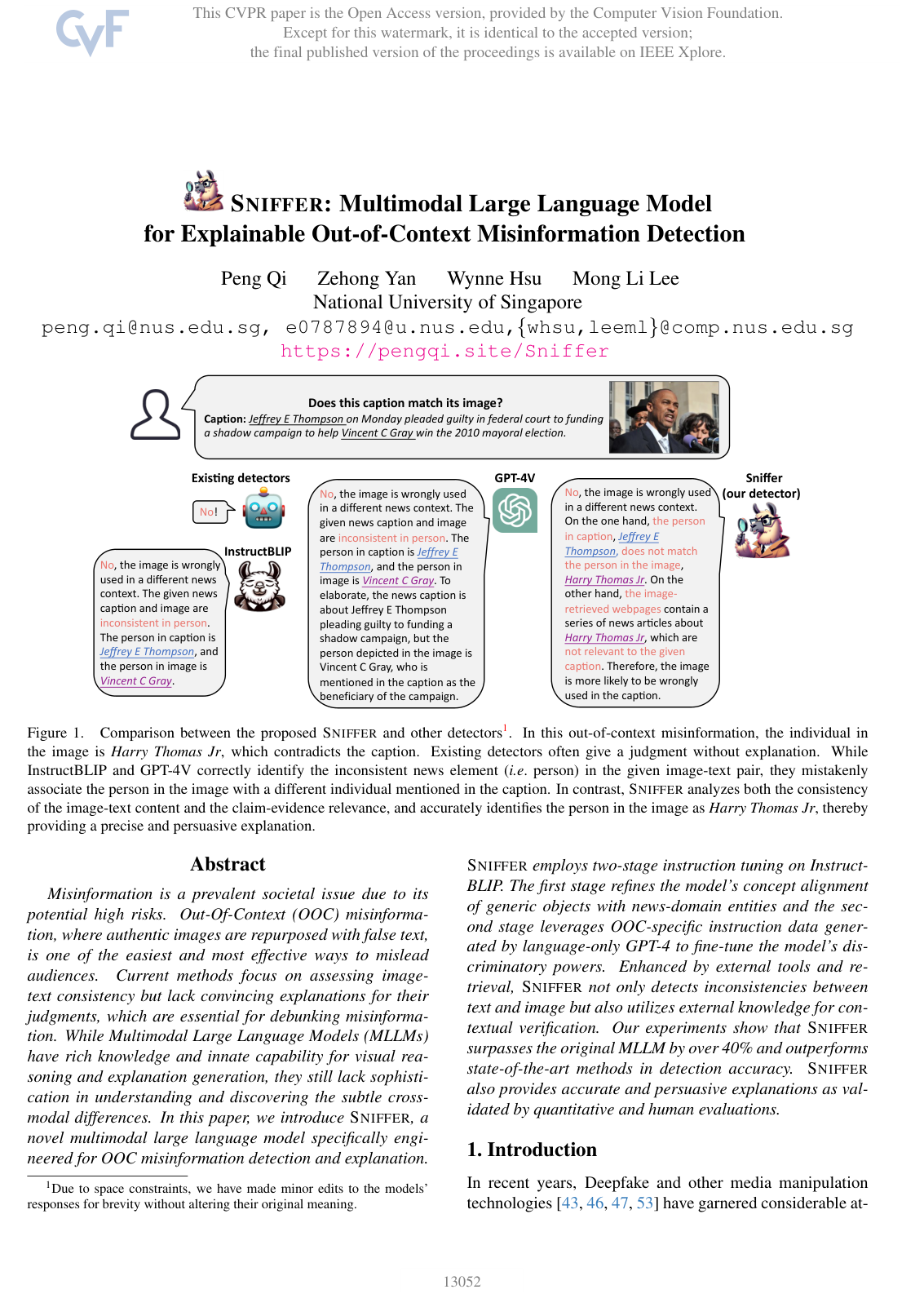
Sniffer: Multimodal Large Language Model for Explainable Out-of-Context Misinformation Detection
Peng Qi, Zehong Yan, Wynne Hsu, Mong-Li Lee
Why you should read this
Proposes SNIFFER, a multimodal large language model fine-tuned via two-stage instruction tuning and augmented with external retrieval to detect out-of-context misinformation while generating accurate, persuasive explanations.
Misinformation is a prevalent societal issue due to its potential high risks. Out-Of-Context (OOC) misinformation, where authentic images are repurposed with false text, is one of the easiest and most effective ways to mislead audiences. Current methods focus on assessing image-text consistency but lack convincing explanations for their judgments, which are essential for debunking misinformation. While Multimodal Large Language Models (MLLMs) have rich knowledge and innate capability for visual reasoning and explanation generation, they still lack sophistication in understanding and discovering the subtle cross-modal differences. In this paper, we introduce SNIFFER, a novel multimodal large language model specifically engineered for OOC misinformation detection and explanation. SNIFFER employs two-stage instruction tuning on Instruct-BLIP. The first stage refines the model’s concept alignment of generic objects with news-domain entities and the second stage leverages OOC-specific instruction data generated by language-only GPT-4 to fine-tune the model’s discriminatory powers. Enhanced by external tools and retrieval, SNIFFER not only detects inconsistencies between text and image but also utilizes external knowledge for contextual verification. Our experiments show that SNIFFER surpasses the original MLLM by over 40% and outperforms state-of-the-art methods in detection accuracy. SNIFFER also provides accurate and persuasive explanations as validated by quantitative and human evaluations.
Added
2026-09-26
Kosmos-G: Generating Images in Context with Multimodal Large Language Models
Xichen Pan, Li Dong, Shaohan Huang, Zhiliang Peng, Wenhu Chen, Furu Wei
Why you should read this
Presents Kosmos-G, a framework that aligns multimodal large language models with CLIP to achieve zero-shot subject-driven image generation from interleaved text and image inputs without requiring test-time tuning or image decoder modifications.
Recent advancements in subject-driven image generation have made significant strides. However, current methods still fall short in diverse application scenarios, as they require test-time tuning and cannot accept interleaved multi-image and text input. These limitations keep them far from the ultimate goal of "image as a foreign language in image generation." This paper presents Kosmos-G, a model that leverages the advanced multimodal perception capabilities of Multimodal Large Language Models (MLLMs) to tackle the aforementioned challenge. Our approach aligns the output space of MLLM with CLIP using the textual modality as an anchor and performs compositional instruction tuning on curated data. Kosmos-G demonstrates an impressive capability of zero-shot subject-driven generation with interleaved multi-image and text input. Notably, the score distillation instruction tuning requires no modifications to the image decoder. This allows for a seamless substitution of CLIP and effortless integration with a myriad of U-Net techniques ranging from fine-grained controls to personalized image decoder variants. We posit Kosmos-G as an initial attempt towards the goal of "image as a foreign language in image generation." The code can be found at this https URL
Added
2026-09-26
TimeSuite: Improving MLLMs for Long Video Understanding via Grounded Tuning
Xiangyu Zeng, Kunchang Li, Chenting Wang, Xinhao Li, Tianxiang Jiang, Ziang Yan, Songze Li, Yansong Shi, Zhengrong Yue, Yi Wang, Yali Wang, Yu Qiao, Limin Wang
Why you should read this
Presents TimeSuite, a grounded instruction-tuning framework that adapts multimodal language models for long-form video comprehension by pairing efficient token compression with explicit timestamp generation to curb hallucinations.
Multimodal Large Language Models (MLLMs) have demonstrated impressive performance in short video understanding. However, understanding long-form videos still remains challenging for MLLMs. This paper proposes TimeSuite, a collection of new designs to adapt the existing short-form video MLLMs for long video understanding, including a simple yet efficient framework to process long video sequence, a high-quality video dataset for grounded tuning of MLLMs, and a carefully-designed instruction tuning task to explicitly incorporate the grounding supervision in the traditional QA format. Specifically, based on VideoChat, we propose our long-video MLLM, coined as VideoChat-T, by implementing a token shuffling to compress long video tokens and introducing Temporal Adaptive Position Encoding (TAPE) to enhance the temporal awareness of visual representation. Meanwhile, we introduce the TimePro, a comprehensive grounding-centric instruction tuning dataset composed of 9 tasks and 349k high-quality grounded annotations. Notably, we design a new instruction tuning task type, called Temporal Grounded Caption, to peform detailed video descriptions with the corresponding time stamps prediction. This explicit temporal location prediction will guide MLLM to correctly attend on the visual content when generating description, and thus reduce the hallucination risk caused by the LLMs. Experimental results demonstrate that our TimeSuite provides a successful solution to enhance the long video understanding capability of short-form MLLM, achieving improvement of 5.6% and 6.8% on the benchmarks of Egoschema and VideoMME, respectively. In addition, VideoChat-T exhibits robust zero-shot temporal grounding capabilities, significantly outperforming the existing state-of-the-art MLLMs. After fine-tuning, it performs on par with the traditional supervised expert models.
Added
2026-09-26
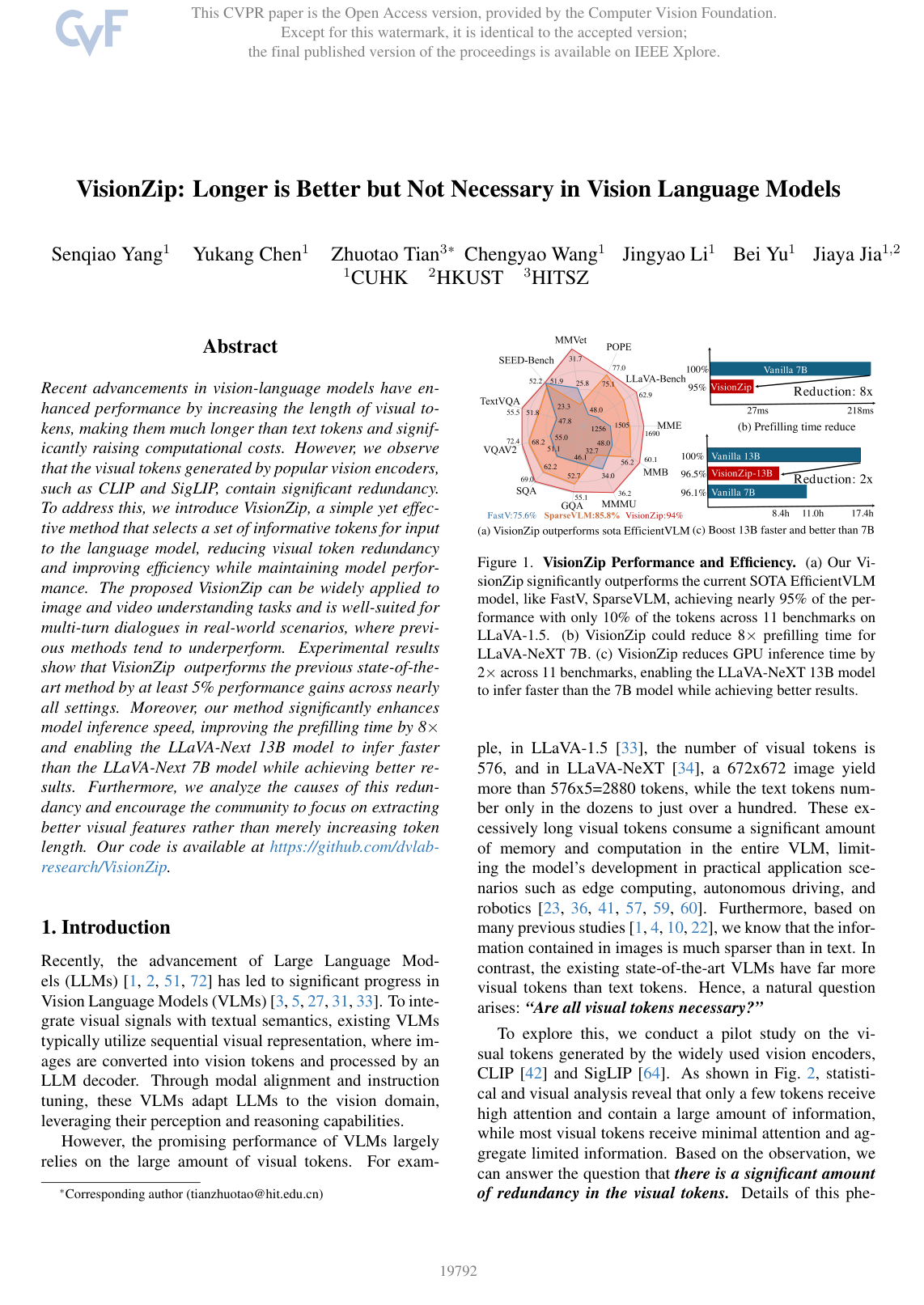
VisionZip: Longer is Better but Not Necessary in Vision Language Models
Senqiao Yang, Yukang Chen, Zhuotao Tian, Chengyao Wang, Jingyao Li, Bei Yu, Jiaya Jia
Why you should read this
Proposes VisionZip, a visual token reduction method that selects dominant tokens and merges redundant ones from vision encoders to achieve an 8x prefilling speedup with minimal performance loss across image and video benchmarks.
Recent advancements in vision-language models have enhanced performance by increasing the length of visual tokens, making them much longer than text tokens and significantly raising computational costs. However, we observe that the visual tokens generated by popular vision encoders, such as CLIP and SigLIP, contain significant redundancy. To address this, we introduce VisionZip, a simple yet effective method that selects a set of informative tokens for input to the language model, reducing visual token redundancy and improving efficiency while maintaining model performance. The proposed VisionZip can be widely applied to image and video understanding tasks and is well-suited for multi-turn dialogues in real-world scenarios, where previous methods tend to underperform. Experimental results show that VisionZip outperforms the previous state-of-the-art method by at least 5% performance gains across nearly all settings. Moreover, our method significantly enhances model inference speed, improving the prefilling time by 8× and enabling the LLaVA-Next 13B model to infer faster than the LLaVA-Next 7B model while achieving better results. Furthermore, we analyze the causes of this redundancy and encourage the community to focus on extracting better visual features rather than merely increasing token length. Our code is available at https://github.com/dvlab-research/VisionZip.
Added
2026-09-26
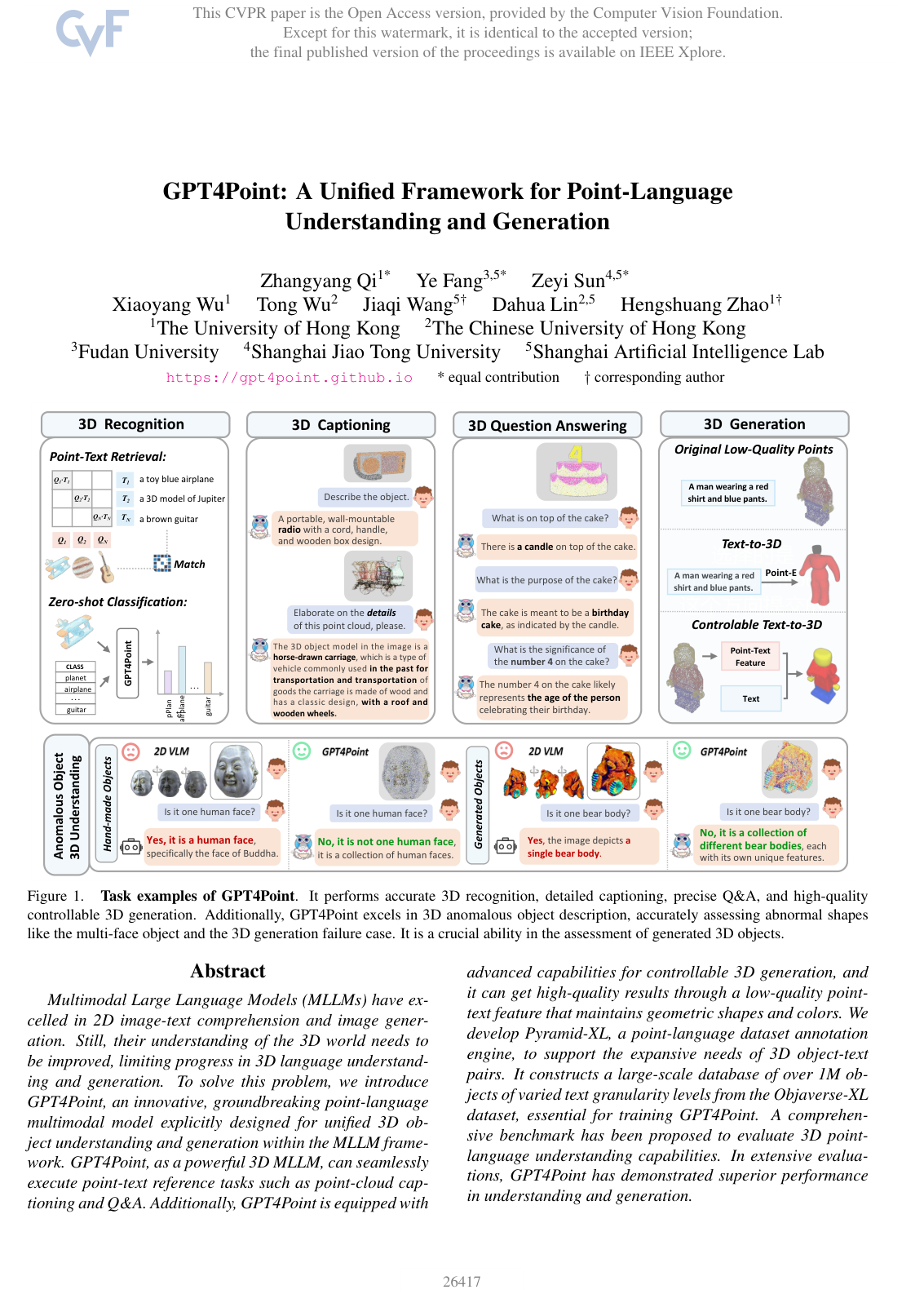
GPT4Point: A Unified Framework for Point-Language Understanding and Generation
Zhangyang Qi, Ye Fang, Zeyi Sun, Xiaoyang Wu, Tong Wu, Jiaqi Wang, Dahua Lin, Hengshuang Zhao
Why you should read this
Presents GPT4Point, a unified point-language framework that connects point cloud features with large language models and diffusion models to perform both 3D object-level understanding and controllable text-to-3D generation.
Multimodal Large Language Models (MLLMs) have excelled in 2D image-text comprehension and image generation. Still, their understanding of the 3D world needs to be improved, limiting progress in 3D language understanding and generation. To solve this problem, we introduce GPT4Point, an innovative, groundbreaking point-language multimodal model explicitly designed for unified 3D object understanding and generation within the MLLM framework. GPT4Point, as a powerful 3D MLLM, can seamlessly execute point-text reference tasks such as point-cloud captioning and Q&A. Additionally, GPT4Point is equipped with advanced capabilities for controllable 3D generation, and it can get high-quality results through a low-quality point-text feature that maintains geometric shapes and colors. We develop Pyramid-XL, a point-language dataset annotation engine, to support the expansive needs of 3D object-text pairs. It constructs a large-scale database of over 1M objects of varied text granularity levels from the Objaverse-XL dataset, essential for training GPT4Point. A comprehensive benchmark has been proposed to evaluate 3D point-language understanding capabilities. In extensive evaluations, GPT4Point has demonstrated superior performance in understanding and generation.
Added
2026-09-26