
keyword
multimodal large language model
A multimodal large language model is an artificial intelligence model that extends standard text-based large language models to process, understand, and generate information across multiple data modalities, such as text, images, video, and audio. Typically built on a transformer architecture, these systems use specialized encoders and alignment mechanisms to project non-textual inputs into a shared semantic space with text tokens. By combining cross-modal perception with the broad contextual reasoning and conversational capabilities of foundation language models, multimodal large language models can perform complex tasks such as visual question answering, image and region captioning, visual grounding, spatial localization, and specialized reasoning across various scientific and technical domains.
4 items
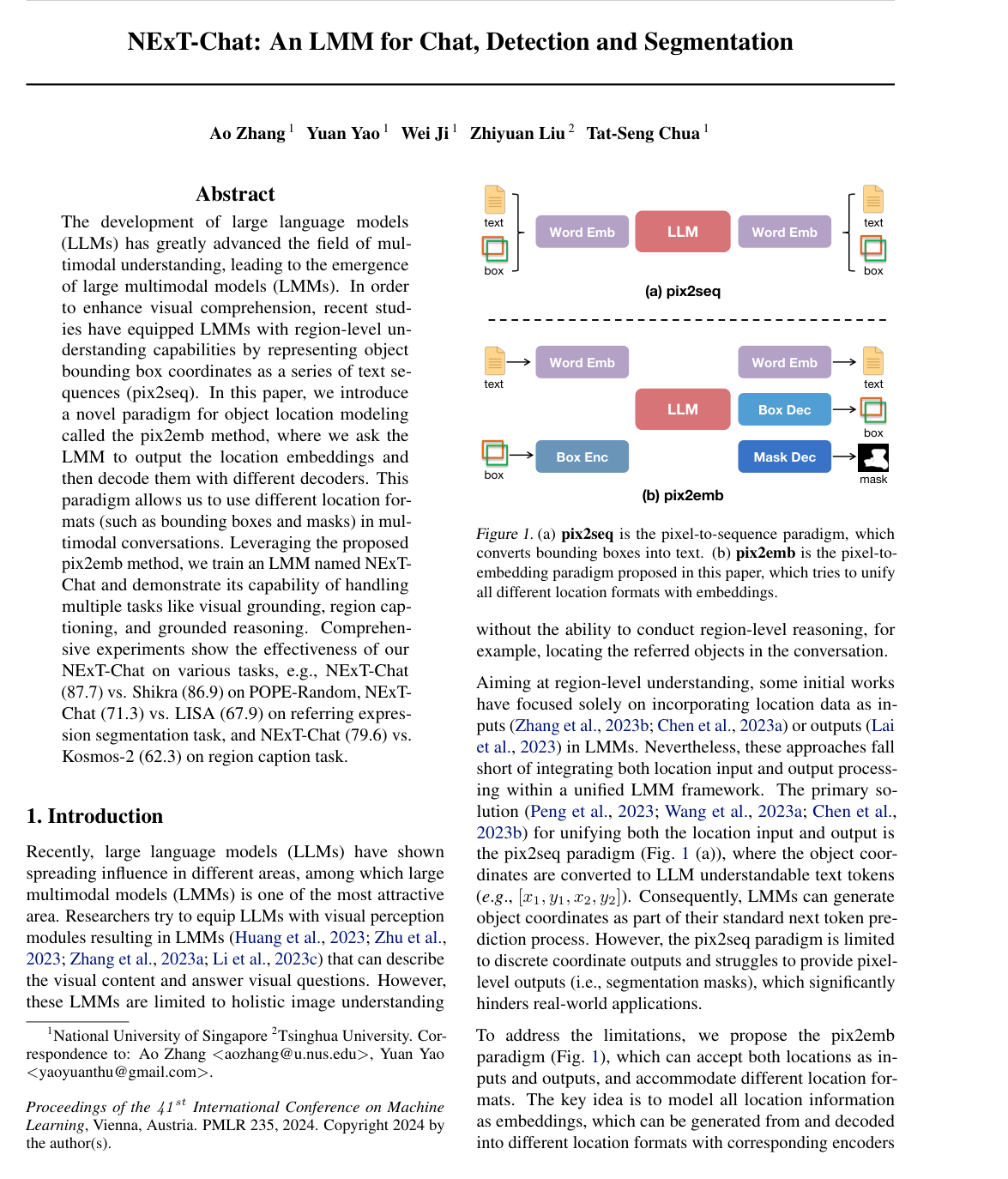
NExT-Chat: An LMM for Chat, Detection and Segmentation
Ao Zhang, Yuan Yao, Wei Ji, Zhiyuan Liu, Tat-Seng Chua
Why you should read this
Proposes a pixel-to-embedding framework that unifies conversational understanding, bounding-box detection, and pixel-level segmentation within a single multimodal language model by decoding learned location representations into multiple spatial formats.
The development of large language models (LLMs) has greatly advanced the field of multimodal understanding, leading to the emergence of large multimodal models (LMMs). In order to enhance visual comprehension, recent studies have equipped LMMs with region-level understanding capabilities by representing object bounding box coordinates as a series of text sequences (pix2seq). In this paper, we introduce a novel paradigm for object location modeling called the pix2emb method, where we ask the LMM to output the location embeddings and then decode them with different decoders. This paradigm allows us to use different location formats (such as bounding boxes and masks) in multimodal conversations. Leveraging the proposed pix2emb method, we train an LMM named NExT-Chat and demonstrate its capability of handling multiple tasks like visual grounding, region captioning, and grounded reasoning. Comprehensive experiments show the effectiveness of our NExT-Chat on various tasks, e.g., NExT-Chat (87.7) vs. Shikra (86.9) on POPE-Random, NExT-Chat (71.3) vs. LISA (67.9) on referring expression segmentation task, and NExT-Chat (79.6) vs. Kosmos-2 (62.3) on region caption task.
Added
2026-10-02
Insights into a radiology-specialised multimodal large language model with sparse autoencoders
Kenza Bouzid, Shruthi Bannur, Felix Meissen, Daniel Coelho de Castro, Anton Schwaighofer, Javier Alvarez-Valle, Stephanie Hyland
Why you should read this
Applies sparse autoencoders to the radiology multimodal model MAIRA-2 to identify human-interpretable representations of pathologies and medical devices while testing whether these internal features can steer clinical text generation.
Interpretability can improve the safety, transparency and trust of AI models, which is especially important in healthcare applications where decisions often carry significant consequences. Mechanistic interpretability, particularly through the use of sparse autoencoders (SAEs), offers a promising approach for uncovering human-interpretable features within large transformer-based models. In this study, we apply Matryoshka-SAE to the radiology-specialised multimodal large language model, MAIRA-2, to interpret its internal representations. Using large-scale automated interpretability of the SAE features, we identify a range of clinically relevant concepts - including medical devices (e.g., line and tube placements, pacemaker presence), pathologies such as pleural effusion and cardiomegaly, longitudinal changes and textual features. We further examine the influence of these features on model behaviour through steering, demonstrating directional control over generations with mixed success. Our results reveal practical and methodological challenges, yet they offer initial insights into the internal concepts learned by MAIRA-2 - marking a step toward deeper mechanistic understanding and interpretability of a radiology-adapted multimodal large language model, and paving the way for improved model transparency. We release the trained SAEs and interpretations: this https URL.
Added
2026-09-29
Wan: Open and Advanced Large-Scale Video Generative Models
Ang Wang, Baole Ai, Bin Wen, Chaojie Mao, Chen-Wei Xie, Di Chen, Feiwu Yu, Haiming Zhao, Jianxiao Yang, Jianyuan Zeng, Jiayu Wang, Jingfeng Zhang, Jingren Zhou, Jinkai Wang, Jixuan Chen, Kai Zhu, Kang Zhao, Keyu Yan, Lianghua Huang, Xiaofeng Meng, Ningying Zhang, Pandeng Li, Ping Wu, Ruihang Chu, Rui Feng, Shiwei Zhang, Siyang Sun, Tao Fang, Tianxing Wang, T. Gui, Tingyu Weng, Tong Shen, Wei Lin, Wei Wang, Wen-Chao Zhou, Wente Wang, Wen Shen, Wenyuan Yu, Xianzhong Shi, Xiaomin Huang, Xin Xu, Yan Kou, Yan-Mei Lv, Yifei Li, Yi-Jing Liu, Yiming Wang, Yingya Zhang, Yitong Huang, Yong Li, You Wu, Yu Liu, Yulin Pan, Yun Zheng, Yuntao Hong, Yupeng Shi, Yutong Feng, Zeyinzi Jiang, Zhen Han, Zhi-Fan Wu, Ziyu Liu
Why you should read this
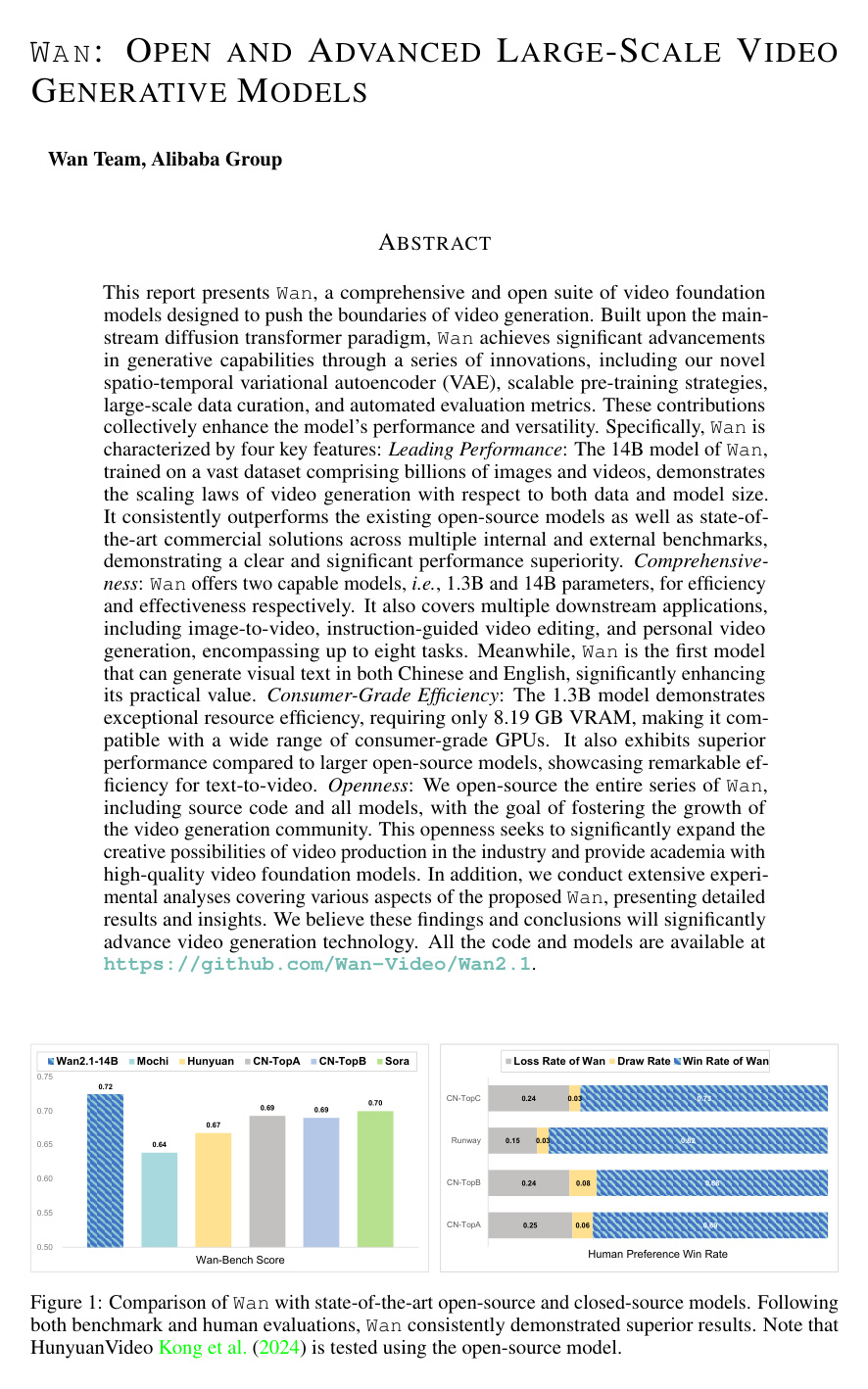
Presents an open-source suite of diffusion transformer video foundation models scaling up to 14 billion parameters that outperforms leading commercial systems while providing a lightweight variant that runs on consumer GPUs with under 8.2 GB of VRAM.
This report presents Wan, a comprehensive and open suite of video foundation models designed to push the boundaries of video generation. Built upon the mainstream diffusion transformer paradigm, Wan achieves significant advancements in generative capabilities through a series of innovations, including our novel VAE, scalable pre-training strategies, large-scale data curation, and automated evaluation metrics. These contributions collectively enhance the model's performance and versatility. Specifically, Wan is characterized by four key features: Leading Performance: The 14B model of Wan, trained on a vast dataset comprising billions of images and videos, demonstrates the scaling laws of video generation with respect to both data and model size. It consistently outperforms the existing open-source models as well as state-of-the-art commercial solutions across multiple internal and external benchmarks, demonstrating a clear and significant performance superiority. Comprehensiveness: Wan offers two capable models, i.e., 1.3B and 14B parameters, for efficiency and effectiveness respectively. It also covers multiple downstream applications, including image-to-video, instruction-guided video editing, and personal video generation, encompassing up to eight tasks. Consumer-Grade Efficiency: The 1.3B model demonstrates exceptional resource efficiency, requiring only 8.19 GB VRAM, making it compatible with a wide range of consumer-grade GPUs. Openness: We open-source the entire series of Wan, including source code and all models, with the goal of fostering the growth of the video generation community. This openness seeks to significantly expand the creative possibilities of video production in the industry and provide academia with high-quality video foundation models. All the code and models are available at this https URL.
Added
2026-09-24
Innovator-VL: A Multimodal Large Language Model for Scientific Discovery
Zichen Wen, Boxue Yang, Shuang Chen, Yaojie Zhang, Yuhang Han, Junlong Ke, Cong Wang, Yicheng Fu, Jiawang Zhao, Jiangchao Yao, Xi Fang, Zhen Wang, Henxing Cai, Lin Yao, Zhifeng Gao, Yanhui Hong, Nang Yuan, Yixuan Li, Guojiang Zhao, Haoyi Tao, Nan Wang, Han Lyu, Guolin Ke, Ning Liao, Xiaoxing Wang, Kai Chen, Zhiyu Li, Feiyu Xiong, Sihan Hu, Kun Chen, Yanfeng Wang, Weinan E, Linfeng Zhang, Linfeng Zhang
Why you should read this
Presents Innovator-VL, a transparent and data-efficient multimodal large language model that establishes a new state of the art in scientific reasoning through a reproducible training recipe and sequence-level policy optimization without requiring massive domain-specific pretraining.
We present Innovator-VL, a scientific multimodal large language model designed to advance understanding and reasoning across diverse scientific domains while maintaining excellent performance on general vision tasks. Contrary to the trend of relying on massive domain-specific pretraining and opaque pipelines, our work demonstrates that principled training design and transparent methodology can yield strong scientific intelligence with substantially reduced data requirements. (i) First, we provide a fully transparent, end-to-end reproducible training pipeline, covering data collection, cleaning, preprocessing, supervised fine-tuning, reinforcement learning, and evaluation, along with detailed optimization recipes. This facilitates systematic extension by the community. (ii) Second, Innovator-VL exhibits remarkable data efficiency, achieving competitive performance on various scientific tasks using fewer than five million curated samples without large-scale pretraining. These results highlight that effective reasoning can be achieved through principled data selection rather than indiscriminate scaling. (iii) Third, Innovator-VL demonstrates strong generalization, achieving competitive performance on general vision, multimodal reasoning, and scientific benchmarks. This indicates that scientific alignment can be integrated into a unified model without compromising general-purpose capabilities. Our practices suggest that efficient, reproducible, and high-performing scientific multimodal models can be built even without large-scale data, providing a practical foundation for future research.
Added
2026-02-02