
keyword
Multimodal alignment
Multimodal alignment is the process of finding, coordinating, and mapping the correspondences between information conveyed across two or more distinct data modalities, such as text, images, audio, video, or tactile signals [cite: s1]. In machine learning and artificial intelligence, it establishes relationships among features or tokens that represent the same underlying semantic concept across different input channels, often by projecting them into a unified representation space. This coordination can be achieved globally across entire data instances, such as pairing a complete image with a descriptive caption, or locally at the sub-component level, such as linking specific words to visual regions, audio segments, or temporal intervals. By synchronizing heterogeneous data formats into a coherent shared structure, multimodal alignment enables unified systems to effectively integrate, cross-reference, and reason over diverse sensory inputs [cite: s1].
4 items
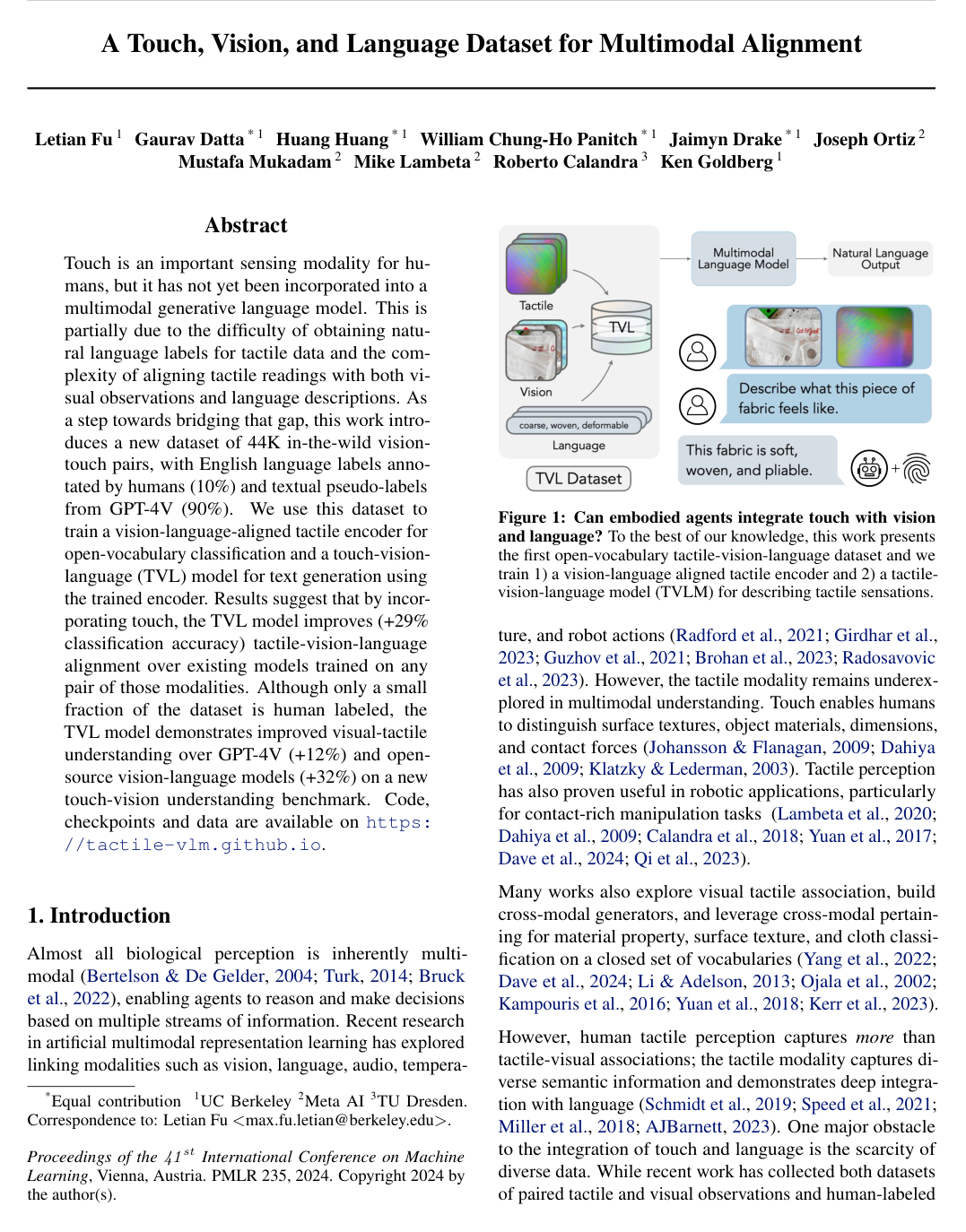
A Touch, Vision, and Language Dataset for Multimodal Alignment
Letian Fu, Gaurav Datta, Huang Huang, William Chung-Ho Panitch, Jaimyn Drake, Joseph Ortiz, Mustafa Mukadam, Mike Lambeta, Roberto Calandra, Ken Goldberg
Why you should read this
Presents a multimodal dataset of 44,000 paired tactile-visual observations and a tri-modal alignment framework that equips language models with the ability to generate accurate natural language descriptions of tactile sensations.
Added
2026-10-02
AnyGPT: Unified Multimodal LLM with Discrete Sequence Modeling
Jun Zhan, Junqi Dai, Jiasheng Ye, Yunhua Zhou, Dong Zhang, Zhigeng Liu, Xin Zhang, Ruibin Yuan, Ge Zhang, Linyang Li, Hang Yan, Jie Fu, Tao Gui, Tianxiang Sun, Yu-Gang Jiang, Xipeng Qiu
Why you should read this
Presents AnyGPT, an any-to-any multimodal language model that unifies speech, text, images, and music using discrete sequence modeling without altering standard model architectures or training objectives.
We introduce AnyGPT, an any-to-any multi-modal language model that utilizes discrete representations for the unified processing of various modalities, including speech, text, images, and music. AnyGPT can be trained stably without any alterations to the current large language model (LLM) architecture or training paradigms. Instead, it relies exclusively on data-level preprocessing, facilitating the seamless integration of new modalities into LLMs, akin to the incorporation of new languages. We build a multimodal text-centric dataset for multimodal alignment pre-training. Utilizing generative models, we synthesize the first large-scale any-to-any multimodal instruction dataset. It consists of 108k samples of multi-turn conversations that intricately interweave various modalities, thus equipping the model to handle arbitrary combinations of multimodal inputs and outputs. Experimental results demonstrate that AnyGPT is capable of facilitating any-to-any multimodal conversation while achieving performance comparable to specialized models across all modalities, proving that discrete representations can effectively and conveniently unify multiple modalities within a language model. Demos are shown in https://junzhan2000.github.io/AnyGPT.github.io/.
Added
2026-09-29
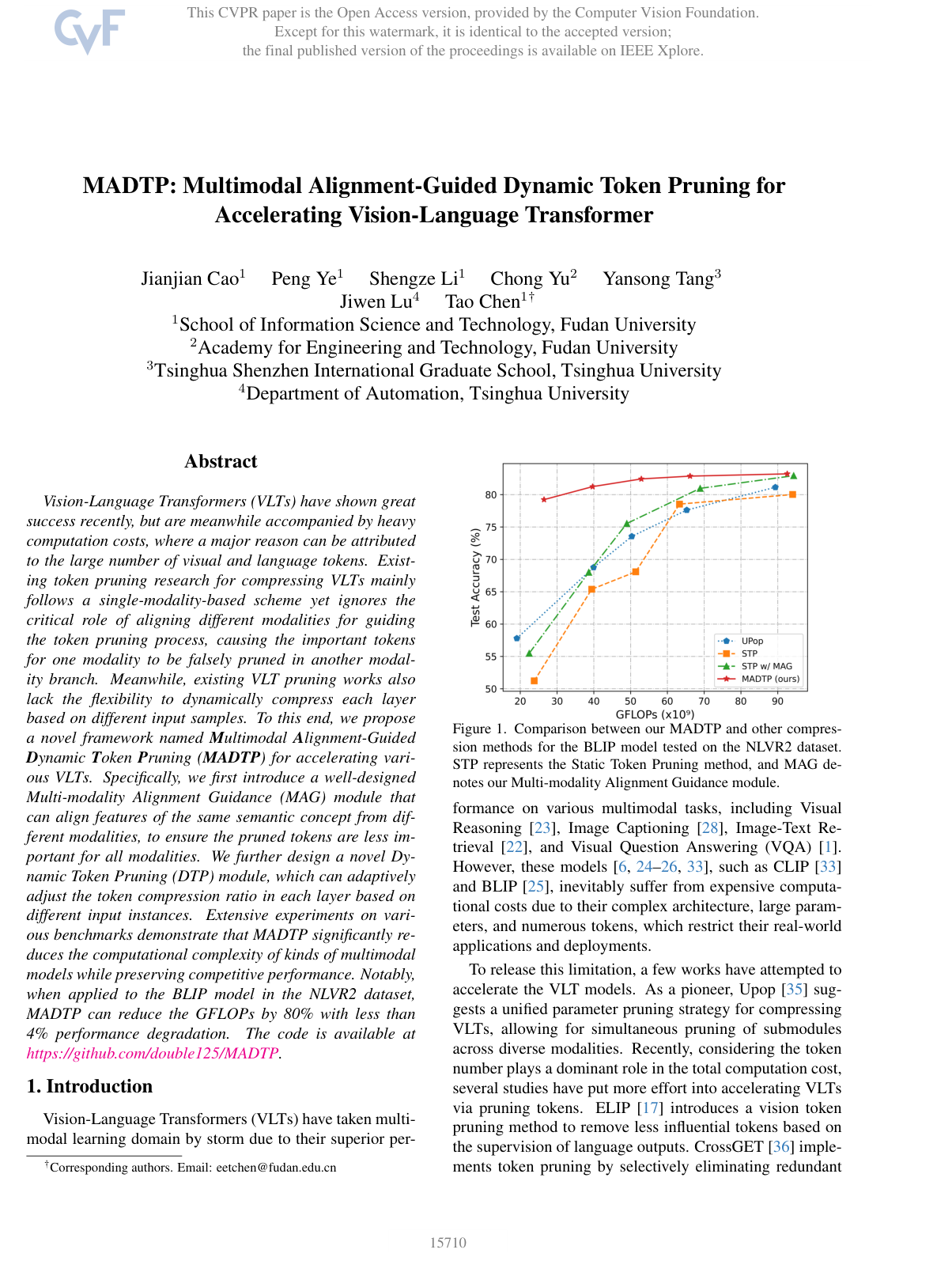
MADTP: Multimodal Alignment-Guided Dynamic Token Pruning for Accelerating Vision-Language Transformer
Jianjian Cao, Peng Ye, Shengze Li, Chong Yu, Yansong Tang, Jiwen Lu, Tao Chen
Why you should read this
Proposes a multimodal alignment-guided dynamic token pruning framework that cuts Vision-Language Transformer computation by up to 80% with minimal accuracy loss by aligning cross-modal representations to prevent false token removal and adaptively tuning layer-wise pruning ratios per input instance.
Vision-Language Transformers (VLTs) have shown great success recently, but are meanwhile accompanied by heavy computation costs, where a major reason can be attributed to the large number of visual and language tokens. Existing token pruning research for compressing VLTs mainly follows a single-modality-based scheme yet ignores the critical role of aligning different modalities for guiding the token pruning process, causing the important tokens for one modality to be falsely pruned in another modality branch. Meanwhile, existing VLT pruning works also lack the flexibility to dynamically compress each layer based on different input samples. To this end, we propose a novel framework named Multimodal Alignment-Guided Dynamic Token Pruning (MADTP) for accelerating various VLTs. Specifically, we first introduce a well-designed Multi-modality Alignment Guidance (MAG) module that can align features of the same semantic concept from different modalities, to ensure the pruned tokens are less important for all modalities. We further design a novel Dynamic Token Pruning (DTP) module, which can adaptively adjust the token compression ratio in each layer based on different input instances. Extensive experiments on various benchmarks demonstrate that MADTP significantly reduces the computational complexity of kinds of multimodal models while preserving competitive performance. Notably, when applied to the BLIP model in the NLVR2 dataset, MADTP can reduce the GFLOPs by 80% with less than 4% performance degradation. The code is available at https://github.com/double125/MADTP.
Added
2026-09-26
Multimodal Machine Learning: A Survey and Taxonomy
Tadas Baltrušaitis, Chaitanya Ahuja, Louis-Philippe Morency
Why you should read this
Establishes a comprehensive taxonomy for multimodal machine learning by structuring the field around five fundamental technical challenges: representation, translation, alignment, fusion, and co-learning.
Our experience of the world is multimodal - we see objects, hear sounds, feel texture, smell odors, and taste flavors. Modality refers to the way in which something happens or is experienced and a research problem is characterized as multimodal when it includes multiple such modalities. In order for Artificial Intelligence to make progress in understanding the world around us, it needs to be able to interpret such multimodal signals together. Multimodal machine learning aims to build models that can process and relate information from multiple modalities. It is a vibrant multi-disciplinary field of increasing importance and with extraordinary potential. Instead of focusing on specific multimodal applications, this paper surveys the recent advances in multimodal machine learning itself and presents them in a common taxonomy. We go beyond the typical early and late fusion categorization and identify broader challenges that are faced by multimodal machine learning, namely: representation, translation, alignment, fusion, and co-learning. This new taxonomy will enable researchers to better understand the state of the field and identify directions for future research.
Added
2026-09-10