
keyword
Multilingual retrieval
Multilingual retrieval is the process and technology of searching, indexing, and retrieving relevant information from document collections across multiple languages. In information retrieval and natural language processing, it enables search systems to process queries and fetch semantically corresponding content regardless of whether the query and the documents share the same language or span different languages. Unlike monolingual retrieval, which operates strictly within a single language, or bilingual cross-lingual retrieval, which focuses on translating or matching between a specific pair of languages, multilingual retrieval leverages unified semantic representations, dense multilingual text embeddings, or translation pipelines to support searching and ranking across dozens or hundreds of languages within a single framework.
2 items
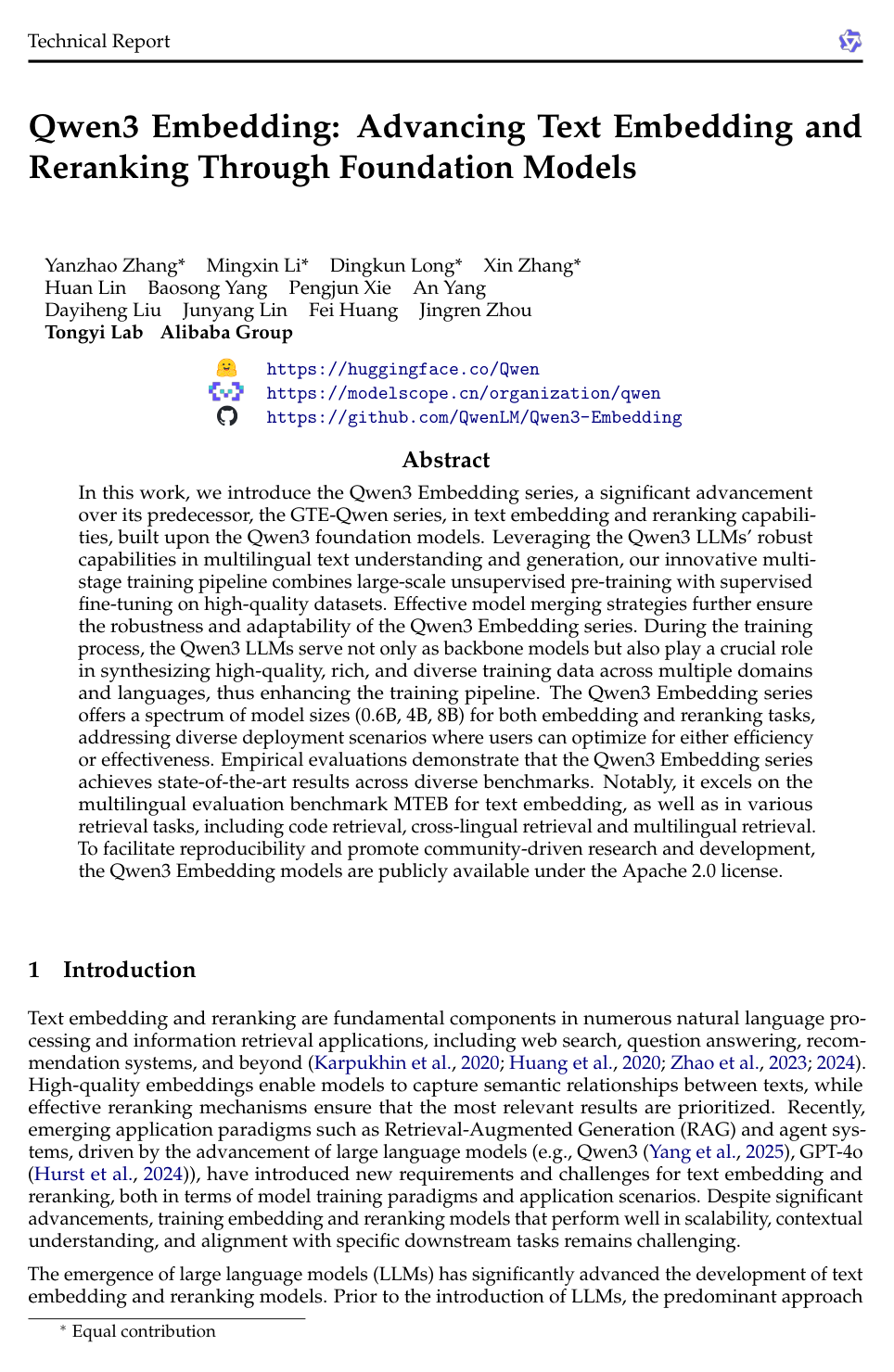
Qwen3 Embedding: Advancing Text Embedding and Reranking Through Foundation Models
Yanzhao Zhang, Mingxin Li, Dingkun Long, Xin Zhang, Huan Lin, Baosong Yang, Pengjun Xie, An Yang, Dayiheng Liu, Junyang Lin, Fei Huang, Jingren Zhou
Why you should read this
Presents the open-source Qwen3 Embedding and reranking model suite across 0.6B to 8B parameters, setting new state-of-the-art performance on multilingual and code retrieval benchmarks through foundation-model-driven synthetic data generation and multi-stage training.
In this work, we introduce the Qwen3 Embedding series, a significant advancement over its predecessor, the GTE-Qwen series, in text embedding and reranking capabilities, built upon the Qwen3 foundation models. Leveraging the Qwen3 LLMs' robust capabilities in multilingual text understanding and generation, our innovative multi-stage training pipeline combines large-scale unsupervised pre-training with supervised fine-tuning on high-quality datasets. Effective model merging strategies further ensure the robustness and adaptability of the Qwen3 Embedding series. During the training process, the Qwen3 LLMs serve not only as backbone models but also play a crucial role in synthesizing high-quality, rich, and diverse training data across multiple domains and languages, thus enhancing the training pipeline. The Qwen3 Embedding series offers a spectrum of model sizes (0.6B, 4B, 8B) for both embedding and reranking tasks, addressing diverse deployment scenarios where users can optimize for either efficiency or effectiveness. Empirical evaluations demonstrate that the Qwen3 Embedding series achieves state-of-the-art results across diverse benchmarks. Notably, it excels on the multilingual evaluation benchmark MTEB for text embedding, as well as in various retrieval tasks, including code retrieval, cross-lingual retrieval and multilingual retrieval. To facilitate reproducibility and promote community-driven research and development, the Qwen3 Embedding models are publicly available under the Apache 2.0 license.
Added
2026-09-25
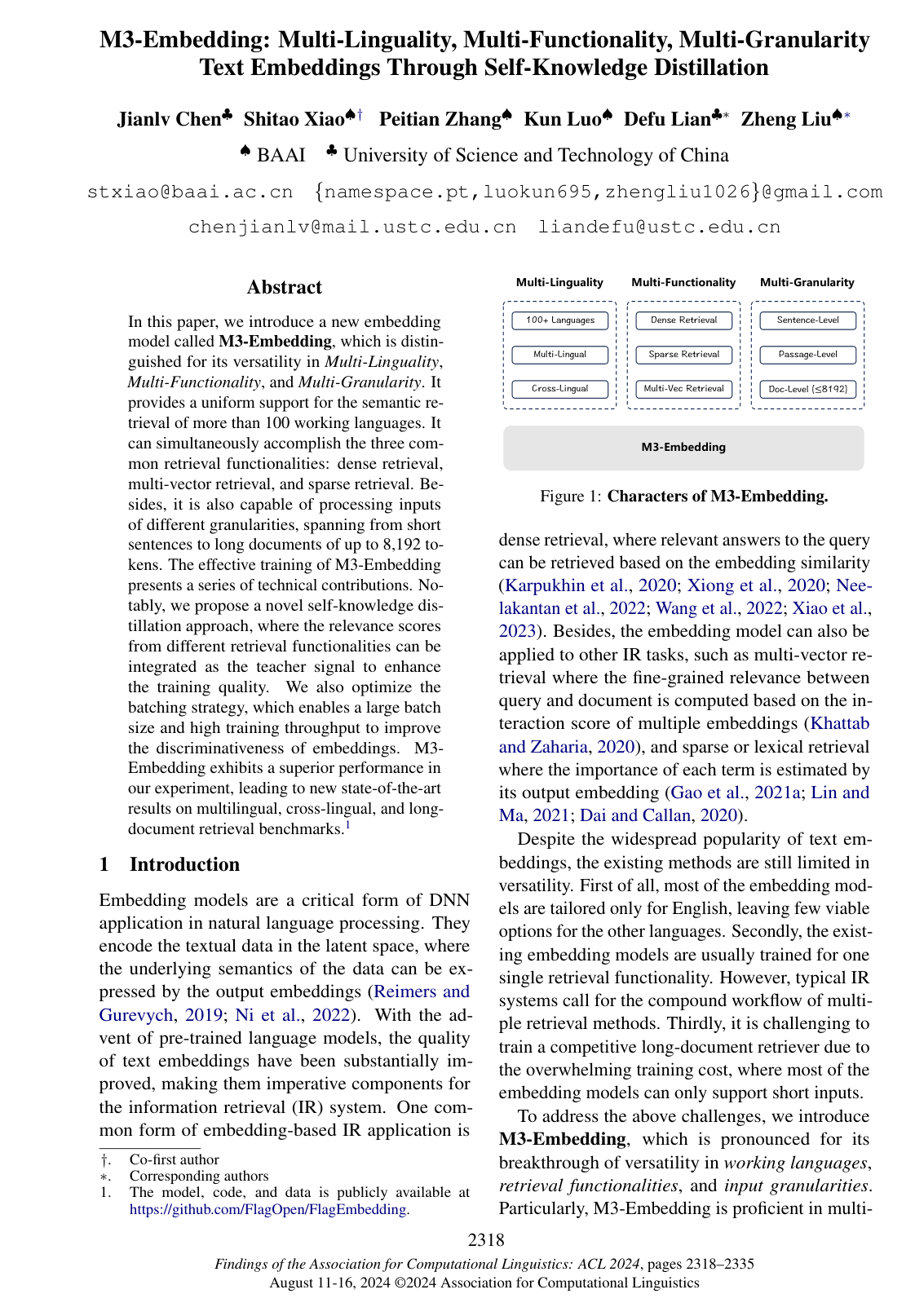
M3-Embedding: Multi-Linguality, Multi-Functionality, Multi-Granularity Text Embeddings Through Self-Knowledge Distillation
Jianlv Chen, Shitao Xiao, Peitian Zhang, Kun Luo, Defu Lian, Zheng Liu
Why you should read this
Introduces M3-Embedding, a versatile text representation model trained through self-knowledge distillation that unifies dense, sparse, and multi-vector retrieval across more than 100 languages and document lengths up to 8,192 tokens.
In this paper, we introduce a new embedding model called M3-Embedding, which is distinguished for its versatility in \textit{Multi-Linguality}, \textit{Multi-Functionality}, and \textit{Multi-Granularity}. It provides a uniform support for the semantic retrieval of more than 100 working languages. It can simultaneously accomplish the three common retrieval functionalities: dense retrieval, multi-vector retrieval, and sparse retrieval. Besides, it is also capable of processing inputs of different granularities, spanning from short sentences to long documents of up to 8,192 tokens. The effective training of M3-Embedding presents a series of technical contributions. Notably, we propose a novel self-knowledge distillation approach, where the relevance scores from different retrieval functionalities can be integrated as the teacher signal to enhance the training quality. We also optimize the batching strategy, which enables a large batch size and high training throughput to improve the discriminativeness of embeddings. M3-Embedding exhibits a superior performance in our experiment, leading to new state-of-the-art results on multilingual, cross-lingual, and long-document retrieval benchmarks.
Added
2026-09-19