
keyword
multilingual models
Multilingual models are language-processing models designed or trained to handle text in more than one language. A single model may support tasks such as understanding, generating, or classifying text across those languages, and may transfer knowledge learned in one language to another.
5 items
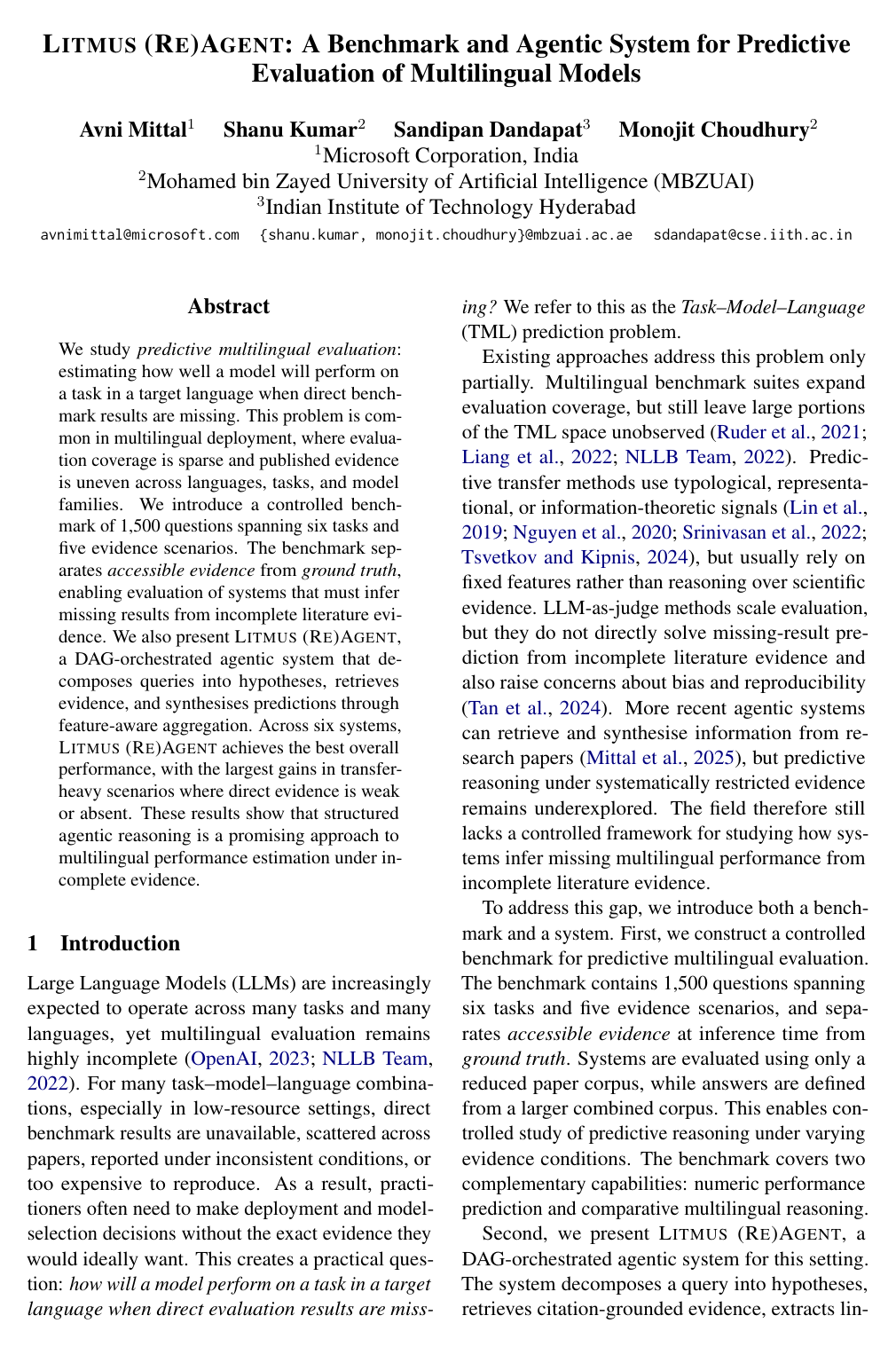
Litmus (Re)Agent: A Benchmark and Agentic System for Predictive Evaluation of Multilingual Models
Avni Mittal, Shanu Kumar, Sandipan Dandapat, Monojit Choudhury
Why you should read this
Introduces a 1,500-question benchmark and a DAG-orchestrated agentic system to accurately predict multilingual model performance across target languages and tasks when direct evaluation data is missing from published literature.
We study predictive multilingual evaluation: estimating how well a model will perform on a task in a target language when direct benchmark results are missing. This problem is common in multilingual deployment, where evaluation coverage is sparse and published evidence is uneven across languages, tasks, and model families. We introduce a controlled benchmark of 1,500 questions spanning six tasks and five evidence scenarios. The benchmark separates accessible evidence from ground truth, enabling evaluation of systems that must infer missing results from incomplete literature evidence. We also present Litmus (Re)Agent, a DAG-orchestrated agentic system that decomposes queries into hypotheses, retrieves evidence, and synthesises predictions through feature-aware aggregation. Across six systems, Litmus (Re)Agent achieves the best overall performance, with the largest gains in transfer-heavy scenarios where direct evidence is weak or absent. These results show that structured agentic reasoning is a promising approach to multilingual performance estimation under incomplete evidence.
Added
2026-09-30
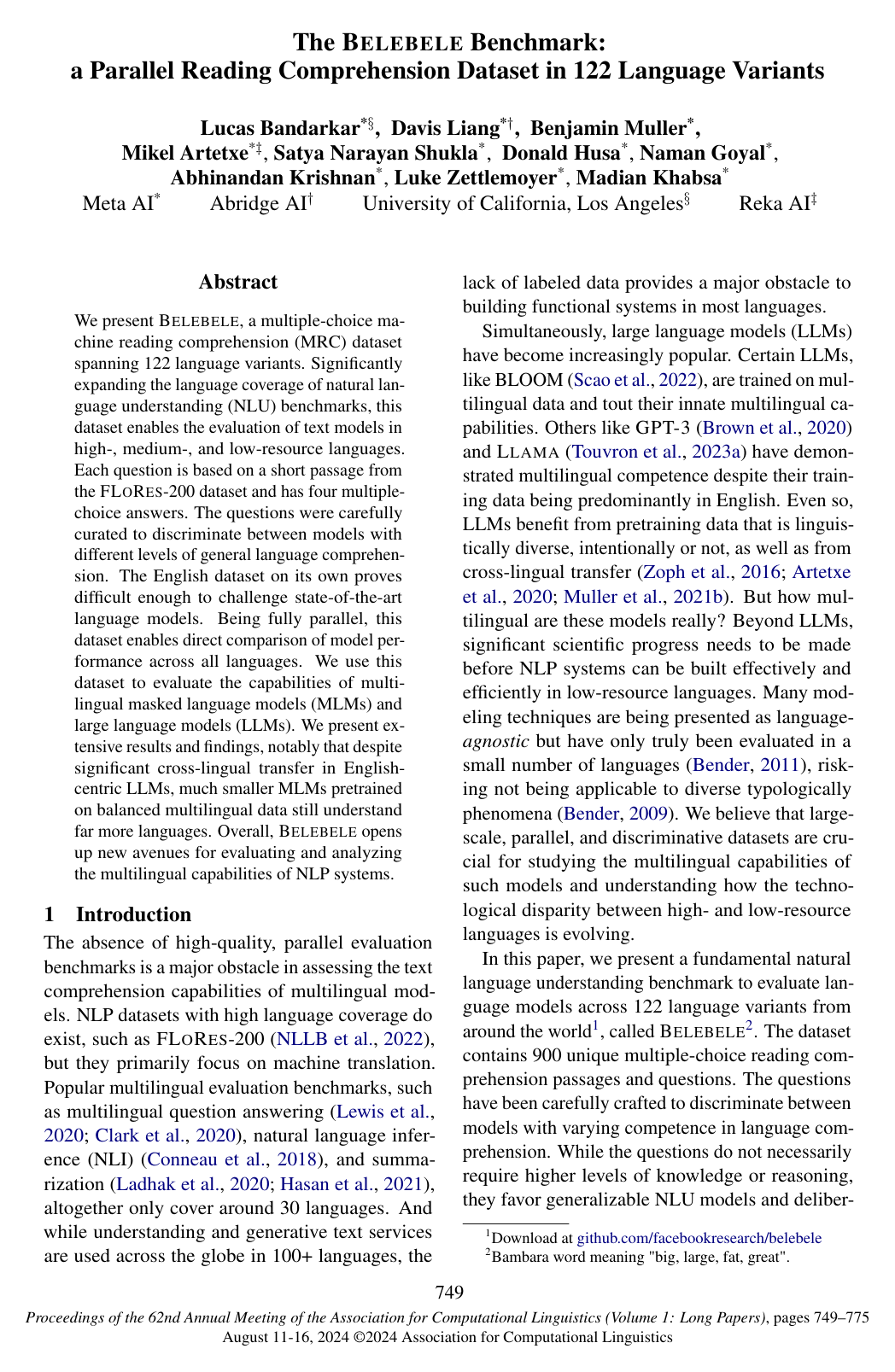
The Belebele Benchmark: a Parallel Reading Comprehension Dataset in 122 Language Variants
Lucas Bandarkar, Davis Liang, Benjamin Muller, Mikel Artetxe, Satya Narayan Shukla, Donald Husa, Naman Goyal, Abhinandan Krishnan, Luke Zettlemoyer, Madian Khabsa
Why you should read this
Introduces a fully parallel reading comprehension benchmark across 122 language variants to evaluate and directly compare language models across high-, medium-, and low-resource languages.
We present Belebele, a multiple-choice machine reading comprehension (MRC) dataset spanning 122 language variants. Significantly expanding the language coverage of natural language understanding (NLU) benchmarks, this dataset enables the evaluation of text models in high-, medium-, and low-resource languages. Each question is based on a short passage from the FLORES-200 dataset and has four multiple-choice answers. The questions were carefully curated to discriminate between models with different levels of general language comprehension. The English dataset on its own proves difficult enough to challenge state-of-the-art language models. Being fully parallel, this dataset enables direct comparison of model performance across all languages. We use this dataset to evaluate the capabilities of multilingual masked language models (MLMs) and large language models (LLMs). We present extensive results and findings, notably that despite significant cross-lingual transfer in English-centric LLMs, much smaller MLMs pretrained on balanced multilingual data still understand far more languages. Overall, Belebele opens up new avenues for evaluating and analyzing the multilingual capabilities of NLP systems.
Added
2026-09-28
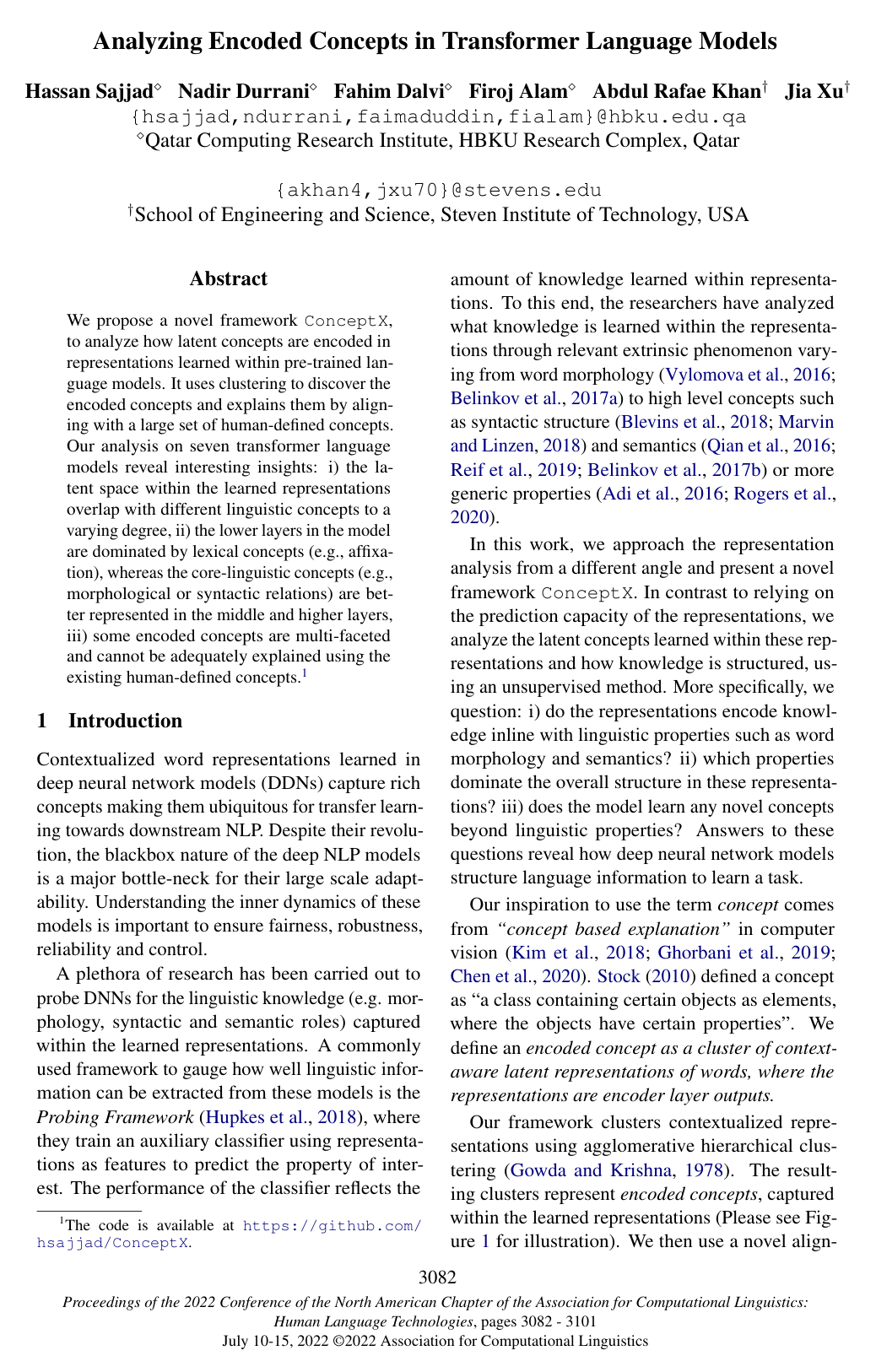
Analyzing Encoded Concepts in Transformer Language Models
Hassan Sajjad, Nadir Durrani, Fahim Dalvi, Firoj Alam, Abdul Rafae Khan, Jia Xu
Why you should read this
Proposes ConceptX, an unsupervised framework that clusters latent contextual representations and aligns them with human-defined linguistic categories to explain how transformer language models organize knowledge across layers without relying on probing classifiers.
We propose a novel framework ConceptX, to analyze how latent concepts are encoded in representations learned within pre-trained language models. It uses clustering to discover the encoded concepts and explains them by aligning with a large set of human-defined concepts. Our analysis on seven transformer language models reveal interesting insights: i) the latent space within the learned representations overlap with different linguistic concepts to a varying degree, ii) the lower layers in the model are dominated by lexical concepts (e.g., affixation), whereas the core-linguistic concepts (e.g., morphological or syntactic relations) are better represented in the middle and higher layers, iii) some encoded concepts are multi-faceted and cannot be adequately explained using the existing human-defined concepts.¹
Added
2026-09-26
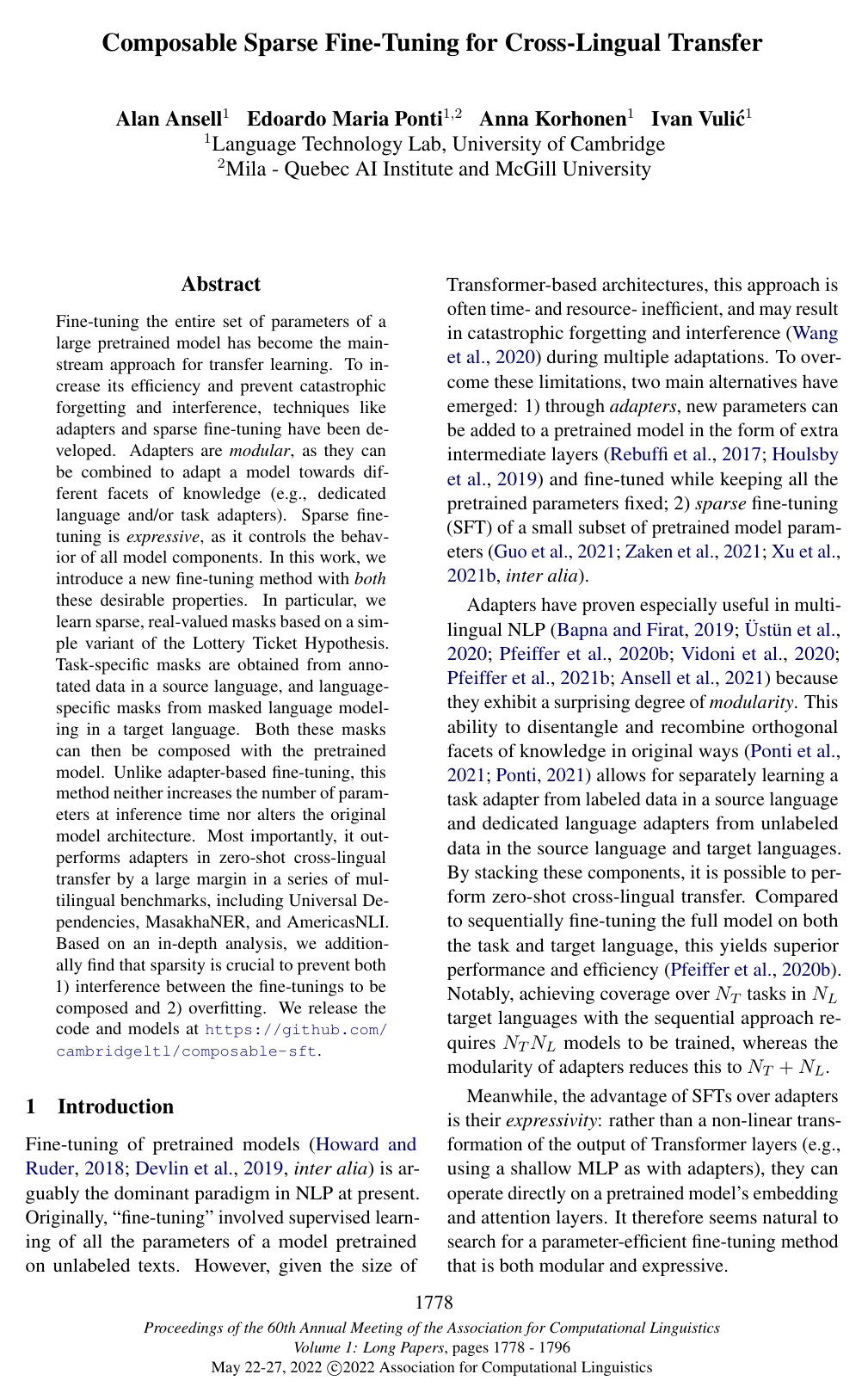
Composable Sparse Fine-Tuning for Cross-Lingual Transfer
Alan Ansell, Edoardo Maria Ponti, Anna Korhonen, Ivan Vulic
Why you should read this
Proposes Lottery Ticket Sparse Fine-Tuning, a parameter-efficient technique that learns and composes task- and language-specific parameter masks to achieve superior zero-shot cross-lingual transfer over adapter-based methods without altering model architecture or slowing inference.
Fine-tuning the entire set of parameters of a large pretrained model has become the mainstream approach for transfer learning. To increase its efficiency and prevent catastrophic forgetting and interference, techniques like adapters and sparse fine-tuning have been developed. Adapters are modular, as they can be combined to adapt a model towards different facets of knowledge (e.g., dedicated language and/or task adapters). Sparse fine-tuning is expressive, as it controls the behavior of all model components. In this work, we introduce a new fine-tuning method with both these desirable properties. In particular, we learn sparse, real-valued masks based on a simple variant of the Lottery Ticket Hypothesis. Task-specific masks are obtained from annotated data in a source language, and language-specific masks from masked language modeling in a target language. Both these masks can then be composed with the pretrained model. Unlike adapter-based fine-tuning, this method neither increases the number of parameters at inference time nor alters the original model architecture. Most importantly, it outperforms adapters in zero-shot cross-lingual transfer by a large margin in a series of multilingual benchmarks, including Universal Dependencies, MasakhaNER, and AmericasNLI. Based on an in-depth analysis, we additionally find that sparsity is crucial to prevent both 1) interference between the fine-tunings to be composed and 2) overfitting. We release the code and models at https://github.com/cambridgeltl/composable-sft.
Added
2026-09-26
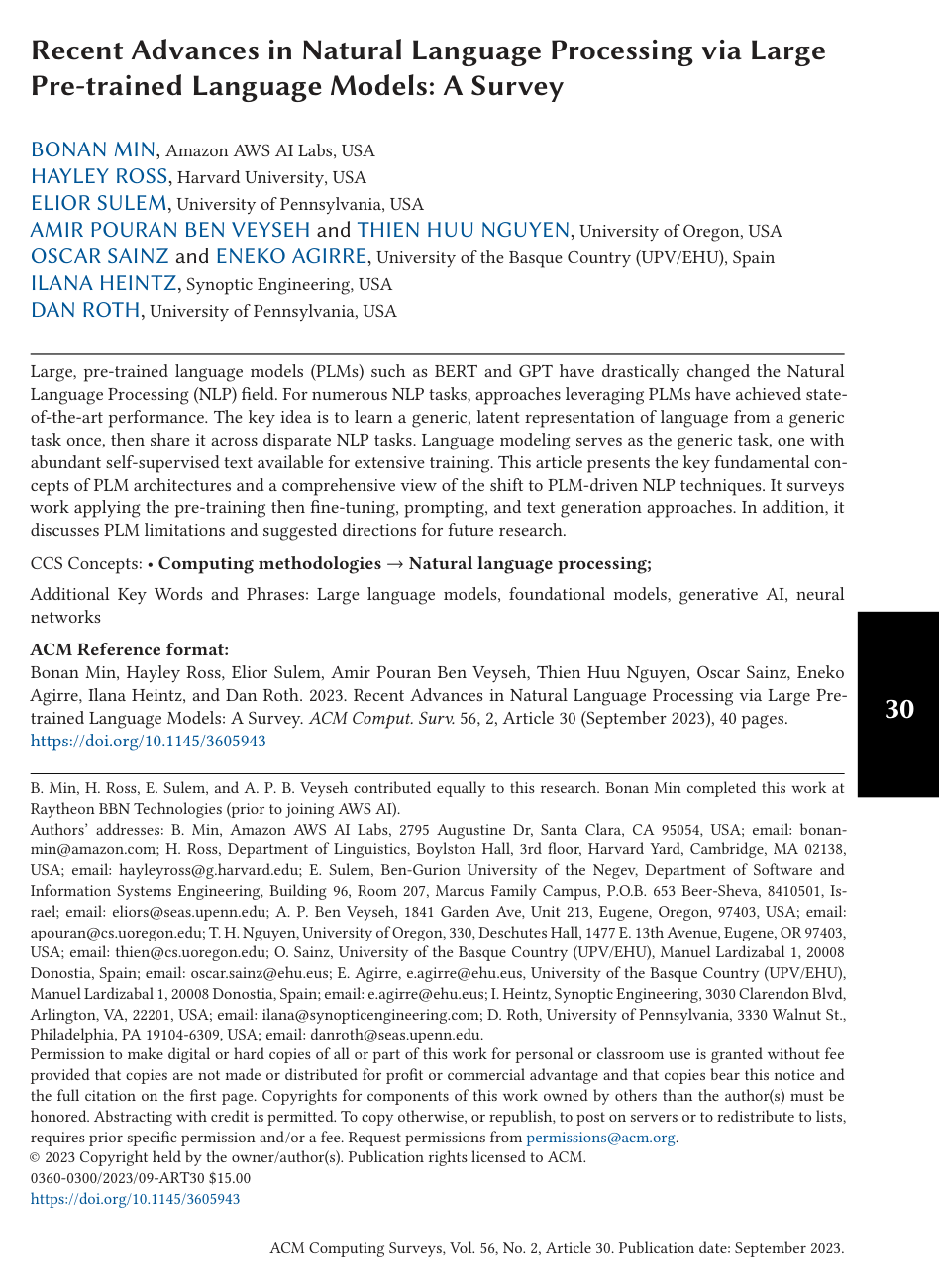
Recent Advances in Natural Language Processing via Large Pre-trained Language Models: A Survey
Bonan Min, Hayley Ross, Elior Sulem, Amir Pouran Ben Veyseh, Thien Huu Nguyen, Oscar Sainz, Eneko Agirre, Ilana Heinz, Dan Roth
Why you should read this
Synthesizes how modern transformer-based language models are adapted across natural language processing tasks through fine-tuning, prompting, text generation, and data augmentation while identifying key limitations and open research directions.
Large, pre-trained transformer-based language models such as BERT have drastically changed the Natural Language Processing (NLP) field. We present a survey of recent work that uses these large language models to solve NLP tasks via pre-training then fine-tuning, prompting, or text generation approaches. We also present approaches that use pre-trained language models to generate data for training augmentation or other purposes. We conclude with discussions on limitations and suggested directions for future research.
Added
2026-09-24