
keyword
multilingual benchmarks
Multilingual benchmarks are standardized evaluation suites and datasets used in natural language processing and artificial intelligence to assess and compare how effectively models understand, reason, and generate text across multiple languages and language varieties. These benchmarks typically aggregate tasks spanning natural language understanding, machine translation, commonsense reasoning, and question answering across typologically diverse languages, including both high-resource and low-resource varieties. By providing consistent evaluation metrics and comparative test environments, multilingual benchmarks enable researchers to measure cross-lingual transfer, identify performance disparities between languages, and track progress toward building inclusive language technologies.
8 items
Systematic Inequalities in Language Technology Performance across the World's Languages
Damián E. Blasi, Antonios Anastasopoulos, Graham Neubig
Why you should read this
Establishes a quantitative framework to measure global disparities in language technology performance across thousands of languages, identifying key socioeconomic drivers behind these gaps and providing actionable policy recommendations for equitable development.
Natural language processing (NLP) systems have become a central technology in communication, education, medicine, artificial intelligence, and many other domains of research and development. While the performance of NLP methods has grown enormously over the last decade, this progress has been restricted to a minuscule subset of the world’s ≈6,500 languages. We introduce a framework for estimating the global utility of language technologies as revealed in a comprehensive snapshot of recent publications in NLP. Our analyses involve the field at large, but also more in-depth studies on both user-facing technologies (machine translation, language understanding, question answering, text-to-speech synthesis) as well as foundational NLP tasks (dependency parsing, morphological inflection). In the process, we (1) quantify disparities in the current state of NLP research, (2) explore some of its associated societal and academic factors, and (3) produce tailored recommendations for evidence-based policy making aimed at promoting more global and equitable language technologies.
Added
2026-10-06
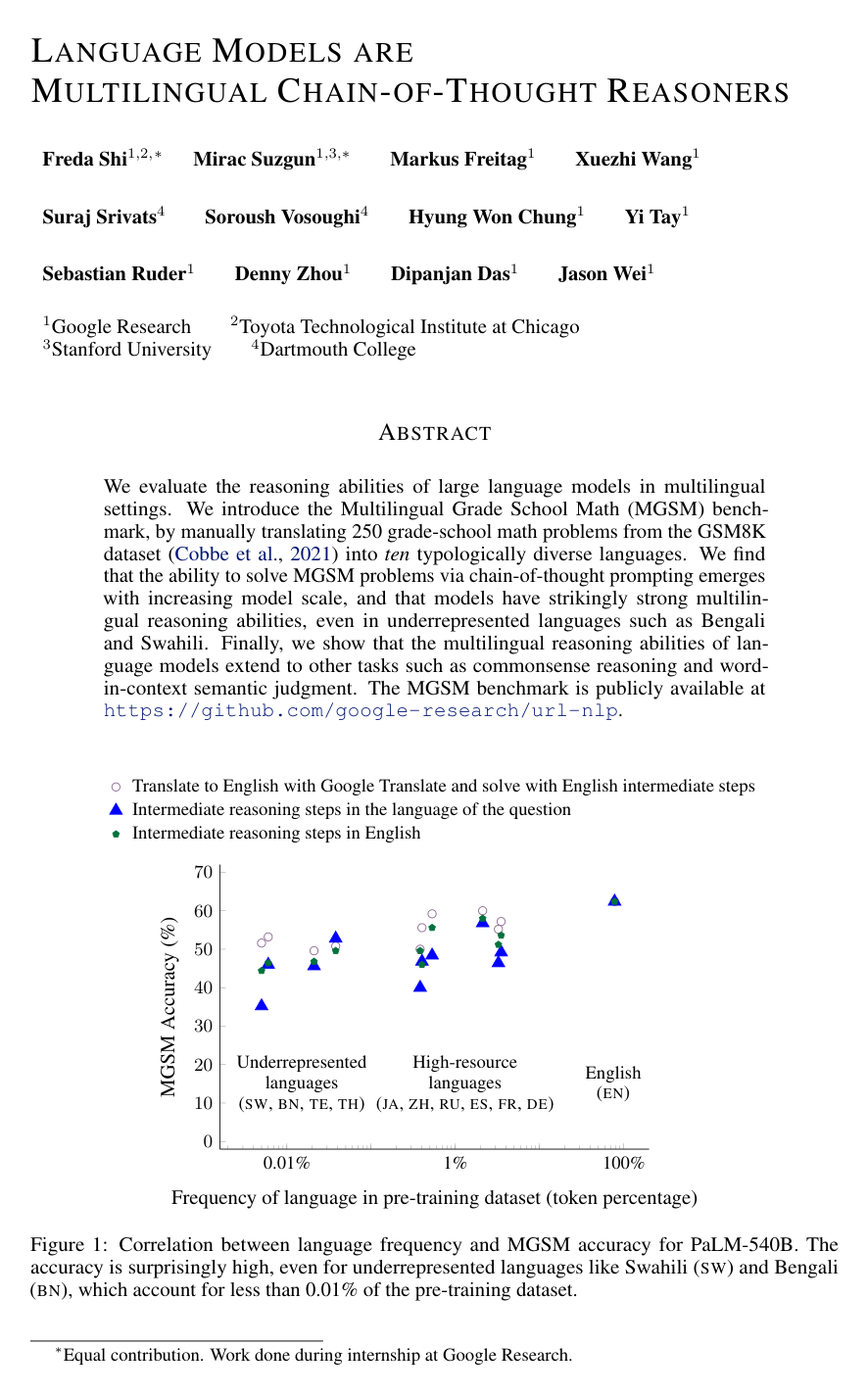
Language Models are Multilingual Chain-of-Thought Reasoners
Freda Shi, Mirac Suzgun, Markus Freitag, Xuezhi Wang, Suraj Srivats, Soroush Vosoughi, Hyung Won Chung, Yi Tay, Sebastian Ruder, Denny Zhou, Dipanjan Das, Jason Wei
Why you should read this
Demonstrates that chain-of-thought reasoning emerges across typologically diverse and underrepresented languages as language models scale, introducing the Multilingual Grade School Math benchmark to evaluate cross-lingual problem solving.
We evaluate the reasoning abilities of large language models in multilingual settings. We introduce the Multilingual Grade School Math (MGSM) benchmark, by manually translating 250 grade-school math problems from the GSM8K dataset (Cobbe et al., 2021) into ten typologically diverse languages. We find that the ability to solve MGSM problems via chain-of-thought prompting emerges with increasing model scale, and that models have strikingly strong multilingual reasoning abilities, even in underrepresented languages such as Bengali and Swahili. Finally, we show that the multilingual reasoning abilities of language models extend to other tasks such as commonsense reasoning and word-in-context semantic judgment. The MGSM benchmark is publicly available at this https URL.
Added
2026-10-05
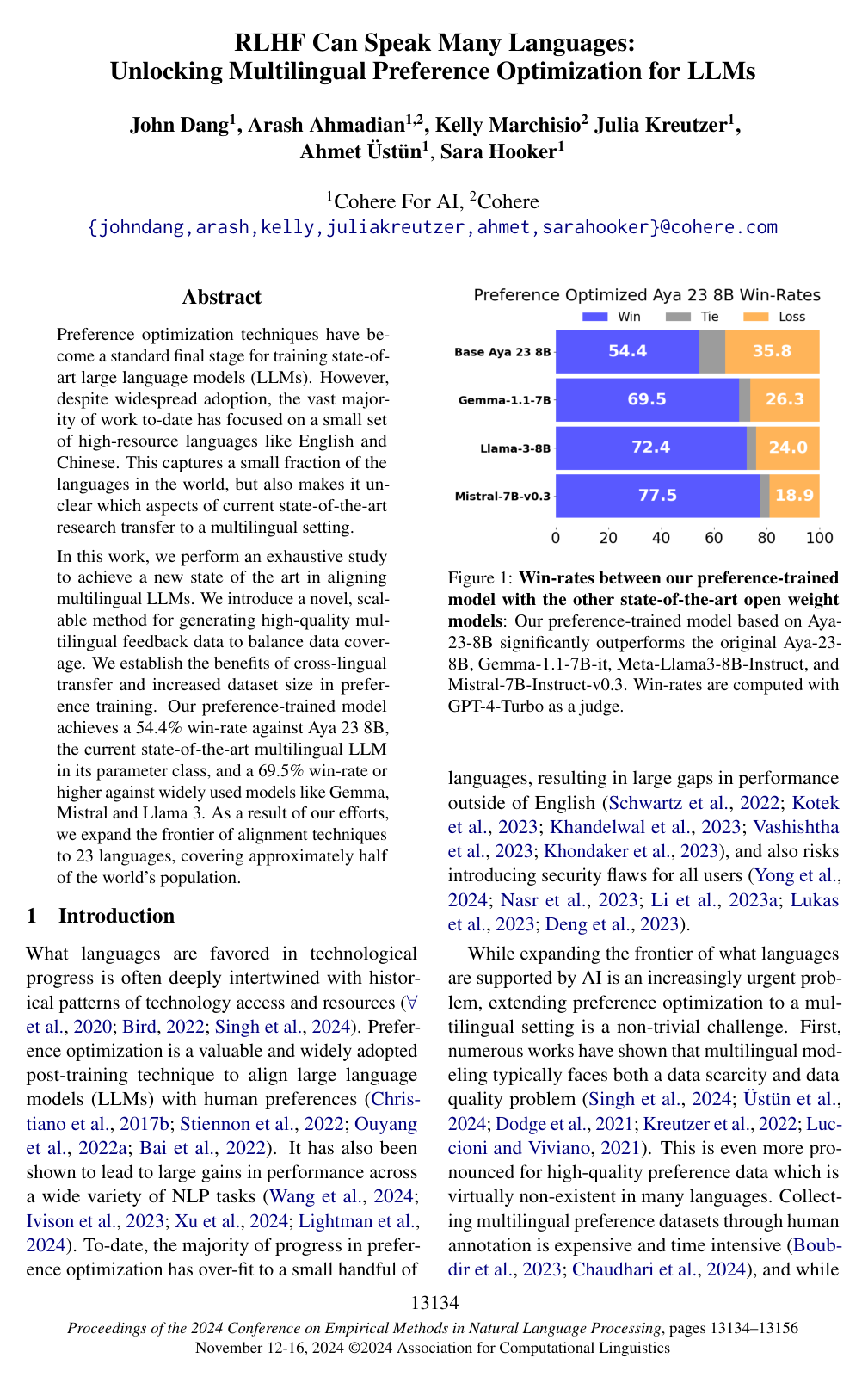
RLHF Can Speak Many Languages: Unlocking Multilingual Preference Optimization for LLMs
John Dang, Arash Ahmadian, Kelly Marchisio, Julia Kreutzer, Ahmet Üstün, Sara Hooker
Why you should read this
Demonstrates how to effectively scale reinforcement learning from human feedback across 23 languages by generating high-quality multilingual preference data, establishing that online optimization algorithms yield substantial cross-lingual transfer and outperform strong open-weight baselines.
Preference optimization techniques have become a standard final stage for training state-of-art large language models (LLMs). However, despite widespread adoption, the vast majority of work to-date has focused on a small set of high-resource languages like English and Chinese. This captures a small fraction of the languages in the world, but also makes it unclear which aspects of current state-of-the-art research transfer to a multilingual setting. In this work, we perform an exhaustive study to achieve a new state of the art in aligning multilingual LLMs. We introduce a novel, scalable method for generating high-quality multilingual feedback data to balance data coverage. We establish the benefits of cross-lingual transfer and increased dataset size in preference training. Our preference-trained model achieves a 54.4% win-rate against Aya 23 8B, the current state-of-the-art multilingual LLM in its parameter class, and a 69.5% win-rate or higher against widely used models like Gemma, Mistral and Llama 3. As a result of our efforts, we expand the frontier of alignment techniques to 23 languages, covering approximately half of the world’s population.
Added
2026-10-04

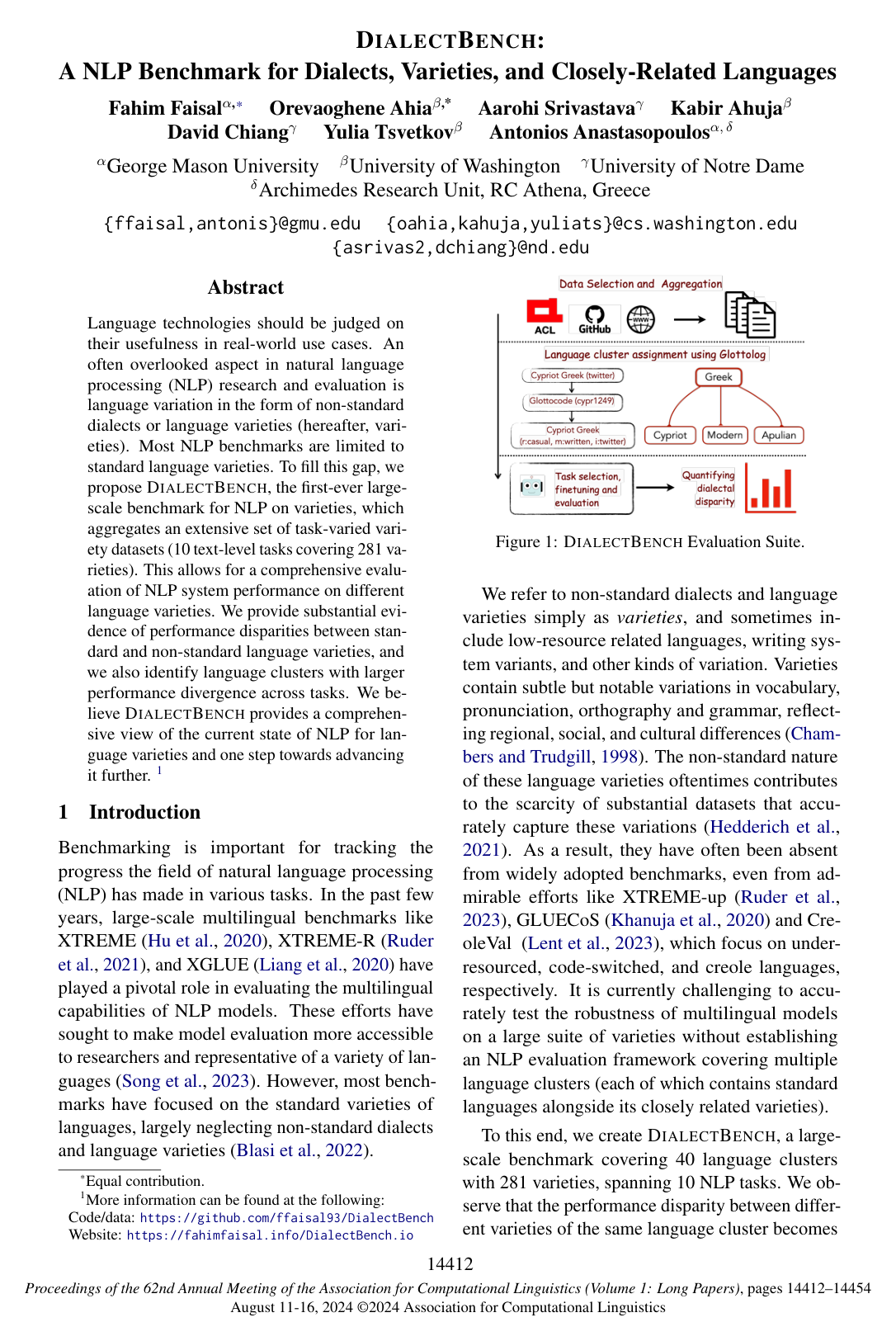
DIALECTBENCH: An NLP Benchmark for Dialects, Varieties, and Closely-Related Languages
Fahim Faisal, Orevaoghene Ahia, Aarohi Srivastava, Kabir Ahuja, David Chiang, Yulia Tsvetkov, Antonios Anastasopoulos
Why you should read this
Introduces DIALECTBENCH, a comprehensive evaluation suite spanning 10 NLP tasks and 281 language varieties across 40 clusters to quantify and analyze performance disparities between standard and non-standard dialects.
Language technologies should be judged on their usefulness in real-world use cases. An often overlooked aspect in natural language processing (NLP) research and evaluation is language variation in the form of non-standard dialects or language varieties (hereafter, varieties). Most NLP benchmarks are limited to standard language varieties. To fill this gap, we propose DIALECTBENCH, the first-ever large-scale benchmark for NLP on varieties, which aggregates an extensive set of task-varied variety datasets (10 text-level tasks covering 281 varieties). This allows for a comprehensive evaluation of NLP system performance on different language varieties. We provide substantial evidence of performance disparities between standard and non-standard language varieties, and we also identify language clusters with larger performance divergence across tasks. We believe DIALECTBENCH provides a comprehensive view of the current state of NLP for language varieties and one step towards advancing it further. 1
Added
2026-10-03
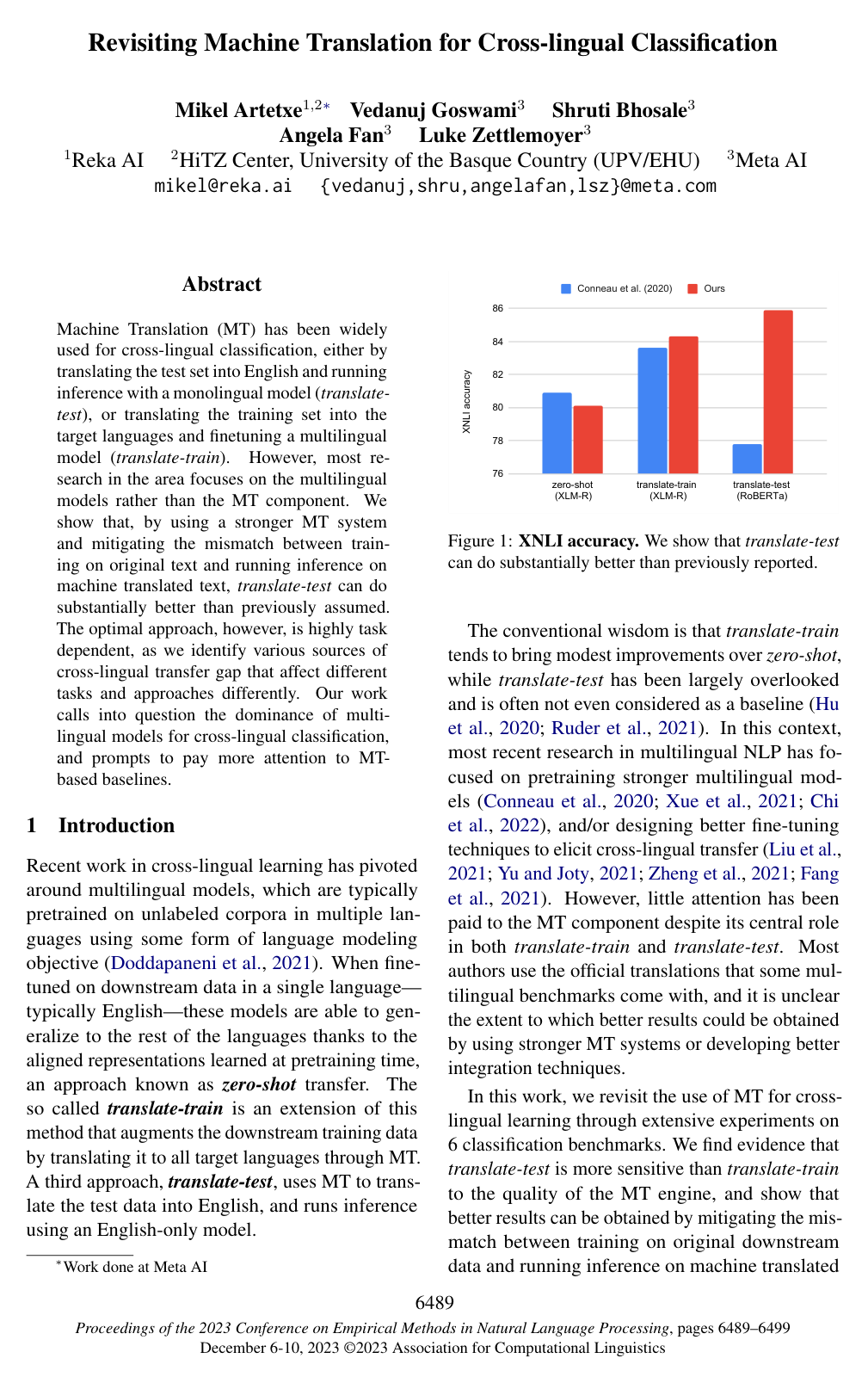
Revisiting Machine Translation for Cross-lingual Classification
Mikel Artetxe, Vedanuj Goswami, Shruti Bhosale, Angela Fan, Luke Zettlemoyer
Why you should read this
Demonstrates that modern machine translation combined with domain adaptation allows simple translate-test pipelines to outperform multilingual pretrained models on complex cross-lingual classification benchmarks like XNLI.
Machine Translation (MT) has been widely used for cross-lingual classification, either by translating the test set into English and running inference with a monolingual model (translate-test), or translating the training set into the target languages and finetuning a multilingual model (translate-train). However, most research in the area focuses on the multilingual models rather than the MT component. We show that, by using a stronger MT system and mitigating the mismatch between training on original text and running inference on machine translated text, translate-test can do substantially better than previously assumed. The optimal approach, however, is highly task dependent, as we identify various sources of cross-lingual transfer gap that affect different tasks and approaches differently. Our work calls into question the dominance of multilingual models for cross-lingual classification, and prompts to pay more attention to MT-based baselines.
Added
2026-09-26
MEGAVERSE: Benchmarking Large Language Models Across Languages, Modalities, Models and Tasks
Sanchit Ahuja, Divyanshu Aggarwal, Varun Gumma, Ishaan Watts, Ashutosh Sathe, Millicent Ochieng, Rishav Hada, Prachi Jain, Mohamed Ahmed, Kalika Bali, Sunayana Sitaram
Why you should read this
Presents a comprehensive evaluation of leading language and multimodal models across 22 datasets and 83 languages to reveal performance disparities on low-resource languages and quantify the prevalence of test set contamination.
There has been a surge in LLM evaluation research to understand LLM capabilities and limitations. However, much of this research has been confined to English, leaving LLM building and evaluation for non-English languages relatively unexplored. Several new LLMs have been introduced recently, necessitating their evaluation on non-English languages. This study aims to perform a thorough evaluation of the non-English capabilities of SoTA LLMs (GPT-3.5-Turbo, GPT-4, PaLM2, Gemini-Pro, Mistral, Llama2, and Gemma) by comparing them on the same set of multilingual datasets. Our benchmark comprises 22 datasets covering 83 languages, including low-resource African languages. We also include two multimodal datasets in the benchmark and compare the performance of LLaVA models, GPT-4-Vision and Gemini-Pro-Vision. Our experiments show that larger models such as GPT-4, Gemini-Pro and PaLM2 outperform smaller models on various tasks, notably on low-resource languages, with GPT-4 outperforming PaLM2 and Gemini-Pro on more datasets. We also perform a study on data contamination and find that several models are likely to be contaminated with multilingual evaluation benchmarks, necessitating approaches to detect and handle contamination while assessing the multilingual performance of LLMs.
Added
2026-09-26
MEGA: Multilingual Evaluation of Generative AI
Kabir Ahuja, Harshita Diddee, Rishav Hada, Millicent Ochieng, Krithika Ramesh, Prachi Jain, Akshay Uttama Nambi, Tanuja Ganu, Sameer Segal, Mohamed Ahmed, Kalika Bali, Sunayana Sitaram
Why you should read this
Introduces MEGA, a comprehensive multilingual benchmark spanning 16 standard tasks across 70 typologically diverse languages to systematically compare generative large language models against prior state-of-the-art systems and identify critical performance gaps in low-resource settings.
Generative AI models have shown impressive performance on many Natural Language Processing tasks such as language understanding, reasoning, and language generation. An important question being asked by the AI community today is about the capabilities and limits of these models, and it is clear that evaluating generative AI is very challenging. Most studies on generative LLMs have been restricted to English and it is unclear how capable these models are at understanding and generating text in other languages. We present the first comprehensive benchmarking of generative LLMs - MEGA, which evaluates models on standard NLP benchmarks, covering 16 NLP datasets across 70 typologically diverse languages. We compare the performance of generative LLMs including Chat-GPT and GPT-4 to State of the Art (SOTA) non-autoregressive models on these tasks to determine how well generative models perform compared to the previous generation of LLMs. We present a thorough analysis of the performance of models across languages and tasks and discuss challenges in improving the performance of generative LLMs on low-resource languages. We create a framework for evaluating generative LLMs in the multilingual setting and provide directions for future progress in the field.
Added
2026-09-26
Mixtral of Experts
Albert Q. Jiang, Alexandre Sablayrolles, Antoine Roux, Arthur Mensch, Blanche Savary, Chris Bamford, Devendra Singh Chaplot, Diego de las Casas, Emma Bou Hanna, Florian Bressand, Gianna Lengyel, Guillaume Bour, Guillaume Lample, Lélio Renard Lavaud, Lucile Saulnier, Marie-Anne Lachaux, Pierre Stock, Sandeep Subramanian, Sophia Yang, Szymon Antoniak, Teven Le Scao, Théophile Gervet, Thibaut Lavril, Thomas Wang, Timothée Lacroix, William El Sayed
Why you should read this
Demonstrates how a Sparse Mixture of Experts model, Mixtral 8x7B, can significantly outperform much larger models like Llama 2 70B and GPT-3.5 across various benchmarks, especially in mathematics, code generation, and multilingual tasks, while maintaining efficient inference.
We introduce Mixtral 8x7B, a Sparse Mixture of Experts (SMoE) language model. Mixtral has the same architecture as Mistral 7B, with the difference that each layer is composed of 8 feedforward blocks (i.e. experts). For every token, at each layer, a router network selects two experts to process the current state and combine their outputs. Even though each token only sees two experts, the selected experts can be different at each timestep. As a result, each token has access to 47B parameters, but only uses 13B active parameters during inference. Mixtral was trained with a context size of 32k tokens and it outperforms or matches Llama 2 70B and GPT-3.5 across all evaluated benchmarks. In particular, Mixtral vastly outperforms Llama 2 70B on mathematics, code generation, and multilingual benchmarks. We also provide a model fine-tuned to follow instructions, Mixtral 8x7B - Instruct, that surpasses GPT-3.5 Turbo, Claude-2.1, Gemini Pro, and Llama 2 70B - chat model on human benchmarks. Both the base and instruct models are released under the Apache 2.0 license.
Added
2026-02-23