
keyword
multilingual abstractive summarization
Multilingual abstractive summarization is the task of generating concise summaries that capture the main ideas of texts in multiple languages, using newly composed wording rather than simply selecting sentences from the source. A system may summarize text in the same language or generate summaries across languages.
3 items
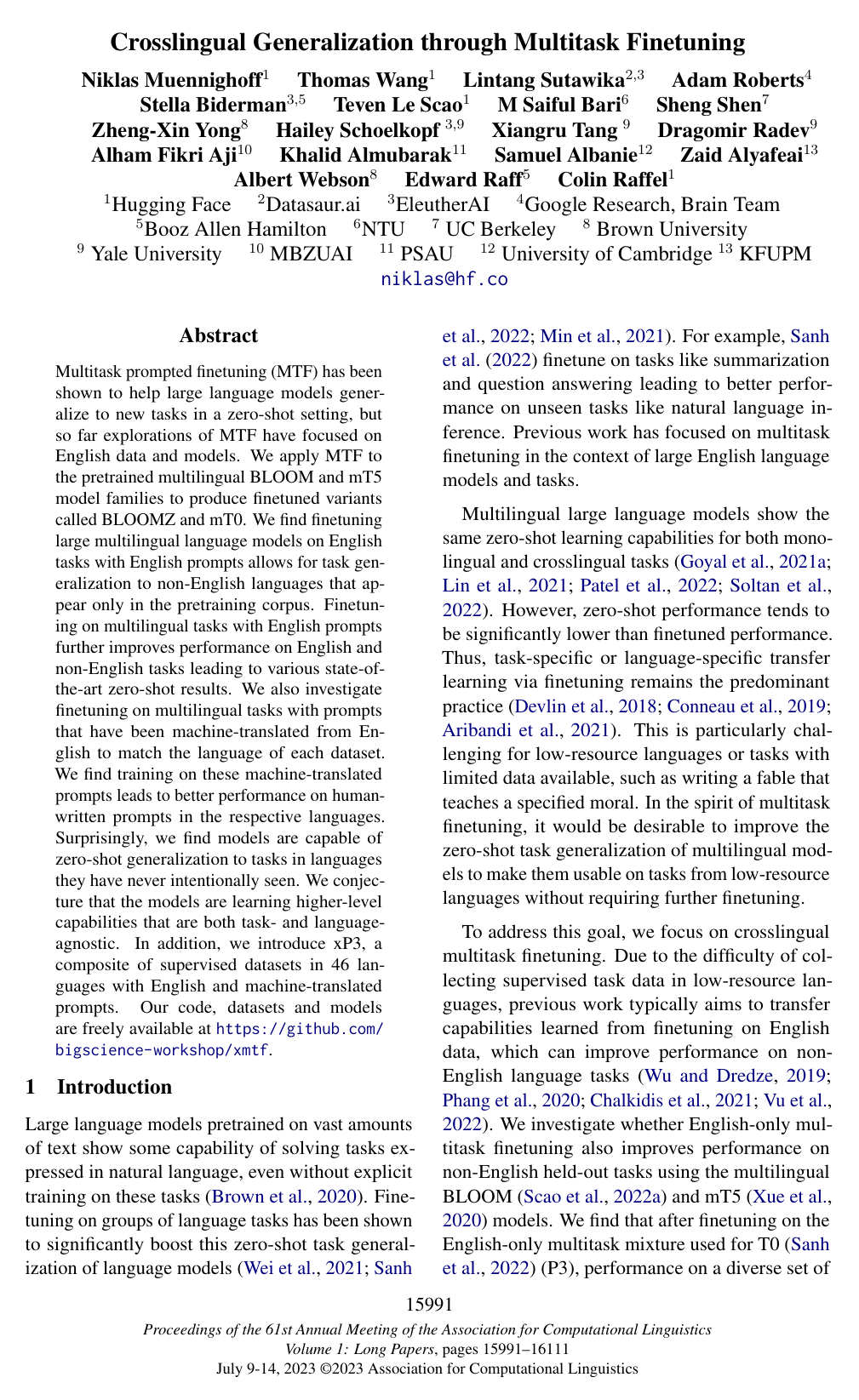
Crosslingual Generalization through Multitask Finetuning
Niklas Muennighoff, Thomas Wang, Lintang Sutawika, Adam Roberts, Stella Biderman, Teven Le Scao, M. Saiful Bari, Sheng Shen, Zheng Xin Yong, Hailey Schoelkopf, Xiangru Tang, Dragomir Radev, Alham Fikri Aji, Khalid Almubarak, Samuel Albanie, Zaid Alyafeai, Albert Webson, Edward Raff, Colin Raffel
Why you should read this
Demonstrates that multitask prompted finetuning on multilingual datasets enables language models to generalize zero-shot to unseen tasks across diverse and even previously unseen languages.
Multitask prompted finetuning (MTF) has been shown to help large language models generalize to new tasks in a zero-shot setting, but so far explorations of MTF have focused on English data and models. We apply MTF to the pretrained multilingual BLOOM and mT5 model families to produce finetuned variants called BLOOMZ and mT0. We find finetuning large multilingual language models on English tasks with English prompts allows for task generalization to non-English languages that appear only in the pretraining corpus. Finetuning on multilingual tasks with English prompts further improves performance on English and non-English tasks leading to various state-of-the-art zero-shot results. We also investigate finetuning on multilingual tasks with prompts that have been machine-translated from English to match the language of each dataset. We find training on these machine-translated prompts leads to better performance on human-written prompts in the respective languages. Surprisingly, we find models are capable of zero-shot generalization to tasks in languages they have never intentionally seen. We conjecture that the models are learning higher-level capabilities that are both task- and language-agnostic. In addition, we introduce xP3, a composite of supervised datasets in 46 languages with English and machine-translated prompts. Our code, datasets and models are freely available at https://github.com/bigscience-workshop/xmtf.
Added
2026-10-05
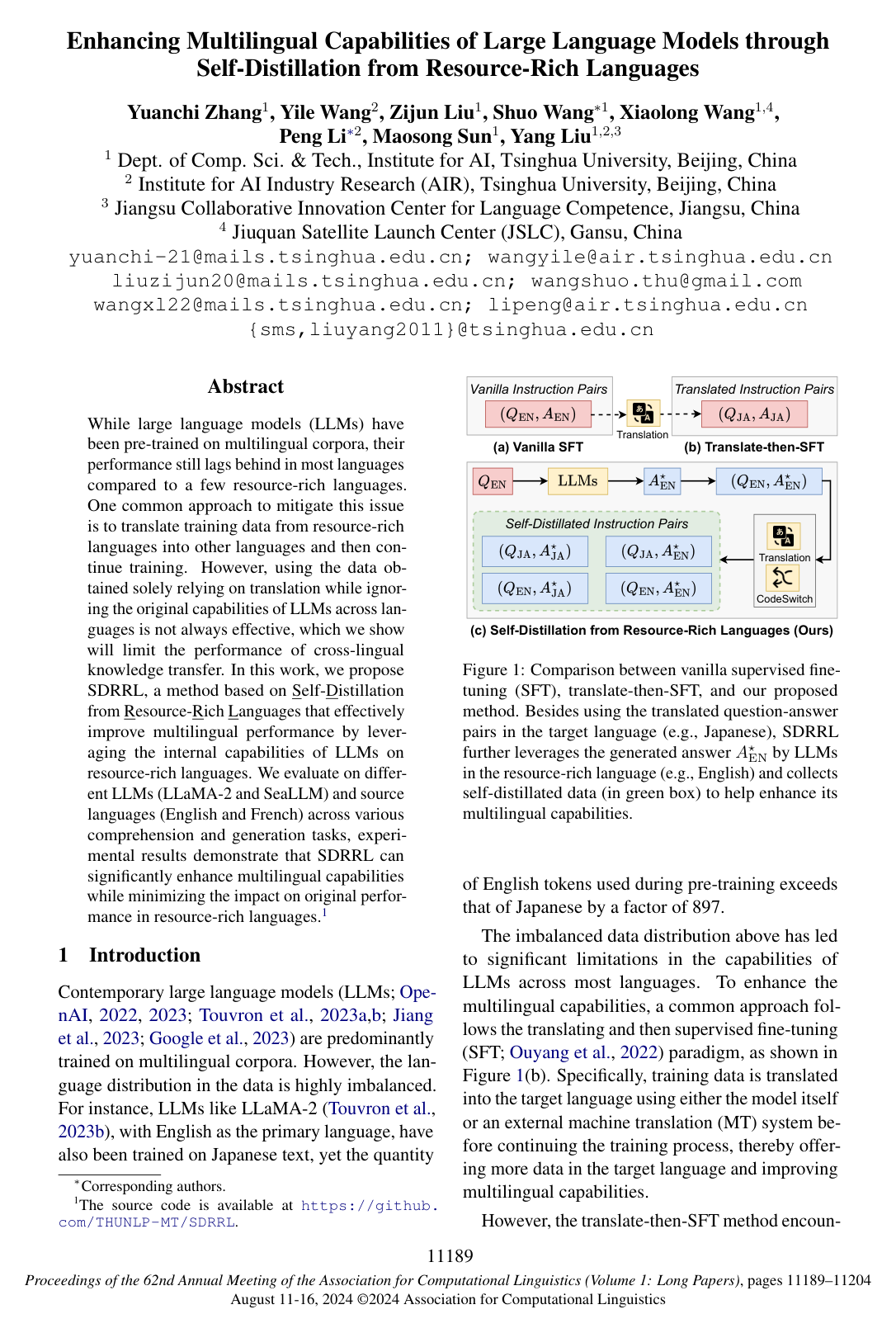
Enhancing Multilingual Capabilities of Large Language Models through Self-Distillation from Resource-Rich Languages
Yuanchi Zhang, Yile Wang, Zijun Liu, Shuo Wang, Xiaolong Wang, Peng Li, Maosong Sun, Yang Liu
Why you should read this
Proposes SDRRL, a self-distillation framework that transfers knowledge from an LLM's own high-resource language outputs to low-resource languages, improving multilingual comprehension and generation while preserving source-language performance.
While large language models (LLMs) have been pre-trained on multilingual corpora, their performance still lags behind in most languages compared to a few resource-rich languages. One common approach to mitigate this issue is to translate training data from resource-rich languages into other languages and then continue training. However, using the data obtained solely relying on translation while ignoring the original capabilities of LLMs across languages is not always effective, which we show will limit the performance of cross-lingual knowledge transfer. In this work, we propose SDRRL, a method based on Self-Distillation from Resource-Rich Languages that effectively improve multilingual performance by leveraging the internal capabilities of LLMs on resource-rich languages. We evaluate on different LLMs (LLaMA-2 and SeaLLM) and source languages (English and French) across various comprehension and generation tasks, experimental results demonstrate that SDRRL can significantly enhance multilingual capabilities while minimizing the impact on original performance in resource-rich languages.
Added
2026-10-04
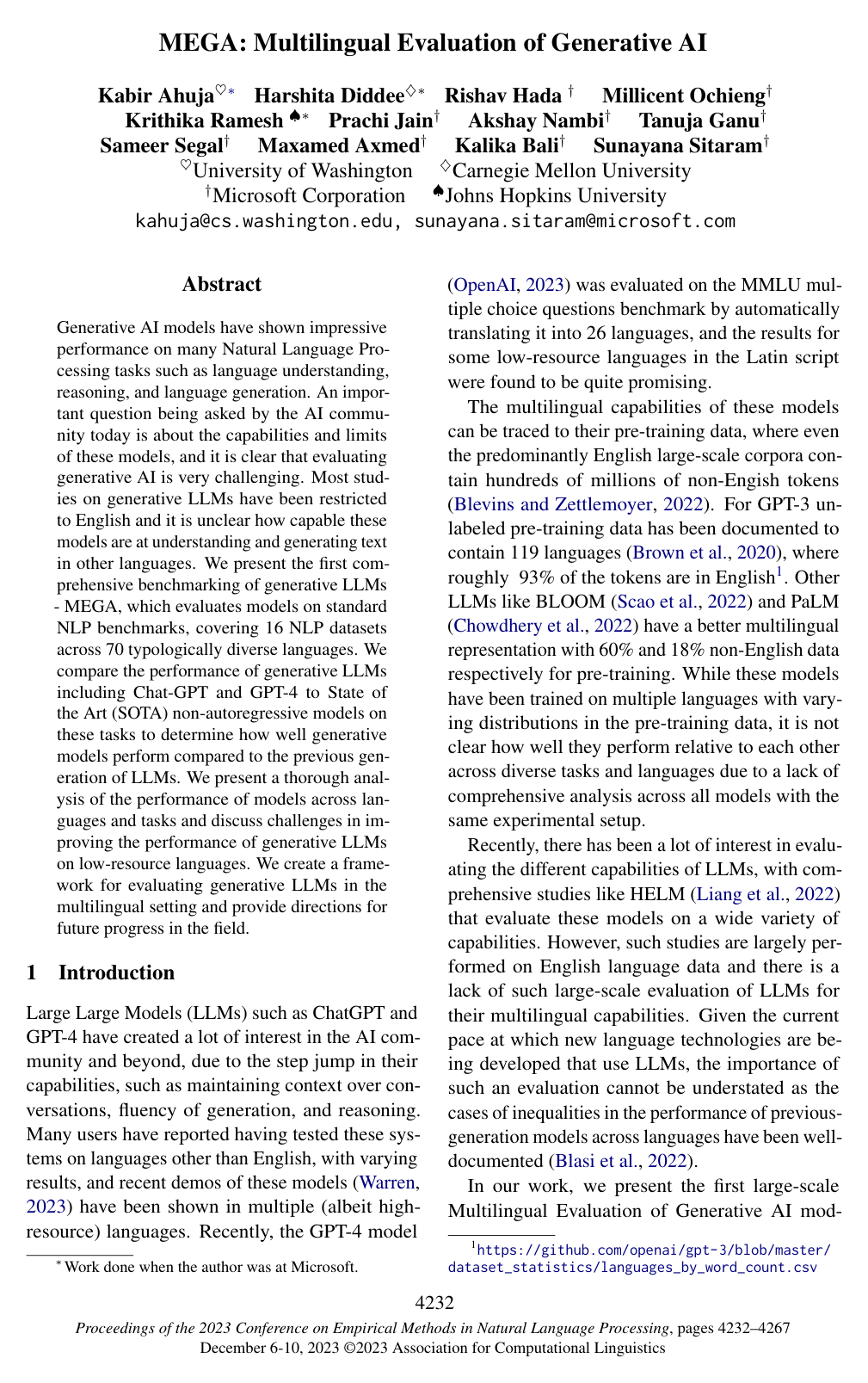
MEGA: Multilingual Evaluation of Generative AI
Kabir Ahuja, Harshita Diddee, Rishav Hada, Millicent Ochieng, Krithika Ramesh, Prachi Jain, Akshay Uttama Nambi, Tanuja Ganu, Sameer Segal, Mohamed Ahmed, Kalika Bali, Sunayana Sitaram
Why you should read this
Introduces MEGA, a comprehensive multilingual benchmark spanning 16 standard tasks across 70 typologically diverse languages to systematically compare generative large language models against prior state-of-the-art systems and identify critical performance gaps in low-resource settings.
Generative AI models have shown impressive performance on many Natural Language Processing tasks such as language understanding, reasoning, and language generation. An important question being asked by the AI community today is about the capabilities and limits of these models, and it is clear that evaluating generative AI is very challenging. Most studies on generative LLMs have been restricted to English and it is unclear how capable these models are at understanding and generating text in other languages. We present the first comprehensive benchmarking of generative LLMs - MEGA, which evaluates models on standard NLP benchmarks, covering 16 NLP datasets across 70 typologically diverse languages. We compare the performance of generative LLMs including Chat-GPT and GPT-4 to State of the Art (SOTA) non-autoregressive models on these tasks to determine how well generative models perform compared to the previous generation of LLMs. We present a thorough analysis of the performance of models across languages and tasks and discuss challenges in improving the performance of generative LLMs on low-resource languages. We create a framework for evaluating generative LLMs in the multilingual setting and provide directions for future progress in the field.
Added
2026-09-26