
keyword
multi-teacher distillation
Multi-teacher distillation is a machine learning technique in knowledge distillation where a single student model is trained using guidance transferred from multiple teacher models rather than a single supervisor. In this framework, diverse teachers possessing different architectures, inductive biases, or domain specializations provide complementary representations, intermediate feature maps, and predictive distributions. The student model integrates these distinct supervisory signals through mechanisms such as weighted logit averaging, feature alignment, contrastive pairs, or adaptive routing, enabling it to synthesize broader knowledge, improve generalization, and often achieve higher performance across varied tasks than when learning from any individual teacher alone.
4 items
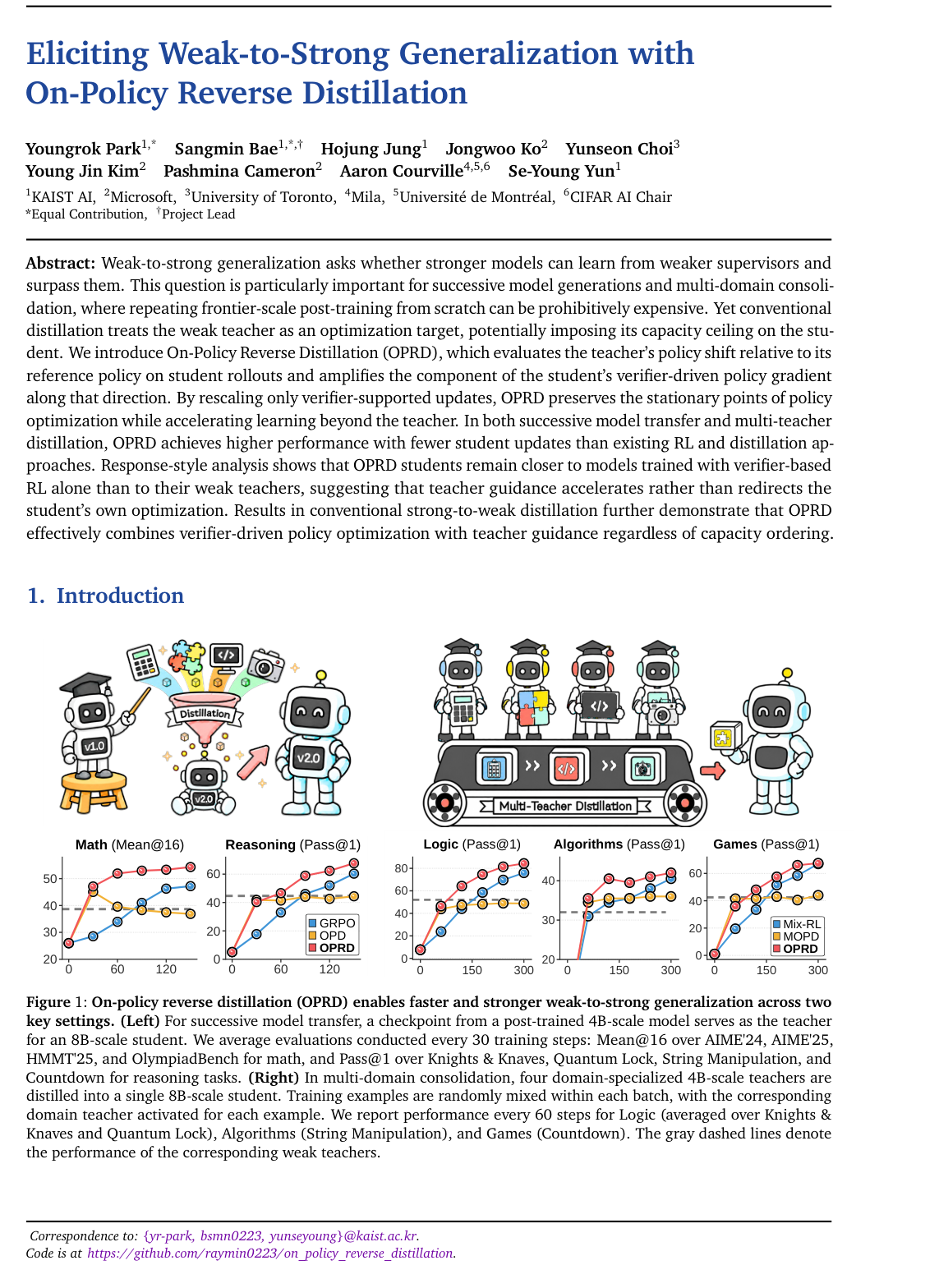
Eliciting Weak-to-Strong Generalization with On-Policy Reverse Distillation
Youngrok Park, Sangmin Bae, Hojung Jung, Jongwoo Ko, Yunseon Choi, Young Jin Kim, Pashmina Cameron, Aaron C. Courville, SeYoung Yun
Why you should read this
Proposes On-Policy Reverse Distillation to overcome the capacity limits of traditional distillation by using weak teacher guidance to accelerate verifier-driven policy gradients on student rollouts, allowing strong models to surpass their teachers with fewer training updates.
Weak-to-strong generalization asks whether stronger models can learn from weaker supervisors and surpass them. This question is particularly important for successive model generations and multi-domain consolidation, where repeating frontier-scale post-training from scratch can be prohibitively expensive. Yet conventional distillation treats the weak teacher as an optimization target, potentially imposing its capacity ceiling on the student. We introduce On-Policy Reverse Distillation (OPRD), which evaluates the teacher's policy shift relative to its reference policy on student rollouts and amplifies the component of the student's verifier-driven policy gradient along that direction. By rescaling only verifier-supported updates, OPRD preserves the stationary points of policy optimization while accelerating learning beyond the teacher. In both successive model transfer and multi-teacher distillation, OPRD achieves higher performance with fewer student updates than existing RL and distillation approaches. Response-style analysis shows that OPRD students remain closer to models trained with verifier-based RL alone than to their weak teachers, suggesting that teacher guidance accelerates rather than redirects the student's own optimization. Results in conventional strong-to-weak distillation further demonstrate that OPRD effectively combines verifier-driven policy optimization with teacher guidance regardless of capacity ordering.
Added
2026-10-05
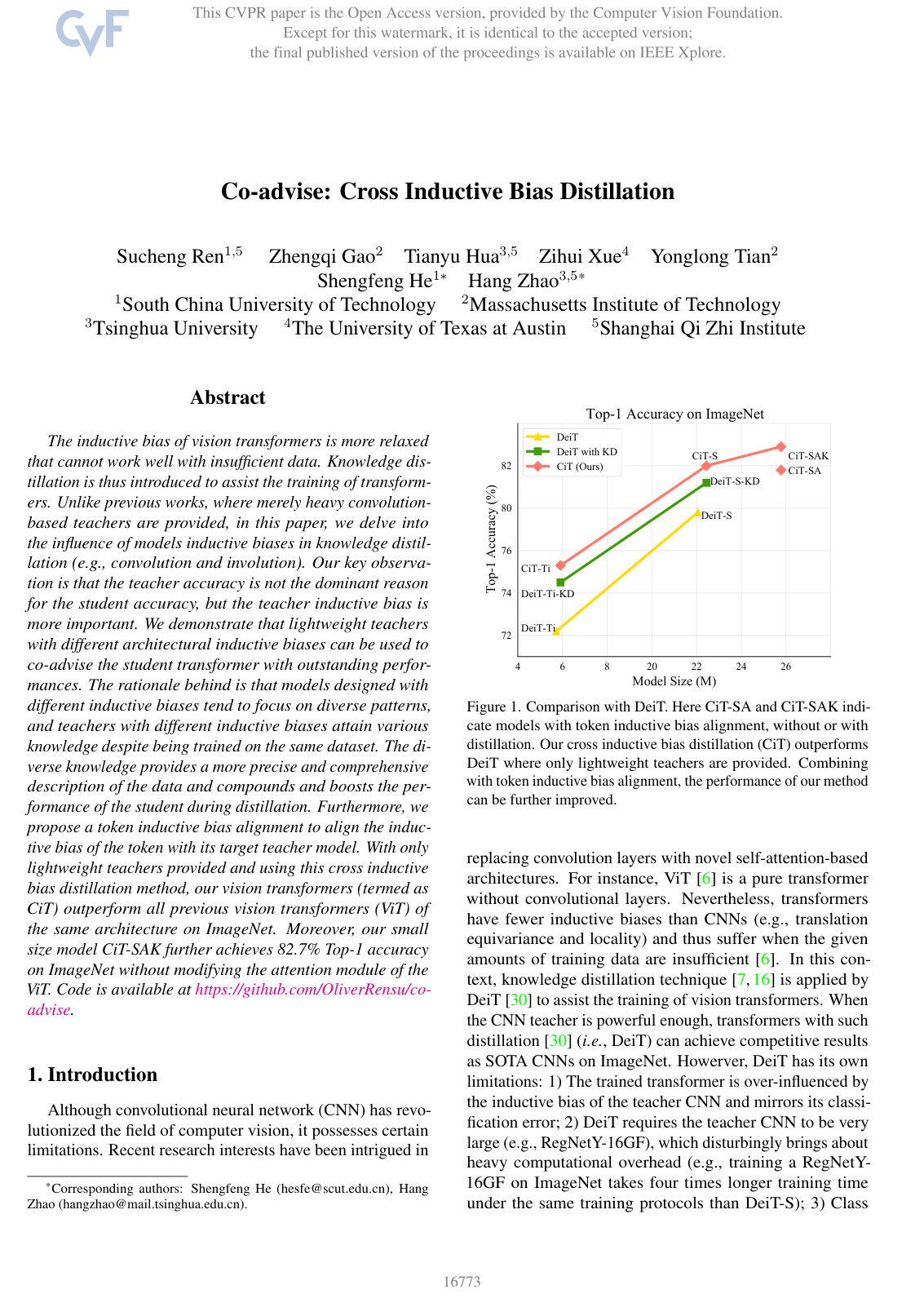
Co-advise: Cross Inductive Bias Distillation
Sucheng Ren, Zhengqi Gao, Tianyu Hua, Zihui Xue, Yonglong Tian, Shengfeng He, Hang Zhao
Why you should read this
Demonstrates that distilling knowledge from multiple lightweight teachers with complementary inductive biases, such as convolution and involution, boosts vision transformer performance beyond traditional heavy-teacher distillation while reducing computational costs.
The inductive bias of vision transformers is more relaxed that cannot work well with insufficient data. Knowledge distillation is thus introduced to assist the training of transformers. Unlike previous works, where merely heavy convolution-based teachers are provided, in this paper, we delve into the influence of models inductive biases in knowledge distillation (e.g., convolution and involution). Our key observation is that the teacher accuracy is not the dominant reason for the student accuracy, but the teacher inductive bias is more important. We demonstrate that lightweight teachers with different architectural inductive biases can be used to co-advise the student transformer with outstanding performances. The rationale behind is that models designed with different inductive biases tend to focus on diverse patterns, and teachers with different inductive biases attain various knowledge despite being trained on the same dataset. The diverse knowledge provides a more precise and comprehensive description of the data and compounds and boosts the performance of the student during distillation. Furthermore, we propose a token inductive bias alignment to align the inductive bias of the token with its target teacher model. With only lightweight teachers provided and using this cross inductive bias distillation method, our vision transformers (termed as CiT) outperform all previous vision transformers (ViT) of the same architecture on ImageNet. Moreover, our small size model CiT-SAK further achieves 82.7% Top-1 accuracy on ImageNet without modifying the attention module of the ViT. Code is available at https://github.com/OliverRensu/co-advise.
Added
2026-09-26
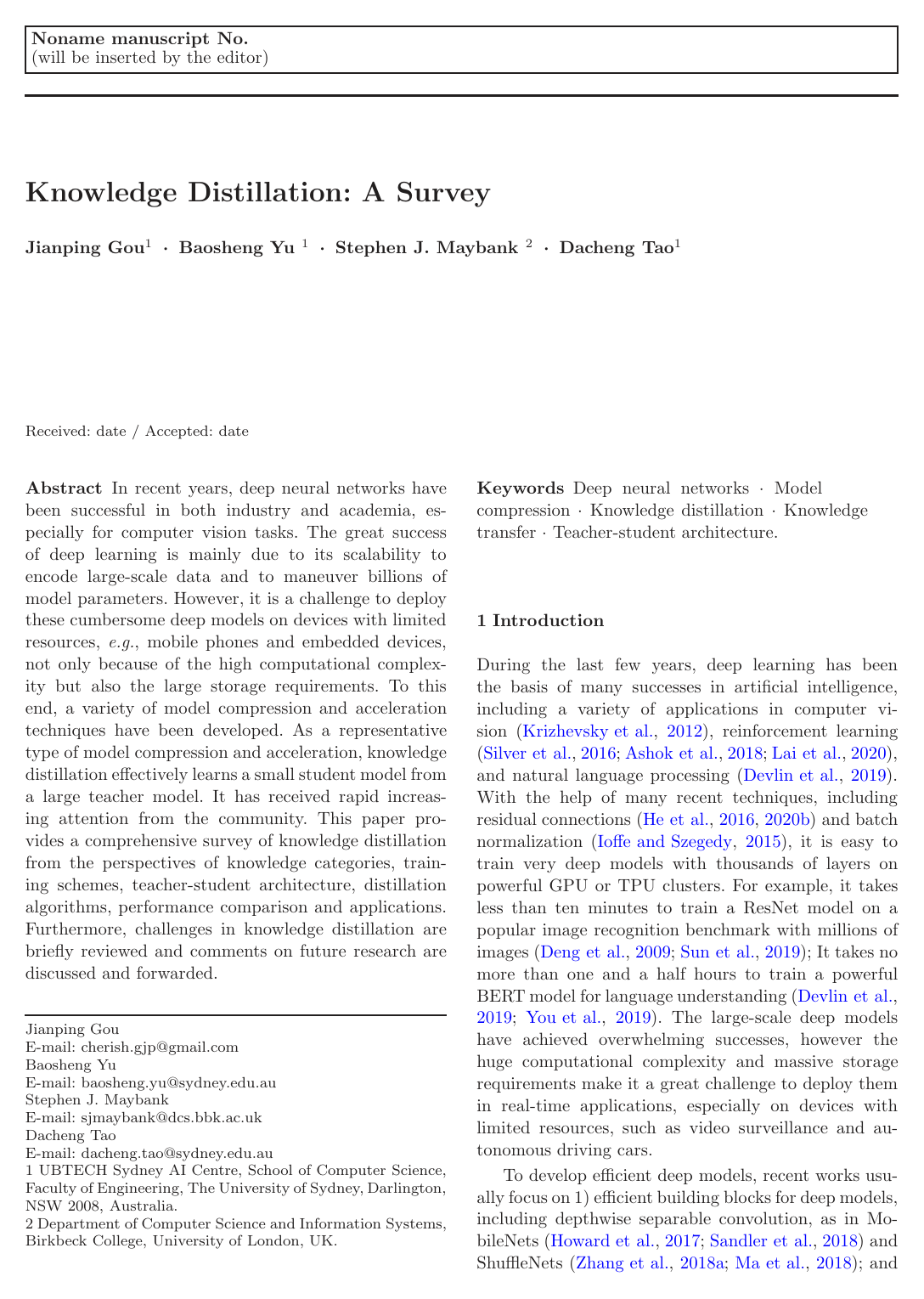
Knowledge Distillation: A Survey
Jianping Gou, Baosheng Yu, Stephen John Maybank, Dacheng Tao
Why you should read this
Categorizes the fundamental mechanisms of knowledge distillation across different knowledge types, training schemes, and teacher-student architectures to guide the compression and deployment of deep neural networks on resource-constrained devices.
In recent years, deep neural networks have been successful in both industry and academia, especially for computer vision tasks. The great success of deep learning is mainly due to its scalability to encode large-scale data and to maneuver billions of model parameters. However, it is a challenge to deploy these cumbersome deep models on devices with limited resources, e.g., mobile phones and embedded devices, not only because of the high computational complexity but also the large storage requirements. To this end, a variety of model compression and acceleration techniques have been developed. As a representative type of model compression and acceleration, knowledge distillation effectively learns a small student model from a large teacher model. It has received rapid increasing attention from the community. This paper provides a comprehensive survey of knowledge distillation from the perspectives of knowledge categories, training schemes, teacher-student architecture, distillation algorithms, performance comparison and applications. Furthermore, challenges in knowledge distillation are briefly reviewed and comments on future research are discussed and forwarded.
Added
2026-09-10
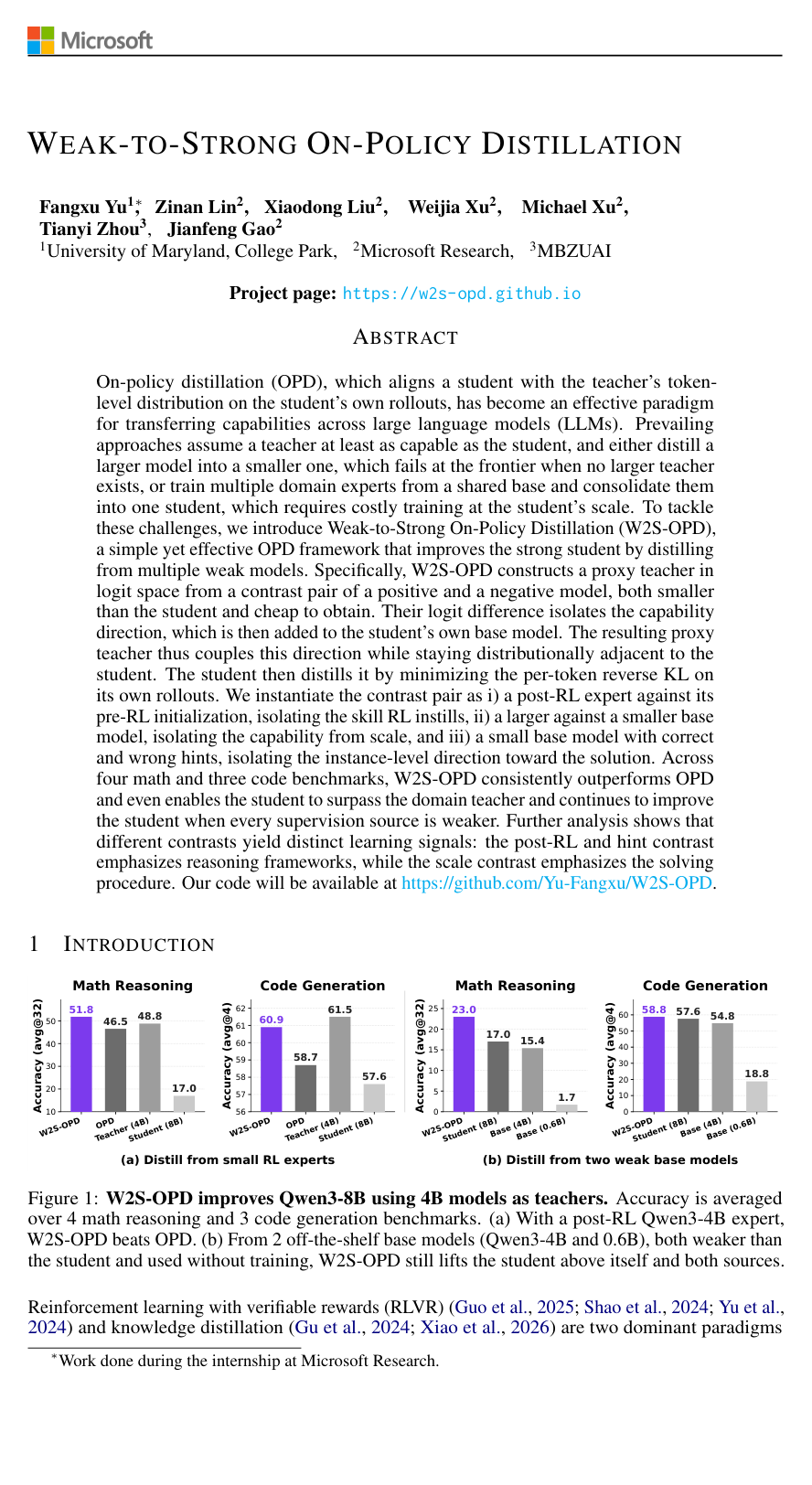
Weak-to-Strong On-Policy Distillation
Fangxu Yu, Zinan Lin, Xiaodong Liu, Weijia Xu, Michael Xu, Tianyi Zhou, Jianfeng Gao
Why you should read this
Introduces Weak-to-Strong On-Policy Distillation (W2S-OPD), a novel framework that significantly improves a strong language model by distilling knowledge from multiple weaker, less costly models, even surpassing the performance of traditional, more powerful teachers.
On-policy distillation (OPD), which aligns a student with the teacher's token-level distribution on the student's own rollouts, is an effective paradigm for transferring capabilities across LLMs. Prevailing approaches assume a teacher at least as capable as the student: they either distill a larger model into a smaller one, which fails at the frontier where no larger teacher exists, or consolidate multiple domain experts trained from a shared base, which requires costly training at the student's scale. We introduce Weak-to-Strong On-Policy Distillation (W2S-OPD), a simple yet effective OPD framework that improves the strong student by distilling from multiple weak models. W2S-OPD constructs a proxy teacher in logit space from a contrast pair of a positive and a negative model, both smaller than the student and cheap to obtain. Their logit difference isolates the capability direction, which is added to the student's own base model, yielding a proxy teacher that couples this direction while staying distributionally adjacent to the student. The student then distills it by minimizing the per-token reverse KL on its own rollouts. We instantiate the contrast pair as i) a post-RL expert against its pre-RL initialization, isolating the skill RL instills, ii) a larger against a smaller base model, isolating the capability from scale, and iii) a small base model with correct versus wrong hints, isolating the instance-level direction toward the solution. Across four math and three code benchmarks, W2S-OPD outperforms OPD, enables the student to surpass the domain teacher, and keeps improving the student even when every supervision source is weaker. Analysis shows different contrasts yield distinct signals: the post-RL and hint contrasts emphasize reasoning frameworks, while the scale contrast emphasizes the solving procedure. Our code will be available at this https URL.
Added
2026-07-31
License
Published with permission