
keyword
multi-step forecasting
Multi-step forecasting is a predictive modeling task in time series analysis where a model forecasts values for multiple future time points rather than just a single subsequent step. Unlike one-step-ahead prediction, which estimates only the immediately following observation, multi-step forecasting projects an entire trajectory or sequence across a defined future horizon. Common implementation strategies include recursive methods that feed earlier predictions back into the model as inputs, direct methods that train separate models for each specific point in the forecast horizon, and multi-output or joint modeling architectures that generate all future steps simultaneously. This approach is essential in fields such as energy load management, finance, traffic control, and weather modeling, where strategic planning requires visibility across extended forward time windows.
4 items
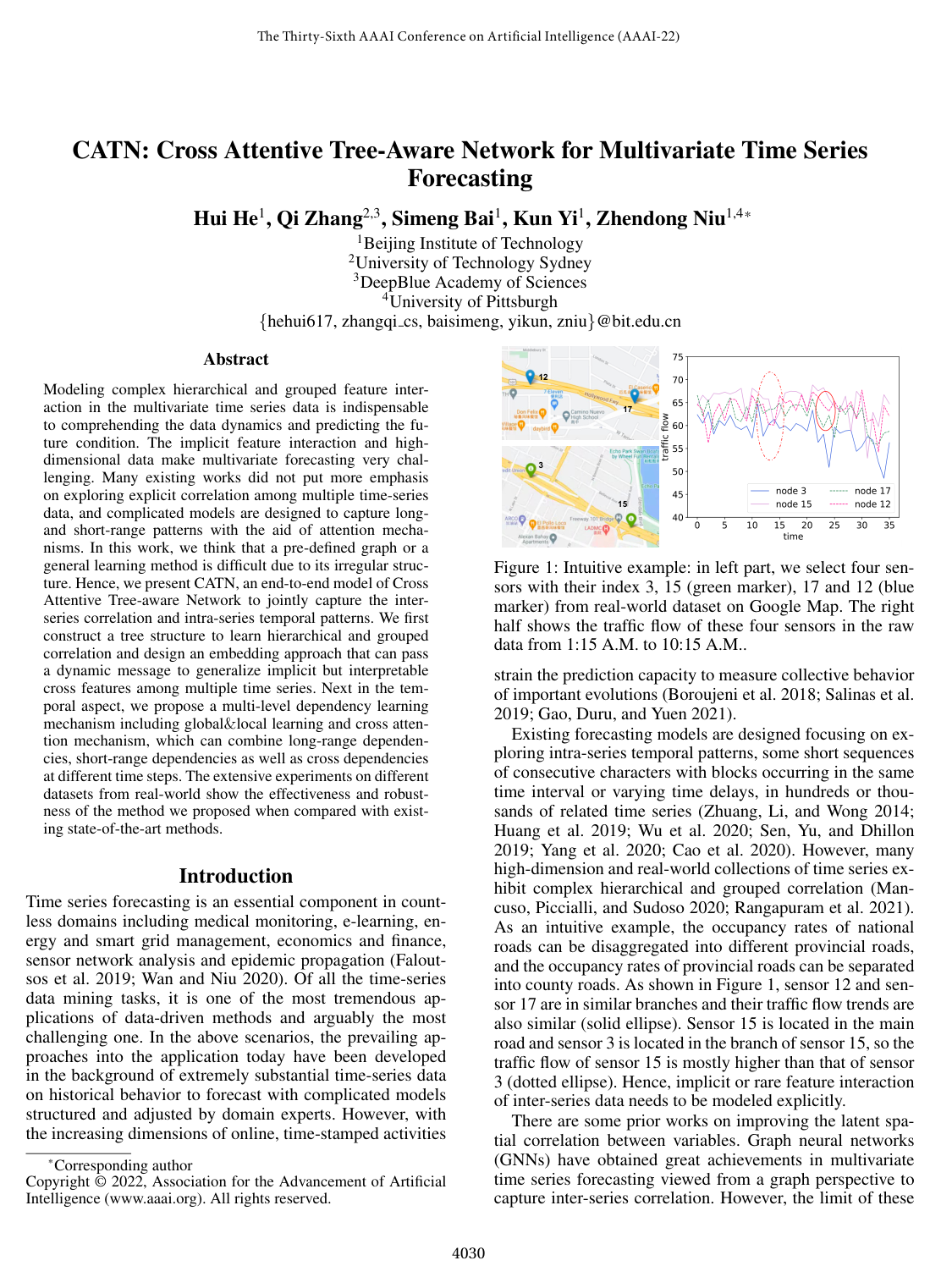
CATN: Cross Attentive Tree-Aware Network for Multivariate Time Series Forecasting
Hui He, Qi Zhang, Simeng Bai, Kun Yi, Zhendong Niu
Why you should read this
Proposes an end-to-end framework that constructs hierarchical tree structures to capture grouped correlations across variables and uses a cross-attention mechanism to jointly model dynamic inter-series and intra-series temporal dependencies for multivariate time series forecasting.
Modeling complex hierarchical and grouped feature interaction in the multivariate time series data is indispensable to comprehending the data dynamics and predicting the future condition. The implicit feature interaction and high-dimensional data make multivariate forecasting very challenging. Many existing works did not put more emphasis on exploring explicit correlation among multiple time-series data, and complicated models are designed to capture long- and short-range patterns with the aid of attention mechanisms. In this work, we think that a pre-defined graph or a general learning method is difficult due to its irregular structure. Hence, we present CATN, an end-to-end model of Cross Attentive Tree-aware Network to jointly capture the inter-series correlation and intra-series temporal patterns. We first construct a tree structure to learn hierarchical and grouped correlation and design an embedding approach that can pass a dynamic message to generalize implicit but interpretable cross features among multiple time series. Next in the temporal aspect, we propose a multi-level dependency learning mechanism including global&local learning and cross attention mechanism, which can combine long-range dependencies, short-range dependencies as well as cross dependencies at different time steps. The extensive experiments on different datasets from real-world show the effectiveness and robustness of the method we proposed when compared with existing state-of-the-art methods.
Added
2026-09-26
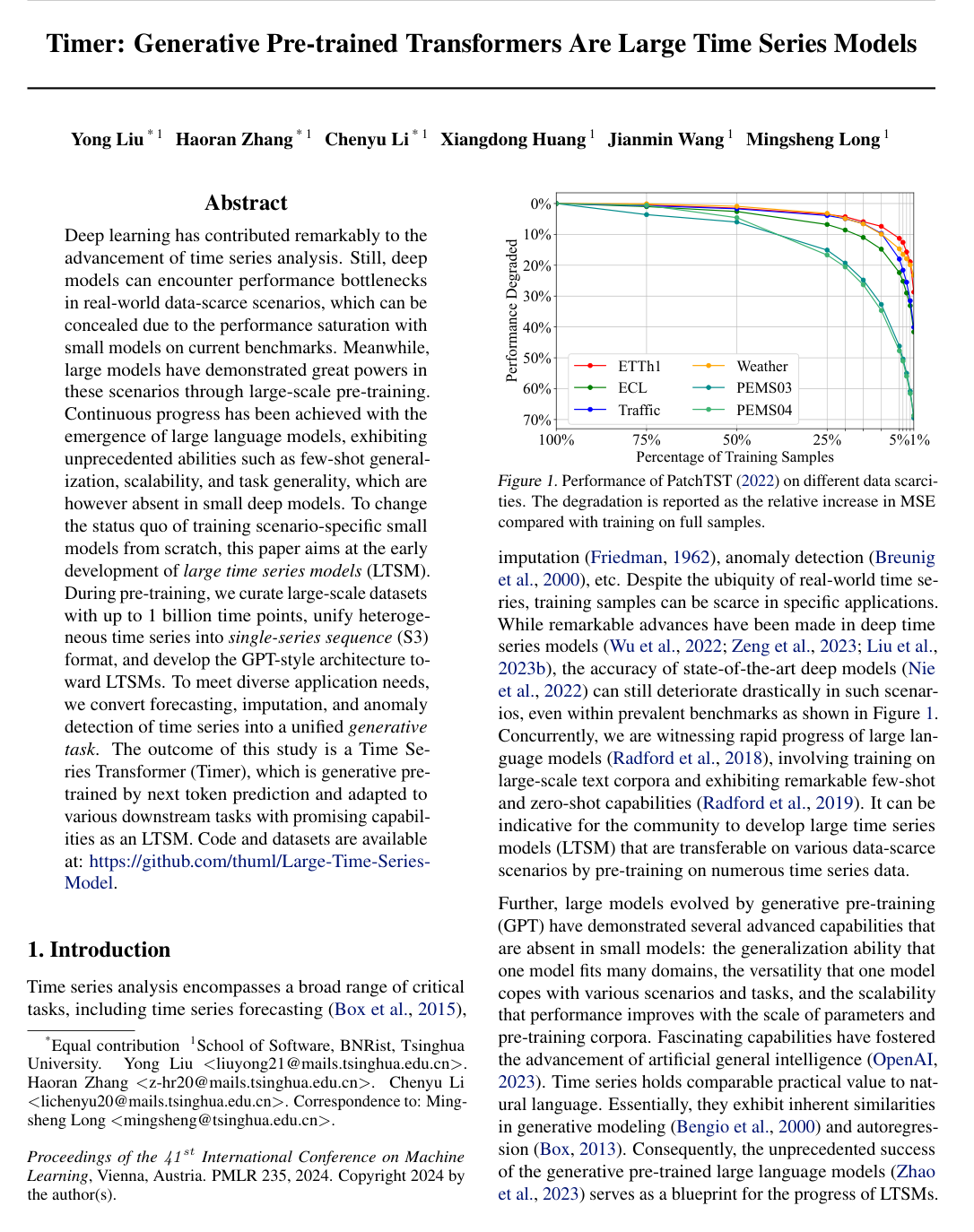
Timer: Generative Pre-trained Transformers Are Large Time Series Models
Yong Liu, Haoran Zhang, Chenyu Li, Xiangdong Huang, Jianmin Wang, Mingsheng Long
Why you should read this
Presents a billion-point pre-trained GPT-style model that unifies diverse time series forecasting, imputation, and anomaly detection into next-token prediction to deliver strong few-shot and zero-shot performance across heterogeneous domains.
Deep learning has contributed remarkably to the advancement of time series analysis. Still, deep models can encounter performance bottlenecks in real-world data-scarce scenarios, which can be concealed due to the performance saturation with small models on current benchmarks. Meanwhile, large models have demonstrated great powers in these scenarios through large-scale pre-training. Continuous progress has been achieved with the emergence of large language models, exhibiting unprecedented abilities such as few-shot generalization, scalability, and task generality, which are however absent in small deep models. To change the status quo of training scenario-specific small models from scratch, this paper aims at the early development of large time series models (LTSM). During pre-training, we curate large-scale datasets with up to 1 billion time points, unify heterogeneous time series into single-series sequence (S3) format, and develop the GPT-style architecture toward LTSMs. To meet diverse application needs, we convert forecasting, imputation, and anomaly detection of time series into a unified generative task. The outcome of this study is a Time Series Transformer (Timer), which is generative pre-trained by next token prediction and adapted to various downstream tasks with promising capabilities as an LTSM. Code and datasets are available at: https://github.com/thuml/Large-Time-Series-Model.
Added
2026-09-26
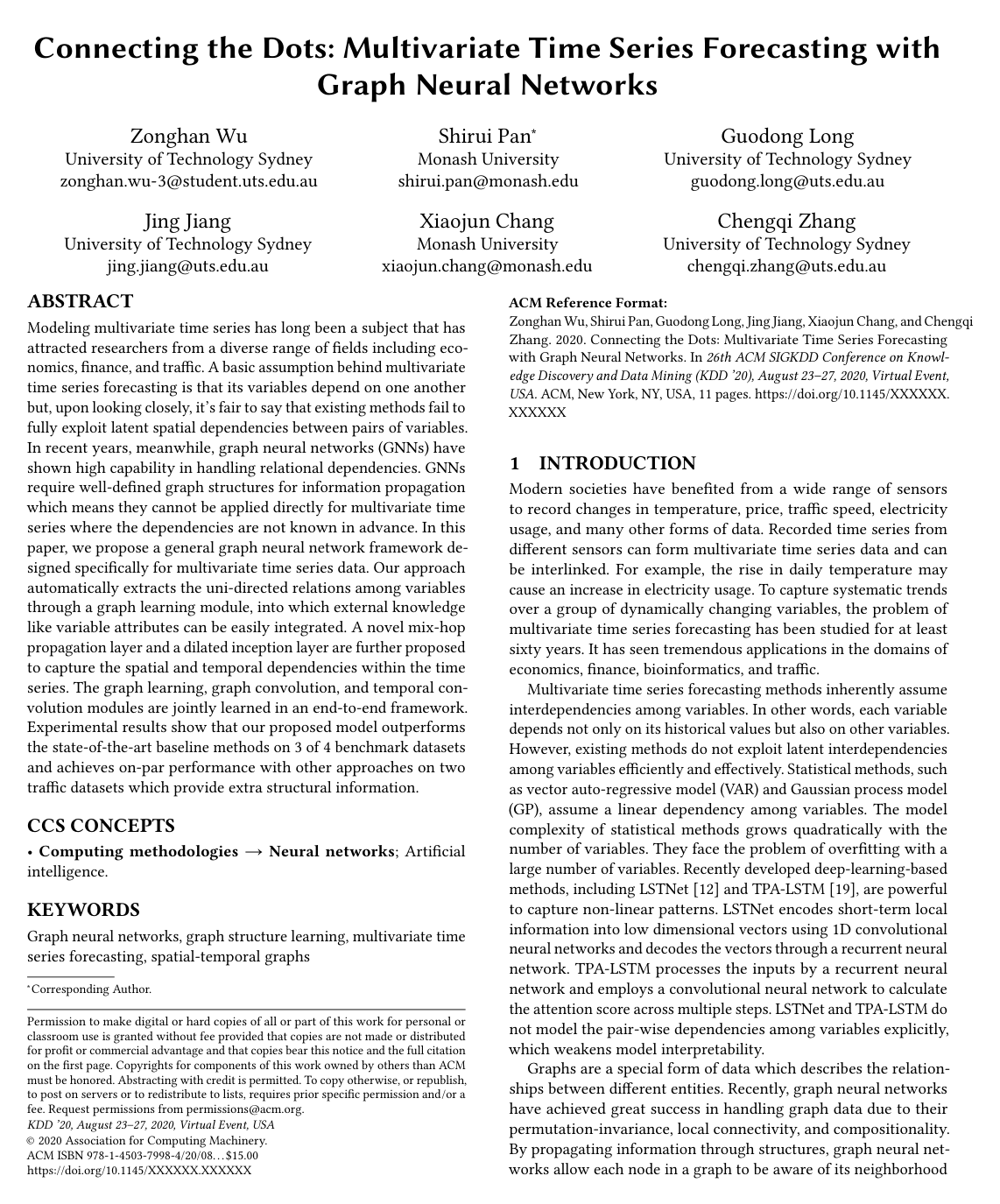
Connecting the Dots: Multivariate Time Series Forecasting with Graph Neural Networks
Zonghan Wu, Shirui Pan, Guodong Long, Jing Jiang, Xiaojun Chang, Chengqi Zhang
Why you should read this
Develops an end-to-end graph neural network framework that automatically learns latent relationships among variables without requiring predefined graph structures, effectively combining spatial and temporal convolutions for multivariate time series forecasting.
Modeling multivariate time series has long been a subject that has attracted researchers from a diverse range of fields including economics, finance, and traffic. A basic assumption behind multivariate time series forecasting is that its variables depend on one another but, upon looking closely, it is fair to say that existing methods fail to fully exploit latent spatial dependencies between pairs of variables. In recent years, meanwhile, graph neural networks (GNNs) have shown high capability in handling relational dependencies. GNNs require well-defined graph structures for information propagation which means they cannot be applied directly for multivariate time series where the dependencies are not known in advance. In this paper, we propose a general graph neural network framework designed specifically for multivariate time series data. Our approach automatically extracts the uni-directed relations among variables through a graph learning module, into which external knowledge like variable attributes can be easily integrated. A novel mix-hop propagation layer and a dilated inception layer are further proposed to capture the spatial and temporal dependencies within the time series. The graph learning, graph convolution, and temporal convolution modules are jointly learned in an end-to-end framework. Experimental results show that our proposed model outperforms the state-of-the-art baseline methods on 3 of 4 benchmark datasets and achieves on-par performance with other approaches on two traffic datasets which provide extra structural information.
Added
2026-09-16
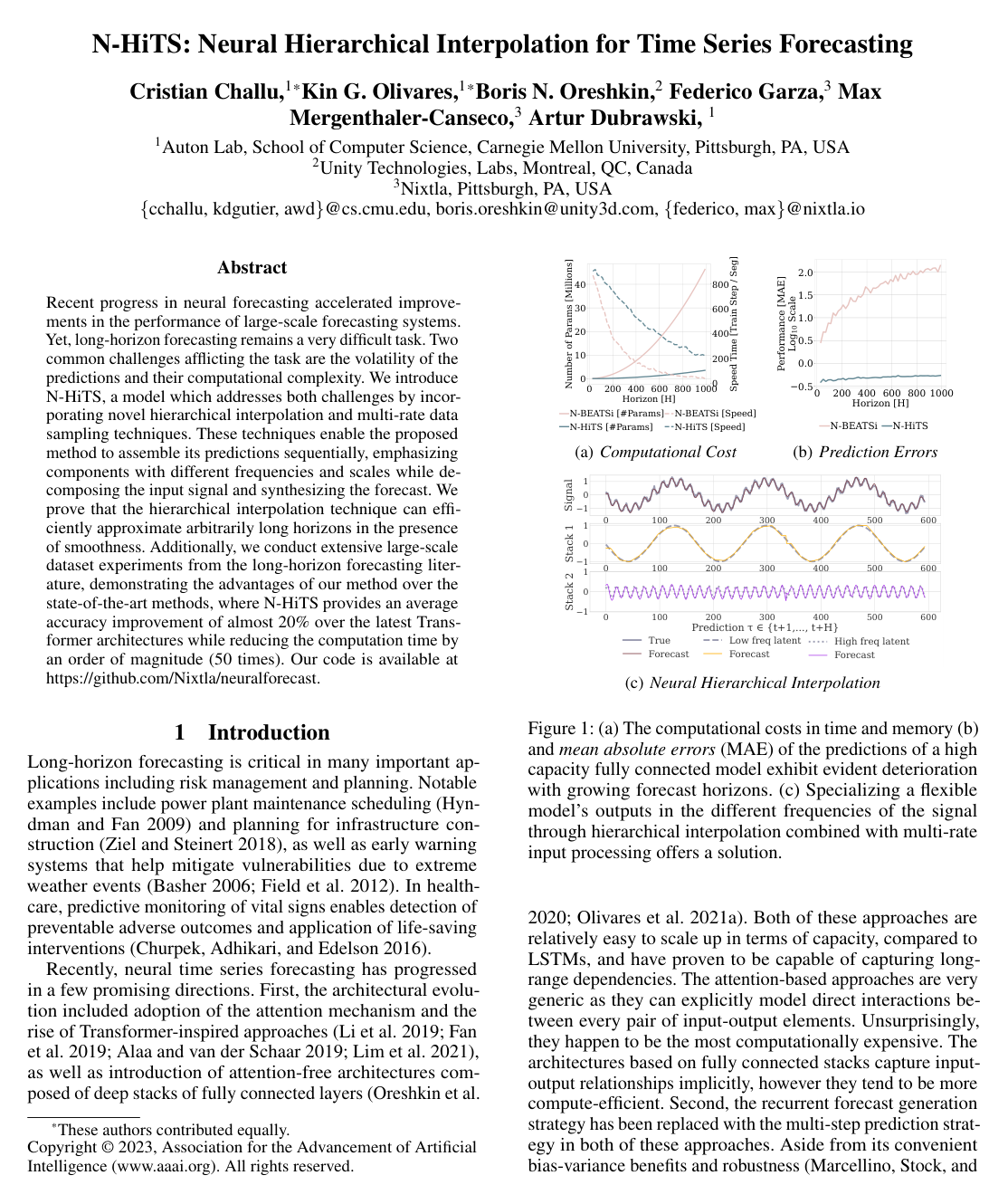
N-HiTS: Neural Hierarchical Interpolation for Time Series Forecasting
Cristian Challu, Kin G. Olivares, Boris N. Oreshkin, Federico Garza, Max Mergenthaler-Canseco, Artur Dubrawski
Why you should read this
Improves upon previous architectures by incorporating multi-rate signal sampling and hierarchical interpolation to computationally capture high-frequency patterns across massive temporal horizons.
Recent progress in neural forecasting accelerated improvements in the performance of large-scale forecasting systems. Yet, long-horizon forecasting remains a very difficult task. Two common challenges afflicting the task are the volatility of the predictions and their computational complexity. We introduce N-HiTS, a model which addresses both challenges by incorporating novel hierarchical interpolation and multi-rate data sampling techniques. These techniques enable the proposed method to assemble its predictions sequentially, emphasizing components with different frequencies and scales while decomposing the input signal and synthesizing the forecast. We prove that the hierarchical interpolation technique can efficiently approximate arbitrarily long horizons in the presence of smoothness. Additionally, we conduct extensive large-scale dataset experiments from the long-horizon forecasting literature, demonstrating the advantages of our method over the state-of-the-art methods, where N-HiTS provides an average accuracy improvement of almost 20% over the latest Transformer architectures while reducing the computation time by an order of magnitude (50 times). Our code is available at bit.ly/3VA5DoT
Added
2026-06-27