
keyword
multi-scale features
Multi-scale features are data representations extracted from an input, such as an image or point cloud, across multiple spatial resolutions, receptive field sizes, or contextual granularities. In machine learning and computer vision architectures, these features are typically generated by processing inputs at different image resolutions, aggregating intermediate representations from various network depths, or employing operations with diverse receptive fields. This approach allows a model to simultaneously capture fine-grained local details, such as precise boundaries and textures, alongside high-level abstract semantics, such as global scene structure and object context. By integrating features across multiple scales, models can robustly detect, recognize, and segment objects that appear at vastly different sizes, distances, and spatial densities.
8 items
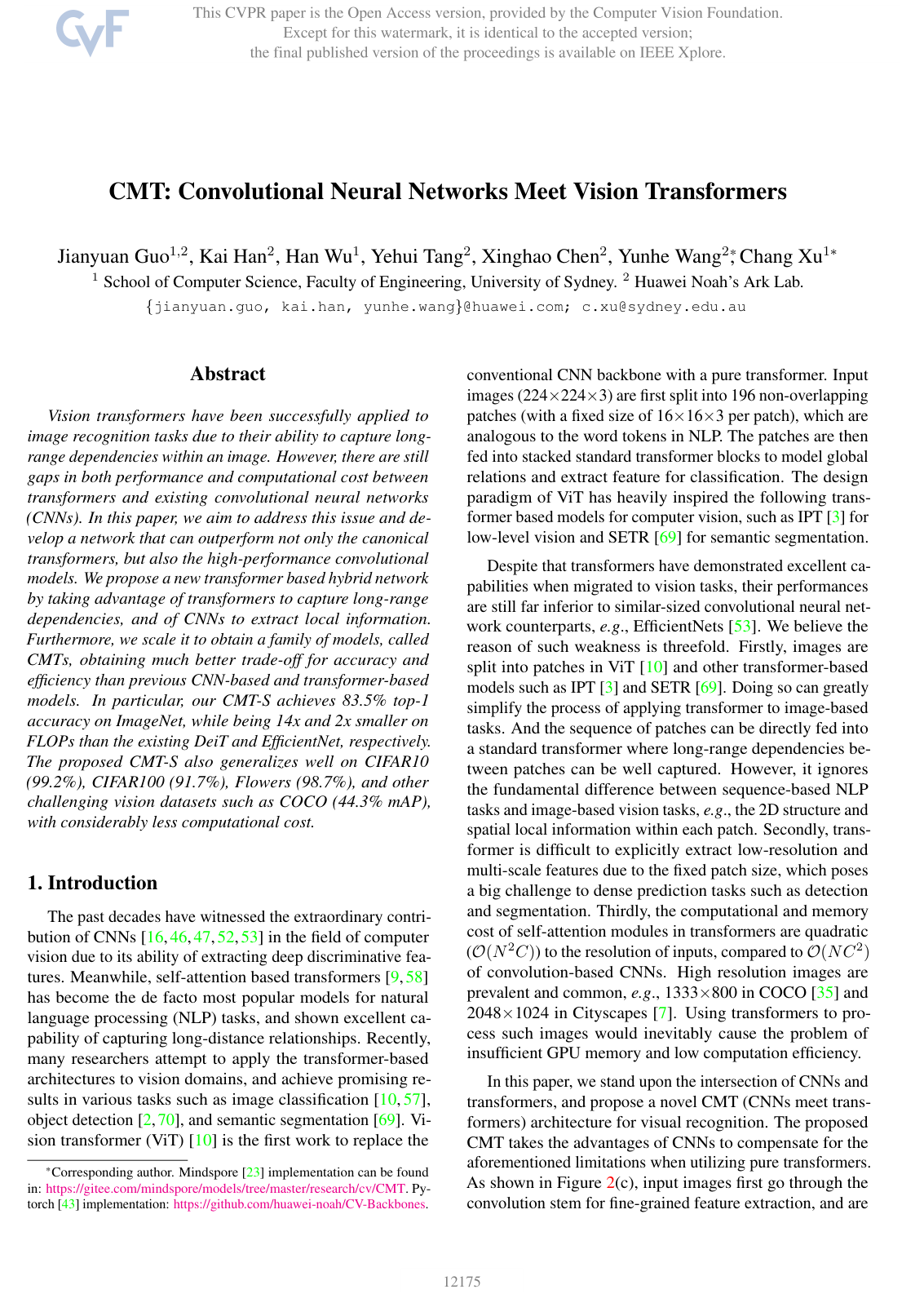
CMT: Convolutional Neural Networks Meet Vision Transformers
Jianyuan Guo, Kai Han, Han Wu, Yehui Tang, Xinghao Chen, Yunhe Wang, Chang Xu
Why you should read this
Presents a hybrid architecture family called CMT that combines convolutional operations with vision transformers to capture both local and global features, achieving superior accuracy and computational efficiency compared to standard CNNs and pure transformers on ImageNet and COCO.
Vision transformers have been successfully applied to image recognition tasks due to their ability to capture long-range dependencies within an image. However, there are still gaps in both performance and computational cost between transformers and existing convolutional neural networks (CNNs). In this paper, we aim to address this issue and develop a network that can outperform not only the canonical transformers, but also the high-performance convolutional models. We propose a new transformer based hybrid network by taking advantage of transformers to capture long-range dependencies, and of CNNs to extract local information. Furthermore, we scale it to obtain a family of models, called CMTs, obtaining much better trade-off for accuracy and efficiency than previous CNN-based and transformer-based models. In particular, our CMT-S achieves 83.5% top-1 accuracy on ImageNet, while being 14x and 2x smaller on FLOPs than the existing DeiT and EfficientNet, respectively. The proposed CMT-S also generalizes well on CIFAR10 (99.2%), CIFAR100 (91.7%), Flowers (98.7%), and other challenging vision datasets such as COCO (44.3% mAP), with considerably less computational cost.
Added
2026-10-05
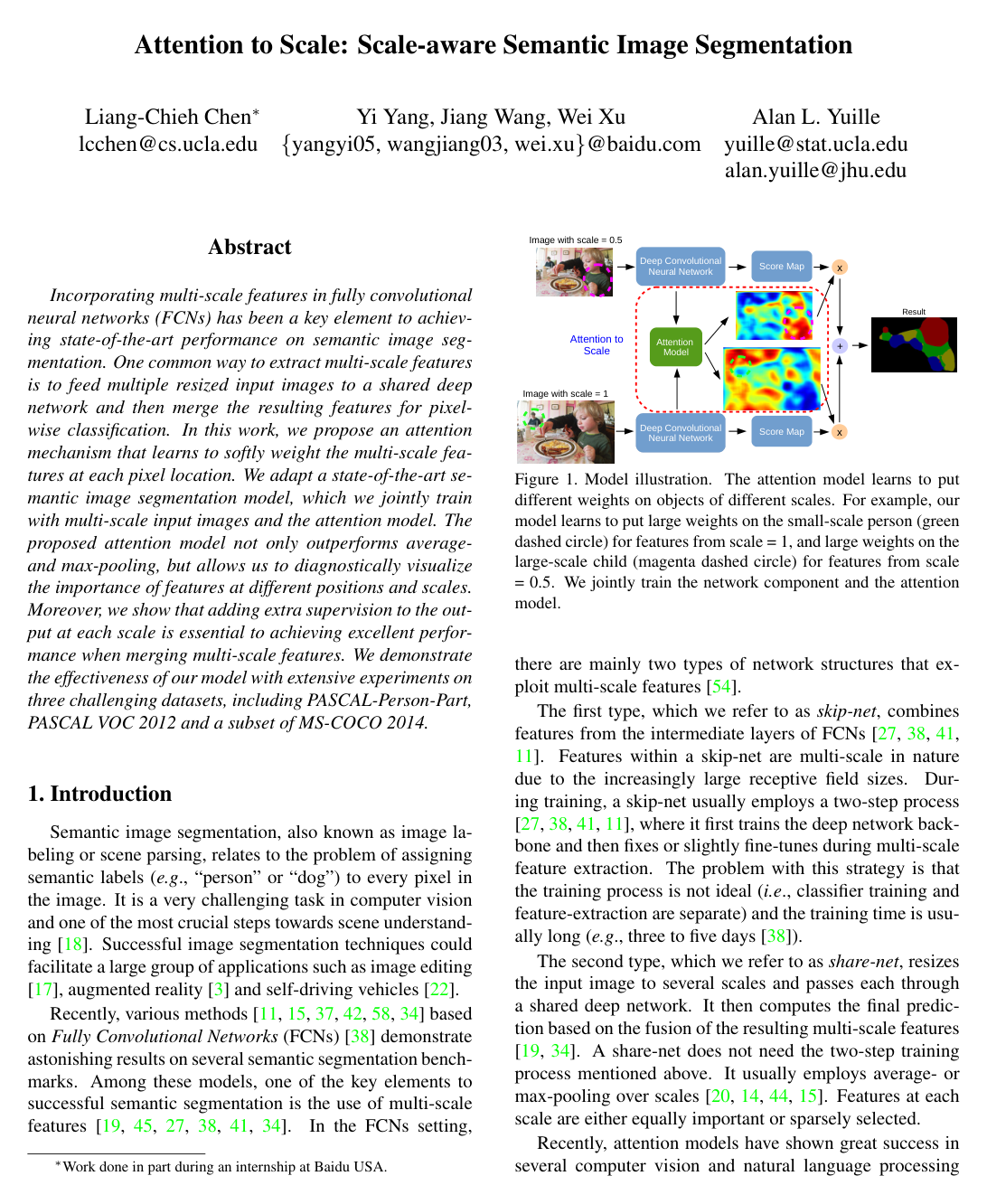
Attention to Scale: Scale-Aware Semantic Image Segmentation
Liang-Chieh Chen, Yi Yang, Jiang Wang, Wei Xu, Alan L. Yuille
Why you should read this
Proposes an attention mechanism that dynamically weights multi-scale features at each pixel, improving semantic image segmentation accuracy over standard pooling baselines while providing interpretable diagnostics of scale selection.
Incorporating multi-scale features in fully convolutional neural networks (FCNs) has been a key element to achieving state-of-the-art performance on semantic image segmentation. One common way to extract multi-scale features is to feed multiple resized input images to a shared deep network and then merge the resulting features for pixelwise classification. In this work, we propose an attention mechanism that learns to softly weight the multi-scale features at each pixel location. We adapt a state-of-the-art semantic image segmentation model, which we jointly train with multi-scale input images and the attention model. The proposed attention model not only outperforms average- and max-pooling, but allows us to diagnostically visualize the importance of features at different positions and scales. Moreover, we show that adding extra supervision to the output at each scale is essential to achieving excellent performance when merging multi-scale features. We demonstrate the effectiveness of our model with extensive experiments on three challenging datasets, including PASCAL-Person-Part, PASCAL VOC 2012 and a subset of MS-COCO 2014.
Added
2026-09-25
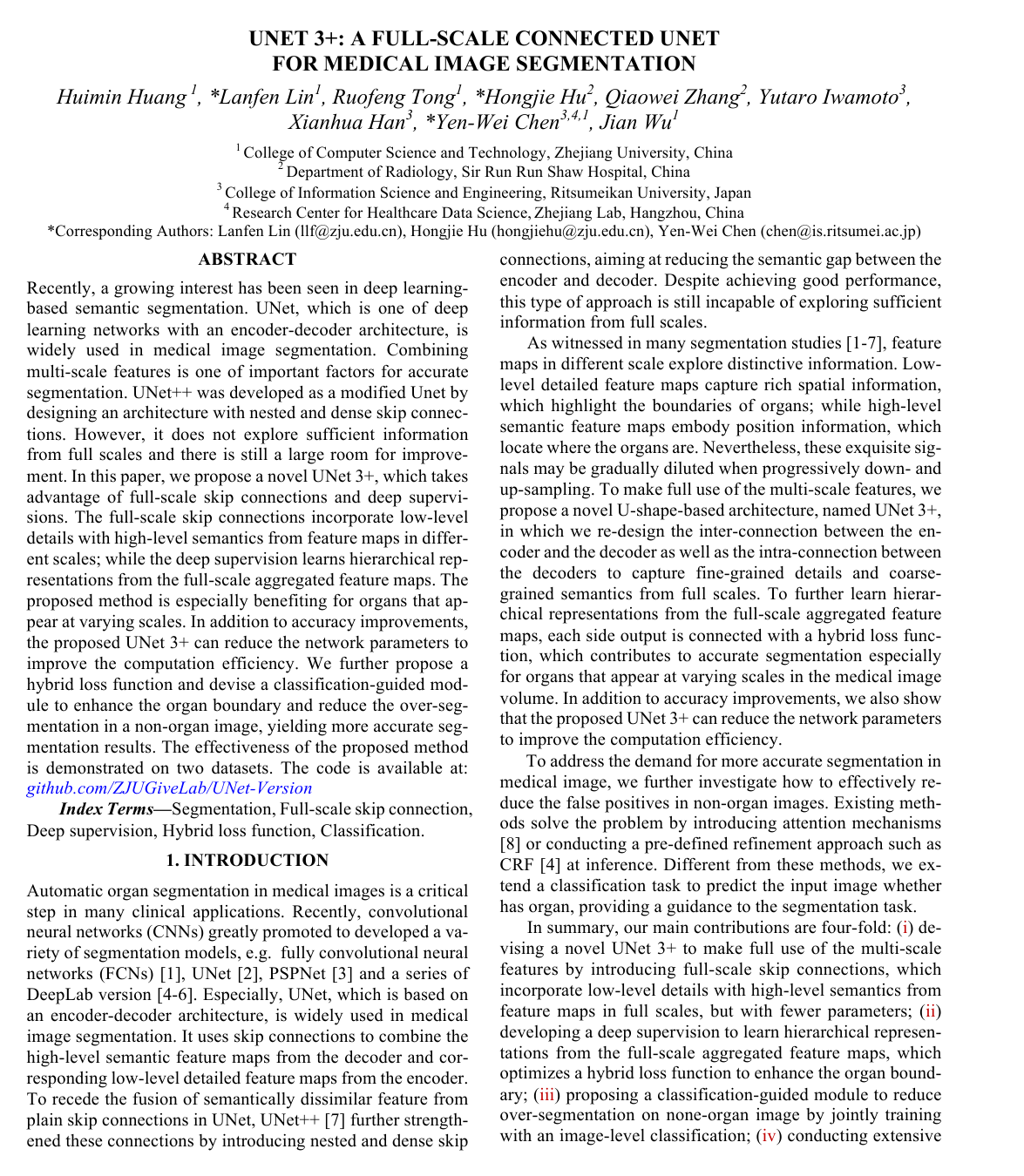
UNet 3+: A Full-Scale Connected UNet for Medical Image Segmentation
Huimin Huang, Lanfen Lin, Ruofeng Tong, Hongjie Hu, Qiaowei Zhang, Yutaro Iwamoto, Xianhua Han, Yen-Wei Chen, Jian Wu
Why you should read this
Introduces UNet 3+, a medical image segmentation architecture that combines full-scale skip connections with deep supervision to capture multi-scale anatomical structures with higher accuracy and fewer parameters than previous UNet variants.
Recently, a growing interest has been seen in deep learning-based semantic segmentation. UNet, which is one of deep learning networks with an encoder-decoder architecture, is widely used in medical image segmentation. Combining multi-scale features is one of important factors for accurate segmentation. UNet++ was developed as a modified Unet by designing an architecture with nested and dense skip connections. However, it does not explore sufficient information from full scales and there is still a large room for improvement. In this paper, we propose a novel UNet 3+, which takes advantage of full-scale skip connections and deep supervisions. The full-scale skip connections incorporate low-level details with high-level semantics from feature maps in different scales; while the deep supervision learns hierarchical representations from the full-scale aggregated feature maps. The proposed method is especially benefiting for organs that appear at varying scales. In addition to accuracy improvements, the proposed UNet 3+ can reduce the network parameters to improve the computation efficiency. We further propose a hybrid loss function and devise a classification-guided module to enhance the organ boundary and reduce the over-segmentation in a non-organ image, yielding more accurate segmentation results. The effectiveness of the proposed method is demonstrated on two datasets. The code is available at: this http URL
Added
2026-09-14
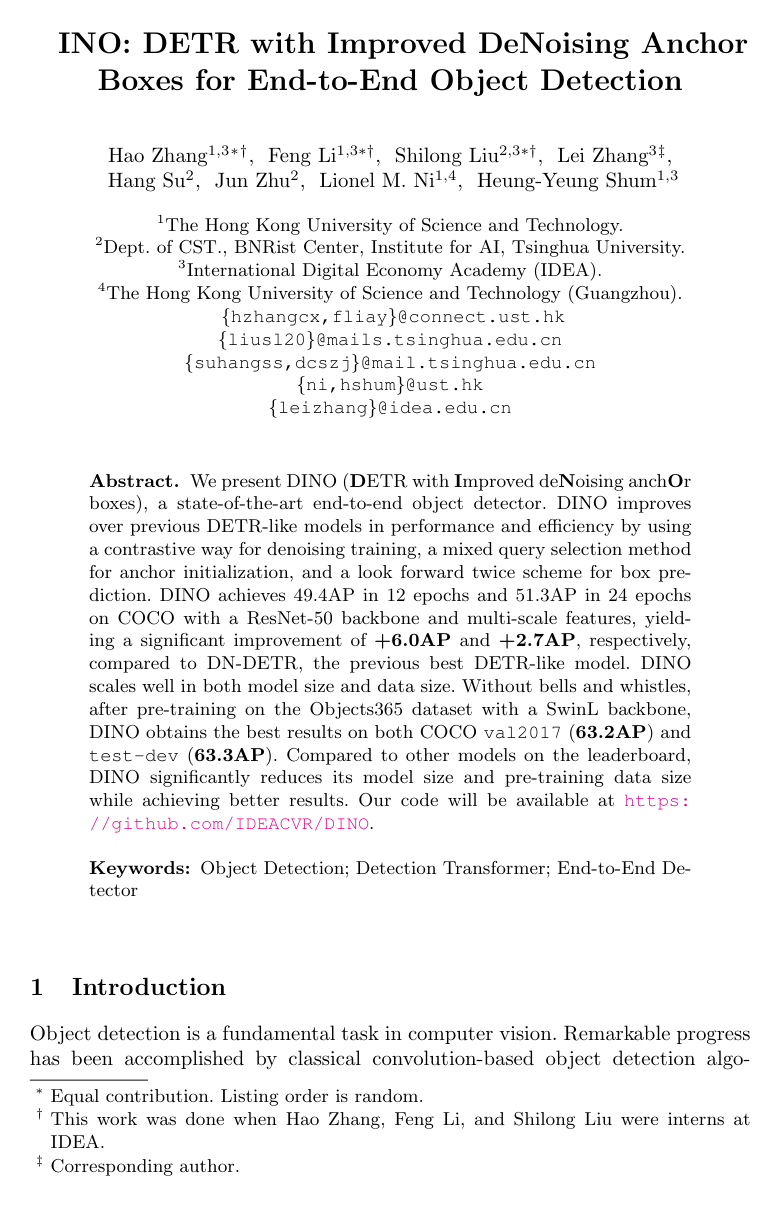
DINO: DETR with Improved DeNoising Anchor Boxes for End-to-End Object Detection
Hao Zhang, Feng Li, Shilong Liu, Lei Zhang, Hang Su, Jun Zhu, Lionel M. Ni, Heung-Yeung Shum
Why you should read this
Introduces DINO, an end-to-end object detector that uses contrastive denoising training and mixed query selection to achieve faster convergence and record-setting accuracy on the COCO benchmark.
We present DINO (\textbf{D}ETR with \textbf{I}mproved de\textbf{N}oising anch\textbf{O}r boxes), a state-of-the-art end-to-end object detector. % in this paper. DINO improves over previous DETR-like models in performance and efficiency by using a contrastive way for denoising training, a mixed query selection method for anchor initialization, and a look forward twice scheme for box prediction. DINO achieves AP in epochs and AP in epochs on COCO with a ResNet-50 backbone and multi-scale features, yielding a significant improvement of \textbf{AP} and \textbf{AP}, respectively, compared to DN-DETR, the previous best DETR-like model. DINO scales well in both model size and data size. Without bells and whistles, after pre-training on the Objects365 dataset with a SwinL backbone, DINO obtains the best results on both COCO \texttt{val2017} (\textbf{AP}) and \texttt{test-dev} (\textbf{AP}). Compared to other models on the leaderboard, DINO significantly reduces its model size and pre-training data size while achieving better results. Our code will be available at \url{this https URL}.
Added
2026-09-12
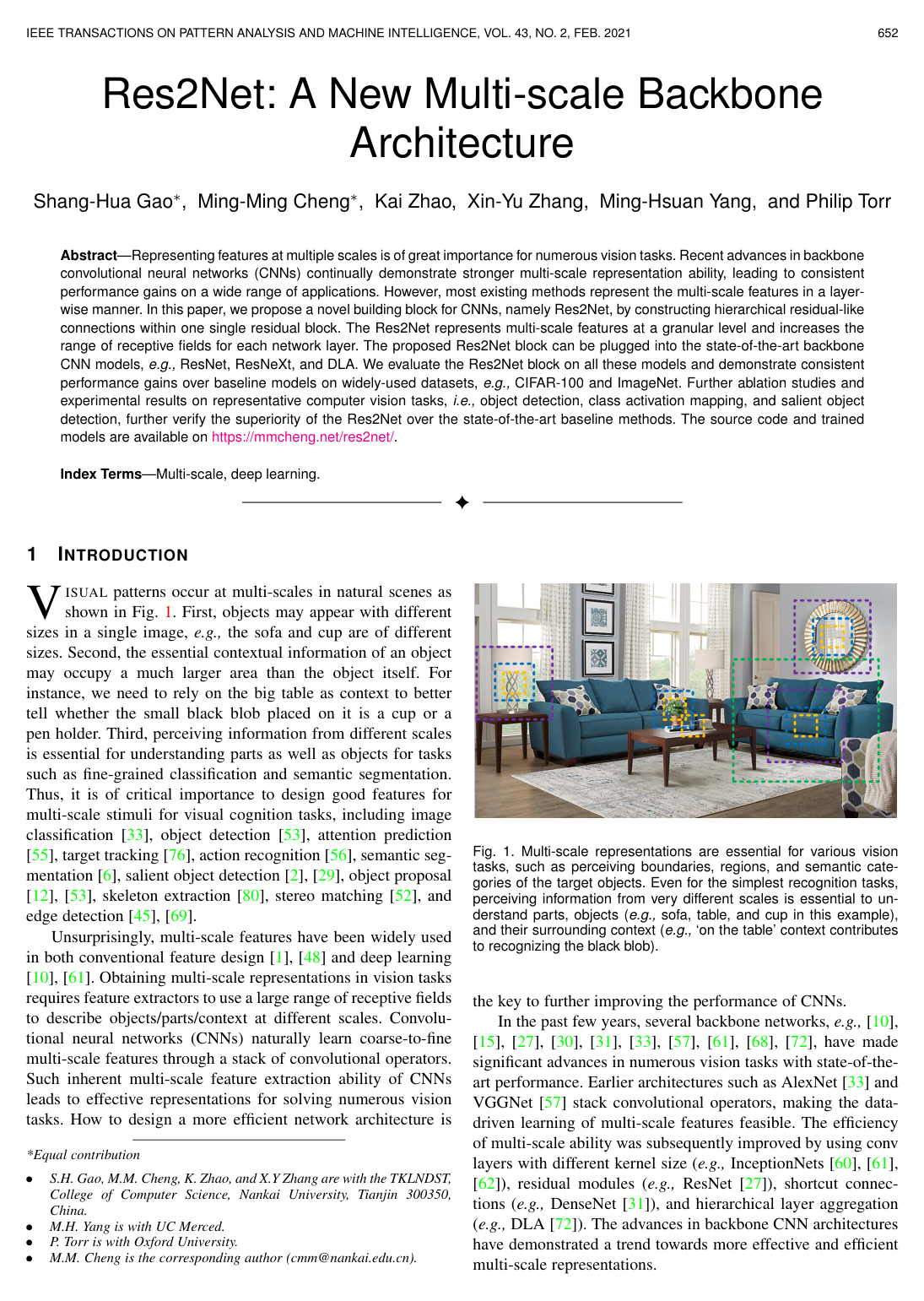
Res2Net: A New Multi-Scale Backbone Architecture
Shanghua Gao, Ming-Ming Cheng, Kai Zhao, Xinyu Zhang, Ming-Hsuan Yang, Philip H. S. Torr
Why you should read this
Introduces Res2Net, a plug-and-play convolutional block with internal hierarchical residual connections that captures granular multi-scale features and improves backbone network performance across image classification, object detection, and salient object detection.
Representing features at multiple scales is of great importance for numerous vision tasks. Recent advances in backbone convolutional neural networks (CNNs) continually demonstrate stronger multi-scale representation ability, leading to consistent performance gains on a wide range of applications. However, most existing methods represent the multi-scale features in a layer-wise manner. In this paper, we propose a novel building block for CNNs, namely Res2Net, by constructing hierarchical residual-like connections within one single residual block. The Res2Net represents multi-scale features at a granular level and increases the range of receptive fields for each network layer. The proposed Res2Net block can be plugged into the state-of-the-art backbone CNN models, e.g., ResNet, ResNeXt, and DLA. We evaluate the Res2Net block on all these models and demonstrate consistent performance gains over baseline models on widely-used datasets, e.g., CIFAR-100 and ImageNet. Further ablation studies and experimental results on representative computer vision tasks, i.e., object detection, class activation mapping, and salient object detection, further verify the superiority of the Res2Net over the state-of-the-art baseline methods. The source code and trained models are available on this https URL.
Added
2026-09-12
Semantic Image Segmentation with Deep Convolutional Nets and Fully Connected CRFs
Liang-Chieh Chen, George Papandreou, Iasonas Kokkinos, Kevin Murphy, Alan L. Yuille
Why you should read this
Introduces DeepLab, a framework combining deep convolutional neural networks with fully connected conditional random fields to overcome spatial localization limits and achieve accurate, efficient semantic image segmentation.
Deep Convolutional Neural Networks (DCNNs) have recently shown state of the art performance in high level vision tasks, such as image classification and object detection. This work brings together methods from DCNNs and probabilistic graphical models for addressing the task of pixel-level classification (also called "semantic image segmentation"). We show that responses at the final layer of DCNNs are not sufficiently localized for accurate object segmentation. This is due to the very invariance properties that make DCNNs good for high level tasks. We overcome this poor localization property of deep networks by combining the responses at the final DCNN layer with a fully connected Conditional Random Field (CRF). Qualitatively, our "DeepLab" system is able to localize segment boundaries at a level of accuracy which is beyond previous methods. Quantitatively, our method sets the new state-of-art at the PASCAL VOC-2012 semantic image segmentation task, reaching 71.6% IOU accuracy in the test set. We show how these results can be obtained efficiently: Careful network re-purposing and a novel application of the 'hole' algorithm from the wavelet community allow dense computation of neural net responses at 8 frames per second on a modern GPU.
Added
2026-09-10
License
Published with permission
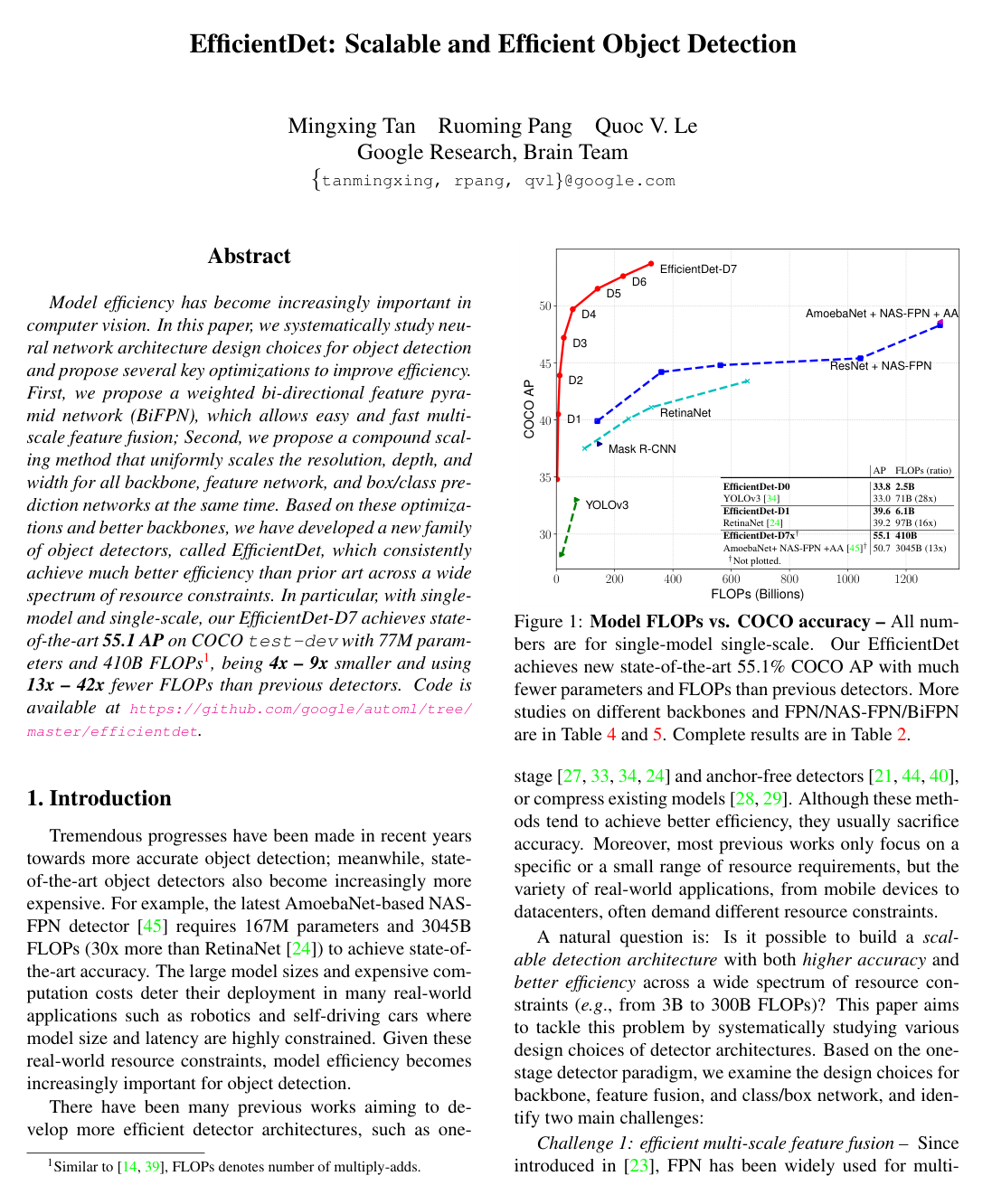
EfficientDet: Scalable and Efficient Object Detection
Mingxing Tan, Ruoming Pang, Quoc V. Le
Why you should read this
Introduces EfficientDet, a scalable object detection architecture combining a weighted bi-directional feature pyramid network and compound scaling to achieve state-of-the-art COCO accuracy with up to nine times fewer parameters and drastically lower computational cost than previous models.
Model efficiency has become increasingly important in computer vision. In this paper, we systematically study neural network architecture design choices for object detection and propose several key optimizations to improve efficiency. First, we propose a weighted bi-directional feature pyramid network (BiFPN), which allows easy and fast multiscale feature fusion; Second, we propose a compound scaling method that uniformly scales the resolution, depth, and width for all backbone, feature network, and box/class prediction networks at the same time. Based on these optimizations and better backbones, we have developed a new family of object detectors, called EfficientDet, which consistently achieve much better efficiency than prior art across a wide spectrum of resource constraints. In particular, with single model and single-scale, our EfficientDet-D7 achieves state-of-the-art 55.1 AP on COCO test-dev with 77M parameters and 410B FLOPs, being 4x - 9x smaller and using 13x - 42x fewer FLOPs than previous detectors. Code is available at this https URL.
Added
2026-09-08
PointNet++: Deep Hierarchical Feature Learning on Point Sets in a Metric Space
C. Qi, L. Yi, Hao Su, L. Guibas
Why you should read this
Introduces a hierarchical deep learning architecture that recursively processes nested point set partitions to capture multi-scale local geometric context and adapt to non-uniform sampling densities in 3D point clouds.
Few prior works study deep learning on point sets. PointNet by Qi et al. is a pioneer in this direction. However, by design PointNet does not capture local structures induced by the metric space points live in, limiting its ability to recognize fine-grained patterns and generalizability to complex scenes. In this work, we introduce a hierarchical neural network that applies PointNet recursively on a nested partitioning of the input point set. By exploiting metric space distances, our network is able to learn local features with increasing contextual scales. With further observation that point sets are usually sampled with varying densities, which results in greatly decreased performance for networks trained on uniform densities, we propose novel set learning layers to adaptively combine features from multiple scales. Experiments show that our network called PointNet++ is able to learn deep point set features efficiently and robustly. In particular, results significantly better than state-of-the-art have been obtained on challenging benchmarks of 3D point clouds.
Added
2026-09-05