
Built independently by an author, for readers. Read the story and support ChapterPal

keyword

multi-modal video-text tasks

Multi-modal video-text tasks are artificial intelligence objectives that involve understanding, aligning, or generating content across natural language text and the multiple information streams embedded in video, such as visual imagery, audio signals, and spoken or transcribed text like subtitles. Unlike tasks that rely solely on silent visual frames paired with text, these tasks require computational models to perform comprehensive cross-modal reasoning by integrating temporal visual changes, acoustic cues, and linguistic dialogue. Prominent examples include multi-modal video retrieval, where comprehensive audio-visual-text data is matched to text queries; multi-modal video captioning, where descriptions are generated from synchronized visual and auditory events; and video question answering, where systems interpret multiple video modalities to answer natural language questions.

1 item
VAST: A Vision-Audio-Subtitle-Text Omni-Modality Foundation Model and Dataset

VAST: A Vision-Audio-Subtitle-Text Omni-Modality Foundation Model and Dataset

Sihan Chen, Handong Li, Qunbo Wang, Zijia Zhao, Mingzhen Sun, Xinxin Zhu, Jing Liu

OrganizationsInstitute of Automation, Chinese Academy of SciencesUniversity of Chinese Academy of Sciences

Why you should read this

Presents VAST-27M, an automatically generated 27-million-clip omni-modality video caption dataset, along with a unified foundation model capable of processing vision, audio, subtitles, and text across diverse retrieval, captioning, and question-answering tasks.

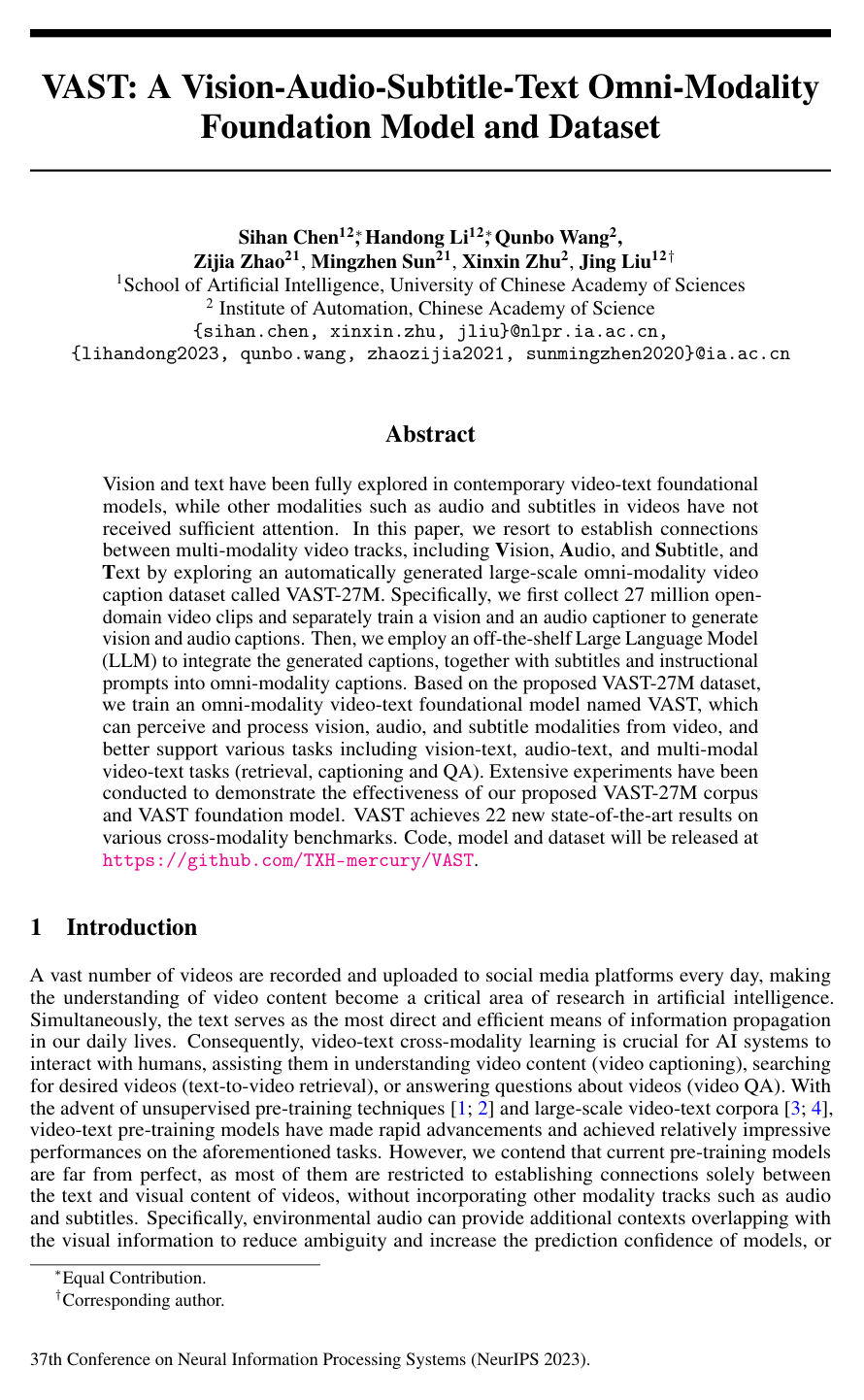
Vision and text have been fully explored in contemporary video-text foudational models, while other modalities such as audio and subtitles in videos have not received sufficient attention. In this paper, we resort to establish connections between multi-modality video tracks, including Vision, Audio, and Subtitle, and Text by exploring an automatically generated large-scale omni-modality video caption dataset called VAST-27M. Specifically, we first collect 27 million open-domain video clips and separately train a vision and an audio captioner to generate vision and audio captions. Then, we employ an off-the-shelf Large Language Model (LLM) to integrate the generated captions, together with subtitles and instructional prompts into omni-modality captions. Based on the proposed VAST-27M dataset, we train an omni-modality video-text foundational model named VAST, which can perceive and process vision, audio, and subtitle modalities from video, and better support various tasks including vision-text, audio-text, and multi-modal video-text tasks (retrieval, captioning and QA). Extensive experiments have been conducted to demonstrate the effectiveness of our proposed VAST-27M corpus and VAST foundation model. VAST achieves 22 new state-of-the-art results on various cross-modality benchmarks. Code, model and dataset will be released at https://github.com/TXH-mercury/VAST.

Added

2026-09-26