Extreme Compression of Large Language Models via Additive Quantization Vage Egiazarian, Andrei Panferov, Denis Kuznedelev, Elias Frantar, Artem Babenko, Dan Alistarh
Why you should read this Introduces AQLM, a multi-codebook quantization method that compresses large language model weights down to 2 bits per parameter while achieving state-of-the-art accuracy and matching 16-bit floating-point inference speeds on standard hardware.
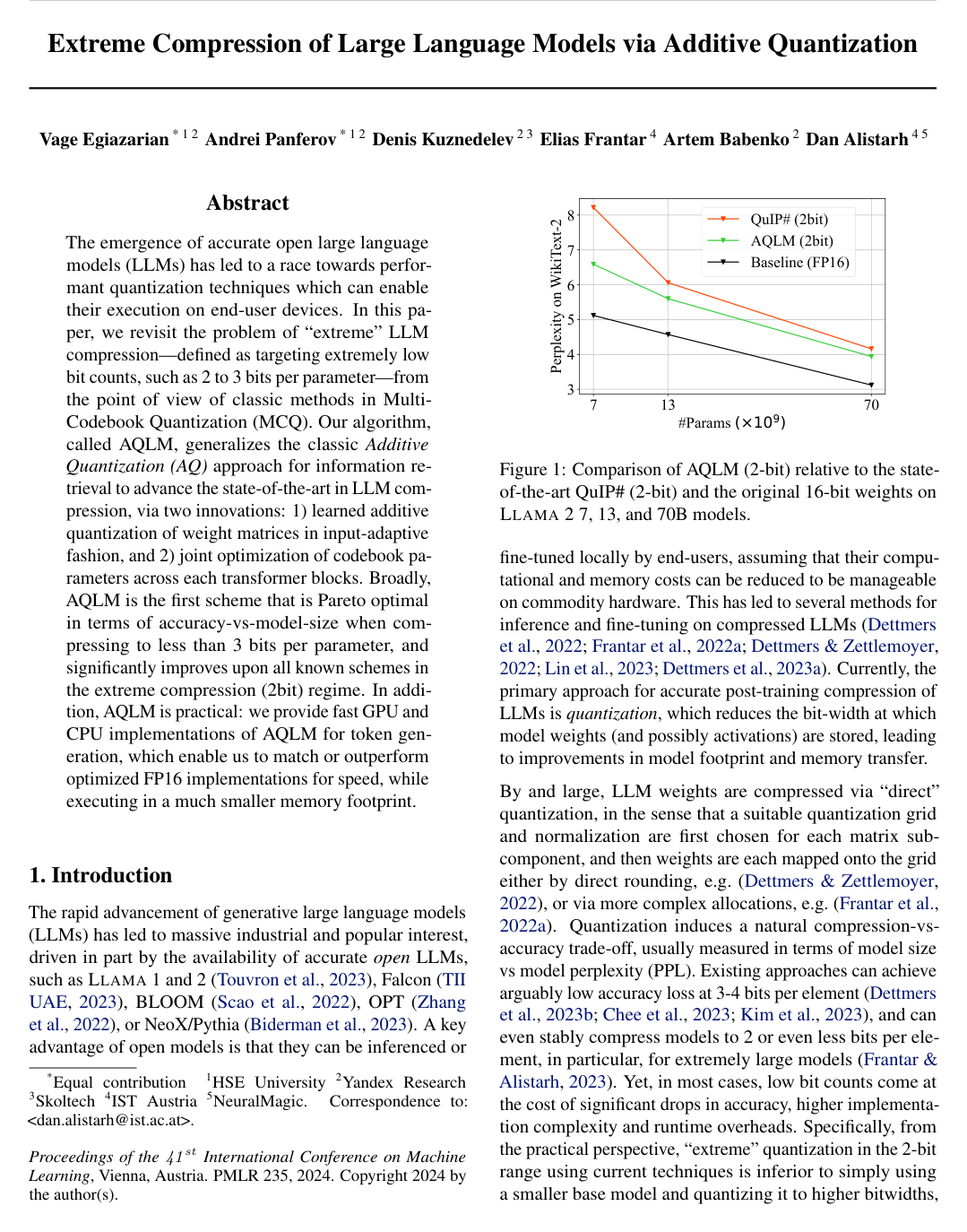
The emergence of accurate open large language models (LLMs) has led to a race towards performant quantization techniques which can enable their execution on end-user devices. In this paper, we revisit the problem of “extreme” LLM compression—defined as targeting extremely low bit counts, such as 2 to 3 bits per parameter—from the point of view of classic methods in Multi-Codebook Quantization (MCQ). Our algorithm, called AQLM, generalizes the classic Additive Quantization (AQ) approach for information retrieval to advance the state-of-the-art in LLM compression, via two innovations: 1) learned additive quantization of weight matrices in input-adaptive fashion, and 2) joint optimization of codebook parameters across each transformer blocks. Broadly, AQLM is the first scheme that is Pareto optimal in terms of accuracy-vs-model-size when compressing to less than 3 bits per parameter, and significantly improves upon all known schemes in the extreme compression (2bit) regime. In addition, AQLM is practical: we provide fast GPU and CPU implementations of AQLM for token generation, which enable us to match or outperform optimized FP16 implementations for speed, while executing in a much smaller memory footprint.