
keyword
multi-agent debate
Multi-agent debate is an artificial intelligence framework in which multiple autonomous agents, typically driven by large language models, engage in structured, iterative discussions and counter-arguments to solve complex tasks, evaluate content, or reach a consensus. Instead of relying on a single model attempting self-correction, this approach assigns distinct roles, perspectives, or domain expertise to individual agents who present, challenge, and refine one another's reasoning across multiple rounds of interaction. Often guided by an adjudicating agent or aggregated through consensus mechanisms, the debate process encourages divergent thinking, exposes logical flaws, and mitigates single-agent cognitive biases, thereby improving the overall accuracy, robustness, and reliability of generated solutions.
8 items
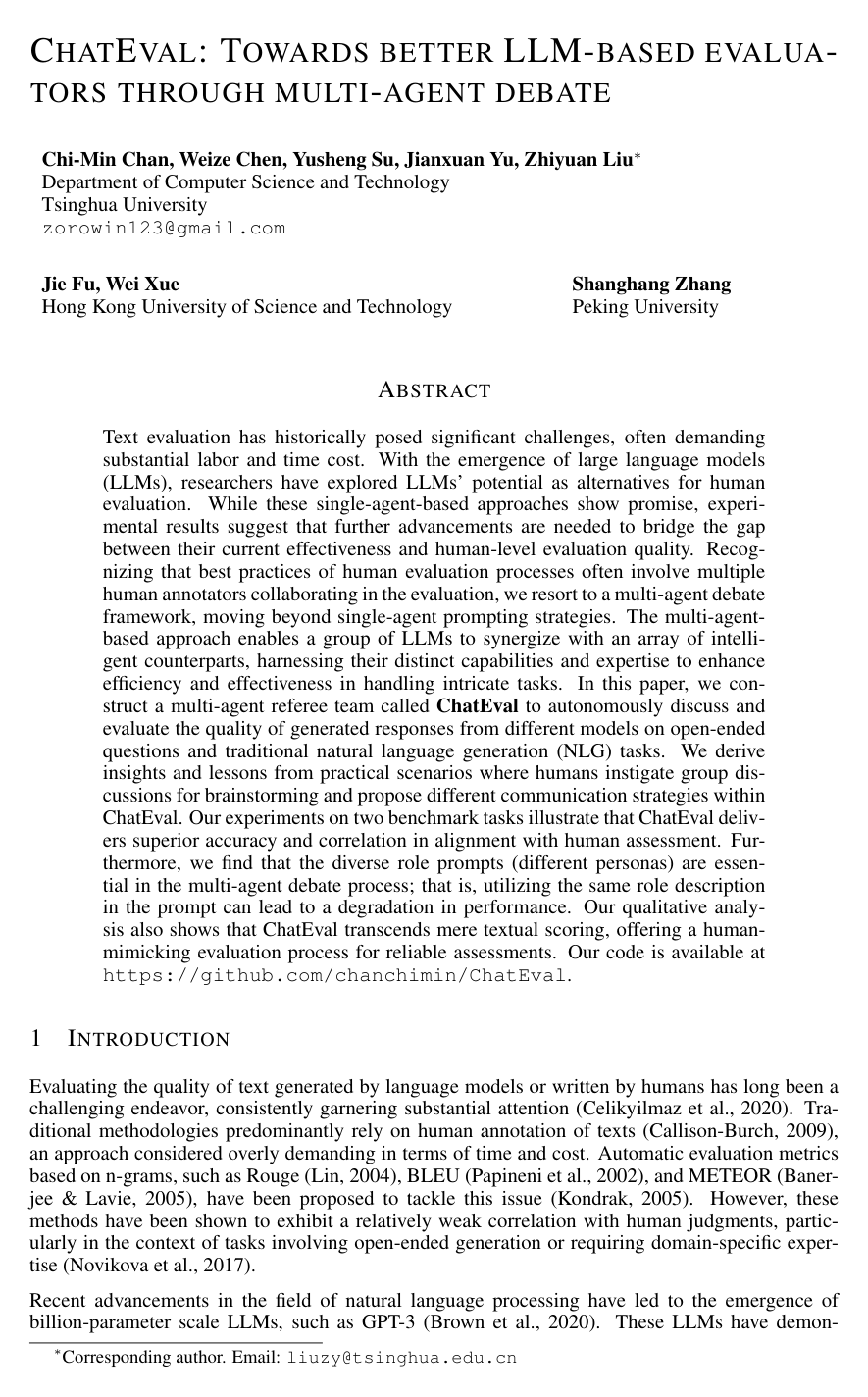
ChatEval: Towards Better LLM-based Evaluators through Multi-Agent Debate
Chi-Min Chan, Weize Chen, Yusheng Su, Jianxuan Yu, Wei Xue, Shanghang Zhang, Jie Fu, Zhiyuan Liu
Why you should read this
Introduces ChatEval, a multi-agent debate framework that uses autonomous discussions among diverse large language models to achieve more reliable, human-aligned evaluations of generated text than standard single-model scoring.
Text evaluation has historically posed significant challenges, often demanding substantial labor and time cost. With the emergence of large language models (LLMs), researchers have explored LLMs' potential as alternatives for human evaluation. While these single-agent-based approaches show promise, experimental results suggest that further advancements are needed to bridge the gap between their current effectiveness and human-level evaluation quality. Recognizing that best practices of human evaluation processes often involve multiple human annotators collaborating in the evaluation, we resort to a multi-agent debate framework, moving beyond single-agent prompting strategies. The multi-agent-based approach enables a group of LLMs to synergize with an array of intelligent counterparts, harnessing their distinct capabilities and expertise to enhance efficiency and effectiveness in handling intricate tasks. In this paper, we construct a multi-agent referee team called ChatEval to autonomously discuss and evaluate the quality of generated responses from different models on open-ended questions and traditional natural language generation (NLG) tasks. Our analysis shows that ChatEval transcends mere textual scoring, offering a human-mimicking evaluation process for reliable assessments. Our code is available at this https URL.
Added
2026-10-04
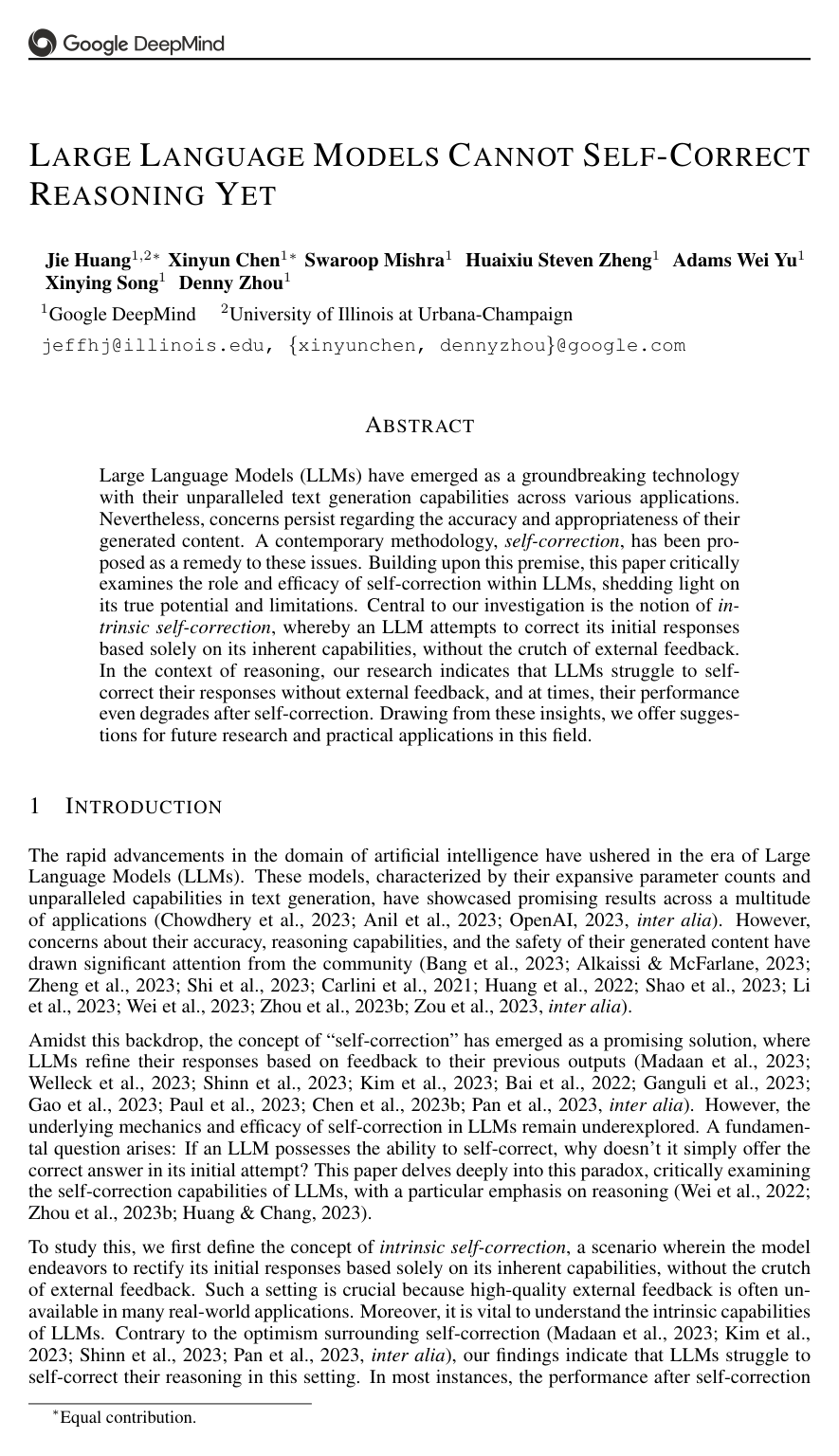
Large Language Models Cannot Self-Correct Reasoning Yet
Jie Huang, Xinyun Chen, Swaroop Mishra, Huaixiu Steven Zheng, Adams Wei Yu, Xinying Song, Denny Zhou
Why you should read this
Demonstrates that large language models cannot intrinsically correct their own reasoning errors without external feedback, revealing that unguided self-correction prompts often degrade rather than improve accuracy.
Large Language Models (LLMs) have emerged as a groundbreaking technology with their unparalleled text generation capabilities across various applications. Nevertheless, concerns persist regarding the accuracy and appropriateness of their generated content. A contemporary methodology, self-correction, has been proposed as a remedy to these issues. Building upon this premise, this paper critically examines the role and efficacy of self-correction within LLMs, shedding light on its true potential and limitations. Central to our investigation is the notion of intrinsic self-correction, whereby an LLM attempts to correct its initial responses based solely on its inherent capabilities, without the crutch of external feedback. In the context of reasoning, our research indicates that LLMs struggle to self-correct their responses without external feedback, and at times, their performance even degrades after self-correction. Drawing from these insights, we offer suggestions for future research and practical applications in this field.
Added
2026-10-04
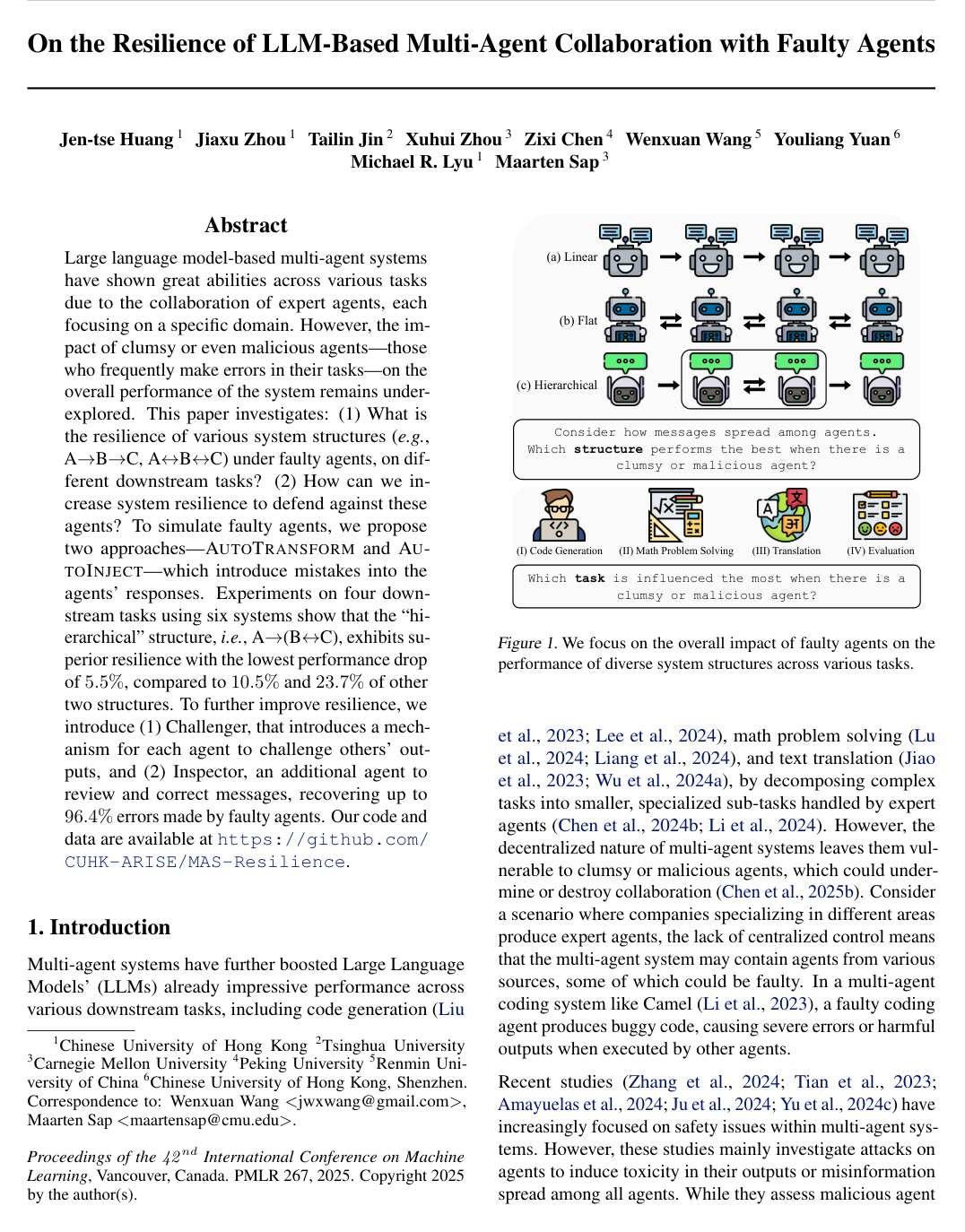
On the Resilience of LLM-Based Multi-Agent Collaboration with Faulty Agents
Jen-tse Huang, Jiaxu Zhou, Tailin Jin, Xuhui Zhou, Zixi Chen, Wenxuan Wang, Youliang Yuan, Michael R. Lyu, Maarten Sap
Why you should read this
Reveals how faulty agents degrade multi-agent LLM systems across different collaboration topologies, establishing that hierarchical workflows maintain the highest stability while introducing automated error injection methods and verification strategies that recover up to 96.4% of compromised performance.
Large language model-based multi-agent systems have shown great abilities across various tasks due to the collaboration of expert agents, each focusing on a specific domain. However, the impact of clumsy or even malicious agents—those who frequently make errors in their tasks—on the overall performance of the system remains under-explored. This paper investigates: (1) What is the resilience of various system structures (e.g., A→B→C, A↔B↔C) under faulty agents, on different downstream tasks? (2) How can we increase system resilience to defend against these agents? To simulate faulty agents, we propose two approaches—AutoTransform and AutoInject—which introduce mistakes into the agents’ responses. Experiments on four downstream tasks using six systems show that the “hierarchical” structure, i.e., A→(B↔C), exhibits superior resilience with the lowest performance drop of 5.5%, compared to 10.5% and 23.7% of other two structures. To further improve resilience, we introduce (1) Challenger, that introduces a mechanism for each agent to challenge others’ outputs, and (2) Inspector, an additional agent to review and correct messages, recovering up to 96.4% errors made by faulty agents. Our code and data are available at https://github.com/CUHK-ARISE/MAS-Resilience.
Added
2026-10-03
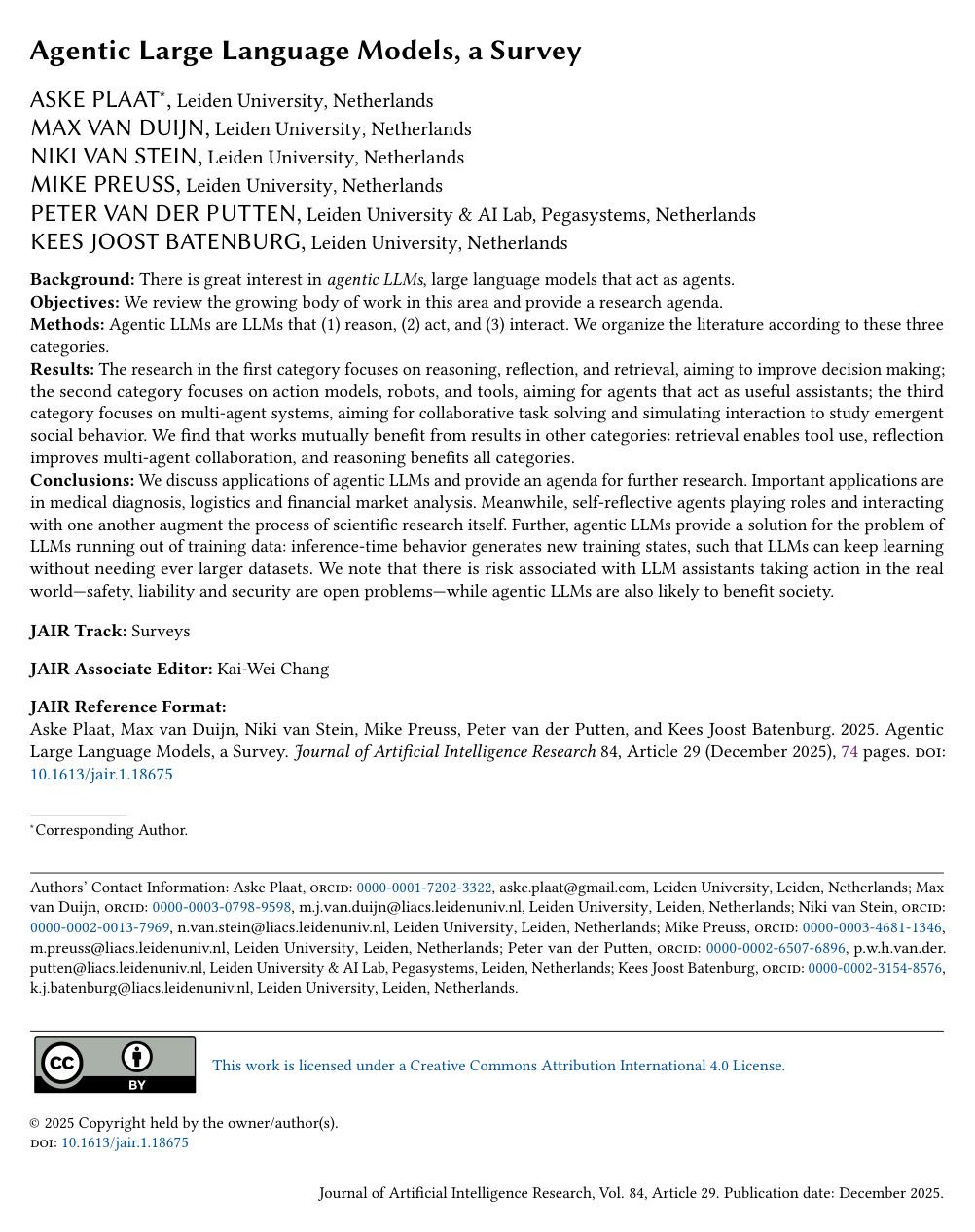
Agentic Large Language Models, a Survey
Aske Plaat, Max J. van Duijn, Niki van Stein, Mike Preuss, Peter van der Putten, Kees Joost Batenburg
Why you should read this
Categorizes autonomous language models across reasoning, acting, and social interaction to explain how agentic behaviors generate new training data and overcome data scaling limits.
Background: There is great interest in agentic LLMs, large language models that act as agents. Objectives: We review the growing body of work in this area and provide a research agenda. Methods: Agentic LLMs are LLMs that (1) reason, (2) act, and (3) interact. We organize the literature according to these three categories. Results: The research in the first category focuses on reasoning, reflection, and retrieval, aiming to improve decision making; the second category focuses on action models, robots, and tools, aiming for agents that act as useful assistants; the third category focuses on multi-agent systems, aiming for collaborative task solving and simulating interaction to study emergent social behavior. We find that works mutually benefit from results in other categories: retrieval enables tool use, reflection improves multi-agent collaboration, and reasoning benefits all categories. Conclusions: We discuss applications of agentic LLMs and provide an agenda for further research. Important applications are in medical diagnosis, logistics and financial market analysis. Meanwhile, self-reflective agents playing roles and interacting with one another augment the process of scientific research itself. Further, agentic LLMs provide a solution for the problem of LLMs running out of training data: inference-time behavior generates new training states, such that LLMs can keep learning without needing ever larger datasets. We note that there is risk associated with LLM assistants taking action in the real world—safety, liability and security are open problems—while agentic LLMs are also likely to benefit society.
Added
2026-10-02
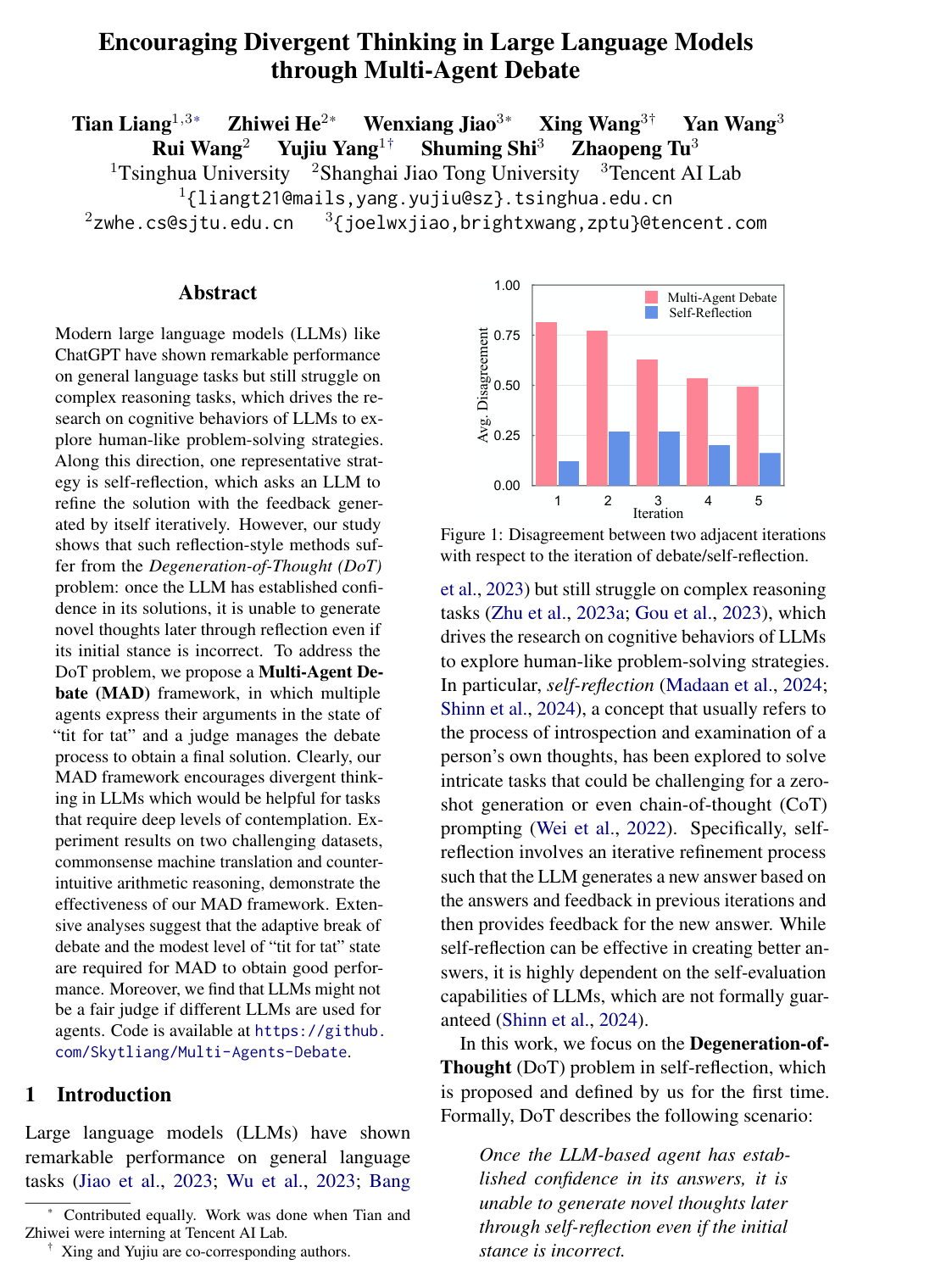
Encouraging Divergent Thinking in Large Language Models through Multi-Agent Debate
Tian Liang, Zhiwei He, Wenxiang Jiao, Xing Wang, Yan Wang, Rui Wang, Yujiu Yang, Shuming Shi, Zhaopeng Tu
Why you should read this
Proposes a multi-agent debate framework that overcomes the cognitive stagnation of single-model self-reflection by using competing agents and an impartial judge to stimulate divergent thinking in complex reasoning tasks.
Modern large language models (LLMs) like ChatGPT have shown remarkable performance on general language tasks but still struggle on complex reasoning tasks, which drives the research on cognitive behaviors of LLMs to explore human-like problem-solving strategies. Along this direction, one representative strategy is self-reflection, which asks an LLM to refine the solution with the feedback generated by itself iteratively. However, our study shows that such reflection-style methods suffer from the Degeneration-of-Thought (DoT) problem: once the LLM has established confidence in its solutions, it is unable to generate novel thoughts later through reflection even if its initial stance is incorrect. To address the DoT problem, we propose a Multi-Agent Debate (MAD) framework, in which multiple agents express their arguments in the state of "tit for tat" and a judge manages the debate process to obtain a final solution. Clearly, our MAD framework encourages divergent thinking in LLMs which would be helpful for tasks that require deep levels of contemplation. Experiment results on two challenging datasets, commonsense machine translation and counter-intuitive arithmetic reasoning, demonstrate the effectiveness of our MAD framework. Extensive analyses suggest that the adaptive break of debate and the modest level of "tit for tat" state are required for MAD to obtain good performance. Moreover, we find that LLMs might not be a fair judge if different LLMs are used for agents. Code is available at this https URL.
Added
2026-09-25
The Rise and Potential of Large Language Model Based Agents: A Survey
Zhiheng Xi, Wenxiang Chen, Xin Guo, Wei He, Yiwen Ding, Boyang Hong, Ming Zhang, Junzhe Wang, Senjie Jin, Enyu Zhou, Rui Zheng, Xiaoran Fan, Xiao Wang, Limao Xiong, Qin Liu, Yuhao Zhou, Weiran Wang, Changhao Jiang, Yicheng Zou, Xiangyang Liu, Zhangyue Yin, Shihan Dou, Rongxiang Weng, Wensen Cheng, Qi Zhang, Wenjuan Qin, Yong-Yan Zheng, Xipeng Qiu, X. Huan, Tao Gui
Why you should read this
Presents a unified architectural framework consisting of brain, perception, and action modules for large language model-based agents while systematically examining their applications across single-agent, multi-agent, and human-collaborative environments.
For a long time, humanity has pursued artificial intelligence (AI) equivalent to or surpassing the human level, with AI agents considered a promising vehicle for this pursuit. AI agents are artificial entities that sense their environment, make decisions, and take actions. Many efforts have been made to develop intelligent agents, but they mainly focus on advancement in algorithms or training strategies to enhance specific capabilities or performance on particular tasks. Actually, what the community lacks is a general and powerful model to serve as a starting point for designing AI agents that can adapt to diverse scenarios. Due to the versatile capabilities they demonstrate, large language models (LLMs) are regarded as potential sparks for Artificial General Intelligence (AGI), offering hope for building general AI agents. Many researchers have leveraged LLMs as the foundation to build AI agents and have achieved significant progress. In this paper, we perform a comprehensive survey on LLM-based agents. We start by tracing the concept of agents from its philosophical origins to its development in AI, and explain why LLMs are suitable foundations for agents. Building upon this, we present a general framework for LLM-based agents, comprising three main components: brain, perception, and action, and the framework can be tailored for different applications. Subsequently, we explore the extensive applications of LLM-based agents in three aspects: single-agent scenarios, multi-agent scenarios, and human-agent cooperation. Following this, we delve into agent societies, exploring the behavior and personality of LLM-based agents, the social phenomena that emerge from an agent society, and the insights they offer for human society. Finally, we discuss several key topics and open problems within the field. A repository for the related papers at this https URL.
Added
2026-09-18
Dive into Claude Code: The Design Space of Today's and Future AI Agent Systems
Jiacheng Liu, Xiaohan Zhao, Xinyi Shang, Zhiqiang Shen
Why you should read this
Explains the architecture of a production-grade AI agent system (Claude Code) by analyzing its source code and comparing it with another system (OpenClaw), offering invaluable insights into how human values, design principles, and deployment contexts shape complex AI architecture, and outlining critical future design directions for agent systems.
Claude Code is an agentic coding tool that can run shell commands, edit files, and call external services on behalf of the user. This study describes its comprehensive architecture by analyzing the publicly available TypeScript source code and further comparing it with OpenClaw, an independent open-source AI agent system that answers many of the same design questions from a different deployment context. Our analysis identifies five human values, philosophies, and needs that motivate the architecture (human decision authority, safety and security, reliable execution, capability amplification, and contextual adaptability) and traces them through thirteen design principles to specific implementation choices. The core of the system is a simple while-loop that calls the model, runs tools, and repeats. Most of the code, however, lives in the systems around this loop: a permission system with seven modes and an ML-based classifier, a five-layer compaction pipeline for context management, four extensibility mechanisms (MCP, plugins, skills, and hooks), a subagent delegation mechanism with worktree isolation, and append-oriented session storage. A comparison with OpenClaw, a multi-channel personal assistant gateway, shows that the same recurring design questions produce different architectural answers when the deployment context changes: from per-action safety classification to perimeter-level access control, from a single CLI loop to an embedded runtime within a gateway control plane, and from context-window extensions to gateway-wide capability registration. We finally identify six open design directions for future agent systems, grounded in recent empirical, architectural, and policy literature.
Added
2026-04-18
License
Published with permission
Mixture-of-Agents Enhances Large Language Model Capabilities
Junlin Wang, Jue Wang, Ben Athiwaratkun, Ce Zhang, James Zou
Why you should read this
Develops a novel Mixture-of-Agents (MoA) methodology that leverages the collective strengths of multiple LLMs to achieve state-of-the-art performance, even surpassing GPT-4 Omni, by enabling them to iteratively refine responses.
Recent advances in large language models (LLMs) demonstrate substantial capabilities in natural language understanding and generation tasks. With the growing number of LLMs, how to harness the collective expertise of multiple LLMs is an exciting open direction. Toward this goal, we propose a new approach that leverages the collective strengths of multiple LLMs through a Mixture-of-Agents (MoA) methodology. In our approach, we construct a layered MoA architecture wherein each layer comprises multiple LLM agents. Each agent takes all the outputs from agents in the previous layer as auxiliary information in generating its response. MoA models achieves state-of-art performance on AlpacaEval 2.0, MT-Bench and FLASK, surpassing GPT-4 Omni. For example, our MoA using only open-source LLMs is the leader of AlpacaEval 2.0 by a substantial gap, achieving a score of 65.1% compared to 57.5% by GPT-4 Omni.
Added
2025-12-14
