
keyword
MS-COCO dataset
The MS-COCO dataset, short for Microsoft Common Objects in Context, is a large-scale visual dataset widely used for training and benchmarking computer vision and machine learning models. It consists of hundreds of thousands of images depicting complex everyday scenes where common objects appear in their natural environments alongside multiple other items. The dataset is distinguished by its extensive multi-task annotations, which provide pixel-level instance segmentation masks, bounding boxes for object localization, keypoints for human pose estimation, and natural language descriptive captions for each image. Covering tens of object categories and dense background classes, MS-COCO serves as a standard benchmark in research for core visual understanding tasks, including object detection, instance segmentation, semantic segmentation, and automated image captioning.
18 items
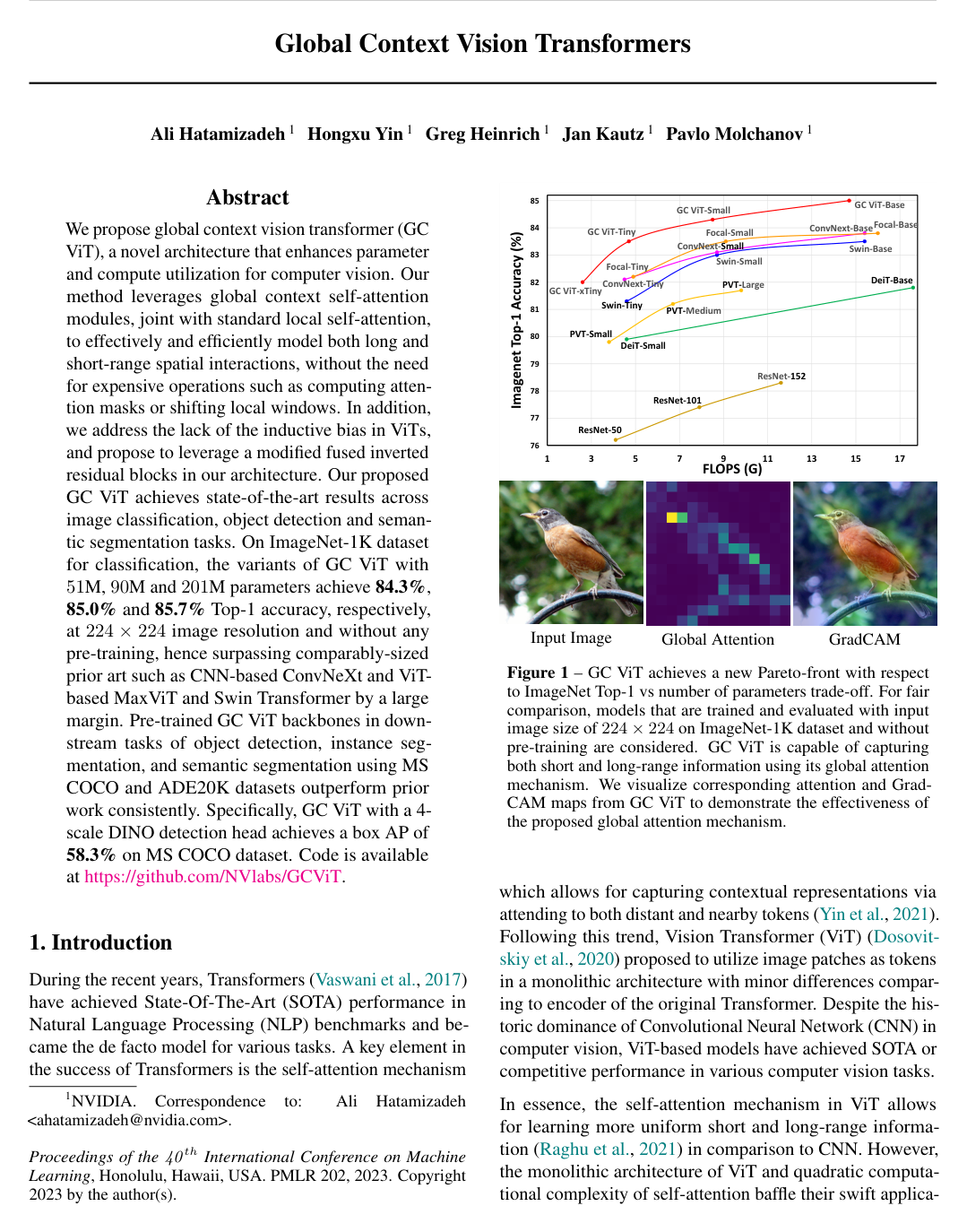
Global Context Vision Transformers
Ali Hatamizadeh, Hongxu Yin, Greg Heinrich, Jan Kautz, Pavlo Molchanov
Why you should read this
Proposes Global Context Vision Transformer (GC ViT), an architecture combining local self-attention with CNN-generated global query tokens and modified fused inverted residual blocks to capture multi-scale spatial dependencies without costly shifted-window computations, achieving superior performance on ImageNet-1K, MS COCO, and ADE20K.
We propose global context vision transformer (GC ViT), a novel architecture that enhances parameter and compute utilization for computer vision. Our method leverages global context self-attention modules, joint with standard local self-attention, to effectively and efficiently model both long and short-range spatial interactions, without the need for expensive operations such as computing attention masks or shifting local windows. In addition, we address the lack of the inductive bias in ViTs, and propose to leverage a modified fused inverted residual blocks in our architecture. Our proposed GC ViT achieves state-of-the-art results across image classification, object detection and semantic segmentation tasks. On ImageNet-1K dataset for classification, the variants of GC ViT with 51M, 90M and 201M parameters achieve 84.3%, 85.0% and 85.7% Top-1 accuracy, respectively, at 224 × 224 image resolution and without any pre-training, hence surpassing comparably-sized prior art such as CNN-based ConvNeXt and ViT-based MaxViT and Swin Transformer by a large margin. Pre-trained GC ViT backbones in downstream tasks of object detection, instance segmentation, and semantic segmentation using MS COCO and ADE20K datasets outperform prior work consistently. Specifically, GC ViT with a 4-scale DINO detection head achieves a box AP of 58.3% on MS COCO dataset. Code is available at https://github.com/NVlabs/GCViT.
Added
2026-10-05
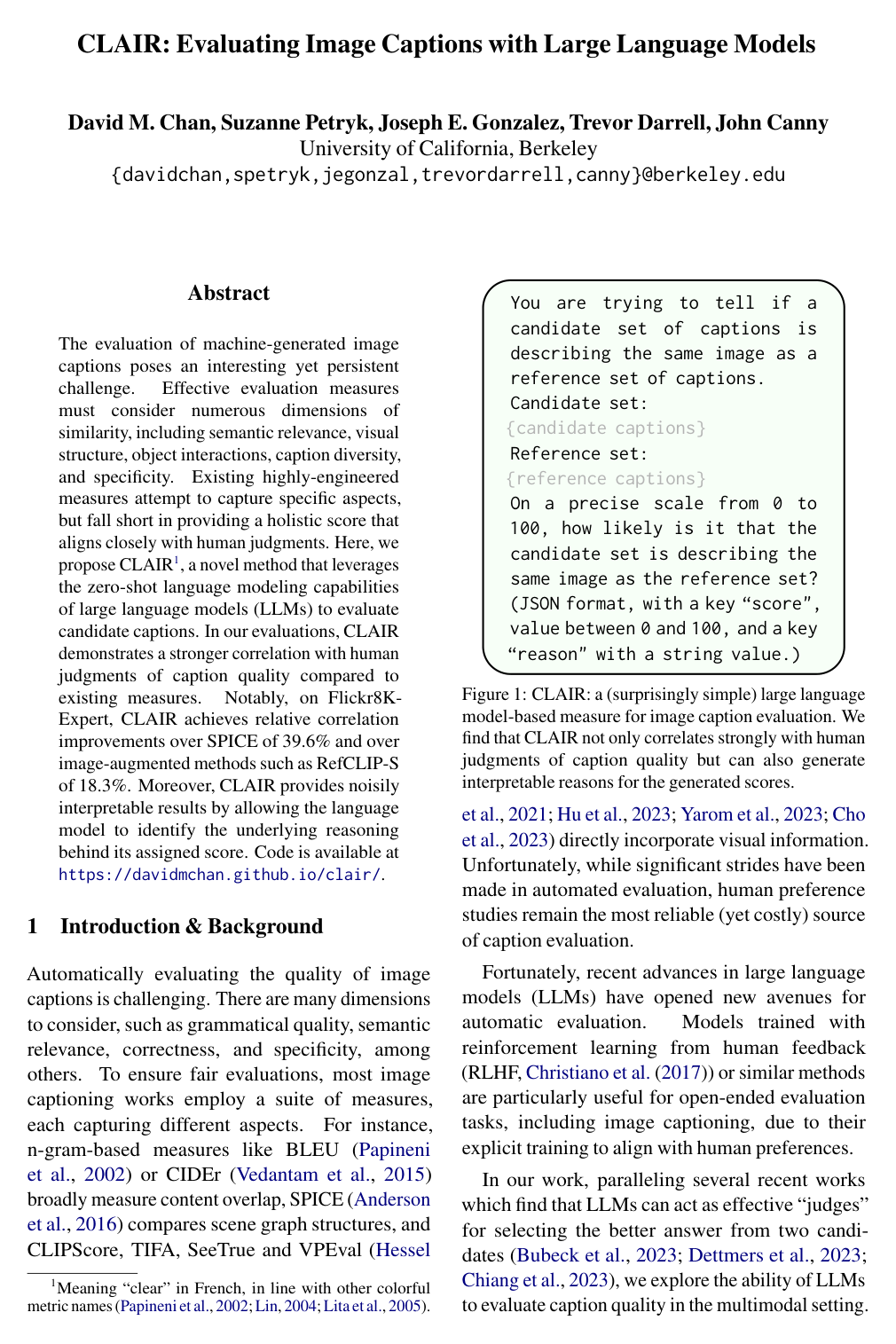
CLAIR: Evaluating Image Captions with Large Language Models
David M. Chan, Suzanne Petryk, Joseph Gonzalez, Trevor Darrell, John F. Canny
Why you should read this
Proposes CLAIR, a zero-shot image caption evaluation metric that uses large language models to produce quality scores and interpretable natural language explanations that align significantly closer with human judgment than traditional metrics like SPICE and RefCLIP-S.
The evaluation of machine-generated image captions poses an interesting yet persistent challenge. Effective evaluation measures must consider numerous dimensions of similarity, including semantic relevance, visual structure, object interactions, caption diversity, and specificity. Existing highly-engineered measures attempt to capture specific aspects, but fall short in providing a holistic score that aligns closely with human judgments. Here, we propose CLAIR¹, a novel method that leverages the zero-shot language modeling capabilities of large language models (LLMs) to evaluate candidate captions. In our evaluations, CLAIR demonstrates a stronger correlation with human judgments of caption quality compared to existing measures. Notably, on Flickr8K-Expert, CLAIR achieves relative correlation improvements over SPICE of 39.6% and over image-augmented methods such as RefCLIP-S of 18.3%. Moreover, CLAIR provides noisy interpretable results by allowing the language model to identify the underlying reasoning behind its assigned score. Code is available at https://davidmchan.github.io/clair/.
Added
2026-10-04
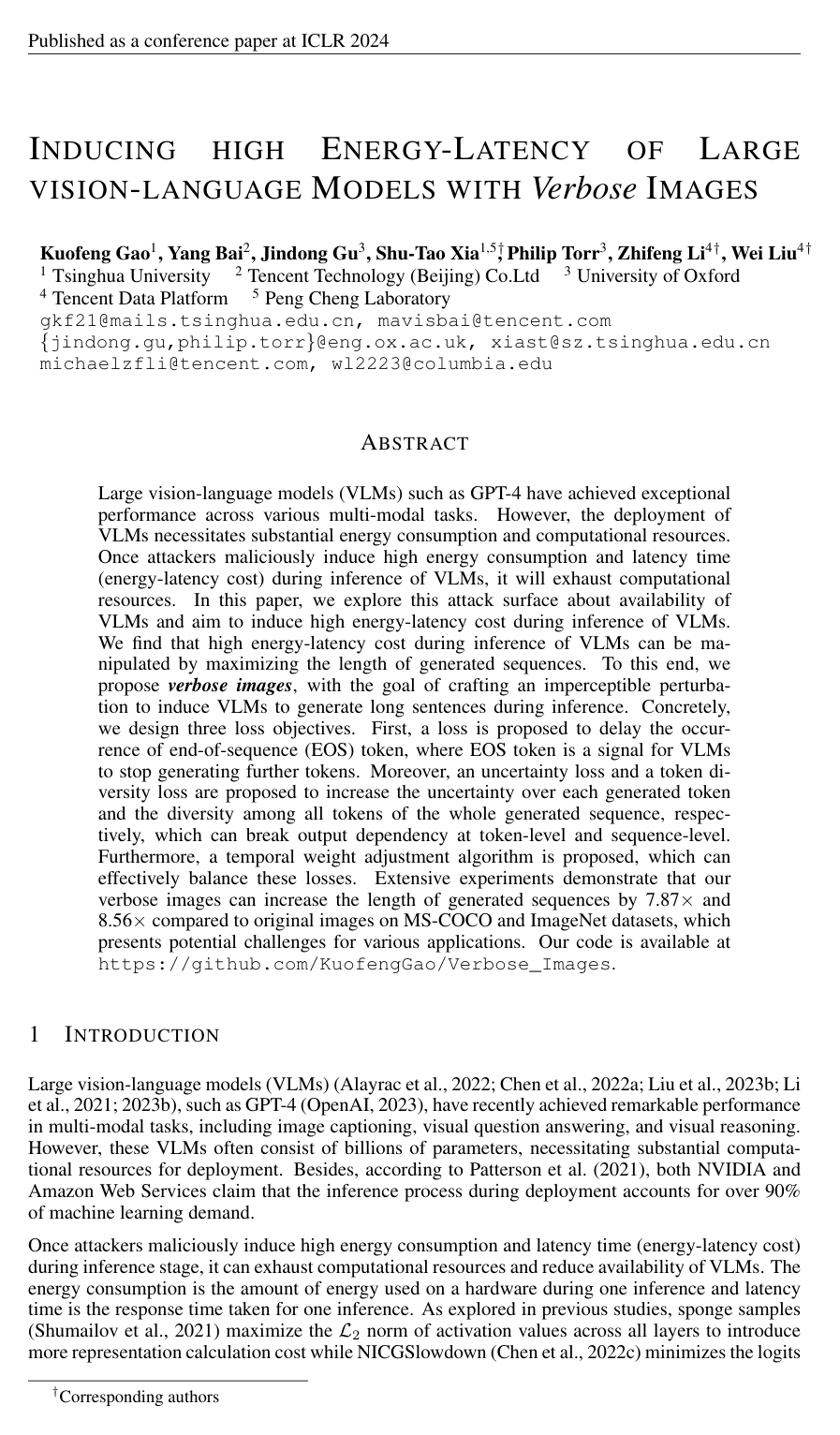
Inducing High Energy-Latency of Large Vision-Language Models with Verbose Images
Kuofeng Gao, Yang Bai, Jindong Gu, Shu-Tao Xia, Philip Torr, Zhifeng Li, Wei Liu
Why you should read this
Demonstrates a severe availability vulnerability in vision-language models by generating imperceptible image perturbations that delay termination tokens to multiply output lengths more than eightfold and exhaust computational resources.
Large vision-language models (VLMs) such as GPT-4 have achieved exceptional performance across various multi-modal tasks. However, the deployment of VLMs necessitates substantial energy consumption and computational resources. Once attackers maliciously induce high energy consumption and latency time (energy-latency cost) during inference of VLMs, it will exhaust computational resources. In this paper, we explore this attack surface about availability of VLMs and aim to induce high energy-latency cost during inference of VLMs. We find that high energy-latency cost during inference of VLMs can be manipulated by maximizing the length of generated sequences. To this end, we propose verbose images, with the goal of crafting an imperceptible perturbation to induce VLMs to generate long sentences during inference. Concretely, we design three loss objectives. First, a loss is proposed to delay the occurrence of end-of-sequence (EOS) token, where EOS token is a signal for VLMs to stop generating further tokens. Moreover, an uncertainty loss and a token diversity loss are proposed to increase the uncertainty over each generated token and the diversity among all tokens of the whole generated sequence, respectively, which can break output dependency at token-level and sequence-level. Furthermore, a temporal weight adjustment algorithm is proposed, which can effectively balance these losses. Extensive experiments demonstrate that our verbose images can increase the length of generated sequences by 7.87 times and 8.56 times compared to original images on MS-COCO and ImageNet datasets, which presents potential challenges for various applications. Our code is available at this https URL.
Added
2026-09-26
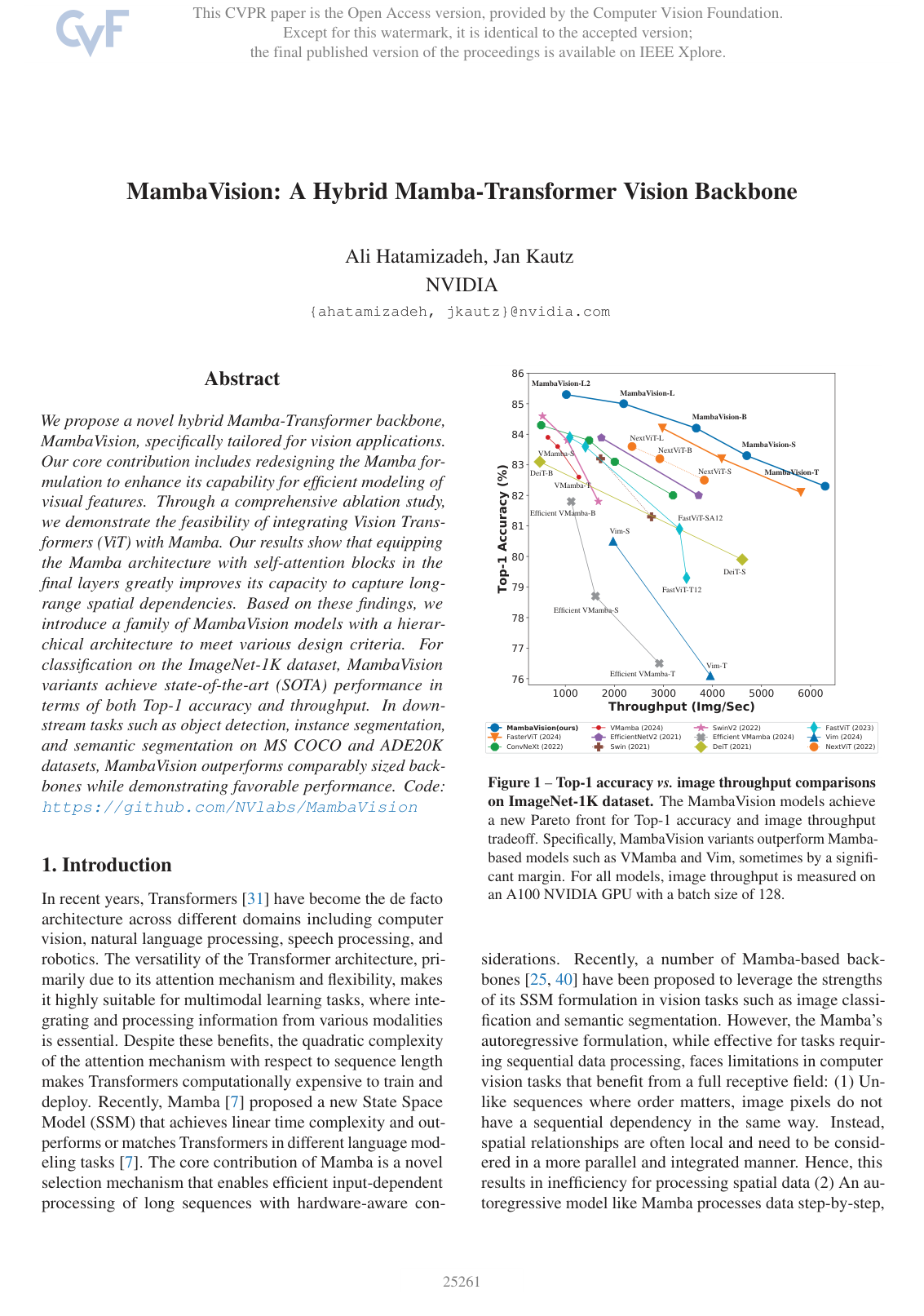
MambaVision: A Hybrid Mamba-Transformer Vision Backbone
Ali Hatamizadeh, Jan Kautz
Why you should read this
Introduces a hybrid vision backbone that strategically places self-attention layers after redesigned Mamba blocks, establishing a new Pareto frontier for the trade-off between ImageNet-1K accuracy and image throughput.
We propose a novel hybrid Mamba-Transformer backbone, MambaVision, specifically tailored for vision applications. Our core contribution includes redesigning the Mamba formulation to enhance its capability for efficient modeling of visual features. Through a comprehensive ablation study, we demonstrate the feasibility of integrating Vision Transformers (ViT) with Mamba. Our results show that equipping the Mamba architecture with self-attention blocks in the final layers greatly improves its capacity to capture long-range spatial dependencies. Based on these findings, we introduce a family of MambaVision models with a hierarchical architecture to meet various design criteria. For classification on the ImageNet-1K dataset, MambaVision variants achieve state-of-the-art (SOTA) performance in terms of both Top-1 accuracy and throughput. In downstream tasks such as object detection, instance segmentation, and semantic segmentation on MS COCO and ADE20K datasets, MambaVision outperforms comparably sized backbones while demonstrating favorable performance. Code: https://github.com/NVlabs/MambaVision
Added
2026-09-26
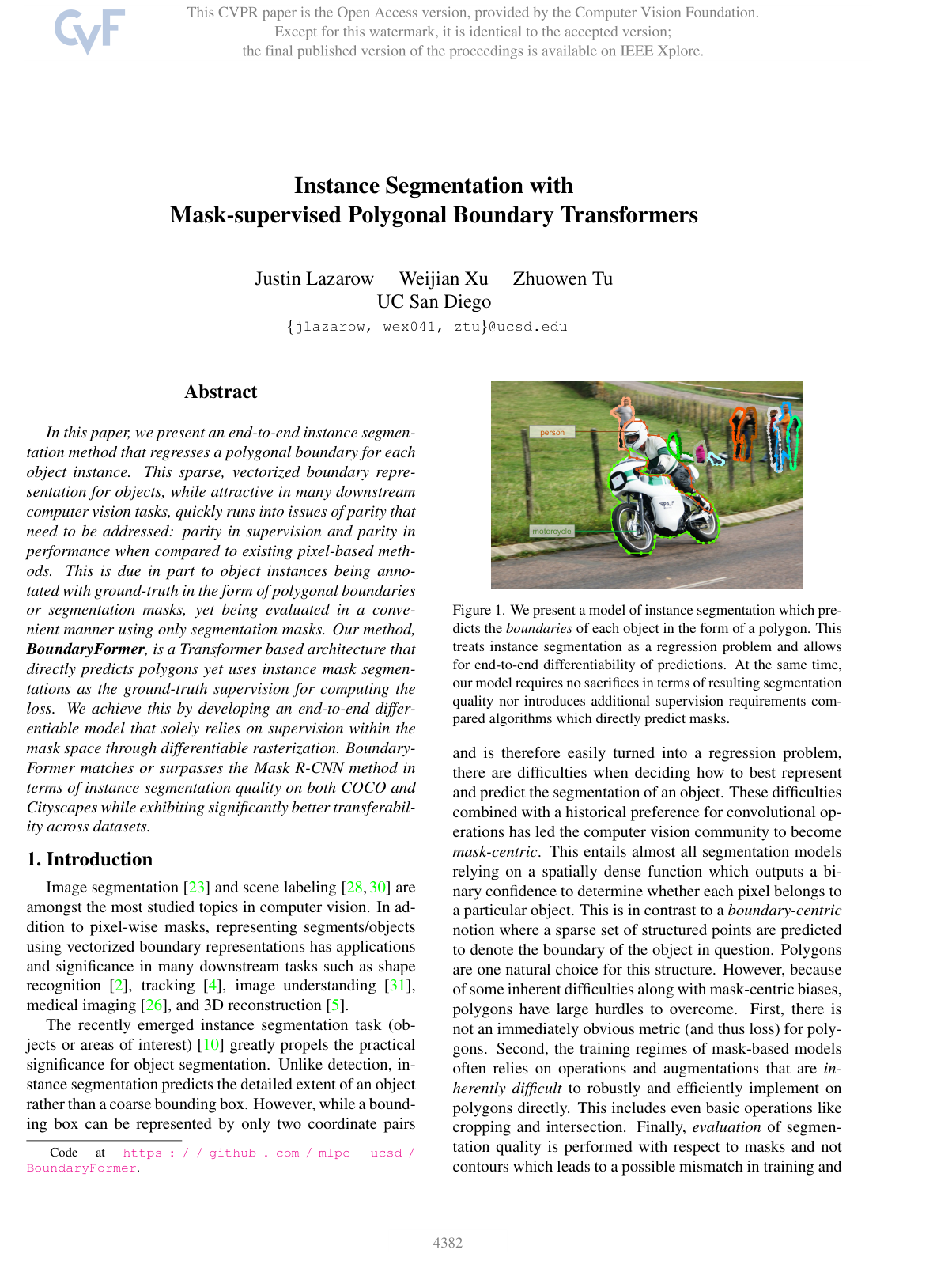
Instance Segmentation with Mask-supervised Polygonal Boundary Transformers
Justin Lazarow, Weijian Xu, Zhuowen Tu
Why you should read this
Introduces BoundaryFormer, an end-to-end framework that directly predicts object boundary polygons supervised solely by pixel masks via differentiable rasterization, matching or outperforming Mask R-CNN on standard benchmarks without requiring polygon annotations.
In this paper, we present an end-to-end instance segmentation method that regresses a polygonal boundary for each object instance. This sparse, vectorized boundary representation for objects, while attractive in many downstream computer vision tasks, quickly runs into issues of parity that need to be addressed: parity in supervision and parity in performance when compared to existing pixel-based methods. This is due in part to object instances being annotated with ground-truth in the form of polygonal boundaries or segmentation masks, yet being evaluated in a conventional manner using only segmentation masks. Our method, BoundaryFormer, is a Transformer based architecture that directly predicts polygons yet uses instance mask segmentations as the ground-truth supervision for computing the loss. We achieve this by developing an end-to-end differentiable model that solely relies on supervision within the mask space through differentiable rasterization. BoundaryFormer matches or surpasses the Mask R-CNN method in terms of instance segmentation quality on both COCO and Cityscapes while exhibiting significantly better transferability across datasets.
Added
2026-09-26
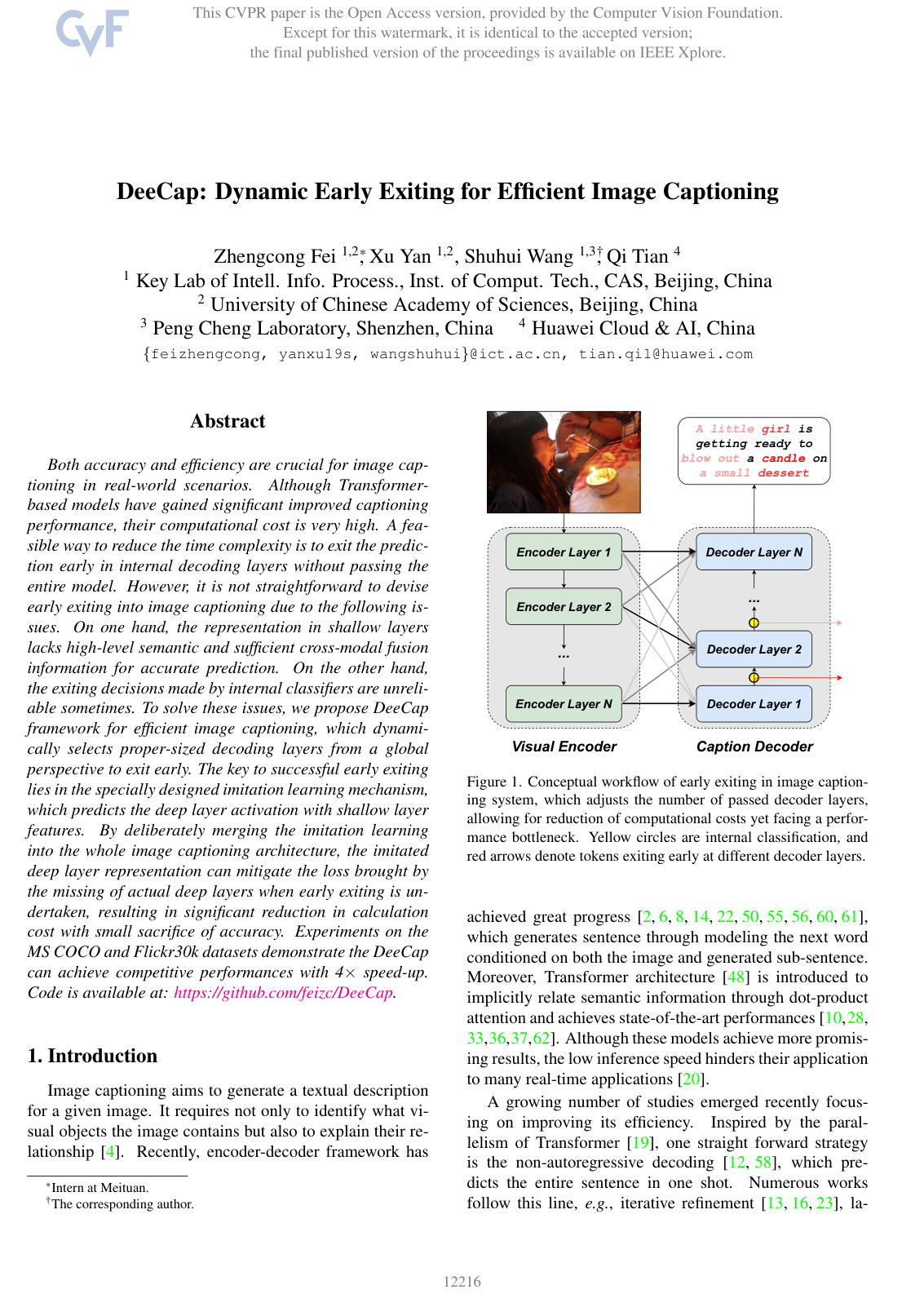
DeeCap: Dynamic Early Exiting for Efficient Image Captioning
Zhengcong Fei, Xu Yan, Shuhui Wang, Qi Tian
Why you should read this
Proposes DeeCap, an efficient image captioning framework that uses imitation learning to approximate deep layer representations from shallow features, enabling dynamic early exiting in Transformer decoders to achieve a 4x inference speed-up with minimal accuracy loss.
Both accuracy and efficiency are crucial for image captioning in real-world scenarios. Although Transformer-based models have gained significant improved captioning performance, their computational cost is very high. A feasible way to reduce the time complexity is to exit the prediction early in internal decoding layers without passing the entire model. However, it is not straightforward to devise early exiting into image captioning due to the following issues. On one hand, the representation in shallow layers lacks high-level semantic and sufficient cross-modal fusion information for accurate prediction. On the other hand, the exiting decisions made by internal classifiers are unreliable sometimes. To solve these issues, we propose DeeCap framework for efficient image captioning, which dynamically selects proper-sized decoding layers from a global perspective to exit early. The key to successful early exiting lies in the specially designed imitation learning mechanism, which predicts the deep layer activation with shallow layer features. By deliberately merging the imitation learning into the whole image captioning architecture, the imitated deep layer representation can mitigate the loss brought by the missing of actual deep layers when early exiting is undertaken, resulting in significant reduction in calculation cost with small sacrifice of accuracy. Experiments on the MS COCO and Flickr30k datasets demonstrate the DeeCap can achieve competitive performances with 4× speed-up. Code is available at: https://github.com/feizc/DeeCap.
Added
2026-09-26
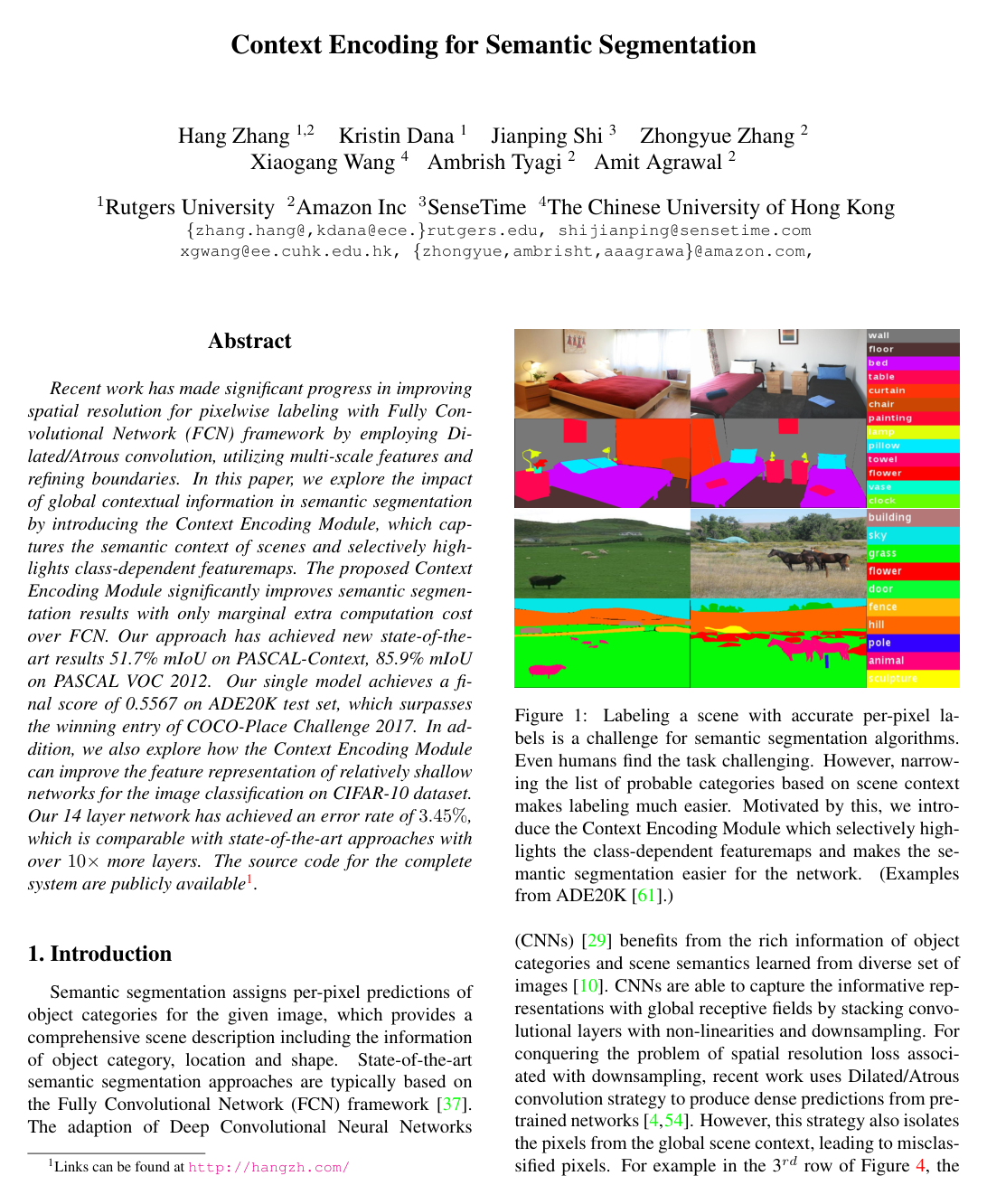
Context Encoding for Semantic Segmentation
Hang Zhang, Kristin Dana, Jianping Shi, Zhongyue Zhang, Xiaogang Wang, Ambrish Tyagi, Amit Agrawal
Why you should read this
Introduces a Context Encoding Module that captures global scene context to selectively emphasize relevant class feature maps, setting state-of-the-art semantic segmentation performance on standard benchmarks while adding minimal computational overhead.
Recent work has made significant progress in improving spatial resolution for pixelwise labeling with Fully Convolutional Network (FCN) framework by employing Dilated/Atrous convolution, utilizing multi-scale features and refining boundaries. In this paper, we explore the impact of global contextual information in semantic segmentation by introducing the Context Encoding Module, which captures the semantic context of scenes and selectively highlights class-dependent featuremaps. The proposed Context Encoding Module significantly improves semantic segmentation results with only marginal extra computation cost over FCN. Our approach has achieved new state-of-the-art results 51.7% mIoU on PASCAL-Context, 85.9% mIoU on PASCAL VOC 2012. Our single model achieves a final score of 0.5567 on ADE20K test set, which surpass the winning entry of COCO-Place Challenge in 2017. In addition, we also explore how the Context Encoding Module can improve the feature representation of relatively shallow networks for the image classification on CIFAR-10 dataset. Our 14 layer network has achieved an error rate of 3.45%, which is comparable with state-of-the-art approaches with over 10 times more layers. The source code for the complete system are publicly available.
Added
2026-09-25
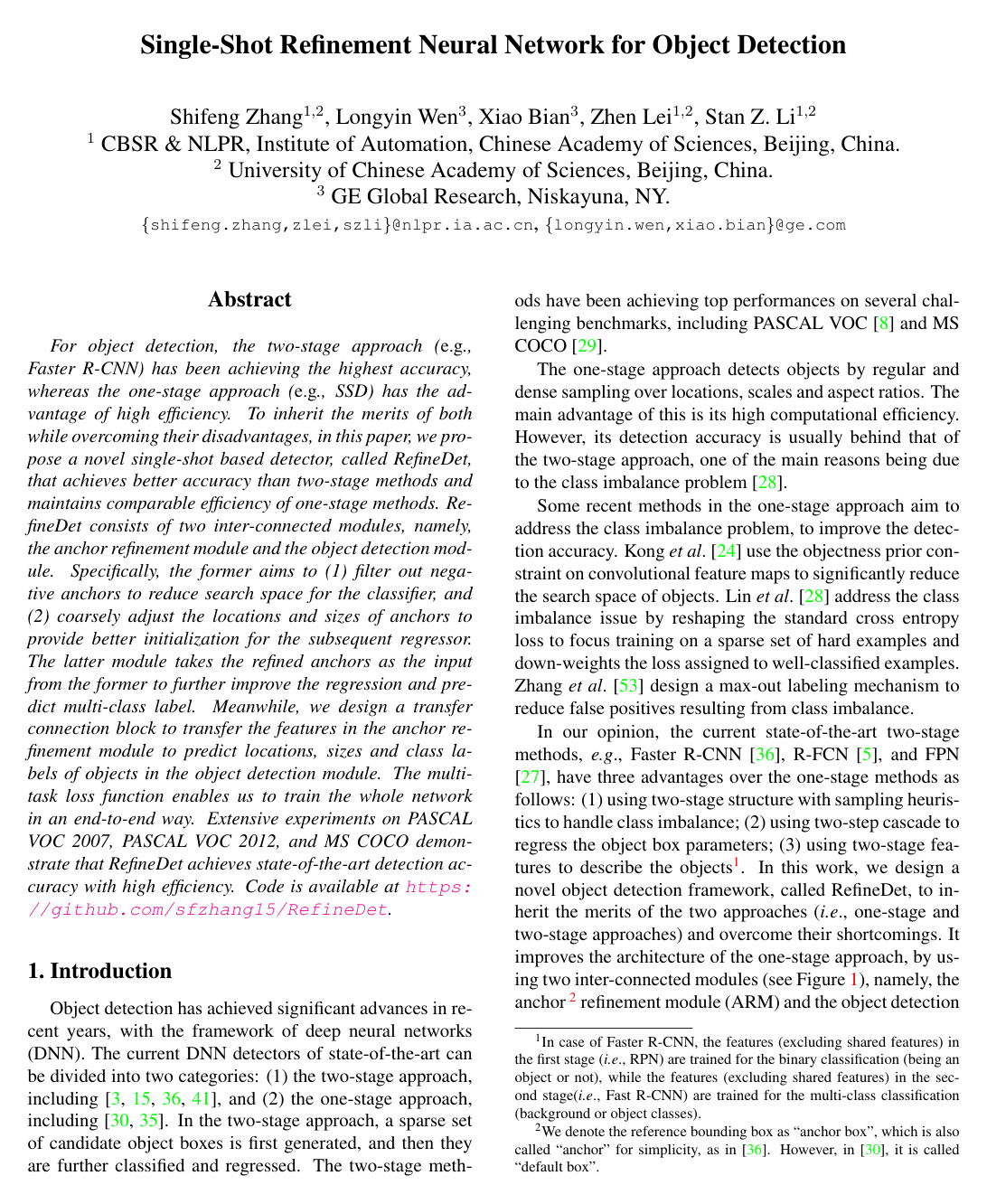
Single-Shot Refinement Neural Network for Object Detection
Shifeng Zhang, Longyin Wen, Xiao Bian, Zhen Lei, Stan Z. Li
Why you should read this
Proposes RefineDet, an object detector that combines the high accuracy of two-stage methods with the fast inference of single-stage models by using anchor refinement and feature transfer modules to filter false positives and optimize bounding boxes before final classification.
For object detection, the two-stage approach (e.g., Faster R-CNN) has been achieving the highest accuracy, whereas the one-stage approach (e.g., SSD) has the advantage of high efficiency. To inherit the merits of both while overcoming their disadvantages, in this paper, we propose a novel single-shot based detector, called RefineDet, that achieves better accuracy than two-stage methods and maintains comparable efficiency of one-stage methods. RefineDet consists of two inter-connected modules, namely, the anchor refinement module and the object detection module. Specifically, the former aims to (1) filter out negative anchors to reduce search space for the classifier, and (2) coarsely adjust the locations and sizes of anchors to provide better initialization for the subsequent regressor. The latter module takes the refined anchors as the input from the former to further improve the regression and predict multi-class label. Meanwhile, we design a transfer connection block to transfer the features in the anchor refinement module to predict locations, sizes and class labels of objects in the object detection module. The multi-task loss function enables us to train the whole network in an end-to-end way. Extensive experiments on PASCAL VOC 2007, PASCAL VOC 2012, and MS COCO demonstrate that RefineDet achieves state-of-the-art detection accuracy with high efficiency. Code is available at this https URL
Added
2026-09-25
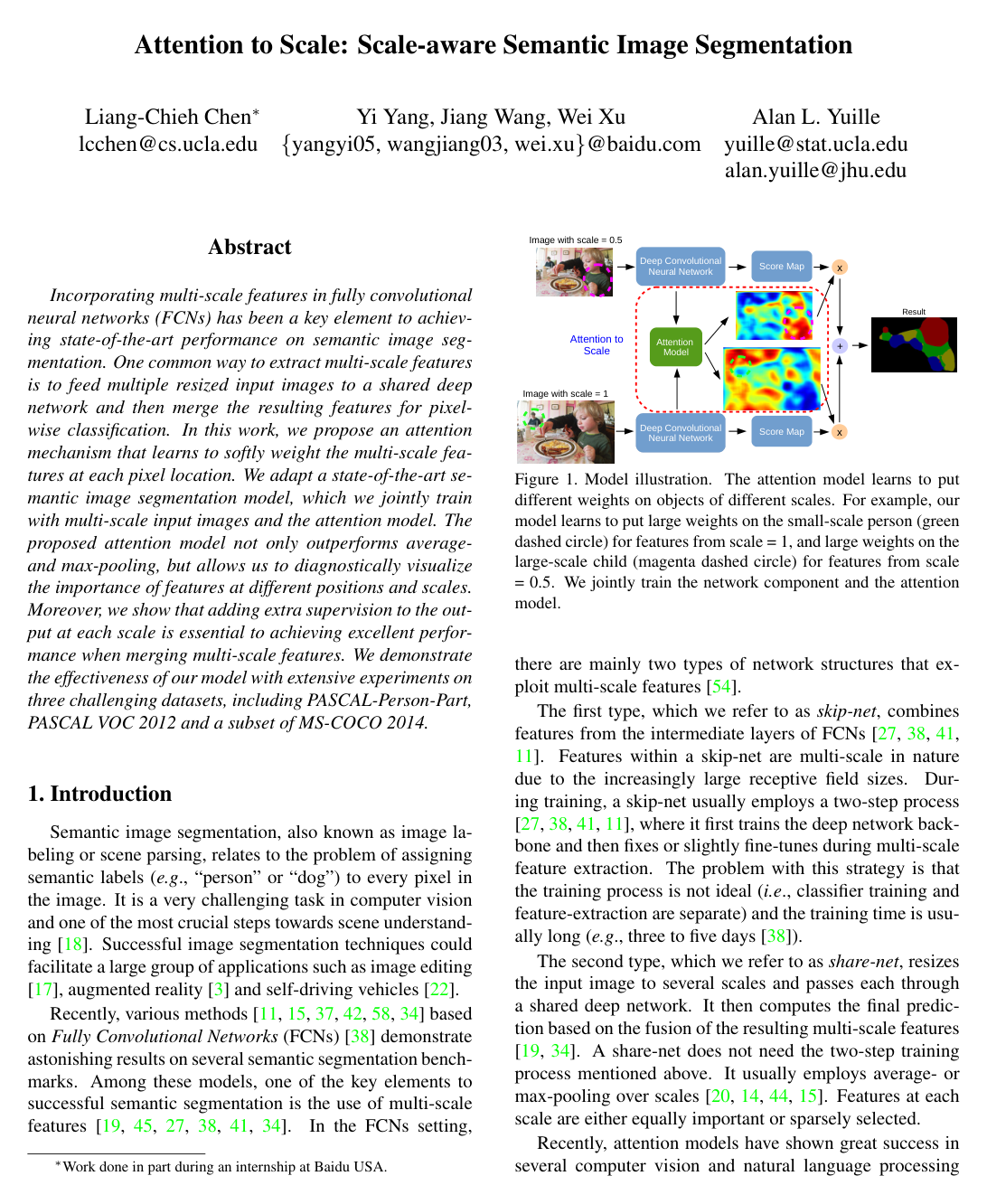
Attention to Scale: Scale-Aware Semantic Image Segmentation
Liang-Chieh Chen, Yi Yang, Jiang Wang, Wei Xu, Alan L. Yuille
Why you should read this
Proposes an attention mechanism that dynamically weights multi-scale features at each pixel, improving semantic image segmentation accuracy over standard pooling baselines while providing interpretable diagnostics of scale selection.
Incorporating multi-scale features in fully convolutional neural networks (FCNs) has been a key element to achieving state-of-the-art performance on semantic image segmentation. One common way to extract multi-scale features is to feed multiple resized input images to a shared deep network and then merge the resulting features for pixelwise classification. In this work, we propose an attention mechanism that learns to softly weight the multi-scale features at each pixel location. We adapt a state-of-the-art semantic image segmentation model, which we jointly train with multi-scale input images and the attention model. The proposed attention model not only outperforms average- and max-pooling, but allows us to diagnostically visualize the importance of features at different positions and scales. Moreover, we show that adding extra supervision to the output at each scale is essential to achieving excellent performance when merging multi-scale features. We demonstrate the effectiveness of our model with extensive experiments on three challenging datasets, including PASCAL-Person-Part, PASCAL VOC 2012 and a subset of MS-COCO 2014.
Added
2026-09-25
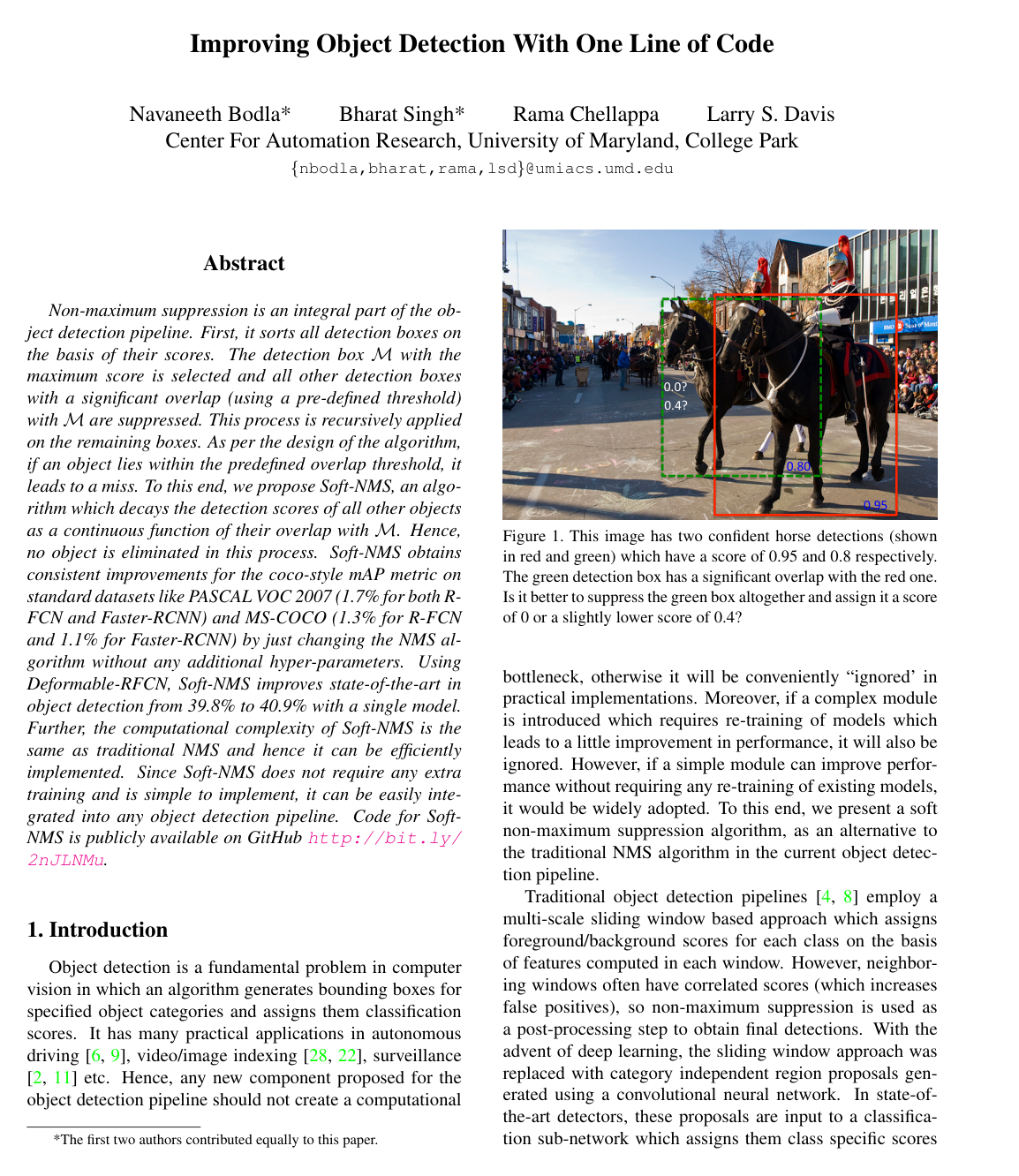
Soft-NMS — Improving Object Detection with One Line of Code
Navaneeth Bodla, Bharat Singh, Rama Chellappa, Larry S. Davis
Why you should read this
Proposes a drop-in replacement for greedy non-maximum suppression that continuously decays overlapping detection scores, boosting object detector accuracy across standard benchmarks without retraining or added computational overhead.
Non-maximum suppression is an integral part of the object detection pipeline. First, it sorts all detection boxes on the basis of their scores. The detection box M with the maximum score is selected and all other detection boxes with a significant overlap (using a pre-defined threshold) with M are suppressed. This process is recursively applied on the remaining boxes. As per the design of the algorithm, if an object lies within the predefined overlap threshold, it leads to a miss. To this end, we propose Soft-NMS, an algorithm which decays the detection scores of all other objects as a continuous function of their overlap with M. Hence, no object is eliminated in this process. Soft-NMS obtains consistent improvements for the coco-style mAP metric on standard datasets like PASCAL VOC 2007 (1.7% for both R-FCN and Faster-RCNN) and MS-COCO (1.3% for R-FCN and 1.1% for Faster-RCNN) by just changing the NMS algorithm without any additional hyper-parameters. Using Deformable-RFCN, Soft-NMS improves state-of-the-art in object detection from 39.8% to 40.9% with a single model. Further, the computational complexity of Soft-NMS is the same as traditional NMS and hence it can be efficiently implemented. Since Soft-NMS does not require any extra training and is simple to implement, it can be easily integrated into any object detection pipeline. Code for Soft-NMS is publicly available on GitHub (this http URL).
Added
2026-09-18
SPICE: Semantic Propositional Image Caption Evaluation
Peter Anderson, Basura Fernando, Mark Johnson, Stephen Gould
Why you should read this
Proposes SPICE, a scene-graph-based image caption evaluation metric that correlates significantly better with human judgment than traditional n-gram methods while enabling targeted diagnostic evaluation of semantic capabilities like counting and color comprehension.
There is considerable interest in the task of automatically generating image captions. However, evaluation is challenging. Existing automatic evaluation metrics are primarily sensitive to n-gram overlap, which is neither necessary nor sufficient for the task of simulating human judgment. We hypothesize that semantic propositional content is an important component of human caption evaluation, and propose a new automated caption evaluation metric defined over scene graphs coined SPICE. Extensive evaluations across a range of models and datasets indicate that SPICE captures human judgments over model-generated captions better than other automatic metrics (e.g., system-level correlation of 0.88 with human judgments on the MS COCO dataset, versus 0.43 for CIDEr and 0.53 for METEOR). Furthermore, SPICE can answer questions such as `which caption-generator best understands colors?' and `can caption-generators count?'
Added
2026-09-15
MobileViT: Light-weight, General-purpose, and Mobile-friendly Vision Transformer
Sachin Mehta, Mohammad Rastegari
Why you should read this
Proposes MobileViT, a lightweight architecture that combines the spatial efficiency of convolutions with the global processing of transformers to consistently outperform standard mobile CNNs and vision transformers on classification and detection benchmarks.
Light-weight convolutional neural networks (CNNs) are the de-facto for mobile vision tasks. Their spatial inductive biases allow them to learn representations with fewer parameters across different vision tasks. However, these networks are spatially local. To learn global representations, self-attention-based vision trans-formers (ViTs) have been adopted. Unlike CNNs, ViTs are heavy-weight. In this paper, we ask the following question: is it possible to combine the strengths of CNNs and ViTs to build a light-weight and low latency network for mobile vision tasks? Towards this end, we introduce MobileViT, a light-weight and general-purpose vision transformer for mobile devices. MobileViT presents a different perspective for the global processing of information with transformers, i.e., transformers as convolutions. Our results show that MobileViT significantly outperforms CNN- and ViT-based networks across different tasks and datasets. On the ImageNet-1k dataset, MobileViT achieves top-1 accuracy of 78.4% with about 6 million parameters, which is 3.2% and 6.2% more accurate than MobileNetv3 (CNN-based) and DeIT (ViT-based) for a similar number of parameters. On the MS-COCO object detection task, MobileViT is 5.7% more accurate than MobileNetv3 for a similar number of parameters. Our source code is open-source and available at: this https URL
Added
2026-09-14
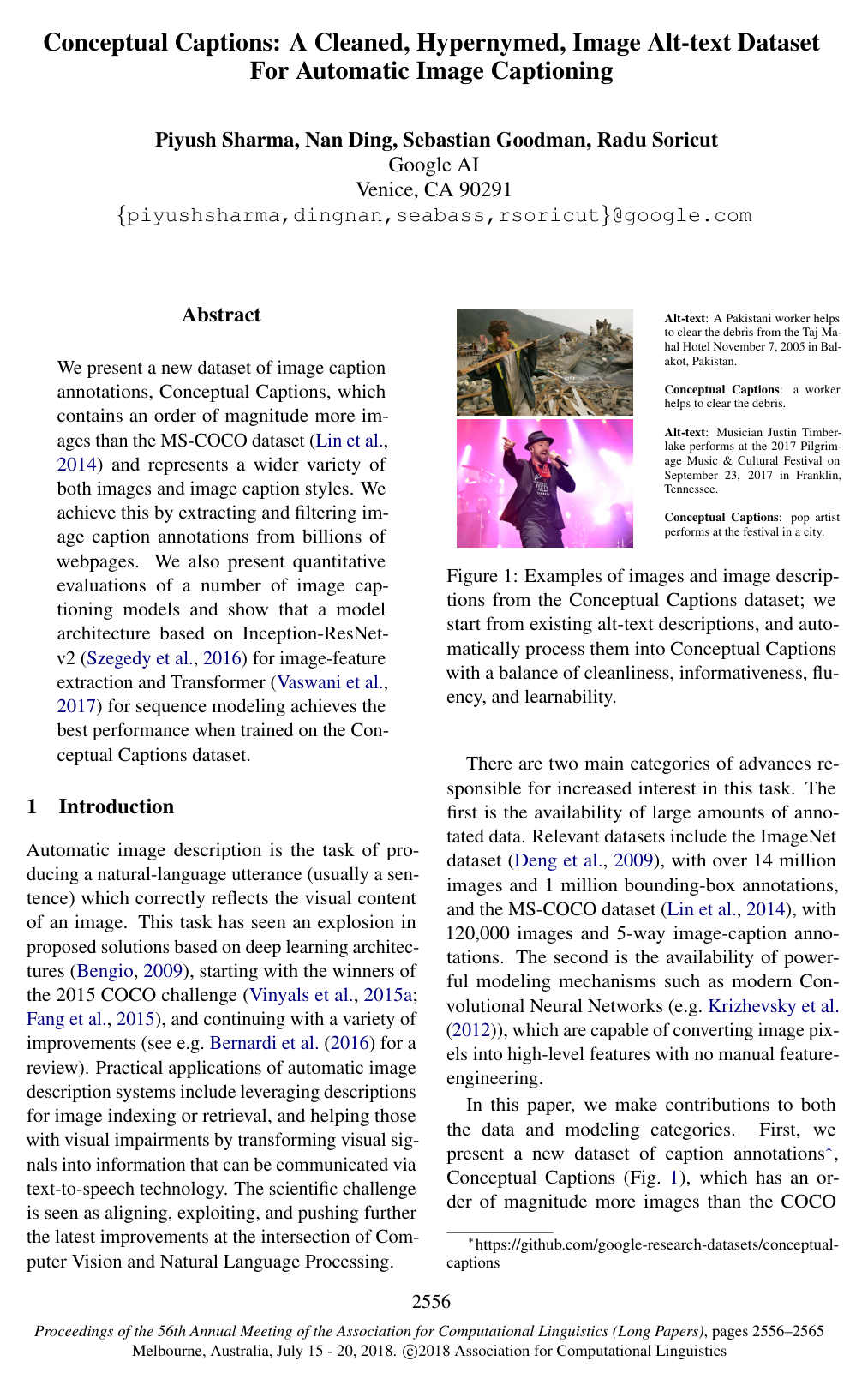
Conceptual Captions: A Cleaned, Hypernymed, Image Alt-text Dataset For Automatic Image Captioning
Piyush Sharma, Nan Ding, Sebastian Goodman, Radu Soricut
Why you should read this
Introduces Conceptual Captions, a 3.3-million-example dataset harvested and hypernymed from web alt-text, and demonstrates that training vision-language models on this large-scale data substantially reduces object hallucinations and improves open-domain image description quality.
We present a new dataset of image caption annotations, Conceptual Captions, which contains an order of magnitude more images than the MS-COCO dataset (Lin et al., 2014) and represents a wider variety of both images and image caption styles. We achieve this by extracting and filtering image caption annotations from billions of webpages. We also present quantitative evaluations of a number of image captioning models and show that a model architecture based on Inception-ResNet-v2 (Szegedy et al., 2016) for image-feature extraction and Transformer (Vaswani et al., 2017) for sequence modeling achieves the best performance when trained on the Conceptual Captions dataset.
Added
2026-09-13
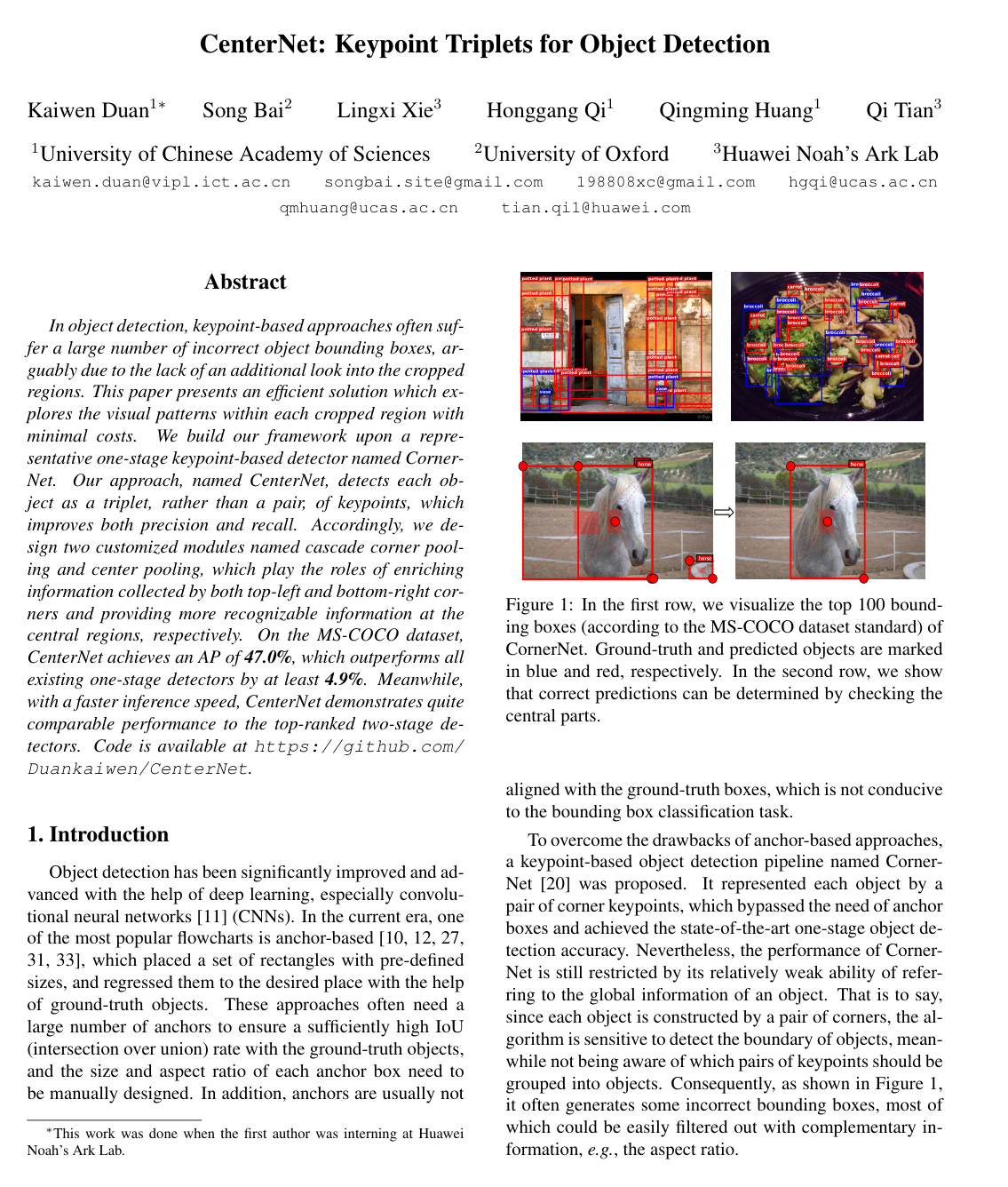
CenterNet: Keypoint Triplets for Object Detection
Kaiwen Duan, Song Bai, Lingxi Xie, Honggang Qi, Qingming Huang, Qi Tian
Why you should read this
Presents CenterNet, an object detection framework that models objects as keypoint triplets using center and cascade corner pooling to filter out incorrect bounding boxes and achieve state-of-the-art one-stage detection accuracy on MS-COCO.
In object detection, keypoint-based approaches often suffer a large number of incorrect object bounding boxes, arguably due to the lack of an additional look into the cropped regions. This paper presents an efficient solution which explores the visual patterns within each cropped region with minimal costs. We build our framework upon a representative one-stage keypoint-based detector named CornerNet. Our approach, named CenterNet, detects each object as a triplet, rather than a pair, of keypoints, which improves both precision and recall. Accordingly, we design two customized modules named cascade corner pooling and center pooling, which play the roles of enriching information collected by both top-left and bottom-right corners and providing more recognizable information at the central regions, respectively. On the MS-COCO dataset, CenterNet achieves an AP of 47.0%, which outperforms all existing one-stage detectors by at least 4.9%. Meanwhile, with a faster inference speed, CenterNet demonstrates quite comparable performance to the top-ranked two-stage detectors. Code is available at this https URL.
Added
2026-09-11
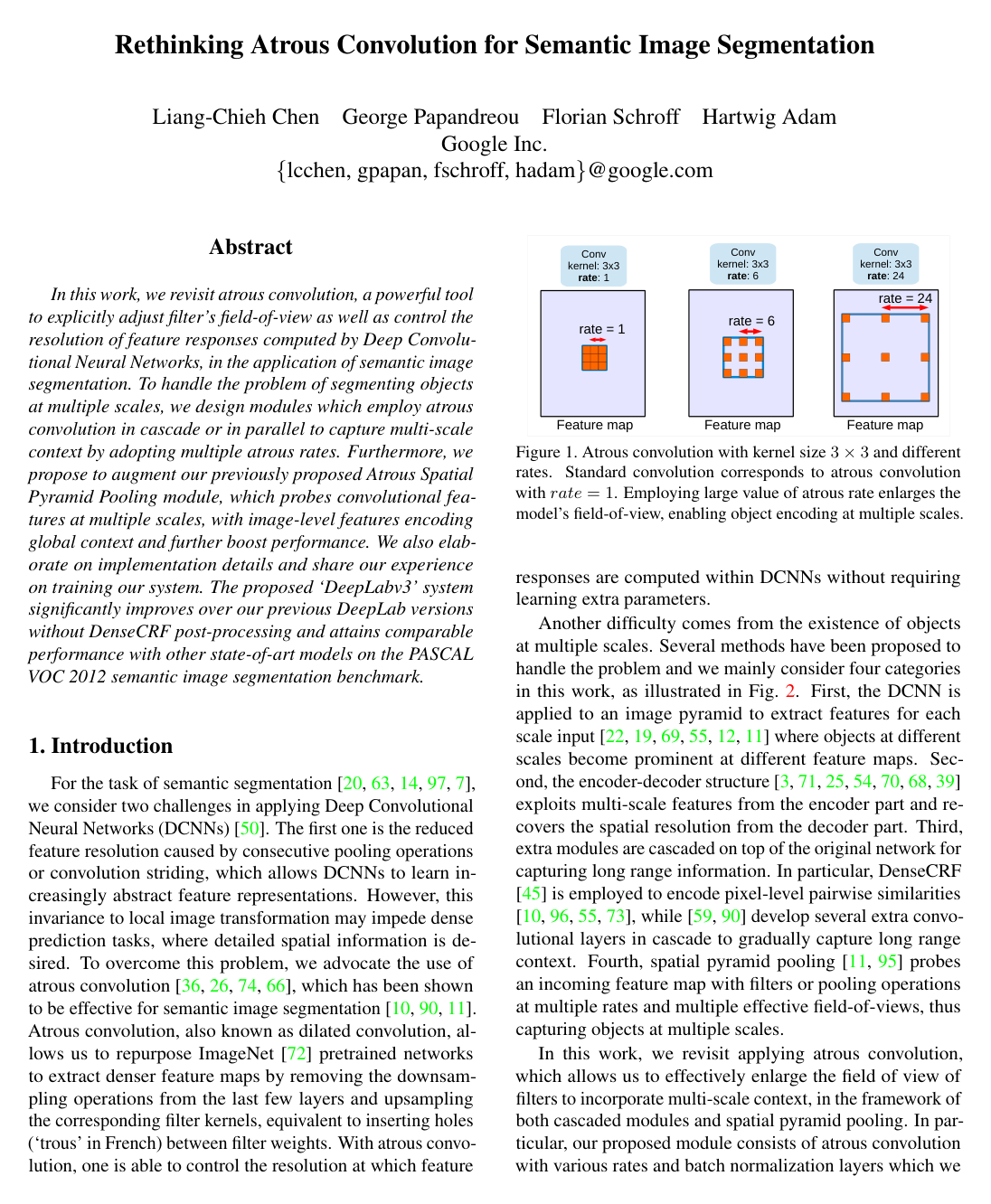
Rethinking Atrous Convolution for Semantic Image Segmentation
Liang-Chieh Chen, George Papandreou, Florian Schroff, Hartwig Adam
Why you should read this
Proposes DeepLabv3, an effective semantic segmentation framework that combines cascading atrous convolutions with an upgraded Atrous Spatial Pyramid Pooling module to capture multi-scale context without relying on conditional random field post-processing.
In this work, we revisit atrous convolution, a powerful tool to explicitly adjust filter's field-of-view as well as control the resolution of feature responses computed by Deep Convolutional Neural Networks, in the application of semantic image segmentation. To handle the problem of segmenting objects at multiple scales, we design modules which employ atrous convolution in cascade or in parallel to capture multi-scale context by adopting multiple atrous rates. Furthermore, we propose to augment our previously proposed Atrous Spatial Pyramid Pooling module, which probes convolutional features at multiple scales, with image-level features encoding global context and further boost performance. We also elaborate on implementation details and share our experience on training our system. The proposed `DeepLabv3' system significantly improves over our previous DeepLab versions without DenseCRF post-processing and attains comparable performance with other state-of-art models on the PASCAL VOC 2012 semantic image segmentation benchmark.
Added
2026-09-11
License
Published with permission
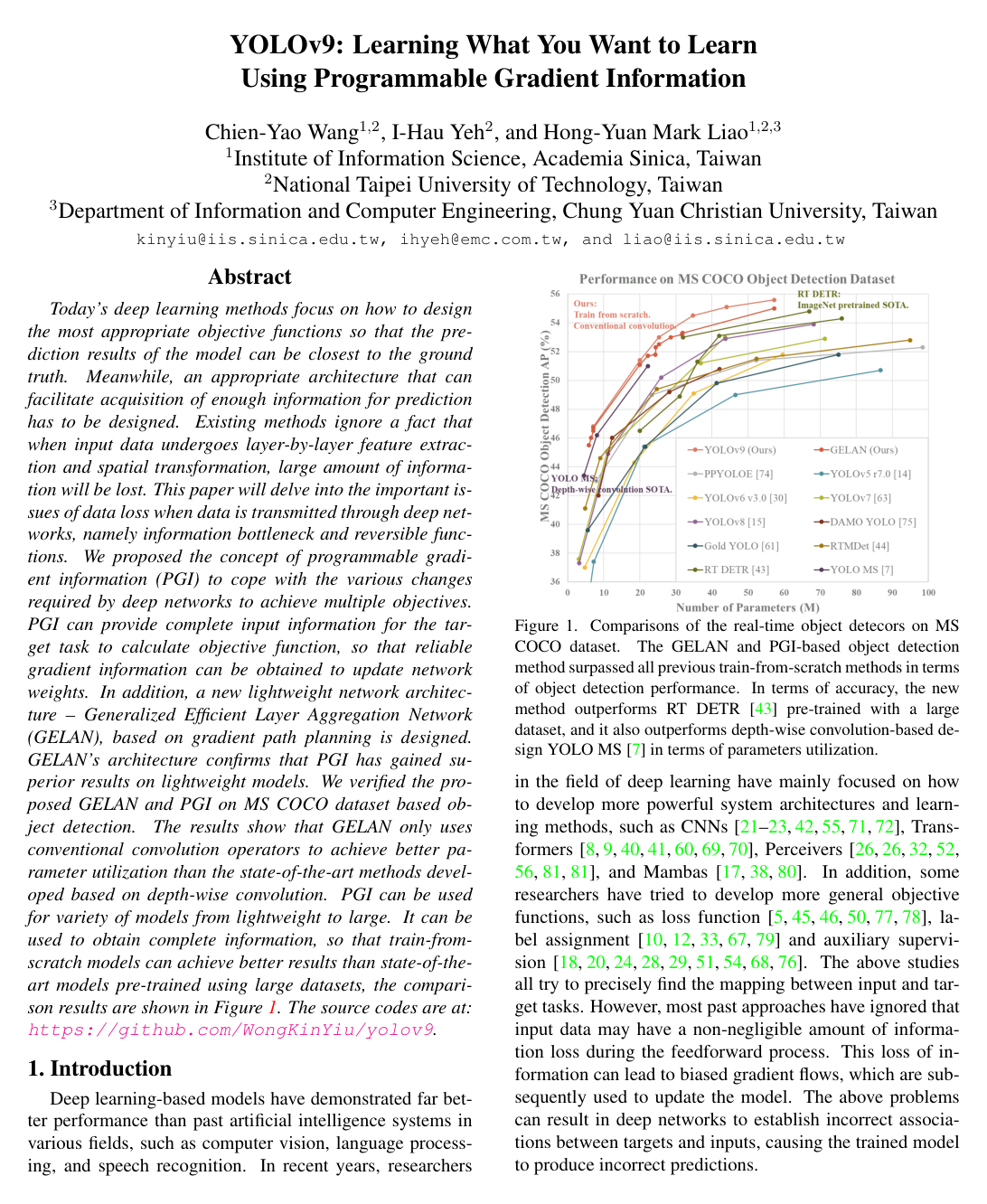
YOLOv9: Learning What You Want to Learn Using Programmable Gradient Information
Chien-Yao Wang, I-Hau Yeh, Hongpeng Liao
Why you should read this
Introduces Programmable Gradient Information and the GELAN architecture to mitigate deep feature information loss, allowing real-time object detection models trained entirely from scratch to outperform existing pre-trained state-of-the-art systems on MS COCO.
Today's deep learning methods focus on how to design the most appropriate objective functions so that the prediction results of the model can be closest to the ground truth. Meanwhile, an appropriate architecture that can facilitate acquisition of enough information for prediction has to be designed. Existing methods ignore a fact that when input data undergoes layer-by-layer feature extraction and spatial transformation, large amount of information will be lost. This paper will delve into the important issues of data loss when data is transmitted through deep networks, namely information bottleneck and reversible functions. We proposed the concept of programmable gradient information (PGI) to cope with the various changes required by deep networks to achieve multiple objectives. PGI can provide complete input information for the target task to calculate objective function, so that reliable gradient information can be obtained to update network weights. In addition, a new lightweight network architecture -- Generalized Efficient Layer Aggregation Network (GELAN), based on gradient path planning is designed. GELAN's architecture confirms that PGI has gained superior results on lightweight models. We verified the proposed GELAN and PGI on MS COCO dataset based object detection. The results show that GELAN only uses conventional convolution operators to achieve better parameter utilization than the state-of-the-art methods developed based on depth-wise convolution. PGI can be used for variety of models from lightweight to large. It can be used to obtain complete information, so that train-from-scratch models can achieve better results than state-of-the-art models pre-trained using large datasets, the comparison results are shown in Figure 1. The source codes are at: this https URL.
Added
2026-09-10
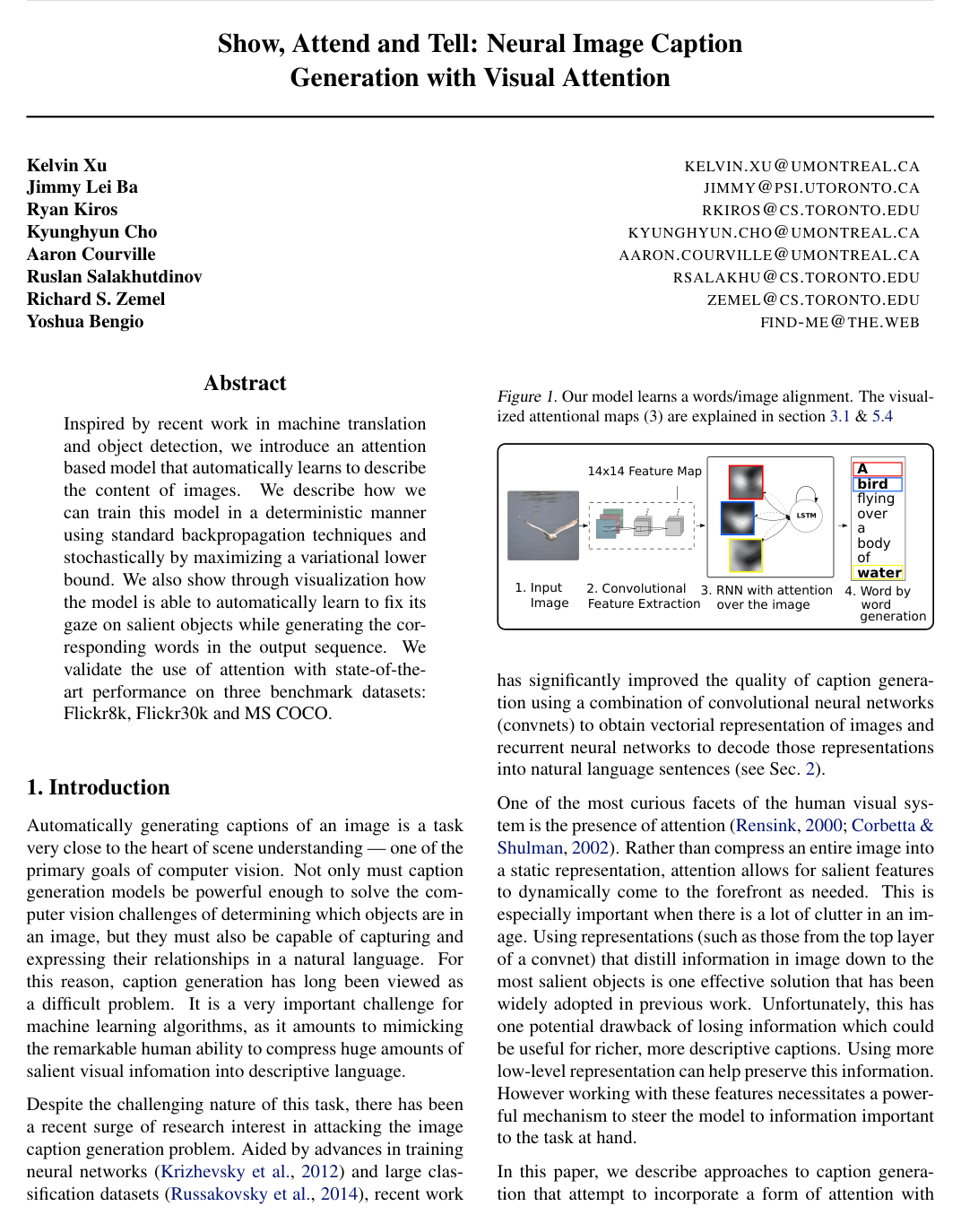
Show, Attend and Tell: Neural Image Caption Generation with Visual Attention
Kelvin Xu, Jimmy Ba, Ryan Kiros, Kyunghyun Cho, Aaron Courville, Ruslan Salakhutdinov, Richard Zemel, Yoshua Bengio
Why you should read this
Demonstrates how a novel attention-based model not only generates state-of-the-art image captions but also visually proves its ability to dynamically focus on salient objects within an image, offering a transparent and intuitive approach to understanding AI's "gaze."
Inspired by recent work in machine translation and object detection, we introduce an attention based model that automatically learns to describe the content of images. We describe how we can train this model in a deterministic manner using standard backpropagation techniques and stochastically by maximizing a variational lower bound. We also show through visualization how the model is able to automatically learn to fix its gaze on salient objects while generating the corresponding words in the output sequence. We validate the use of attention with state-of-the-art performance on three benchmark datasets: Flickr8k, Flickr30k and MS COCO.
Added
2026-02-11
License
Published with permission
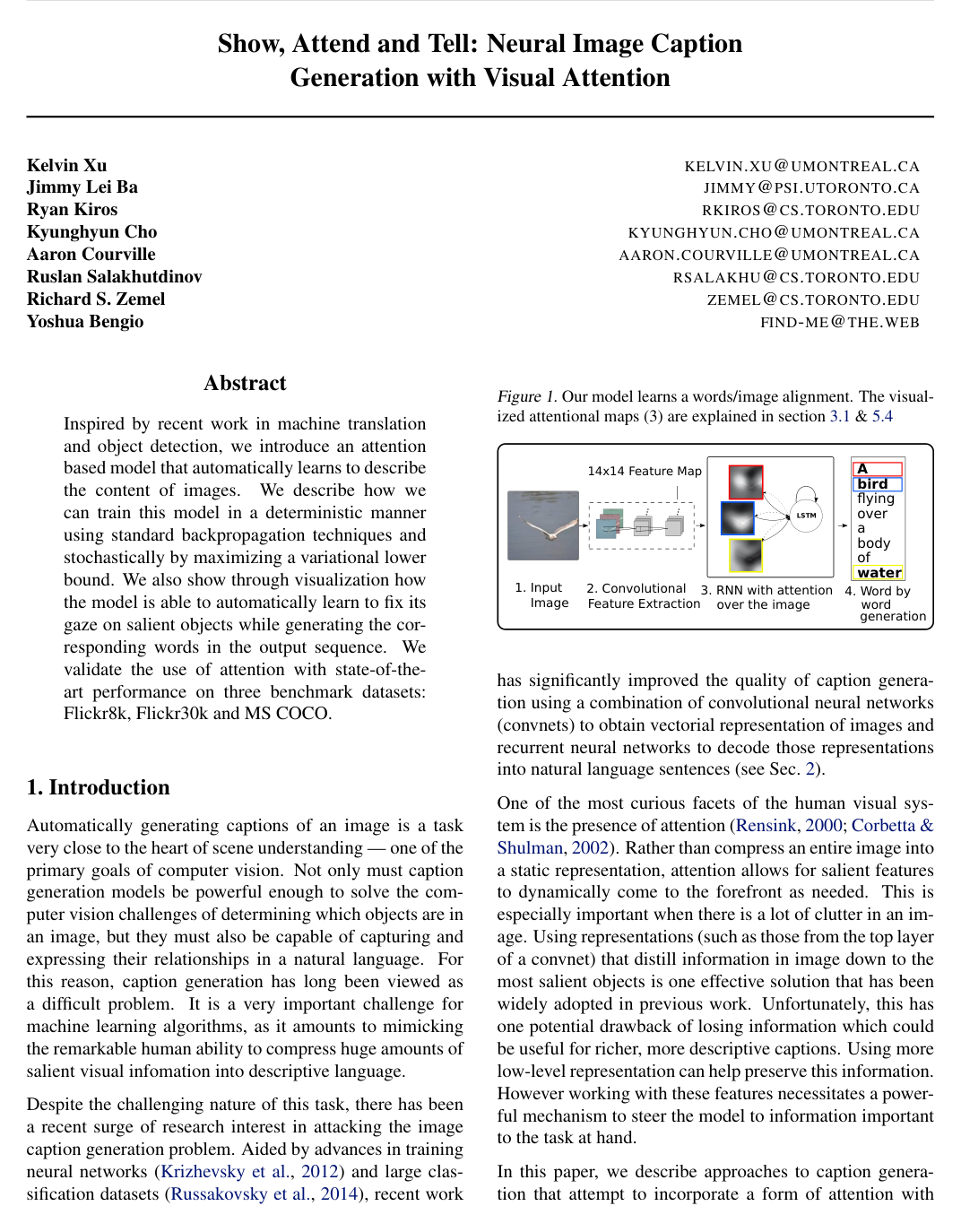
Show, Attend and Tell: Neural Image Caption Generation with Visual Attention
Kelvin Xu, Jimmy Ba, Ryan Kiros, Kyunghyun Cho, Aaron Courville, Ruslan Salakhutdinov, Richard Zemel, Yoshua Bengio
Why you should read this
Demonstrates that attention can apply to spatial grids (images), introducing "hard" stochastic attention alongside "soft" deterministic attention.
Inspired by recent work in machine translation and object detection, we introduce an attention based model that automatically learns to describe the content of images. We describe how we can train this model in a deterministic manner using standard backpropagation techniques and stochastically by maximizing a variational lower bound. We also show through visualization how the model is able to automatically learn to fix its gaze on salient objects while generating the corresponding words in the output sequence. We validate the use of attention with state-of-the-art performance on three benchmark datasets: Flickr8k, Flickr30k and MS COCO.
Added
2026-01-28