
Built independently by an author, for readers. Read the story and support ChapterPal

keyword

MPII Human Pose dataset

The MPII Human Pose dataset is a computer vision benchmark designed for training and evaluating articulated two-dimensional human pose estimation algorithms. Developed by researchers at the Max Planck Institute for Informatics, it contains roughly 25,000 images extracted from online video clips featuring more than 40,000 people across hundreds of real-world everyday activities. The dataset provides annotations for up to sixteen standard body joints per person, alongside joint visibility flags, activity labels, and supplementary data such as occlusion status and 3D torso and head orientations. Because it captures realistic conditions involving diverse viewpoints, background clutter, and challenging body articulations, it is widely utilized as a standard benchmark for measuring keypoint localization precision and human pose representation learning.

1 item
Deep High-Resolution Representation Learning for Human Pose Estimation

Deep High-Resolution Representation Learning for Human Pose Estimation

Ke Sun, Bin Xiao, Dong Liu, Jingdong Wang

OrganizationsMicrosoftUniversity of Science and Technology of China

Why you should read this

Proposes a deep high-resolution representation learning network that maintains spatial precision throughout processing across parallel multi-scale stages, substantially improving keypoint localization on standard human pose benchmarks.

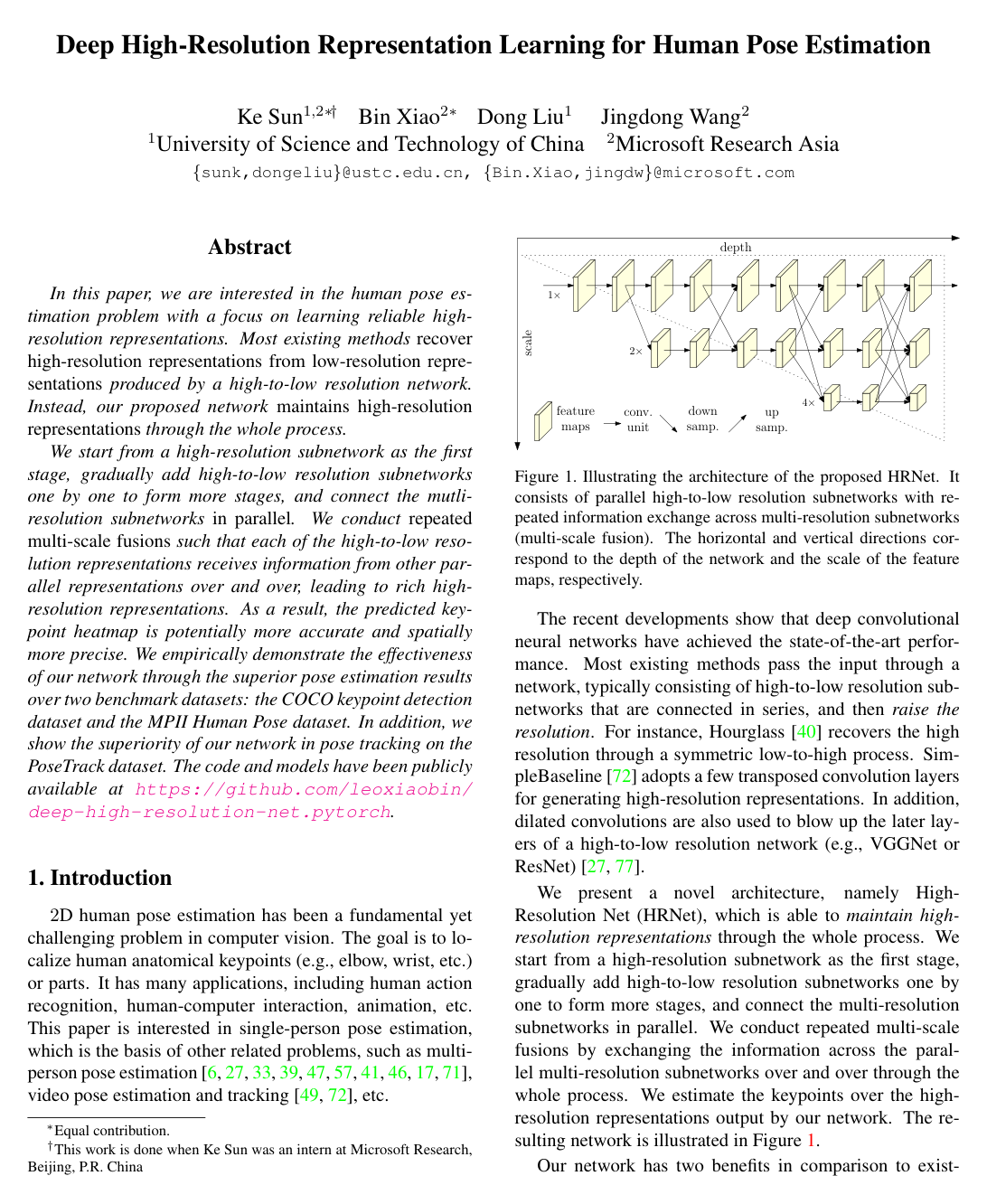
This is an official pytorch implementation of Deep High-Resolution Representation Learning for Human Pose Estimation. In this work, we are interested in the human pose estimation problem with a focus on learning reliable high-resolution representations. Most existing methods recover high-resolution representations from low-resolution representations produced by a high-to-low resolution network. Instead, our proposed network maintains high-resolution representations through the whole process. We start from a high-resolution subnetwork as the first stage, gradually add high-to-low resolution subnetworks one by one to form more stages, and connect the mutli-resolution subnetworks in parallel. We conduct repeated multi-scale fusions such that each of the high-to-low resolution representations receives information from other parallel representations over and over, leading to rich high-resolution representations. As a result, the predicted keypoint heatmap is potentially more accurate and spatially more precise. We empirically demonstrate the effectiveness of our network through the superior pose estimation results over two benchmark datasets: the COCO keypoint detection dataset and the MPII Human Pose dataset. The code and models have been publicly available at \url{this https URL}.

Added

2026-09-10