
keyword
motion modeling
Motion modeling is the computational and mathematical process of estimating, representing, and predicting the spatial and temporal movements of objects, surfaces, or camera viewpoints across sequences of visual data. In computer vision and video analysis, it establishes formal descriptions of dynamic behavior, ranging from parametric trajectory and kinematic state estimations to dense pixel flows and spatiotemporal feature representations. By capturing how entities shift, accelerate, or deform over time, motion modeling enables automated systems to maintain object associations through occlusions, analyze human actions, interpolate intermediate video frames, and synthesize coherent dynamic visual scenes.
6 items
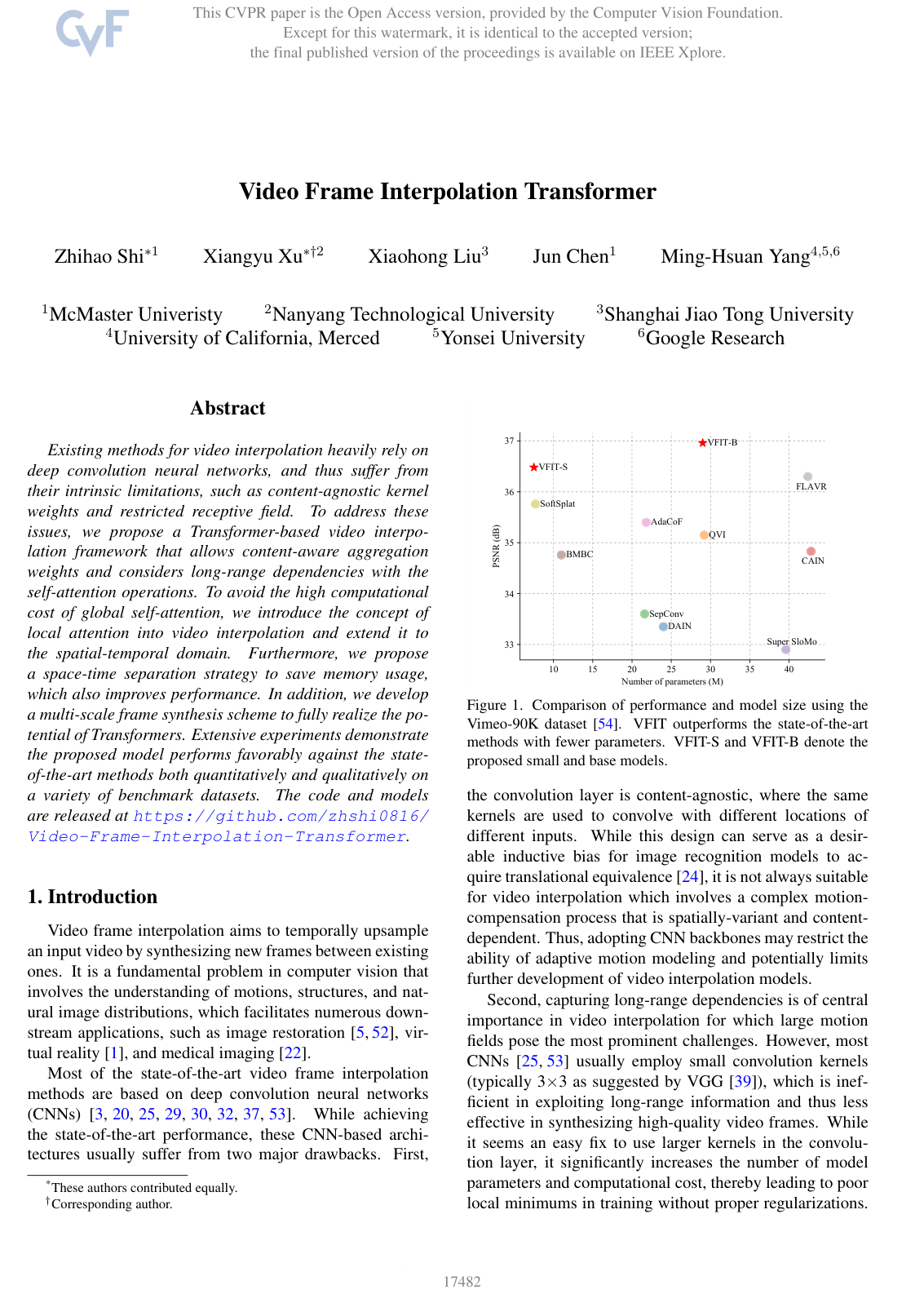
Video Frame Interpolation Transformer
Zhihao Shi, Xiangyu Xu, Xiaohong Liu, Jun Chen, Ming-Hsuan Yang
Why you should read this
Proposes a lightweight video frame interpolation transformer that adapts local self-attention into a space-time separable mechanism to capture long-range spatial-temporal dependencies with high memory efficiency.
Existing methods for video interpolation heavily rely on deep convolution neural networks, and thus suffer from their intrinsic limitations, such as content-agnostic kernel weights and restricted receptive field. To address these issues, we propose a Transformer-based video interpolation framework that allows content-aware aggregation weights and considers long-range dependencies with the self-attention operations. To avoid the high computational cost of global self-attention, we introduce the concept of local attention into video interpolation and extend it to the spatial-temporal domain. Furthermore, we propose a space-time separation strategy to save memory usage, which also improves performance. In addition, we develop a multi-scale frame synthesis scheme to fully realize the potential of Transformers. Extensive experiments demonstrate the proposed model performs favorably against the state-of-the-art methods both quantitatively and qualitatively on a variety of benchmark datasets. The code and models are released at https://github.com/zhshi0816/Video-Frame-Interpolation-Transformer.
Added
2026-10-05
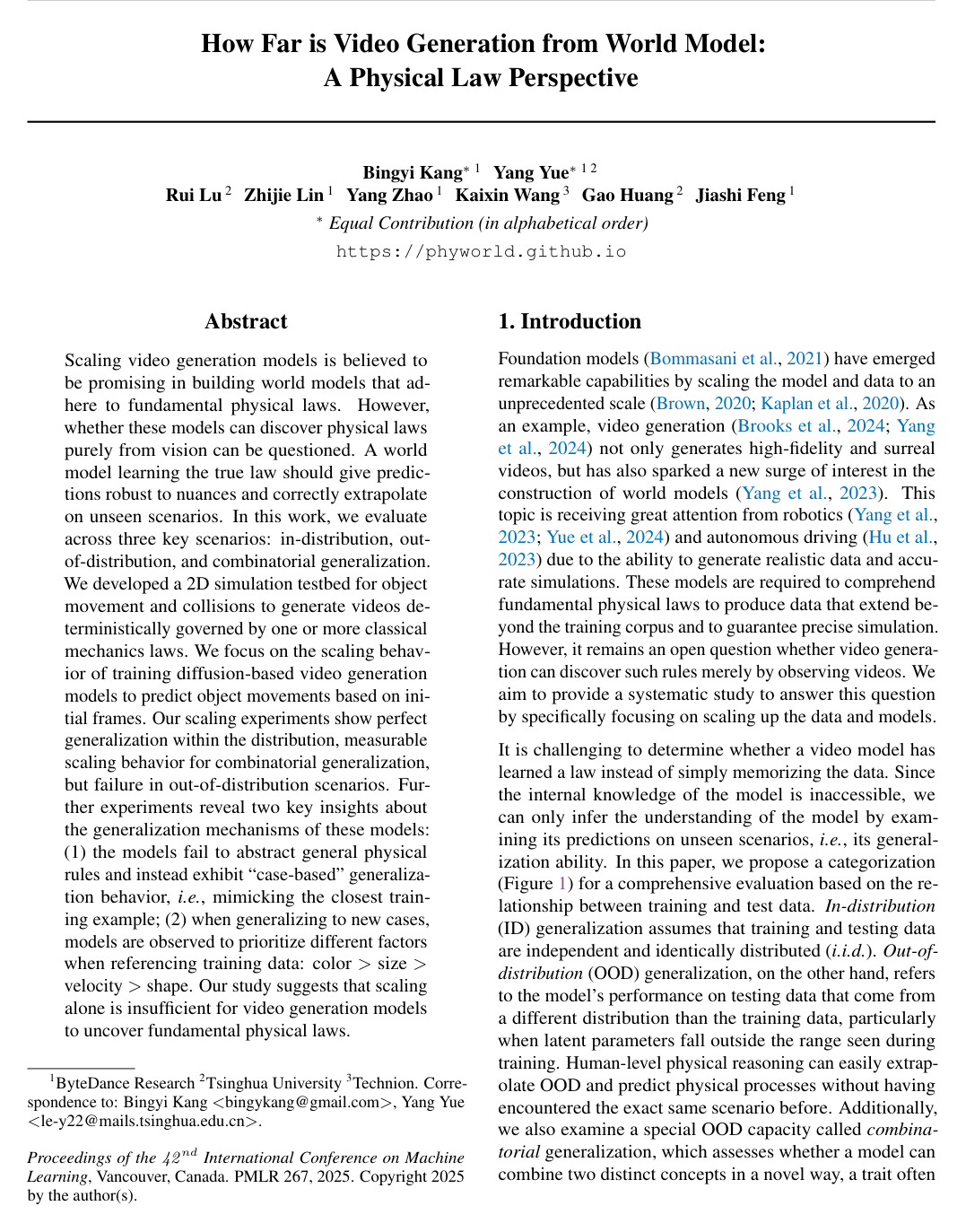
How Far Is Video Generation from World Model: A Physical Law Perspective
Bingyi Kang, Yang Yue, Rui Lu, Zhijie Lin, Yang Zhao, Kaixin Wang, Gao Huang, Jiashi Feng
Why you should read this
Demonstrates through controlled 2D mechanics simulations that scaling video diffusion models improves in-distribution and combinatorial generalization but fails to discover fundamental physical laws for out-of-distribution extrapolation, relying instead on case-based mimicry prioritized by superficial visual attributes.
Scaling video generation models is believed to be promising in building world models that adhere to fundamental physical laws. However, whether these models can discover physical laws purely from vision can be questioned. A world model learning the true law should give predictions robust to nuances and correctly extrapolate on unseen scenarios. In this work, we evaluate across three key scenarios: in-distribution, out-of-distribution, and combinatorial generalization. We developed a 2D simulation testbed for object movement and collisions to generate videos deterministically governed by one or more classical mechanics laws. We focus on the scaling behavior of training diffusion-based video generation models to predict object movements based on initial frames. Our scaling experiments show perfect generalization within the distribution, measurable scaling behavior for combinatorial generalization, but failure in out-of-distribution scenarios. Further experiments reveal two key insights about the generalization mechanisms of these models: (1) the models fail to abstract general physical rules and instead exhibit “case-based” generalization behavior, i.e., mimicking the closest training example; (2) when generalizing to new cases, models are observed to prioritize different factors when referencing training data: color > size > velocity > shape. Our study suggests that scaling alone is insufficient for video generation models to uncover fundamental physical laws.
Added
2026-10-01
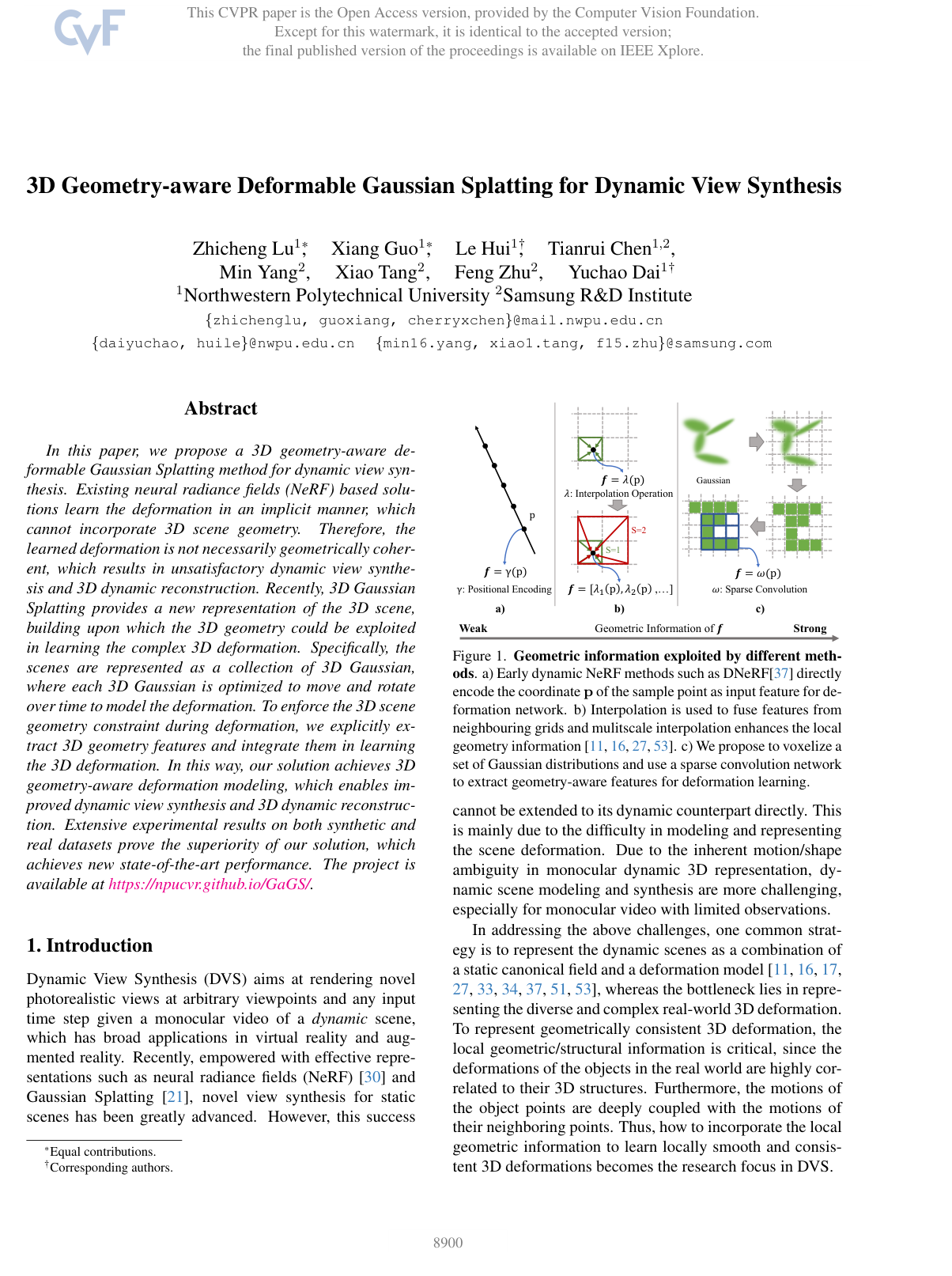
3D Geometry-aware Deformable Gaussian Splatting for Dynamic View Synthesis
Zhicheng Lu, Xiang Guo, Le Hui, Tianrui Chen, Min Yang, Xiao Tang, Feng Zhu, Yuchao Dai
Why you should read this
Proposes a dynamic novel view synthesis framework that voxelizes 3D Gaussians and applies sparse 3D convolutions alongside continuous 6D rotation representations to model geometrically coherent non-rigid scene deformations.
Added
2026-09-26
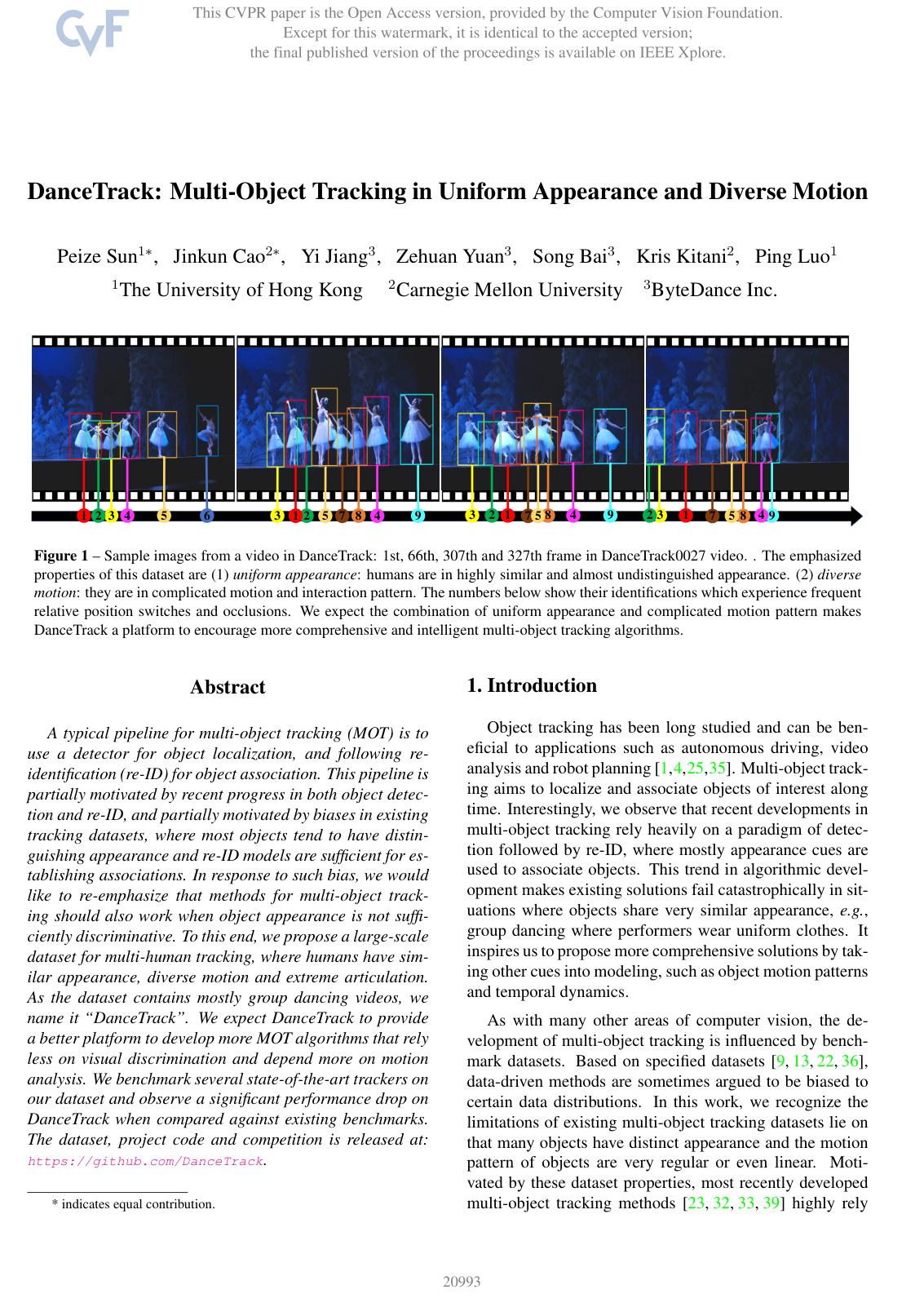
DanceTrack: Multi-Object Tracking in Uniform Appearance and Diverse Motion
Peize Sun, Jinkun Cao, Yi Jiang, Zehuan Yuan, Song Bai, Kris Kitani, Ping Luo
Why you should read this
Introduces DanceTrack, a large-scale multi-human tracking benchmark of group dancing scenes featuring uniform appearance and complex motion patterns, exposing the vulnerabilities of conventional appearance-based tracking models and directing research toward motion-centric association.
A typical pipeline for multi-object tracking (MOT) is to use a detector for object localization, and following re-identification (re-ID) for object association. This pipeline is partially motivated by recent progress in both object detection and re-ID, and partially motivated by biases in existing tracking datasets, where most objects tend to have distinguishing appearance and re-ID models are sufficient for establishing associations. In response to such bias, we would like to re-emphasize that methods for multi-object tracking should also work when object appearance is not sufficiently discriminative. To this end, we propose a large-scale dataset for multi-human tracking, where humans have similar appearance, diverse motion and extreme articulation. As the dataset contains mostly group dancing videos, we name it “DanceTrack”. We expect DanceTrack to provide a better platform to develop more MOT algorithms that rely less on visual discrimination and depend more on motion analysis. We benchmark several state-of-the-art trackers on our dataset and observe a significant performance drop on DanceTrack when compared against existing benchmarks. The dataset, project code and competition is released at: https://github.com/DanceTrack.
Added
2026-09-26
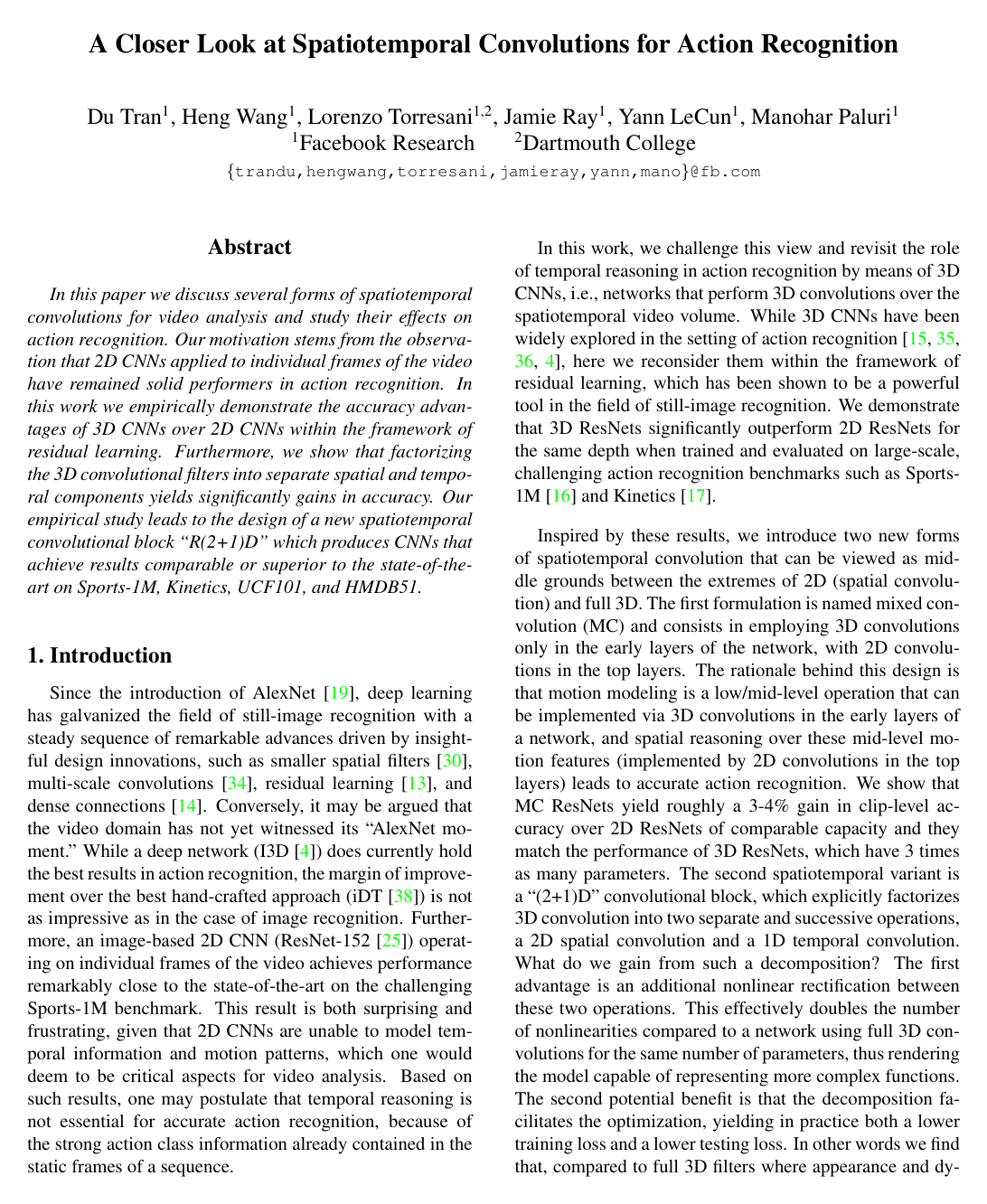
A Closer Look at Spatiotemporal Convolutions for Action Recognition
Du Tran, Heng Wang, Lorenzo Torresani, Jamie Ray, Yann LeCun, Manohar Paluri
Why you should read this
Introduces the R(2+1)D architecture, which factorizes 3D spatiotemporal convolutions into separate 2D spatial and 1D temporal operations to surpass conventional 3D CNNs across major action recognition benchmarks.
In this paper we discuss several forms of spatiotemporal convolutions for video analysis and study their effects on action recognition. Our motivation stems from the observation that 2D CNNs applied to individual frames of the video have remained solid performers in action recognition. In this work we empirically demonstrate the accuracy advantages of 3D CNNs over 2D CNNs within the framework of residual learning. Furthermore, we show that factorizing the 3D convolutional filters into separate spatial and temporal components yields significantly advantages in accuracy. Our empirical study leads to the design of a new spatiotemporal convolutional block "R(2+1)D" which gives rise to CNNs that achieve results comparable or superior to the state-of-the-art on Sports-1M, Kinetics, UCF101 and HMDB51.
Added
2026-09-11
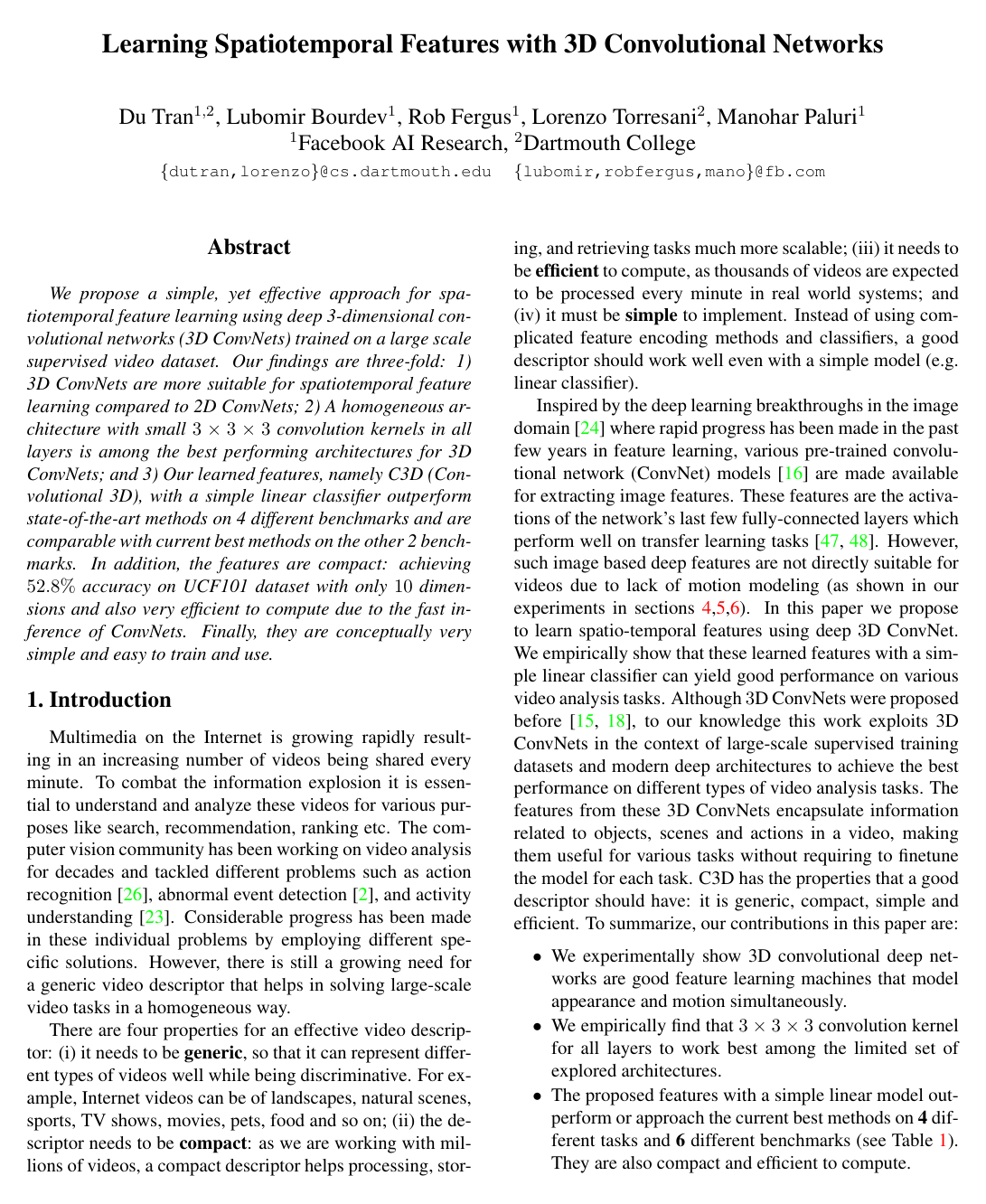
Learning Spatiotemporal Features with 3D Convolutional Networks
Du Tran, Lubomir Bourdev, Rob Fergus, Lorenzo Torresani, Manohar Paluri
Why you should read this
Proposes C3D, a 3D convolutional network architecture with 3x3x3 filters that extracts compact, efficient spatiotemporal features capable of surpassing state-of-the-art video analysis methods across diverse action recognition benchmarks.
We propose a simple, yet effective approach for spatiotemporal feature learning using deep 3-dimensional convolutional networks (3D ConvNets) trained on a large scale supervised video dataset. Our findings are three-fold: 1) 3D ConvNets are more suitable for spatiotemporal feature learning compared to 2D ConvNets; 2) A homogeneous architecture with small 3x3x3 convolution kernels in all layers is among the best performing architectures for 3D ConvNets; and 3) Our learned features, namely C3D (Convolutional 3D), with a simple linear classifier outperform state-of-the-art methods on 4 different benchmarks and are comparable with current best methods on the other 2 benchmarks. In addition, the features are compact: achieving 52.8% accuracy on UCF101 dataset with only 10 dimensions and also very efficient to compute due to the fast inference of ConvNets. Finally, they are conceptually very simple and easy to train and use.
Added
2026-09-07