
keyword
monolingual models
Monolingual models are language models or other machine-learning models designed or trained to work primarily in one language. Unlike multilingual models, they focus on that language’s text and linguistic patterns, though they may still be used alongside translation systems for cross-language tasks.
2 items
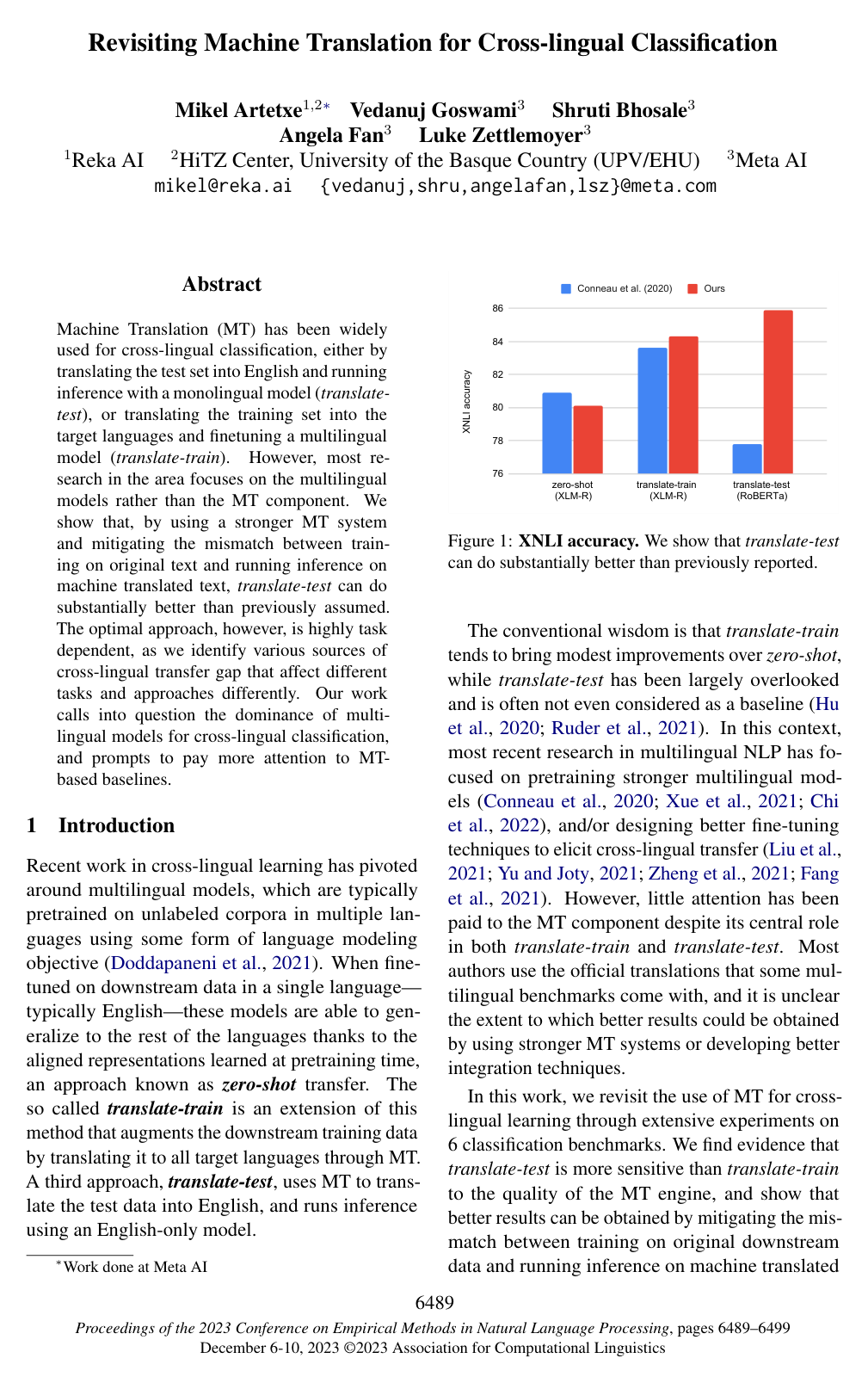
Revisiting Machine Translation for Cross-lingual Classification
Mikel Artetxe, Vedanuj Goswami, Shruti Bhosale, Angela Fan, Luke Zettlemoyer
Why you should read this
Demonstrates that modern machine translation combined with domain adaptation allows simple translate-test pipelines to outperform multilingual pretrained models on complex cross-lingual classification benchmarks like XNLI.
Machine Translation (MT) has been widely used for cross-lingual classification, either by translating the test set into English and running inference with a monolingual model (translate-test), or translating the training set into the target languages and finetuning a multilingual model (translate-train). However, most research in the area focuses on the multilingual models rather than the MT component. We show that, by using a stronger MT system and mitigating the mismatch between training on original text and running inference on machine translated text, translate-test can do substantially better than previously assumed. The optimal approach, however, is highly task dependent, as we identify various sources of cross-lingual transfer gap that affect different tasks and approaches differently. Our work calls into question the dominance of multilingual models for cross-lingual classification, and prompts to pay more attention to MT-based baselines.
Added
2026-09-26
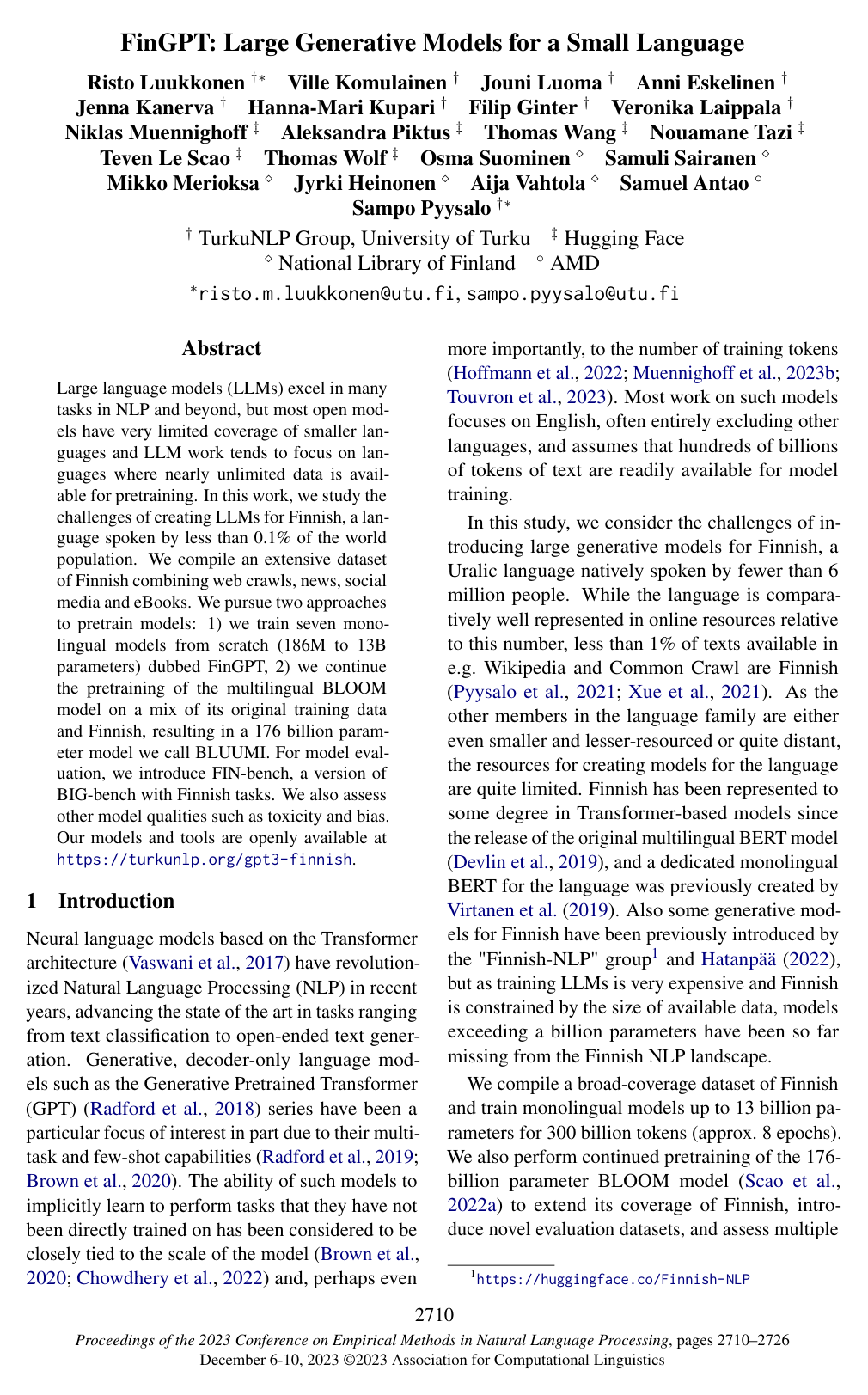
FinGPT: Large Generative Models for a Small Language
Risto Luukkonen, Ville Komulainen, Jouni Luoma, Anni Eskelinen, Jenna Kanerva, Hanna-Mari Kupari, Filip Ginter, Veronika Laippala, Niklas Muennighoff, Aleksandra Piktus, Thomas Wang, Nouamane Tazi, Teven Le Scao, Thomas Wolf, Osma Suominen, Samuli Sairanen, Mikko Merioksa, Jyrki Heinonen, Aija Vahtola, Samuel Antao, Sampo Pyysalo
Why you should read this
Presents open-source Finnish generative language models scaling up to 176 billion parameters alongside a localized evaluation benchmark, offering a practical framework for developing large-scale foundation models for lower-resourced languages.
Large language models (LLMs) excel in many tasks in NLP and beyond, but most open models have very limited coverage of smaller languages and LLM work tends to focus on languages where nearly unlimited data is available for pretraining. In this work, we study the challenges of creating LLMs for Finnish, a language spoken by less than 0.1% of the world population. We compile an extensive dataset of Finnish combining web crawls, news, social media and eBooks. We pursue two approaches to pretrain models: 1) we train seven monolingual models from scratch (186M to 13B parameters) dubbed FinGPT, 2) we continue the pretraining of the multilingual BLOOM model on a mix of its original training data and Finnish, resulting in a 176 billion parameter model we call BLUUMI. For model evaluation, we introduce FIN-bench, a version of BIG-bench with Finnish tasks. We also assess other model qualities such as toxicity and bias. Our models and tools are openly available at https://turkunlp.org/gpt3-finnish.
Added
2026-09-26