
keyword
model uncertainty
Model uncertainty, also known as epistemic uncertainty, is the lack of certainty in the predictions or parameters of a statistical or machine learning model caused by insufficient training data, incomplete knowledge, or model misspecification. Unlike aleatoric uncertainty, which stems from the inherent noise and stochastic nature of the observed environment and remains irreducible, model uncertainty can be decreased as more representative data is collected or as the model structure is refined. In practical applications such as autonomous systems, decision-making, and healthcare, estimating model uncertainty enables algorithms to detect unfamiliar scenarios, avoid overconfident errors, and provide reliable confidence assessments alongside their predictions.
7 items
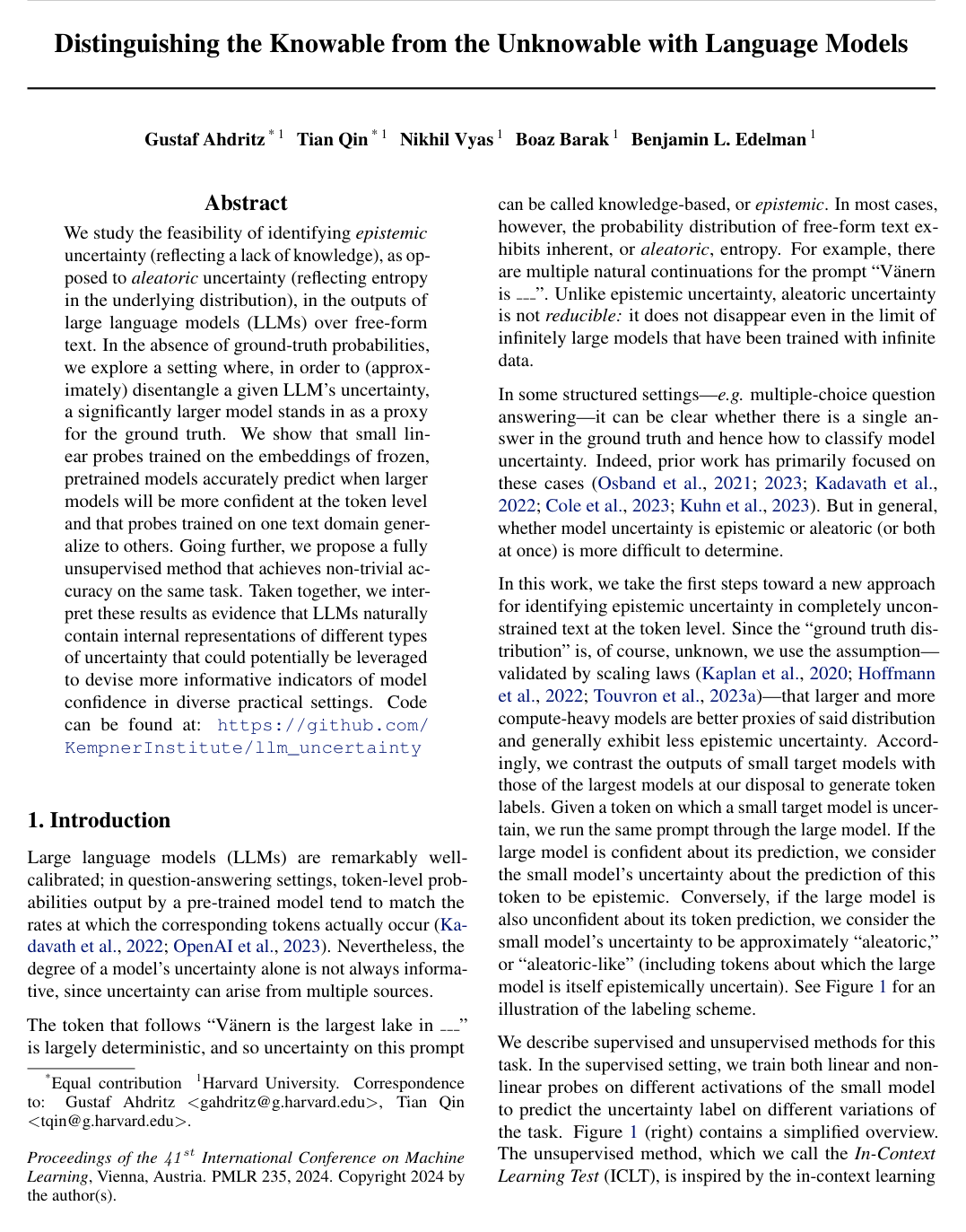
Distinguishing the Knowable from the Unknowable with Language Models
Gustaf Ahdritz, Tian Qin, Nikhil Vyas, Boaz Barak, Benjamin L. Edelman
Why you should read this
Demonstrates that language models internally separate reducible epistemic uncertainty from inherent aleatoric entropy, enabling simple probes and unsupervised methods to accurately detect when an uncertain prediction is caused by a lack of knowledge rather than inherent ambiguity.
We study the feasibility of identifying epistemic uncertainty (reflecting a lack of knowledge), as opposed to aleatoric uncertainty (reflecting entropy in the underlying distribution), in the outputs of large language models (LLMs) over free-form text. In the absence of ground-truth probabilities, we explore a setting where, in order to (approximately) disentangle a given LLM’s uncertainty, a significantly larger model stands in as a proxy for the ground truth. We show that small linear probes trained on the embeddings of frozen, pretrained models accurately predict when larger models will be more confident at the token level and that probes trained on one text domain generalize to others. Going further, we propose a fully unsupervised method that achieves non-trivial accuracy on the same task. Taken together, we interpret these results as evidence that LLMs naturally contain internal representations of different types of uncertainty that could potentially be leveraged to devise more informative indicators of model confidence in diverse practical settings. Code can be found at: https://github.com/KempnerInstitute/llm_uncertainty
Added
2026-10-05
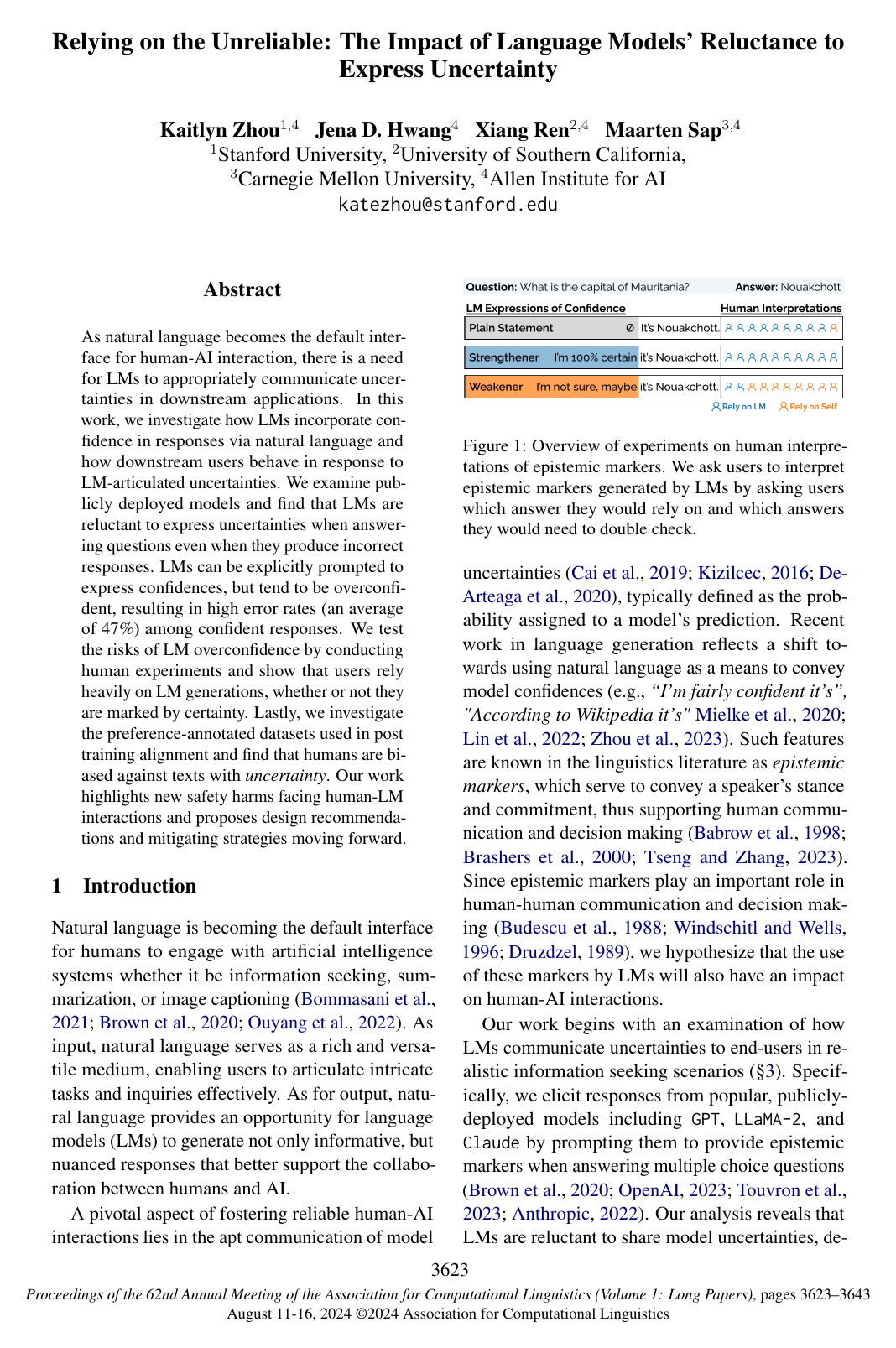
Relying on the Unreliable: The Impact of Language Models' Reluctance to Express Uncertainty
Kaitlyn Zhou, Jena D. Hwang, Xiang Ren, Maarten Sap
Why you should read this
Reveals that language models rarely express uncertainty and suffer from a 47% error rate on confident statements, tracing this miscalibration to human preference biases during post-training alignment and demonstrating the resulting risks of human overreliance.
As natural language becomes the default interface for human-AI interaction, there is a need for LMs to appropriately communicate uncertainties in downstream applications. In this work, we investigate how LMs incorporate confidence in responses via natural language and how downstream users behave in response to LM-articulated uncertainties. We examine publicly deployed models and find that LMs are reluctant to express uncertainties when answering questions even when they produce incorrect responses. LMs can be explicitly prompted to express confidences, but tend to be overconfident, resulting in high error rates (an average of 47%) among confident responses. We test the risks of LM overconfidence by conducting human experiments and show that users rely heavily on LM generations, whether or not they are marked by certainty. Lastly, we investigate the preference-annotated datasets used in post training alignment and find that humans are biased against texts with uncertainty. Our work highlights new safety harms facing human-LM interactions and proposes design recommendations and mitigating strategies moving forward.
Added
2026-10-01
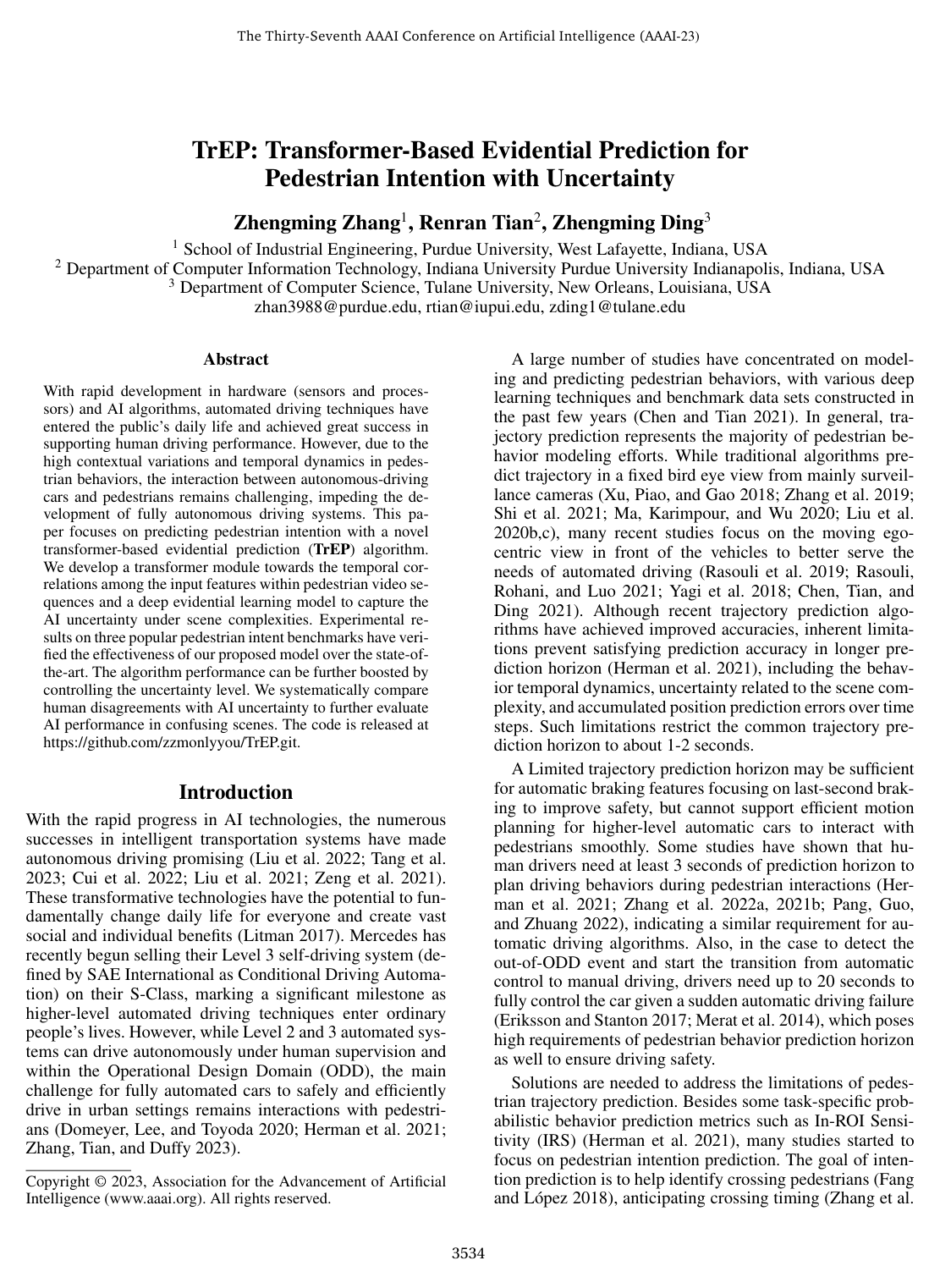
TrEP: Transformer-Based Evidential Prediction for Pedestrian Intention with Uncertainty
Zhengming Zhang, Renran Tian, Zhengming Ding
Why you should read this
Proposes a compact transformer-based evidential prediction model that captures temporal dynamics from motion features and quantifies pedestrian crossing intention uncertainty to align AI confidence with human annotator disagreements.
With rapid development in hardware (sensors and processors) and AI algorithms, automated driving techniques have entered the public's daily life and achieved great success in supporting human driving performance. However, due to the high contextual variations and temporal dynamics in pedestrian behaviors, the interaction between autonomous-driving cars and pedestrians remains challenging, impeding the development of fully autonomous driving systems. This paper focuses on predicting pedestrian intention with a novel transformer-based evidential prediction (TrEP) algorithm. We develop a transformer module towards the temporal correlations among the input features within pedestrian video sequences and a deep evidential learning model to capture the AI uncertainty under scene complexities. Experimental results on three popular pedestrian intent benchmarks have verified the effectiveness of our proposed model over the state-of-the-art. The algorithm performance can be further boosted by controlling the uncertainty level. We systematically compare human disagreements with AI uncertainty to further evaluate AI performance in confusing scenes. The code is released at https://github.com/zzmonlyyou/TrEP.git.
Added
2026-09-26
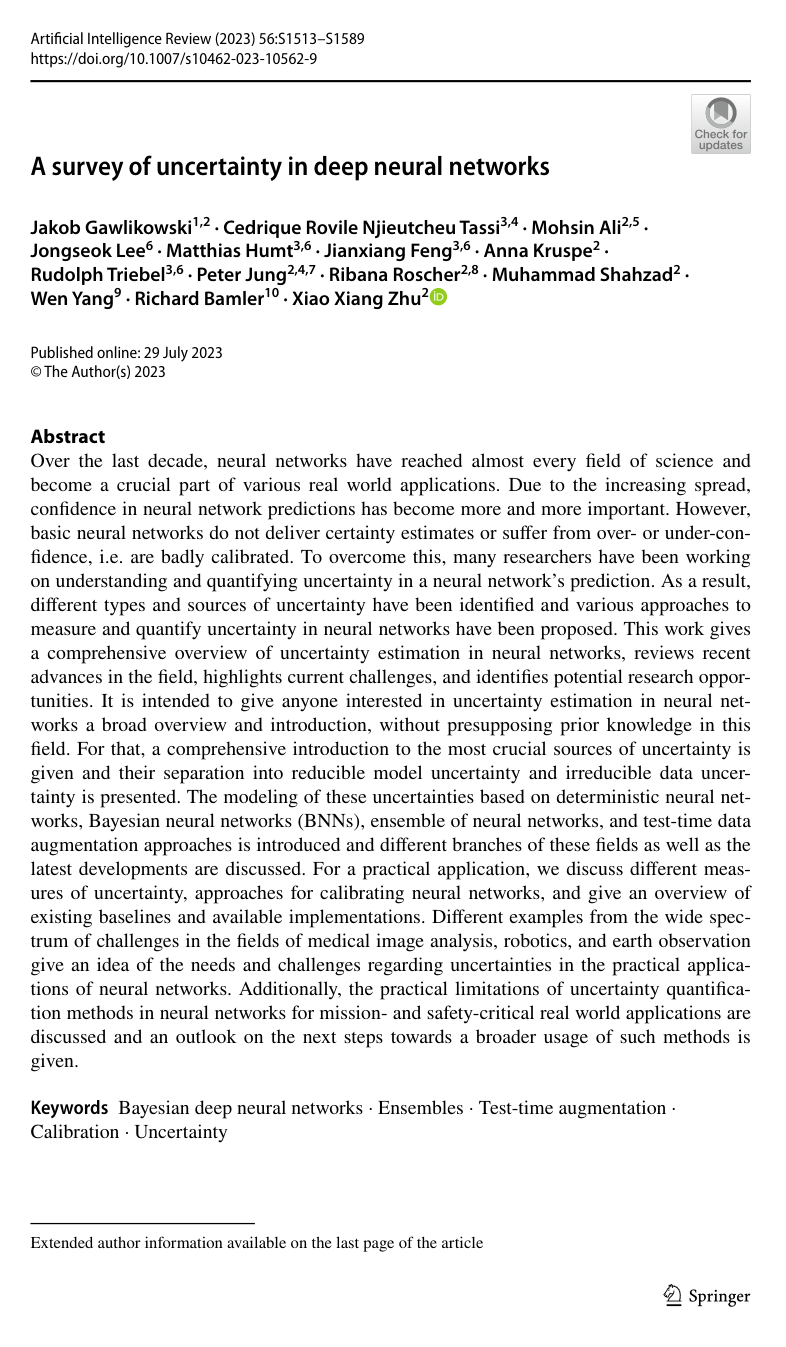
A survey of uncertainty in deep neural networks
Jakob Gawlikowski, Cedrique Rovile Njieutcheu Tassi, Mohsin Ali, Jongseok Lee, Matthias Humt, Jianxiang Feng, Anna Kruspe, Rudolph Triebel, Peter Jung, Ribana Roscher, Muhammad Shahzad, Wen Yang, Richard Bamler, Xiao Xiang Zhu
Why you should read this
Synthesizes uncertainty estimation methods in deep learning across Bayesian networks, ensembles, deterministic models, and test-time augmentation while detailing calibration techniques and deployment challenges in safety-critical applications.
Due to their increasing spread, confidence in neural network predictions became more and more important. However, basic neural networks do not deliver certainty estimates or suffer from over or under confidence. Many researchers have been working on understanding and quantifying uncertainty in a neural network's prediction. As a result, different types and sources of uncertainty have been identified and a variety of approaches to measure and quantify uncertainty in neural networks have been proposed. This work gives a comprehensive overview of uncertainty estimation in neural networks, reviews recent advances in the field, highlights current challenges, and identifies potential research opportunities. It is intended to give anyone interested in uncertainty estimation in neural networks a broad overview and introduction, without presupposing prior knowledge in this field. A comprehensive introduction to the most crucial sources of uncertainty is given and their separation into reducible model uncertainty and not reducible data uncertainty is presented. The modeling of these uncertainties based on deterministic neural networks, Bayesian neural networks, ensemble of neural networks, and test-time data augmentation approaches is introduced and different branches of these fields as well as the latest developments are discussed. For a practical application, we discuss different measures of uncertainty, approaches for the calibration of neural networks and give an overview of existing baselines and implementations. Different examples from the wide spectrum of challenges in different fields give an idea of the needs and challenges regarding uncertainties in practical applications. Additionally, the practical limitations of current methods for mission- and safety-critical real world applications are discussed and an outlook on the next steps towards a broader usage of such methods is given.
Added
2026-09-21

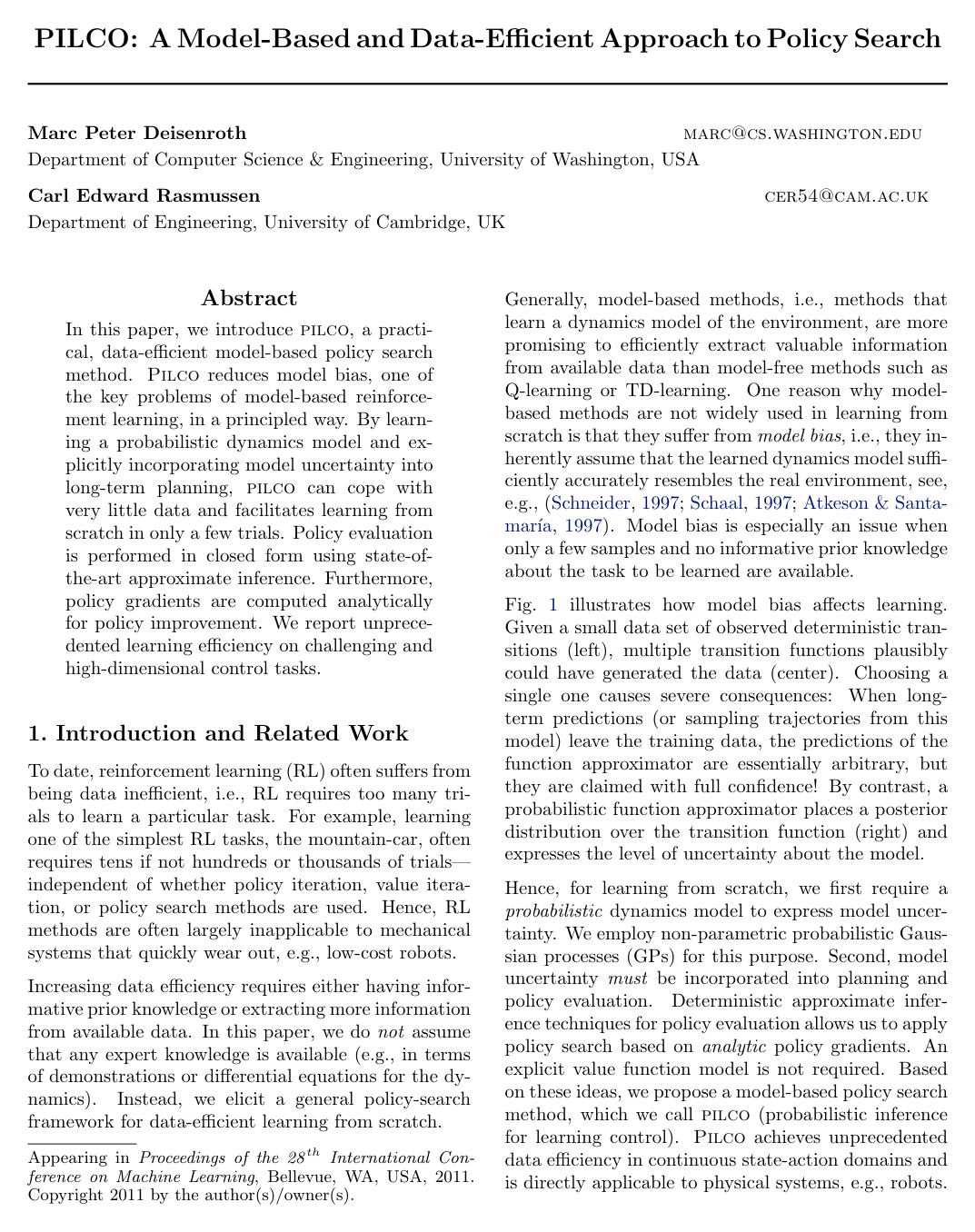
PILCO: A Model-Based and Data-Efficient Approach to Policy Search
Marc Peter Deisenroth, Carl Edward Rasmussen
Why you should read this
Proposes a model-based reinforcement learning framework that leverages Gaussian process dynamics and analytic policy gradients to dramatically reduce model bias and achieve unprecedented data efficiency on continuous control tasks.
In this paper, we introduce PILCO, a practical, data-efficient model-based policy search method. PILCO reduces model bias, one of the key problems of model-based reinforcement learning, in a principled way. By learning a probabilistic dynamics model and explicitly incorporating model uncertainty into long-term planning, PILCO can cope with very little data and facilitates learning from scratch in only a few trials. Policy evaluation is performed in closed form using state-of-the-art approximate inference. Furthermore, policy gradients are computed analytically for policy improvement. We report unprecedented learning efficiency on challenging and high-dimensional control tasks.
Added
2026-09-18
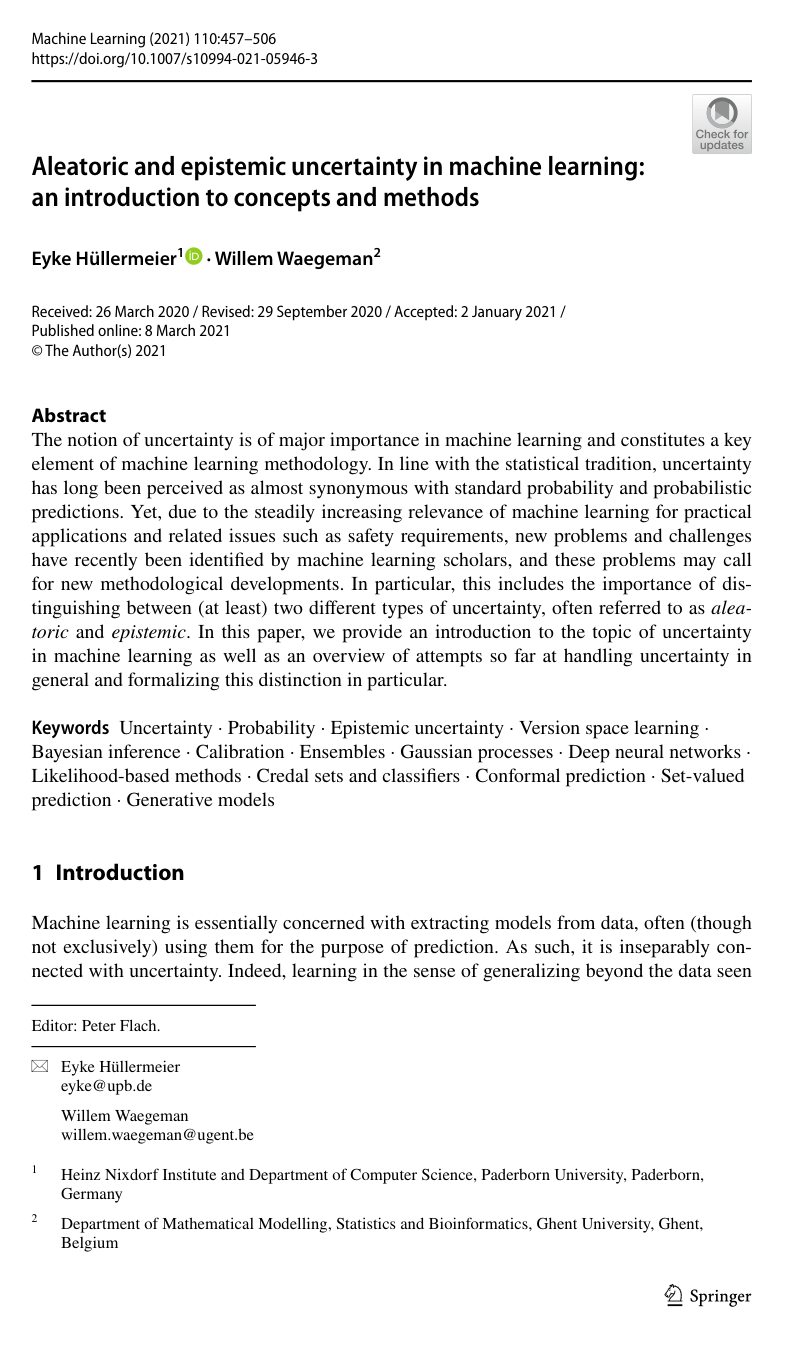
Aleatoric and epistemic uncertainty in machine learning: an introduction to concepts and methods
Eyke Hüllermeier, Willem Waegeman
Why you should read this
Clarifies the critical distinction between irreducible data randomness and reducible model ignorance, providing a comprehensive framework for quantifying both aleatoric and epistemic uncertainty to build safer, more reliable machine learning systems.
The notion of uncertainty is of major importance in machine learning and constitutes a key element of machine learning methodology. In line with the statistical tradition, uncertainty has long been perceived as almost synonymous with standard probability and probabilistic predictions. Yet, due to the steadily increasing relevance of machine learning for practical applications and related issues such as safety requirements, new problems and challenges have recently been identified by machine learning scholars, and these problems may call for new methodological developments. In particular, this includes the importance of distinguishing between (at least) two different types of uncertainty, often referred to as aleatoric and epistemic. In this paper, we provide an introduction to the topic of uncertainty in machine learning as well as an overview of attempts so far at handling uncertainty in general and formalizing this distinction in particular.
Added
2026-09-16
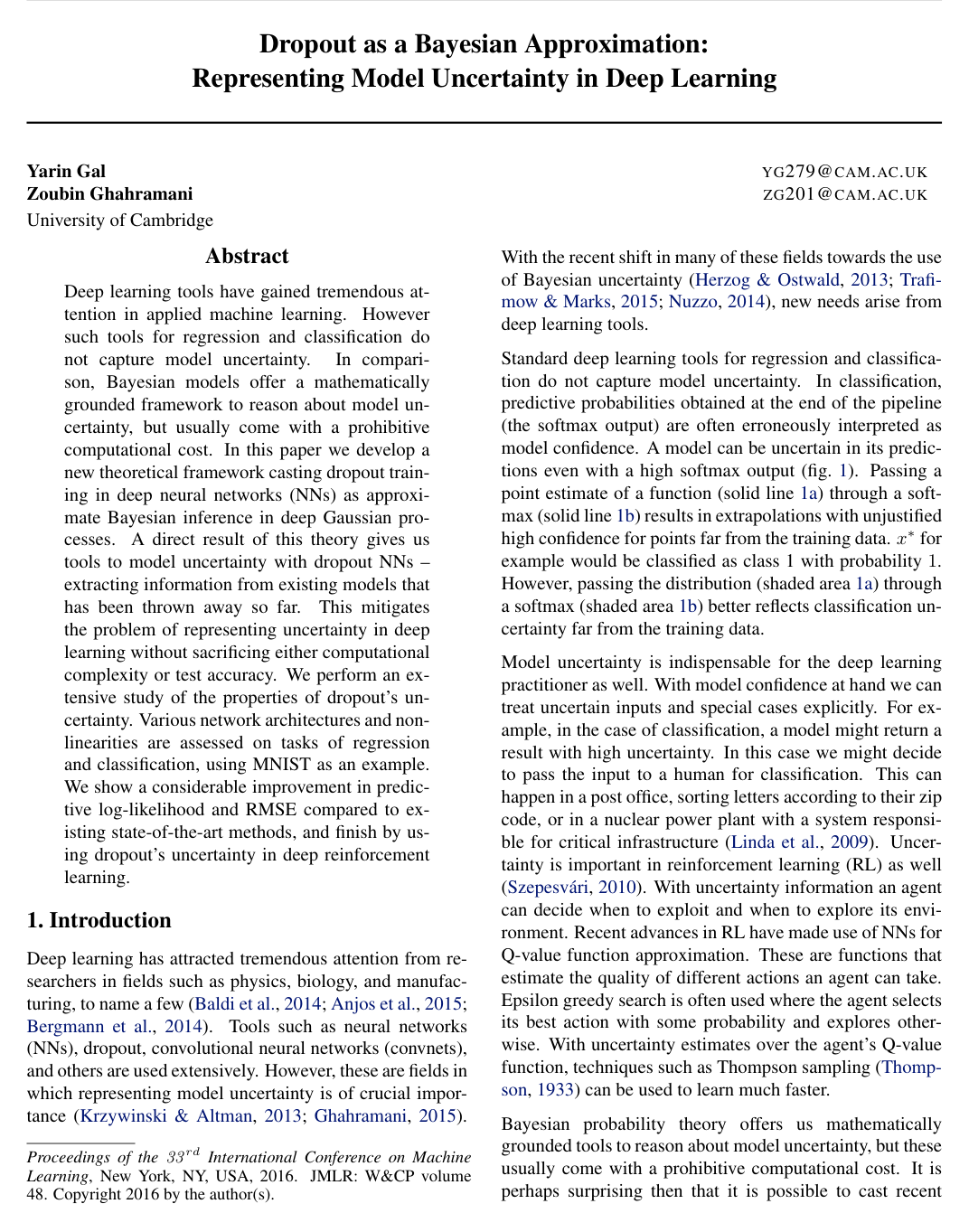
Dropout as a Bayesian Approximation: Representing Model Uncertainty in Deep Learning
Yarin Gal, Zoubin Ghahramani
Why you should read this
Establishes a novel theoretical framework that transforms dropout training into approximate Bayesian inference within deep Gaussian processes, enabling deep neural networks to quantify model uncertainty without compromising computational efficiency or test accuracy.
Deep learning tools have gained tremendous attention in applied machine learning. However such tools for regression and classification do not capture model uncertainty. In comparison, Bayesian models offer a mathematically grounded framework to reason about model uncertainty, but usually come with a prohibitive computational cost. In this paper we develop a new theoretical framework casting dropout training in deep neural networks (NNs) as approximate Bayesian inference in deep Gaussian processes. A direct result of this theory gives us tools to model uncertainty with dropout NNs -- extracting information from existing models that has been thrown away so far. This mitigates the problem of representing uncertainty in deep learning without sacrificing either computational complexity or test accuracy. We perform an extensive study of the properties of dropout's uncertainty. Various network architectures and non-linearities are assessed on tasks of regression and classification, using MNIST as an example. We show a considerable improvement in predictive log-likelihood and RMSE compared to existing state-of-the-art methods, and finish by using dropout's uncertainty in deep reinforcement learning.
Added
2026-04-27