
keyword
model evaluation
Model evaluation is the systematic process of assessing the performance, accuracy, robustness, and generalizability of a trained machine learning or artificial intelligence model using validation datasets, benchmarks, or simulated testing environments. This procedure measures how effectively and reliably a model performs its intended task on unseen data using standardized quantitative metrics, qualitative assessments, and specialized testing protocols. Beyond aggregate predictive scores, comprehensive model evaluation examines critical operational qualities such as behavioral consistency across diverse demographic subgroups, resilience against adversarial inputs, alignment with specified task requirements, and failure modes on individual test items to verify that the system is safe, trustworthy, and suitable for deployment.
4 items
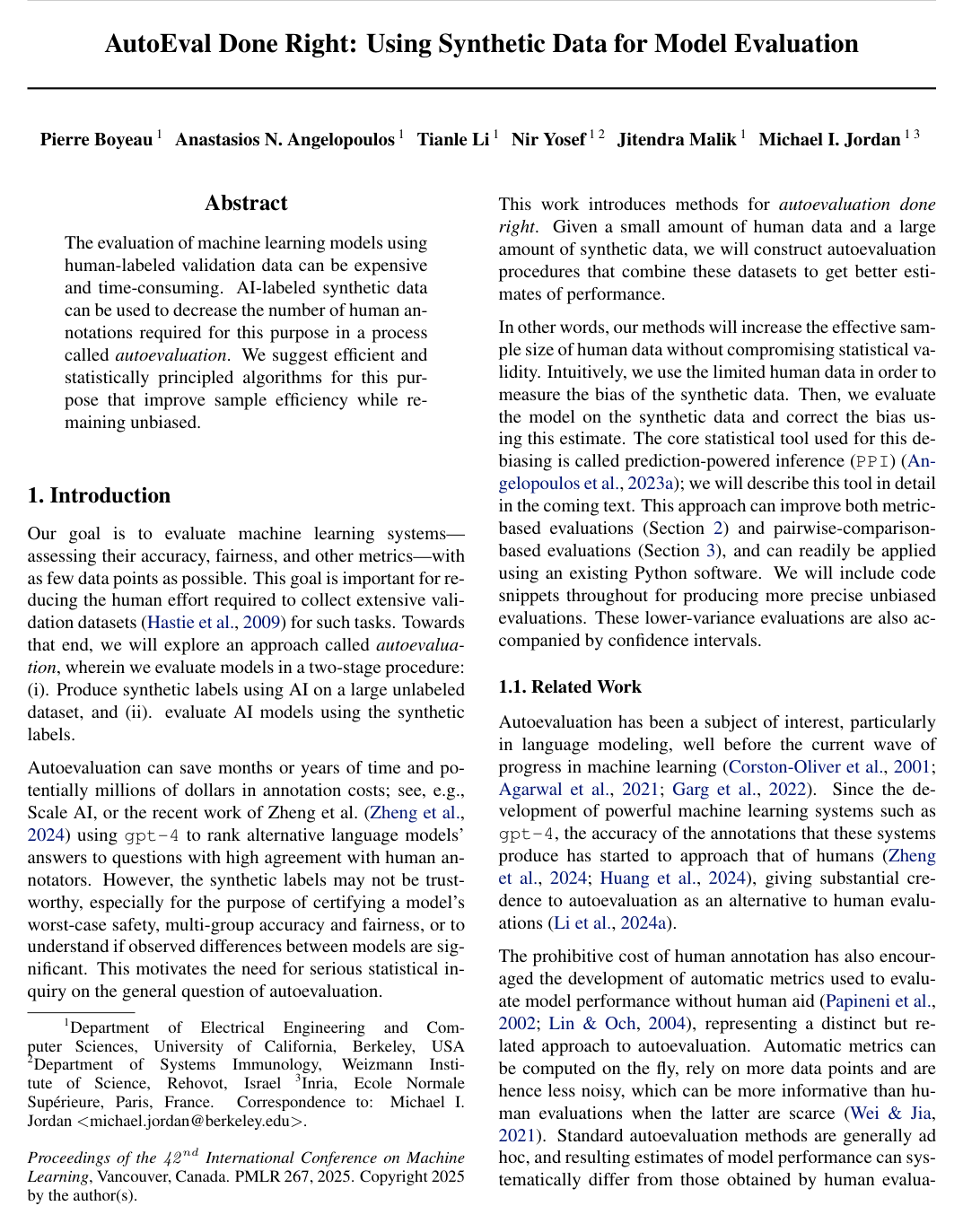
AutoEval Done Right: Using Synthetic Data for Model Evaluation
Pierre Boyeau, Anastasios Nikolas Angelopoulos, Tianle Li, Nir Yosef, Jitendra Malik, Michael I. Jordan
Why you should read this
Develops a statistically rigorous autoevaluation framework using prediction-powered inference to combine limited human annotations with abundant synthetic data, delivering unbiased model performance estimates and tight confidence intervals at a fraction of standard labeling costs.
The evaluation of machine learning models using human-labeled validation data can be expensive and time-consuming. AI-labeled synthetic data can be used to decrease the number of human annotations required for this purpose in a process called autoevaluation. We suggest efficient and statistically principled algorithms for this purpose that improve sample efficiency while remaining unbiased.
Added
2026-10-05
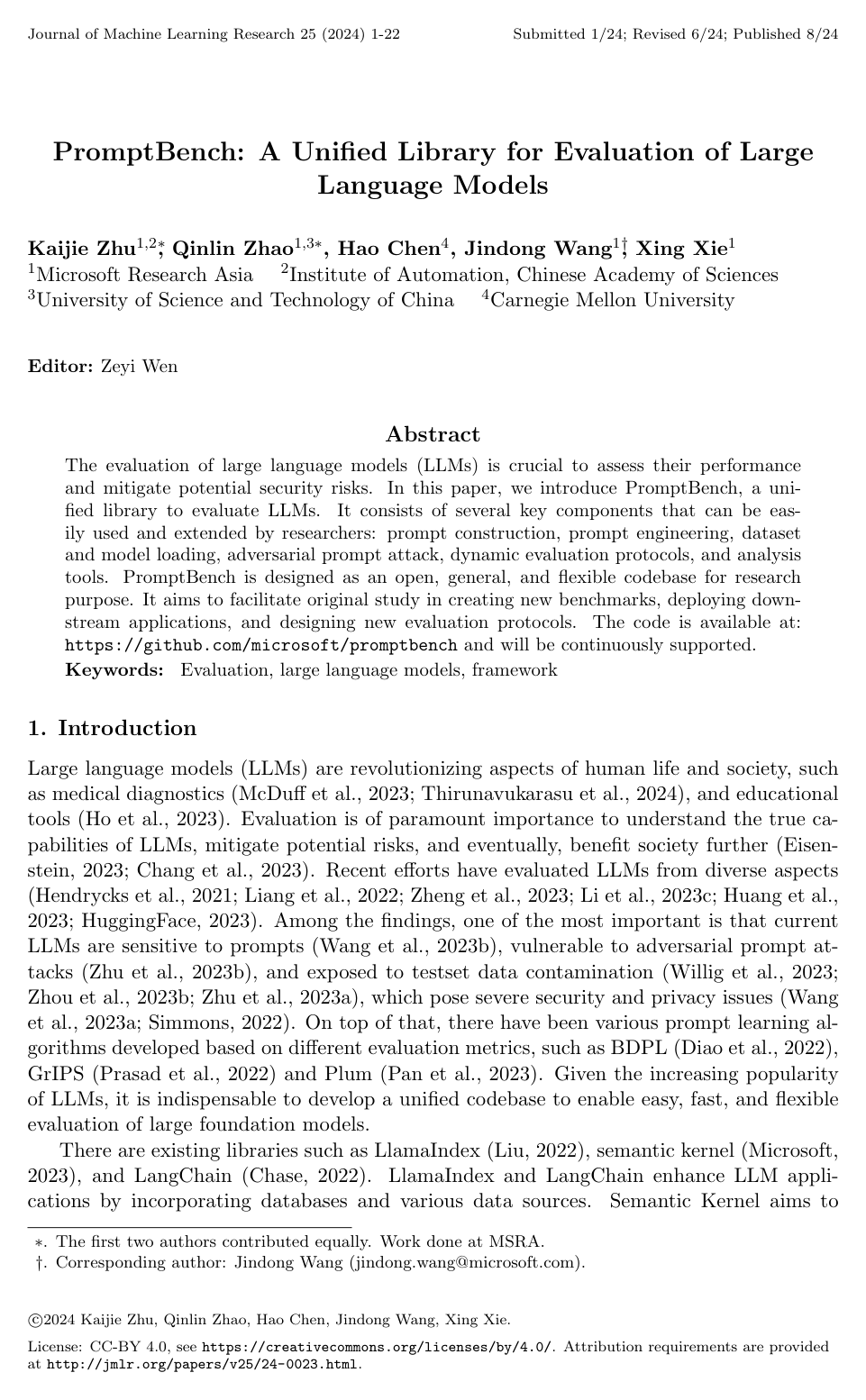
PromptBench: A Unified Library for Evaluation of Large Language Models
Kaijie Zhu, Qinlin Zhao, Hao Chen, Jindong Wang, Xing Xie
Why you should read this
Introduces PromptBench, an open-source evaluation framework that unifies model benchmarking, prompt engineering, multi-level adversarial attacks, and dynamic testing protocols to rigorously assess large language models.
The evaluation of large language models (LLMs) is crucial to assess their performance and mitigate potential security risks. In this paper, we introduce PromptBench, a unified library to evaluate LLMs. It consists of several key components that can be easily used and extended by researchers: prompt construction, prompt engineering, dataset and model loading, adversarial prompt attack, dynamic evaluation protocols, and analysis tools. PromptBench is designed as an open, general, and flexible codebase for research purpose. It aims to facilitate original study in creating new benchmarks, deploying downstream applications, and designing new evaluation protocols. The code is available at: https://github.com/microsoft/promptbench and will be continuously supported.
Added
2026-10-03
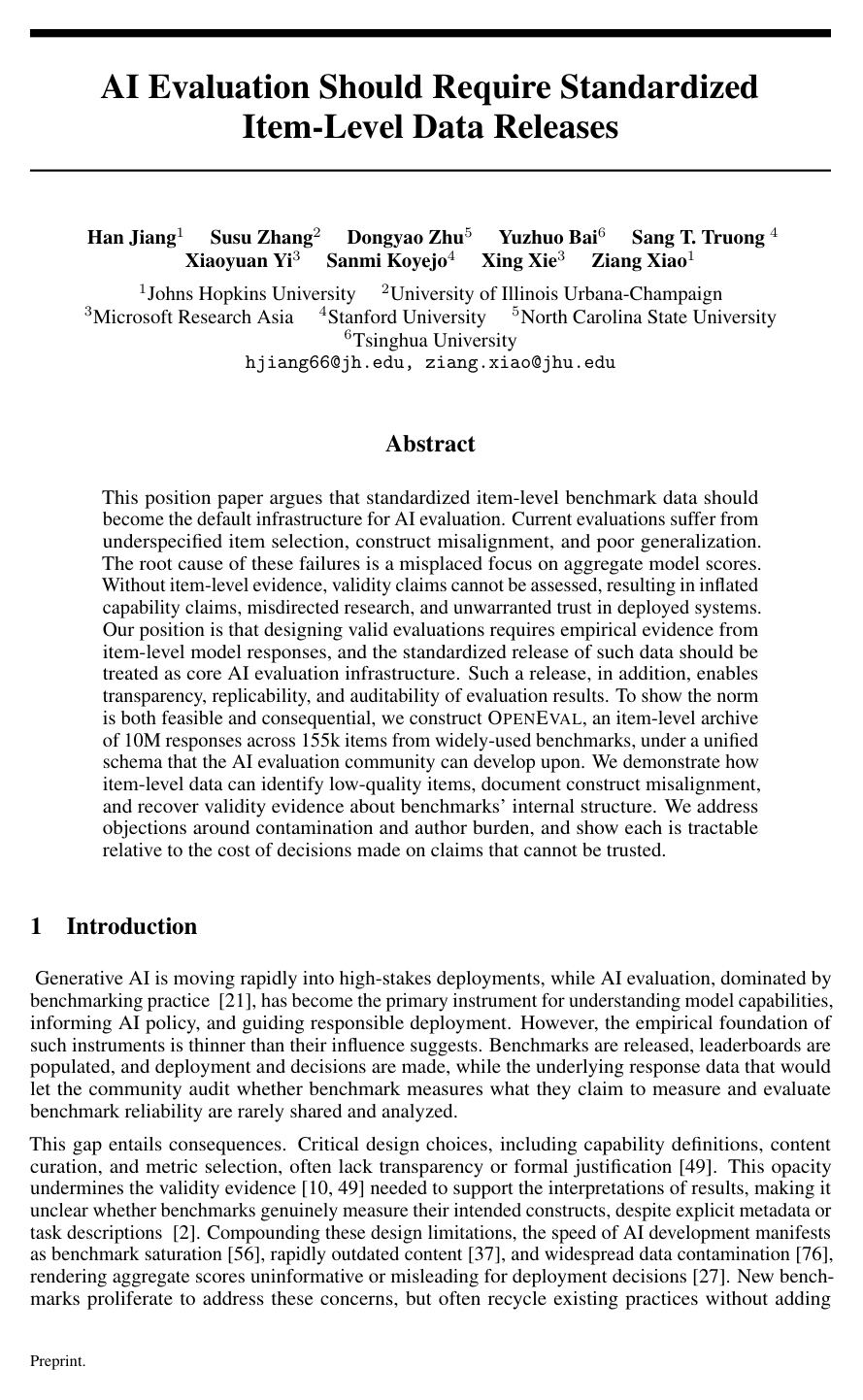
AI Evaluation Should Require Standardized Item-Level Data Releases
Hang Jiang, Susu Zhang, Dongyao Zhu, Yuzhuo Bai, Sang Truong, Xiaoyuan Yi, Sanmi Koyejo, Xing Xie, Ziang Xiao
Why you should read this
Proposes standardizing item-level model response releases as essential AI evaluation infrastructure, introducing the ten-million-response OpenEval repository to expose benchmark flaws, diagnose construct misalignment, and prevent inflated model capability claims.
This position paper argues that standardized item-level benchmark data should become the default infrastructure for AI evaluation. Current evaluations suffer from underspecified item selection, construct misalignment, and poor generalization. The root cause of these failures is a misplaced focus on aggregate model scores. Without item-level evidence, validity claims cannot be assessed, resulting in inflated capability claims, misdirected research, and unwarranted trust in deployed systems. Our position is that designing valid evaluations requires empirical evidence from item-level model responses, and the standardized release of such data should be treated as core AI evaluation infrastructure. Such a release, in addition, enables transparency, replicability, and auditability of evaluation results. To show the norm is both feasible and consequential, we construct OpenEval, an item-level archive of 10M responses across 155k items from widely-used benchmarks, under a unified schema that the AI evaluation community can develop upon. We demonstrate how item-level data can identify low-quality items, document construct misalignment, and recover validity evidence about benchmarks' internal structure. We address objections around contamination and author burden, and show each is tractable relative to the cost of decisions made on claims that cannot be trusted.
Added
2026-09-30
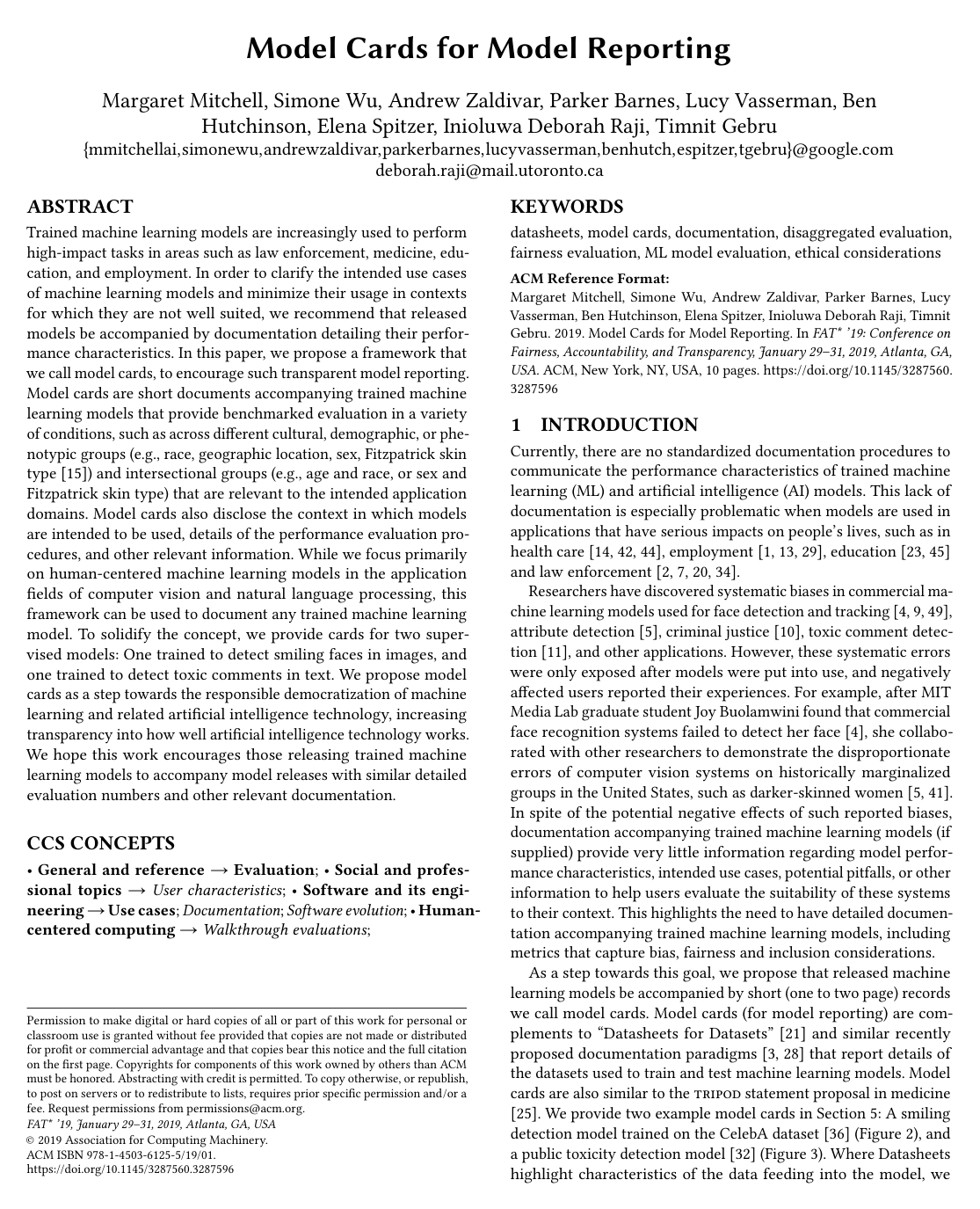
Model Cards for Model Reporting
Margaret Mitchell, Simone Wu, Andrew Zaldivar, Parker Barnes, Lucy Vasserman, Ben Hutchinson, Elena Spitzer, Inioluwa Deborah Raji, Timnit Gebru
Why you should read this
Establishes a transparent documentation template that forces practitioners to explicitly declare model limitations, intended use cases, and disaggregated performance metrics across demographic subpopulations.
Trained machine learning models are increasingly used to perform high-impact tasks in areas such as law enforcement, medicine, education, and employment. In order to clarify the intended use cases of machine learning models and minimize their usage in contexts for which they are not well suited, we recommend that released models be accompanied by documentation detailing their performance characteristics. In this paper, we propose a framework that we call model cards, to encourage such transparent model reporting. Model cards are short documents accompanying trained machine learning models that provide benchmarked evaluation in a variety of conditions, such as across different cultural, demographic, or phenotypic groups (e.g., race, geographic location, sex, Fitzpatrick skin type [15]) and intersectional groups (e.g., age and race, or sex and Fitzpatrick skin type) that are relevant to the intended application domains. Model cards also disclose the context in which models are intended to be used, details of the performance evaluation procedures, and other relevant information. While we focus primarily on human-centered machine learning models in the application fields of computer vision and natural language processing, this framework can be used to document any trained machine learning model. To solidify the concept, we provide cards for two supervised models: One trained to detect smiling faces in images, and one trained to detect toxic comments in text. We propose model cards as a step towards the responsible democratization of machine learning and related artificial intelligence technology, increasing transparency into how well artificial intelligence technology works. We hope this work encourages those releasing trained machine learning models to accompany model releases with similar detailed evaluation numbers and other relevant documentation.
Added
2026-03-22