
keyword
model activations
Model activations are the intermediate numerical values and hidden representation vectors produced by the internal layers and units of a neural network as it processes an input. Generated during a forward pass through successive mathematical operations and activation functions, these internal states encode the features, patterns, and latent concepts that the network learns from data. Researchers and practitioners analyze, probe, and manipulate model activations to examine how knowledge is structured within internal vector spaces, trace the computational circuits responsible for specific model behaviors, and interpret a network's underlying mechanisms independently of its final generated outputs.
2 items
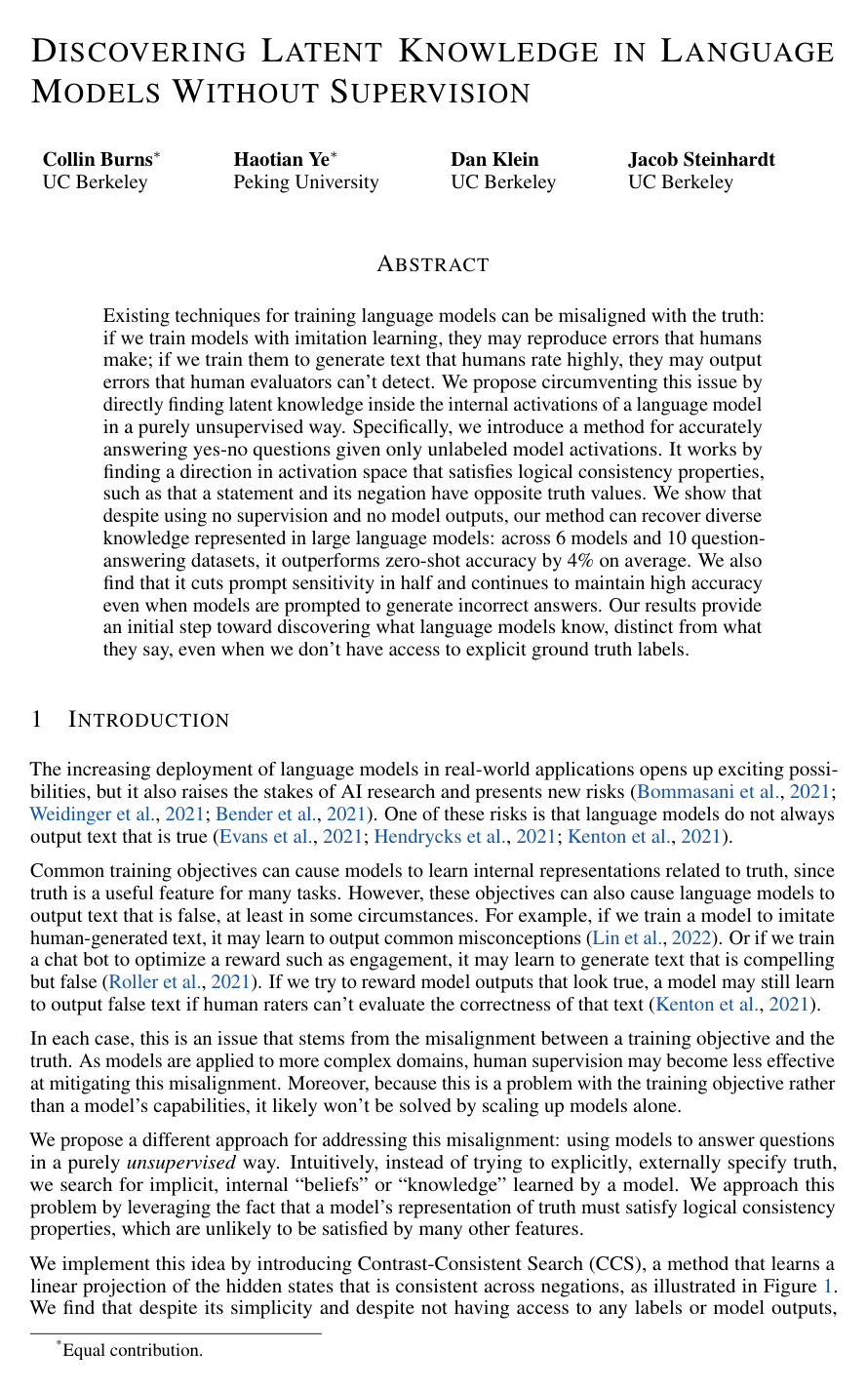
Discovering Latent Knowledge in Language Models Without Supervision
Collin Burns, Haotian Ye, Dan Klein, Jacob Steinhardt
Why you should read this
Introduces an unsupervised technique for extracting truthful latent knowledge directly from language model activations by enforcing logical consistency, enabling accurate question answering even when models are prompted to generate false outputs.
Existing techniques for training language models can be misaligned with the truth: if we train models with imitation learning, they may reproduce errors that humans make; if we train them to generate text that humans rate highly, they may output errors that human evaluators can't detect. We propose circumventing this issue by directly finding latent knowledge inside the internal activations of a language model in a purely unsupervised way. Specifically, we introduce a method for accurately answering yes-no questions given only unlabeled model activations. It works by finding a direction in activation space that satisfies logical consistency properties, such as that a statement and its negation have opposite truth values. We show that despite using no supervision and no model outputs, our method can recover diverse knowledge represented in large language models: across 6 models and 10 question-answering datasets, it outperforms zero-shot accuracy by 4\% on average. We also find that it cuts prompt sensitivity in half and continues to maintain high accuracy even when models are prompted to generate incorrect answers. Our results provide an initial step toward discovering what language models know, distinct from what they say, even when we don't have access to explicit ground truth labels.
Added
2026-09-26
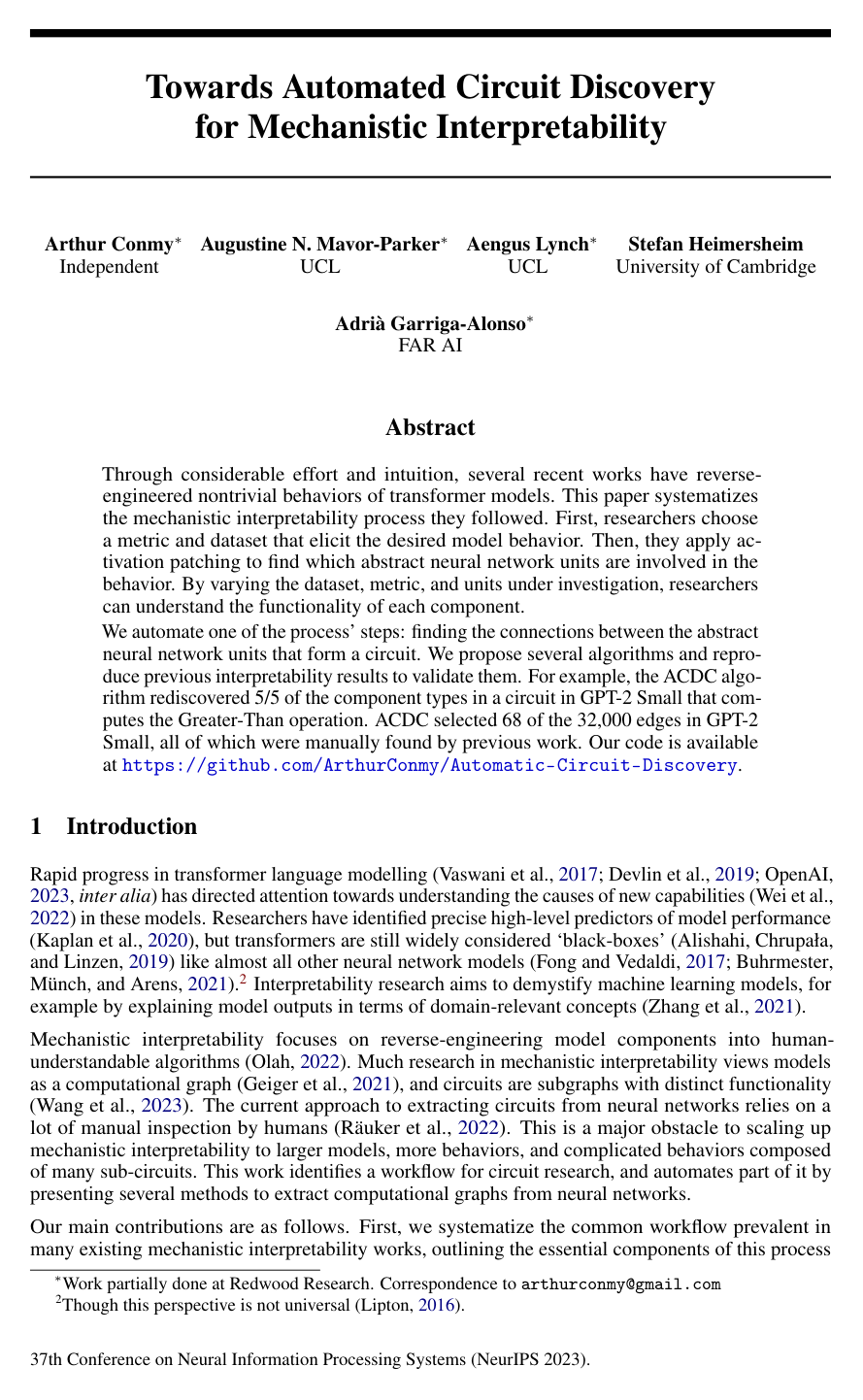
Towards Automated Circuit Discovery for Mechanistic Interpretability
Arthur Conmy, Augustine N. Mavor-Parker, Aengus Lynch, Stefan Heimersheim, Adrià Garriga-Alonso
Why you should read this
Proposes an automated circuit discovery algorithm that replaces labor-intensive manual patching to efficiently isolate the computational subgraphs responsible for specific behaviors in transformer models.
Through considerable effort and intuition, several recent works have reverse-engineered nontrivial behaviors of transformer models. This paper systematizes the mechanistic interpretability process they followed. First, researchers choose a metric and dataset that elicit the desired model behavior. Then, they apply activation patching to find which abstract neural network units are involved in the behavior. By varying the dataset, metric, and units under investigation, researchers can understand the functionality of each component. We automate one of the process' steps: to identify the circuit that implements the specified behavior in the model's computational graph. We propose several algorithms and reproduce previous interpretability results to validate them. For example, the ACDC algorithm rediscovered 5/5 of the component types in a circuit in GPT-2 Small that computes the Greater-Than operation. ACDC selected 68 of the 32,000 edges in GPT-2 Small, all of which were manually found by previous work. Our code is available at this https URL.
Added
2026-09-25