
Built independently by an author, for readers. Read the story and support ChapterPal

keyword

Modality utilization

Modality utilization refers to the extent to which a multimodal machine learning system relies on and extracts meaningful information from a specific input modality, such as text, imagery, or audio, to make its predictions. In multimodal deep neural networks, training dynamics often lead to an imbalance where the network disproportionately exploits a single dominant modality while under-utilizing or neglecting others. Modality utilization measures this dependence, often quantified by assessing the predictive performance gain or the learning progression attributable to a given modality when it is integrated alongside other data streams. Evaluating and balancing modality utilization helps prevent modality neglect, ensuring that the model effectively synthesizes complementary information across all available data types to improve overall robustness and generalization.

1 item
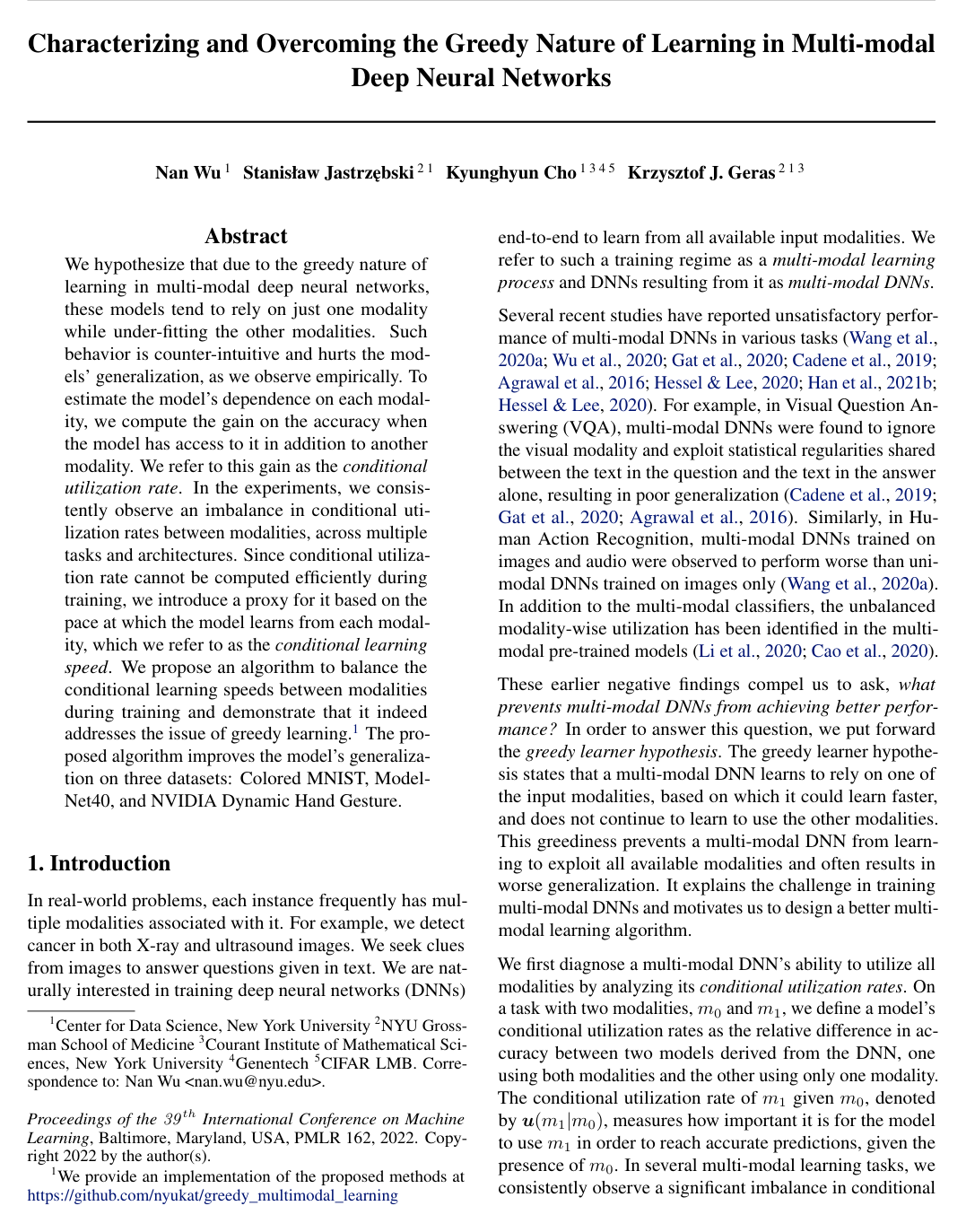
Characterizing and Overcoming the Greedy Nature of Learning in Multi-modal Deep Neural Networks

Characterizing and Overcoming the Greedy Nature of Learning in Multi-modal Deep Neural Networks

Nan Wu, Stanislaw Jastrzebski, Kyunghyun Cho, Krzysztof J. Geras

OrganizationsCIFARGenentechNew York University

Why you should read this

Explains why multi-modal neural networks often over-rely on a single modality and introduces a training algorithm that balances learning speeds across modalities to improve overall generalization.

We hypothesize that due to the greedy nature of learning in multi-modal deep neural networks, these models tend to rely on just one modality while under-fitting the other modalities. Such behavior is counter-intuitive and hurts the models’ generalization, as we observe empirically. To estimate the model’s dependence on each modality, we compute the gain on the accuracy when the model has access to it in addition to another modality. We refer to this gain as the conditional utilization rate. In the experiments, we consistently observe an imbalance in conditional utilization rates between modalities, across multiple tasks and architectures. Since conditional utilization rate cannot be computed efficiently during training, we introduce a proxy for it based on the pace at which the model learns from each modality, which we refer to as the conditional learning speed. We propose an algorithm to balance the conditional learning speeds between modalities during training and demonstrate that it indeed addresses the issue of greedy learning.1 The proposed algorithm improves the model’s generalization on three datasets: Colored MNIST, ModelNet40, and NVIDIA Dynamic Hand Gesture.

Added

2026-09-26