Built independently by an author, for readers. Read the story and support ChapterPal

keyword

modality-specific features

Modality-specific features are the unique characteristics, patterns, and information native to a single data type or input channel, such as text, audio, or visual signals, that are not shared by other modalities. In multimodal machine learning, these features represent the private aspects of an individual data stream, capturing specialized cues such as acoustic pitch in speech, facial expressions in video, or syntactic structures in written language. By isolating and preserving these distinctive attributes alongside shared cross-modal representations, multimodal systems can retain complementary and non-redundant information from each distinct source, preventing the loss of unique signals during data fusion and improving overall model performance.

1 item

MISA: Modality-Invariant and -Specific Representations for Multimodal Sentiment Analysis

MISA: Modality-Invariant and -Specific Representations for Multimodal Sentiment Analysis

Devamanyu Hazarika, Roger Zimmermann, Soujanya Poria

OrganizationsNational University of SingaporeSingapore University of Technology and Design

Why you should read this

Proposes a multimodal representation framework, MISA, that factorizes signals into invariant and modality-specific subspaces, effectively resolving heterogeneous modality gaps to achieve state-of-the-art performance in sentiment analysis and humor detection.

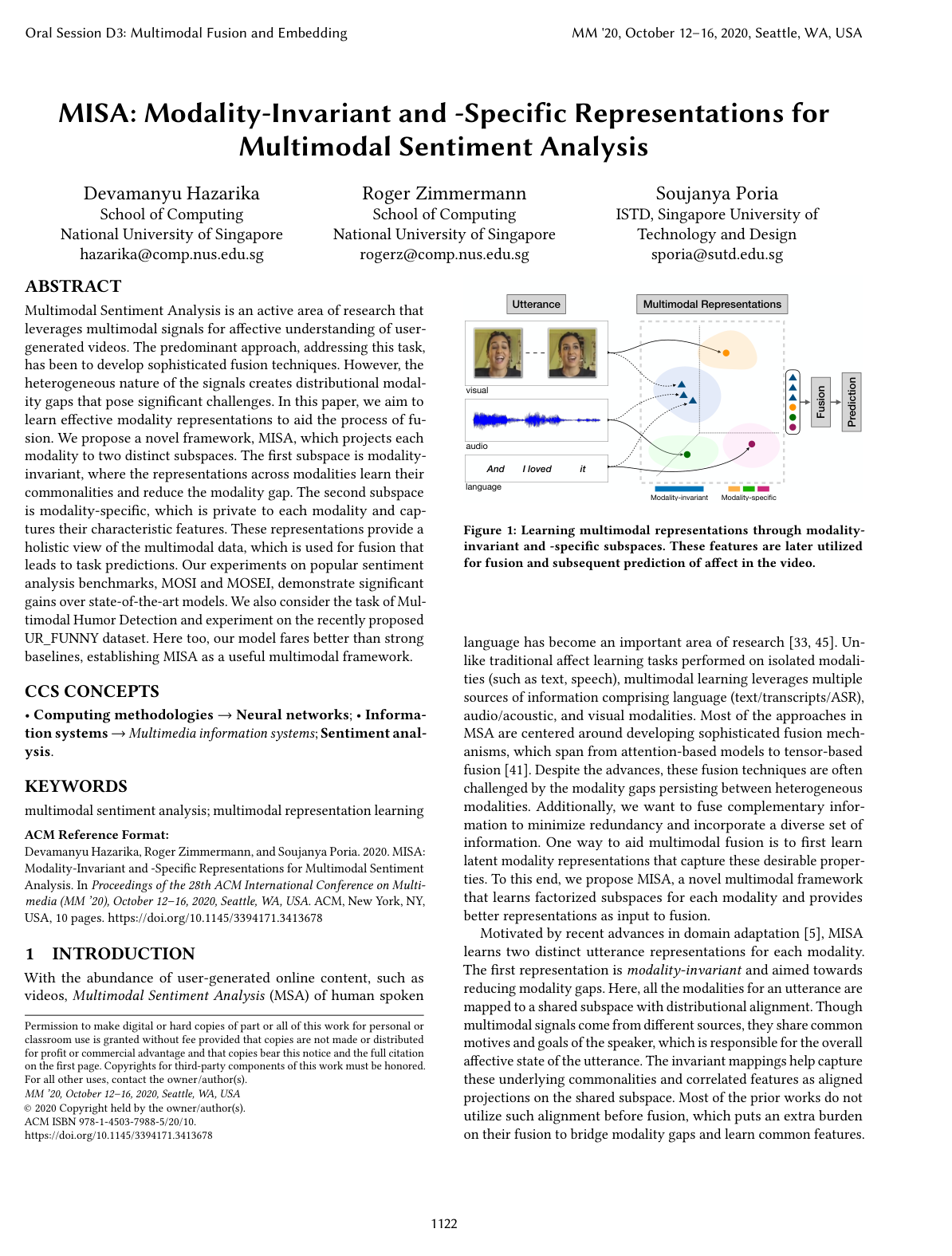
Multimodal Sentiment Analysis is an active area of research that leverages multimodal signals for affective understanding of user-generated videos. The predominant approach, addressing this task, has been to develop sophisticated fusion techniques. However, the heterogeneous nature of the signals creates distributional modality gaps that pose significant challenges. In this paper, we aim to learn effective modality representations to aid the process of fusion. We propose a novel framework, MISA, which projects each modality to two distinct subspaces. The first subspace is modality-invariant, where the representations across modalities learn their commonalities and reduce the modality gap. The second subspace is modality-specific, which is private to each modality and captures their characteristic features. These representations provide a holistic view of the multimodal data, which is used for fusion that leads to task predictions. Our experiments on popular sentiment analysis benchmarks, MOSI and MOSEI, demonstrate significant gains over state-of-the-art models. We also consider the task of Multimodal Humor Detection and experiment on the recently proposed UR_FUNNY dataset. Here too, our model fares better than strong baselines, establishing MISA as a useful multimodal framework.

Added

2026-09-25