
Built independently by an author, for readers. Read the story and support ChapterPal

keyword

mixed negatives

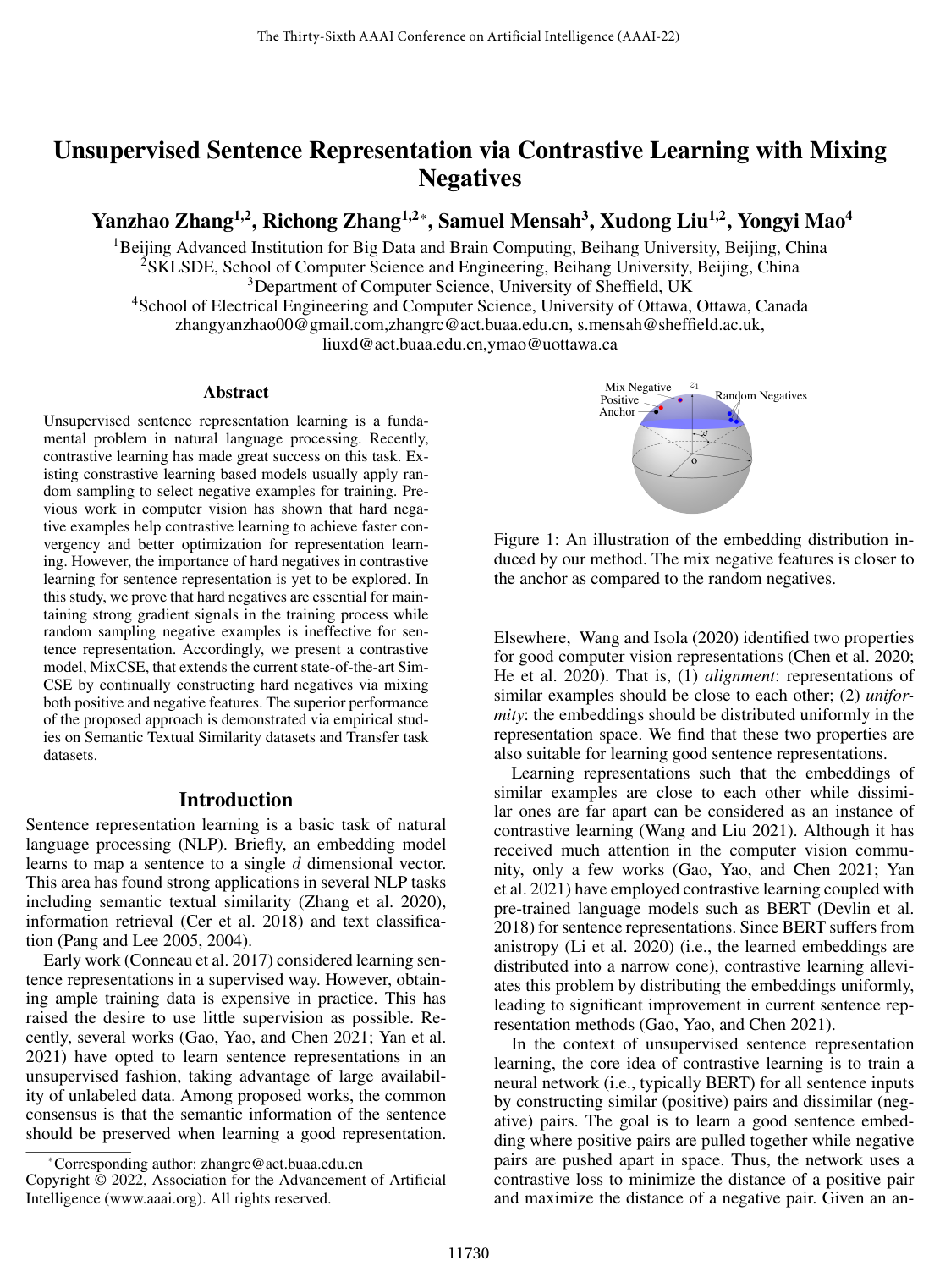
Mixed negatives are synthetically generated negative examples created in contrastive representation learning by interpolating or combining the feature representations of existing data points, such as blending features between positive and negative instances or across multiple negative instances. In contrastive learning, a model learns meaningful representations by pulling similar examples together in an embedding space while pushing dissimilar negative examples apart. Standard negative samples selected at random often provide weak learning signals because they are trivially easy for the network to differentiate. By synthesizing mixed negative embeddings directly in the latent space, practitioners introduce harder negative examples that lie closer to the target representations. This approach maintains informative gradient signals throughout training and encourages models to capture more robust and fine-grained distinctions across tasks in natural language processing and computer vision without requiring excessively large memory banks or additional annotated data.

1 item
Unsupervised Sentence Representation via Contrastive Learning with Mixing Negatives

Unsupervised Sentence Representation via Contrastive Learning with Mixing Negatives

Yanzhao Zhang, Richong Zhang, Samuel Mensah, Xudong Liu, Yongyi Mao

OrganizationsAdvanced Innovation Center for Big Data and Brain ComputingBeihang UniversitySKLSDEUniversity of OttawaUniversity of Sheffield

Why you should read this

Proposes MixCSE, a contrastive sentence representation framework that overcomes vanishing gradient signals by continually generating artificial hard negative features through mixing positive and negative samples, achieving state-of-the-art results on semantic textual similarity and transfer tasks.

Unsupervised sentence representation learning is a fundamental problem in natural language processing. Recently, contrastive learning has made great success on this task. Existing contrastive learning based models usually apply random sampling to select negative examples for training. Previous work in computer vision has shown that hard negative examples help contrastive learning to achieve faster convergence and better optimization for representation learning. However, the importance of hard negatives in contrastive learning for sentence representation is yet to be explored. In this study, we prove that hard negatives are essential for maintaining strong gradient signals in the training process while random sampling negative examples is ineffective for sentence representation. Accordingly, we present a contrastive model, MixCSE, that extends the current state-of-the-art SimCSE by continually constructing hard negatives via mixing both positive and negative features. The superior performance of the proposed approach is demonstrated via empirical studies on Semantic Textual Similarity datasets and Transfer task datasets.

Added

2026-09-26