
Built independently by an author, for readers. Read the story and support ChapterPal

keyword

meta similarity correction

Meta similarity correction is a machine learning technique used in multimodal data processing to adjust and refine similarity scores between paired data instances, such as images and text, when the training data contains mismatched or noisy correspondences. By treating the assessment of cross-modal alignment as a meta-learning objective, an auxiliary meta-network is trained on verified positive and negative pairs to determine the true semantic relatedness of sample pairs. This mechanism generates reliable similarity metrics that prevent the primary model from mistakenly enforcing similarity on incorrect pairings, effectively mitigating the risk of overfitting to corrupted labels, improving representation alignment, and aiding sample purification in cross-modal retrieval tasks.

1 item
Noisy Correspondence Learning with Meta Similarity Correction

Noisy Correspondence Learning with Meta Similarity Correction

Haochen Han, Kaiyao Miao, Qinghua Zheng, Minnan Luo

OrganizationsXi'an Jiaotong University

Why you should read this

Proposes a meta-learning framework that trains a correction network on clean and mismatched meta-data to rectify similarity scores and filter out mismatched cross-modal pairs during retrieval training.

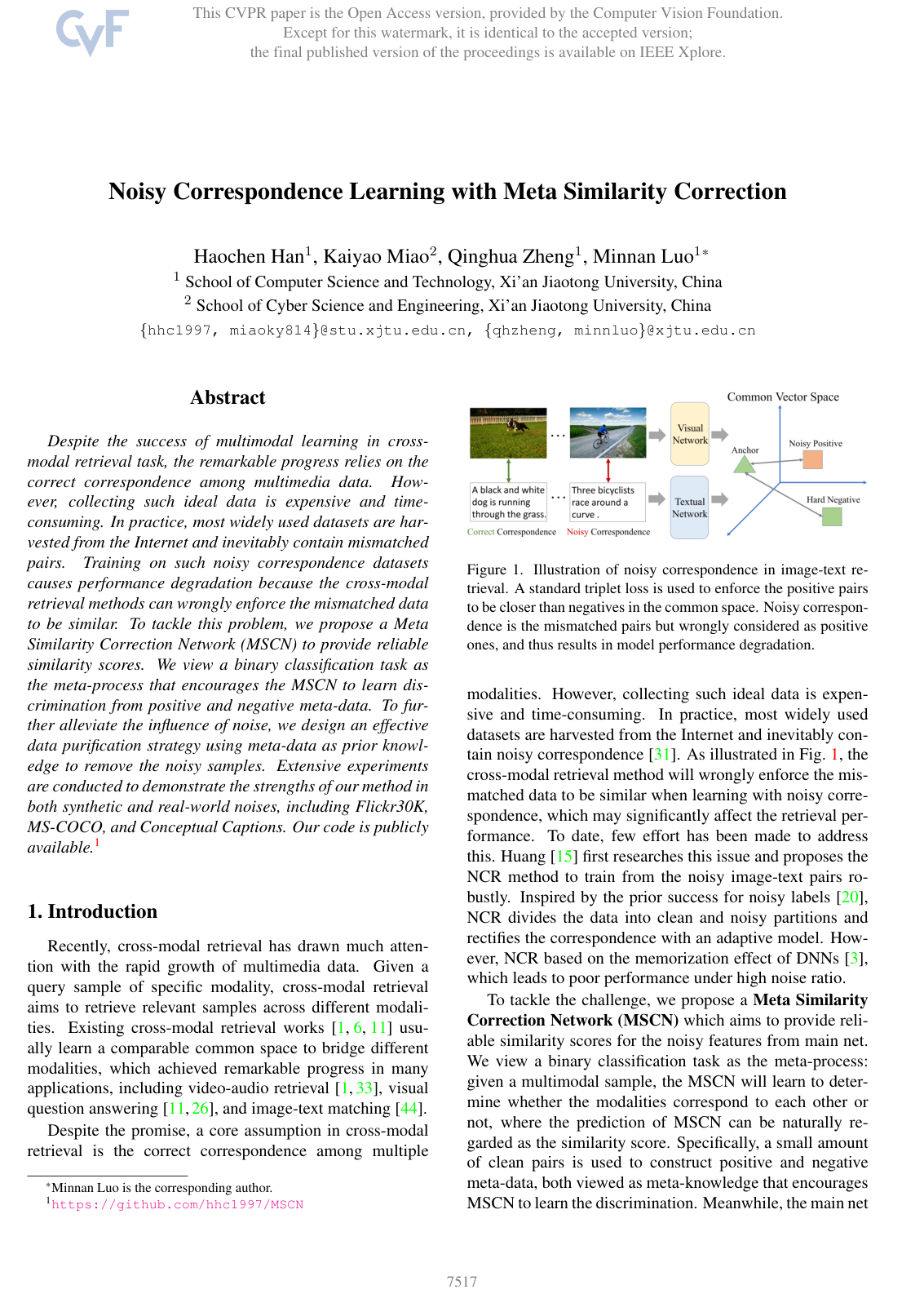
Despite the success of multimodal learning in cross-modal retrieval task, the remarkable progress relies on the correct correspondence among multimedia data. However, collecting such ideal data is expensive and time-consuming. In practice, most widely used datasets are harvested from the Internet and inevitably contain mismatched pairs. Training on such noisy correspondence datasets causes performance degradation because the cross-modal retrieval methods can wrongly enforce the mismatched data to be similar. To tackle this problem, we propose a Meta Similarity Correction Network (MSCN) to provide reliable similarity scores. We view a binary classification task as the meta-process that encourages the MSCN to learn discrimination from positive and negative meta-data. To further alleviate the influence of noise, we design an effective data purification strategy using meta-data as prior knowledge to remove the noisy samples. Extensive experiments are conducted to demonstrate the strengths of our method in both synthetic and real-world noises, including Flickr30K, MS-COCO, and Conceptual Captions. Our code is publicly available.

Added

2026-09-26