Built independently by an author, for readers. Read the story and support ChapterPal

keyword

memory replay GANs

Memory replay GANs are continual learning frameworks based on generative adversarial networks that prevent catastrophic forgetting when sequentially learning new categories or tasks. Rather than storing and accessing historical training data, which can introduce storage burdens and data privacy concerns, the architecture leverages a generative replay mechanism to reproduce synthetic samples of previously learned distributions. When new tasks arrive, the model combines newly presented real data with these replayed artificial samples through strategies such as joint training or replay alignment, enabling the generative model to preserve synthesis performance on past categories while continuously acquiring knowledge of novel classes.

1 item

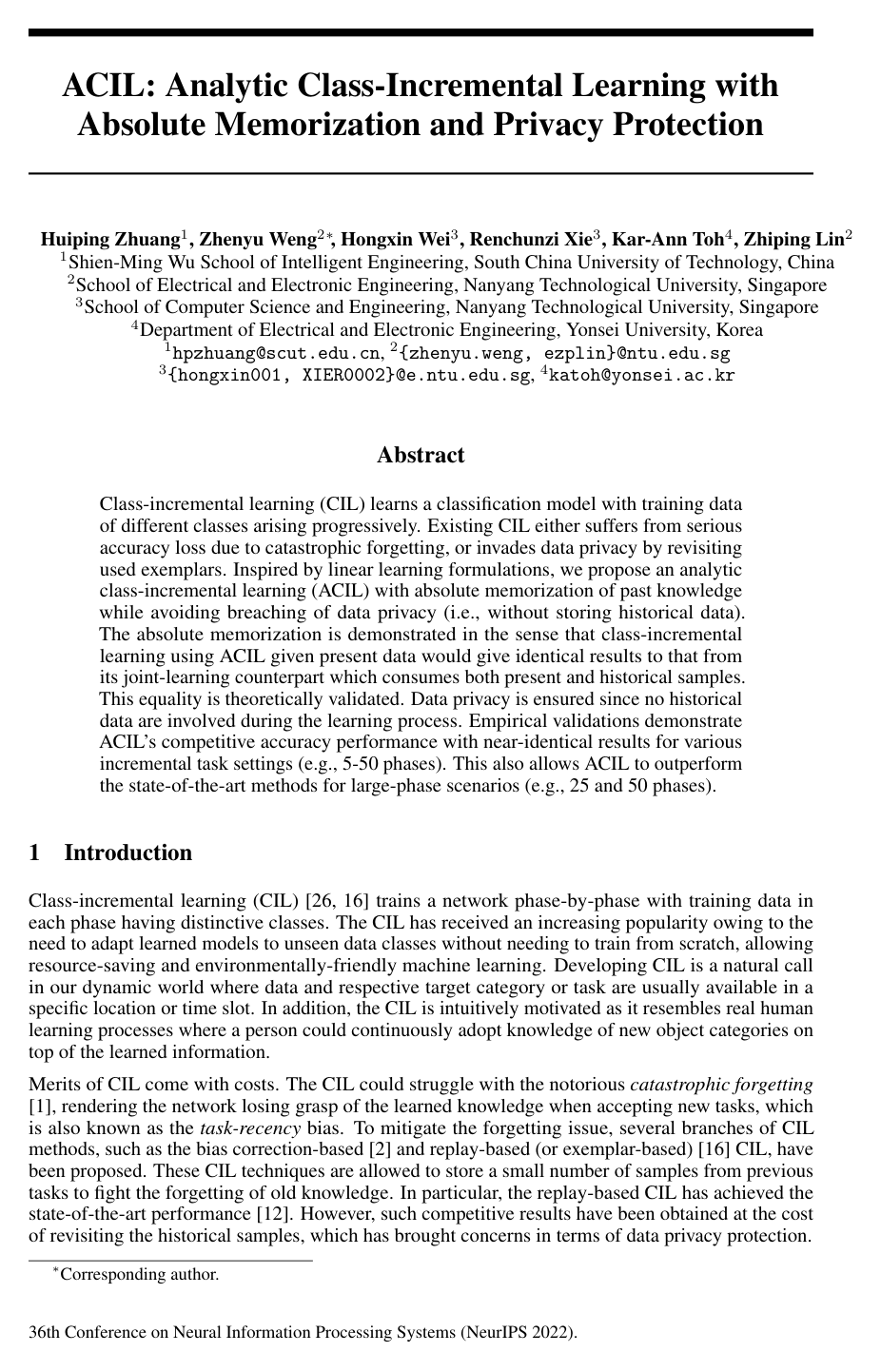
ACIL: Analytic Class-Incremental Learning with Absolute Memorization and Privacy Protection

ACIL: Analytic Class-Incremental Learning with Absolute Memorization and Privacy Protection

Huiping Zhuang, Zhenyu Weng, Hongxin Wei, Renchunzi Xie, Kar-Ann Toh, Zhiping Lin

OrganizationsNanyang Technological UniversitySouth China University of TechnologyYonsei University

Why you should read this

Proposes an analytic class-incremental learning framework that mathematically matches the performance of joint training without storing historical exemplar data, eliminating catastrophic forgetting while protecting data privacy across multi-phase learning tasks.

Class-incremental learning (CIL) learns a classification model with training data of different classes arising progressively. Existing CIL either suffers from serious accuracy loss due to catastrophic forgetting, or invades data privacy by revisiting used exemplars. Inspired by linear learning formulations, we propose an analytic class-incremental learning (ACIL) with absolute memorization of past knowledge while avoiding breaching of data privacy (i.e., without storing historical data). The absolute memorization is demonstrated in the sense that class-incremental learning using ACIL given present data would give identical results to that from its joint-learning counterpart which consumes both present and historical samples. This equality is theoretically validated. Data privacy is ensured since no historical data are involved during the learning process. Empirical validations demonstrate ACIL's competitive accuracy performance with near-identical results for various incremental task settings (e.g., 5-50 phases). This also allows ACIL to outperform the state-of-the-art methods for large-phase scenarios (e.g., 25 and 50 phases).

Added

2026-09-26