
keyword
memory networks
Memory networks are a class of machine learning models that integrate neural inference mechanisms with an explicit, addressable long-term memory component to store and reason over information. Unlike standard recurrent neural architectures that compress all historical context into fixed-size continuous hidden states, memory networks maintain a separate memory bank that can be explicitly written to, updated, and read from during computation. The architecture typically operates through four coordinated components that map incoming inputs into internal feature representations, update the memory with new facts, retrieve and infer relevant stored knowledge in response to a query, and convert the output into a final prediction or natural language response. This design enables multi-step reasoning and dynamic knowledge retrieval, making memory networks particularly effective for complex tasks such as question answering, dialogue systems, and long-range language understanding.
15 items
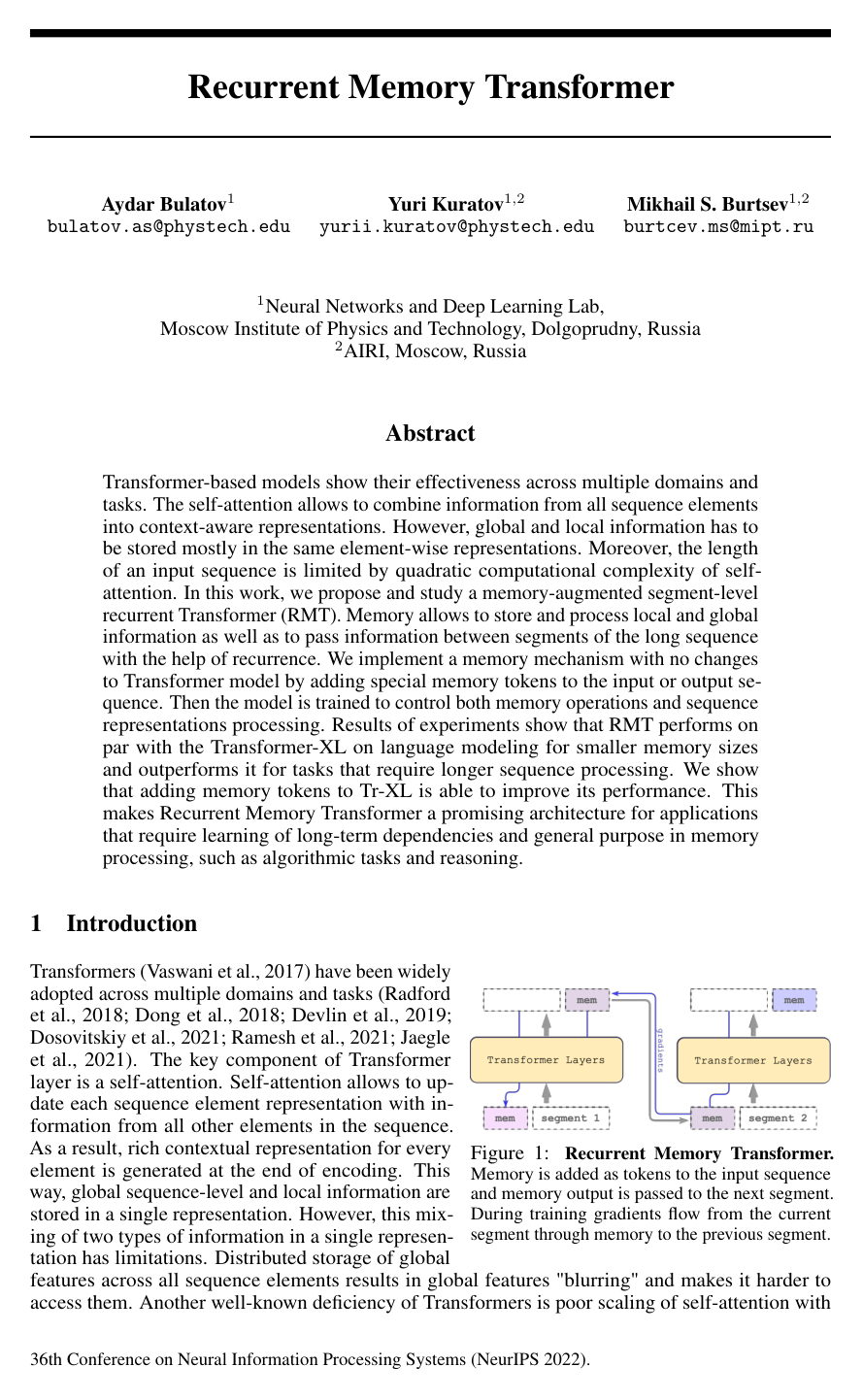
Recurrent Memory Transformer
Aydar Bulatov, Yuri Kuratov, Mikhail Burtsev
Why you should read this
Proposes the Recurrent Memory Transformer, a plug-and-play architecture that enables standard Transformers to scale to virtually unlimited sequence lengths without modifying underlying self-attention layers by passing dedicated memory tokens recurrently across segments.
Transformer-based models show their effectiveness across multiple domains and tasks. The self-attention allows to combine information from all sequence elements into context-aware representations. However, global and local information has to be stored mostly in the same element-wise representations. Moreover, the length of an input sequence is limited by quadratic computational complexity of self-attention. In this work, we propose and study a memory-augmented segment-level recurrent Transformer (RMT). Memory allows to store and process local and global information as well as to pass information between segments of the long sequence with the help of recurrence. We implement a memory mechanism with no changes to Transformer model by adding special memory tokens to the input or output sequence. Then the model is trained to control both memory operations and sequence representations processing. Results of experiments show that RMT performs on par with the Transformer-XL on language modeling for smaller memory sizes and outperforms it for tasks that require longer sequence processing. We show that adding memory tokens to Tr-XL is able to improve its performance. This makes Recurrent Memory Transformer a promising architecture for applications that require learning of long-term dependencies and general purpose in memory processing, such as algorithmic tasks and reasoning.
Added
2026-10-05
The Dual Form of Neural Networks Revisited: Connecting Test Time Predictions to Training Patterns via Spotlights of Attention
Kazuki Irie, Róbert Csordás, Jürgen Schmidhuber
Why you should read this
Reformulates linear layers in gradient-trained neural networks as key-value attention over the entire training history, providing a direct method to trace and interpret how specific training samples drive test-time predictions.
Linear layers in neural networks (NNs) trained by gradient descent can be expressed as a key-value memory system which stores all training datapoints and the initial weights, and produces outputs using unnormalised dot attention over the entire training experience. While this has been technically known since the 1960s, no prior work has effectively studied the operations of NNs in such a form, presumably due to prohibitive time and space complexities and impractical model sizes, all of them growing linearly with the number of training patterns which may get very large. However, this dual formulation offers a possibility of directly visualising how an NN makes use of training patterns at test time, by examining the corresponding attention weights. We conduct experiments on small scale supervised image classification tasks in single-task, multi-task, and continual learning settings, as well as language modelling, and discuss potentials and limits of this view for better understanding and interpreting how NNs exploit training patterns. Our code is public†.
Added
2026-09-26
SWEM: Towards Real-Time Video Object Segmentation with Sequential Weighted Expectation-Maximization
Zhihui Lin, Tianyu Yang, Maomao Li, Ziyu Wang, Chun Yuan, Wenhao Jiang, Wei Liu
Why you should read this
Proposes a sequential weighted Expectation-Maximization network that simultaneously compresses intra-frame and inter-frame memory features into a fixed-size representation, enabling real-time video object segmentation at 36 FPS while maintaining high segmentation accuracy.
Matching-based methods, especially those based on space-time memory, are significantly ahead of other solutions in semi-supervised video object segmentation (VOS). However, continuously growing and redundant template features lead to an inefficient inference. To alleviate this, we propose a novel Sequential Weighted Expectation-Maximization (SWEM) network to greatly reduce the redundancy of memory features. Different from the previous methods which only detect feature redundancy between frames, SWEM merges both intra-frame and inter-frame similar features by leveraging the sequential weighted EM algorithm. Further, adaptive weights for frame features endow SWEM with the flexibility to represent hard samples, improving the discrimination of templates. Besides, the proposed method maintains a fixed number of template features in memory, which ensures the stable inference complexity of the VOS system. Extensive experiments on commonly used DAVIS and YouTube-VOS datasets verify the high efficiency (36 FPS) and high performance (84.3% J&F on DAVIS 2017 validation dataset) of SWEM.
Added
2026-09-26
Memory Networks
Jason Weston, Sumit Chopra, Antoine Bordes
Why you should read this
Introduces Memory Networks, a learning architecture that integrates explicit read-write memory with neural inference to enable multi-step reasoning and dynamic knowledge retrieval for question answering.
We describe a new class of learning models called memory networks. Memory networks reason with inference components combined with a long-term memory component; they learn how to use these jointly. The long-term memory can be read and written to, with the goal of using it for prediction. We investigate these models in the context of question answering (QA) where the long-term memory effectively acts as a (dynamic) knowledge base, and the output is a textual response. We evaluate them on a large-scale QA task, and a smaller, but more complex, toy task generated from a simulated world. In the latter, we show the reasoning power of such models by chaining multiple supporting sentences to answer questions that require understanding the intension of verbs.
Added
2026-09-18
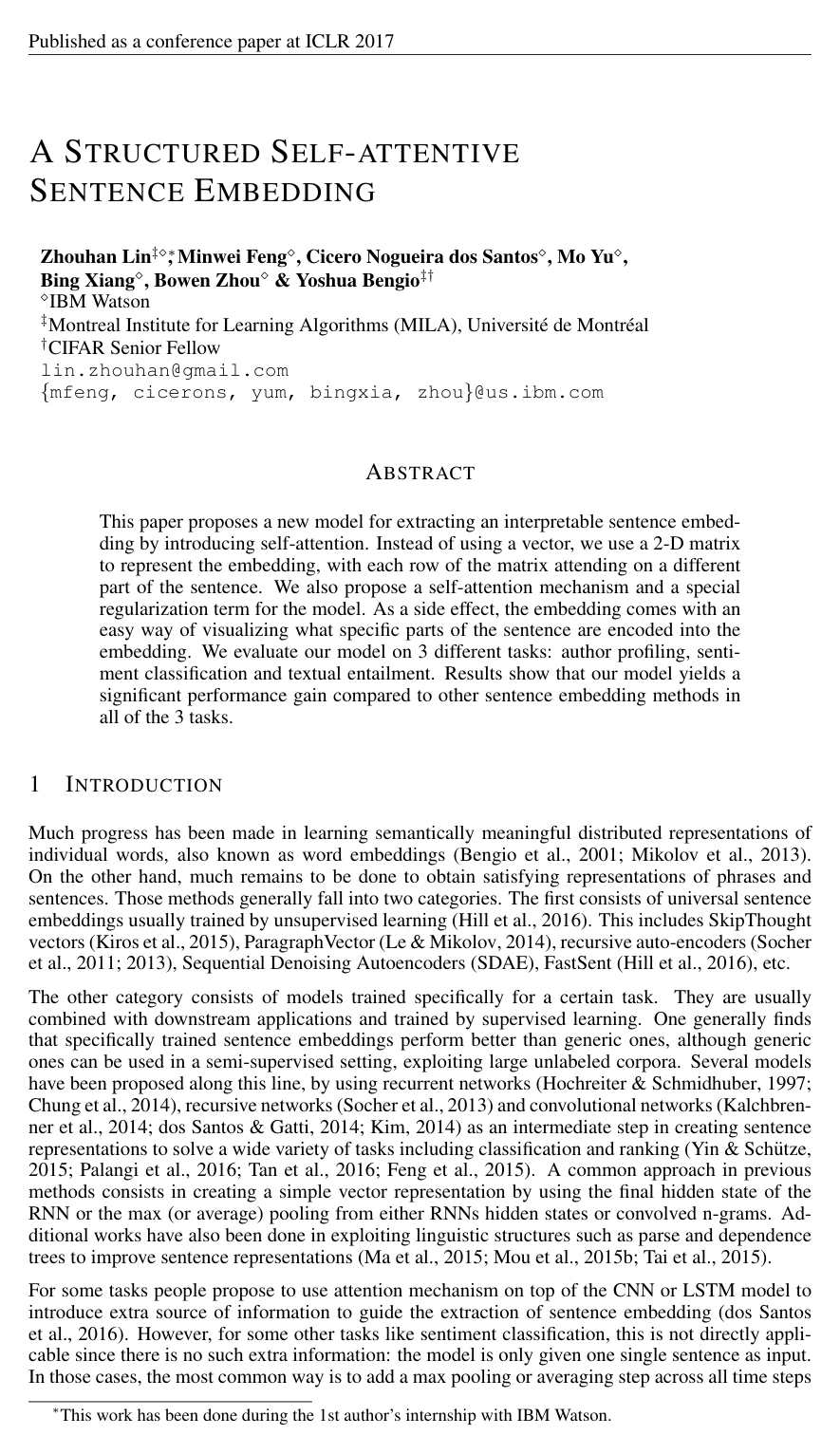
A Structured Self-attentive Sentence Embedding
Zhouhan Lin, Minwei Feng, Cicero Nogueira dos Santos, Mo Yu, Bing Xiang, Bowen Zhou, Yoshua Bengio
Why you should read this
Proposes a structured self-attention mechanism that replaces fixed sentence vectors with 2-D matrix embeddings, enabling models to capture multiple semantic aspects of text while providing interpretable visual attention across natural language processing tasks.
This paper proposes a new model for extracting an interpretable sentence embedding by introducing self-attention. Instead of using a vector, we use a 2-D matrix to represent the embedding, with each row of the matrix attending on a different part of the sentence. We also propose a self-attention mechanism and a special regularization term for the model. As a side effect, the embedding comes with an easy way of visualizing what specific parts of the sentence are encoded into the embedding. We evaluate our model on 3 different tasks: author profiling, sentiment classification, and textual entailment. Results show that our model yields a significant performance gain compared to other sentence embedding methods in all of the 3 tasks.
Added
2026-09-15
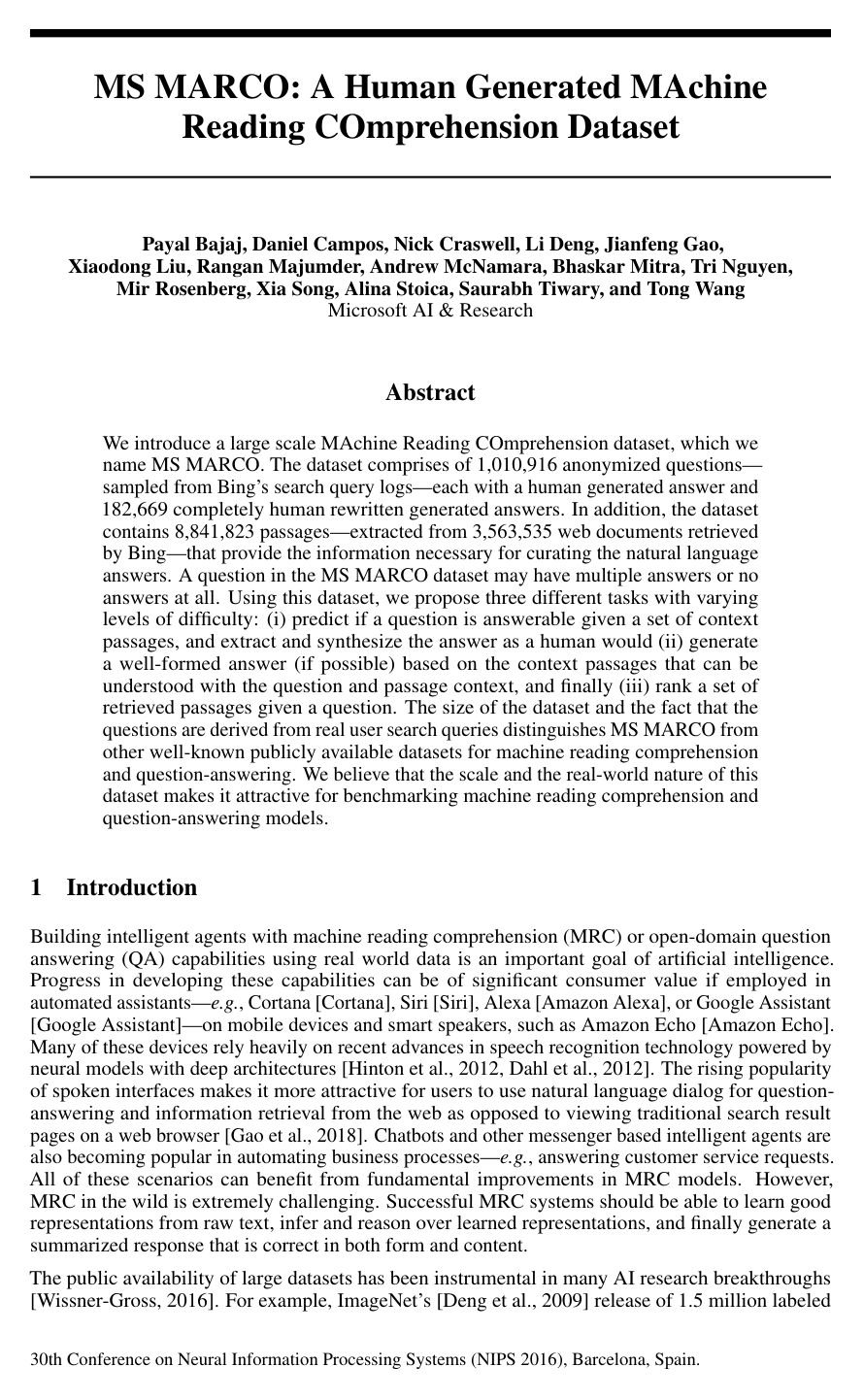
MS MARCO: A Human Generated MAchine Reading COmprehension Dataset
Daniel Fernando Campos, Tri Nguyen, Mir Rosenberg, Xia Song, Jianfeng Gao, Saurabh Tiwary, Rangan Majumder, Li Deng, Bhaskar Mitra
Why you should read this
Introduces MS MARCO, a large-scale dataset of over one million real search queries paired with human-written answers across millions of web passages, providing essential benchmarks for neural information retrieval and machine reading comprehension.
We introduce a large scale MAchine Reading COmprehension dataset, which we name MS MARCO. The dataset comprises of 1,010,916 anonymized questions---sampled from Bing's search query logs---each with a human generated answer and 182,669 completely human rewritten generated answers. In addition, the dataset contains 8,841,823 passages---extracted from 3,563,535 web documents retrieved by Bing---that provide the information necessary for curating the natural language answers. A question in the MS MARCO dataset may have multiple answers or no answers at all. Using this dataset, we propose three different tasks with varying levels of difficulty: (i) predict if a question is answerable given a set of context passages, and extract and synthesize the answer as a human would (ii) generate a well-formed answer (if possible) based on the context passages that can be understood with the question and passage context, and finally (iii) rank a set of retrieved passages given a question. The size of the dataset and the fact that the questions are derived from real user search queries distinguishes MS MARCO from other well-known publicly available datasets for machine reading comprehension and question-answering. We believe that the scale and the real-world nature of this dataset makes it attractive for benchmarking machine reading comprehension and question-answering models.
Added
2026-09-11
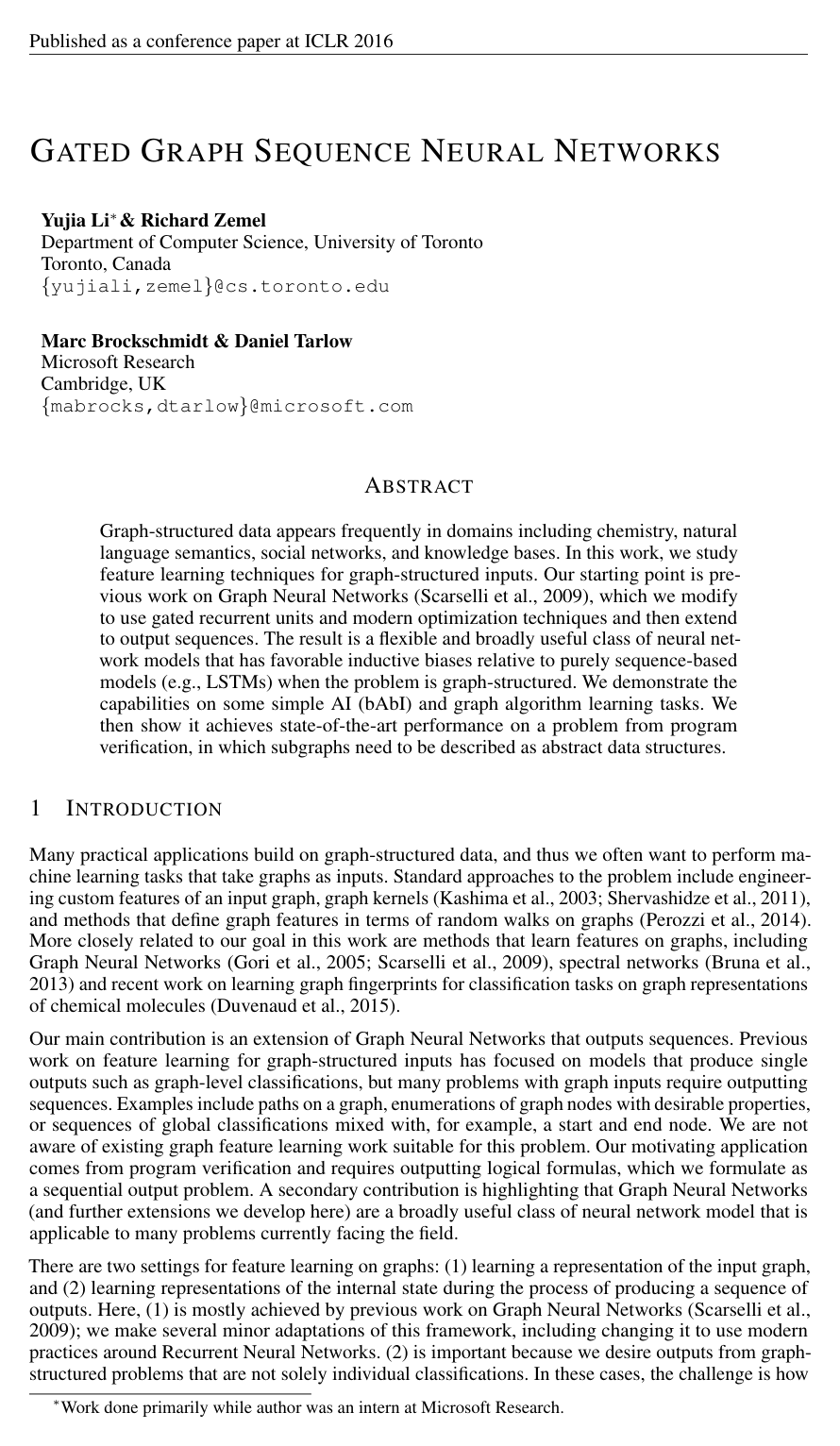
Gated Graph Sequence Neural Networks
Yujia Li, Daniel Tarlow, Marc Brockschmidt, Richard Zemel
Why you should read this
Introduces Gated Graph Sequence Neural Networks, modernizing graph neural architectures with gated recurrent units to learn representations and generate sequential outputs across graph-structured tasks such as program verification.
Graph-structured data appears frequently in domains including chemistry, natural language semantics, social networks, and knowledge bases. In this work, we study feature learning techniques for graph-structured inputs. Our starting point is previous work on Graph Neural Networks (Scarselli et al., 2009), which we modify to use gated recurrent units and modern optimization techniques and then extend to output sequences. The result is a flexible and broadly useful class of neural network models that has favorable inductive biases relative to purely sequence-based models (e.g., LSTMs) when the problem is graph-structured. We demonstrate the capabilities on some simple AI (bAbI) and graph algorithm learning tasks. We then show it achieves state-of-the-art performance on a problem from program verification, in which subgraphs need to be matched to abstract data structures.
Added
2026-09-11
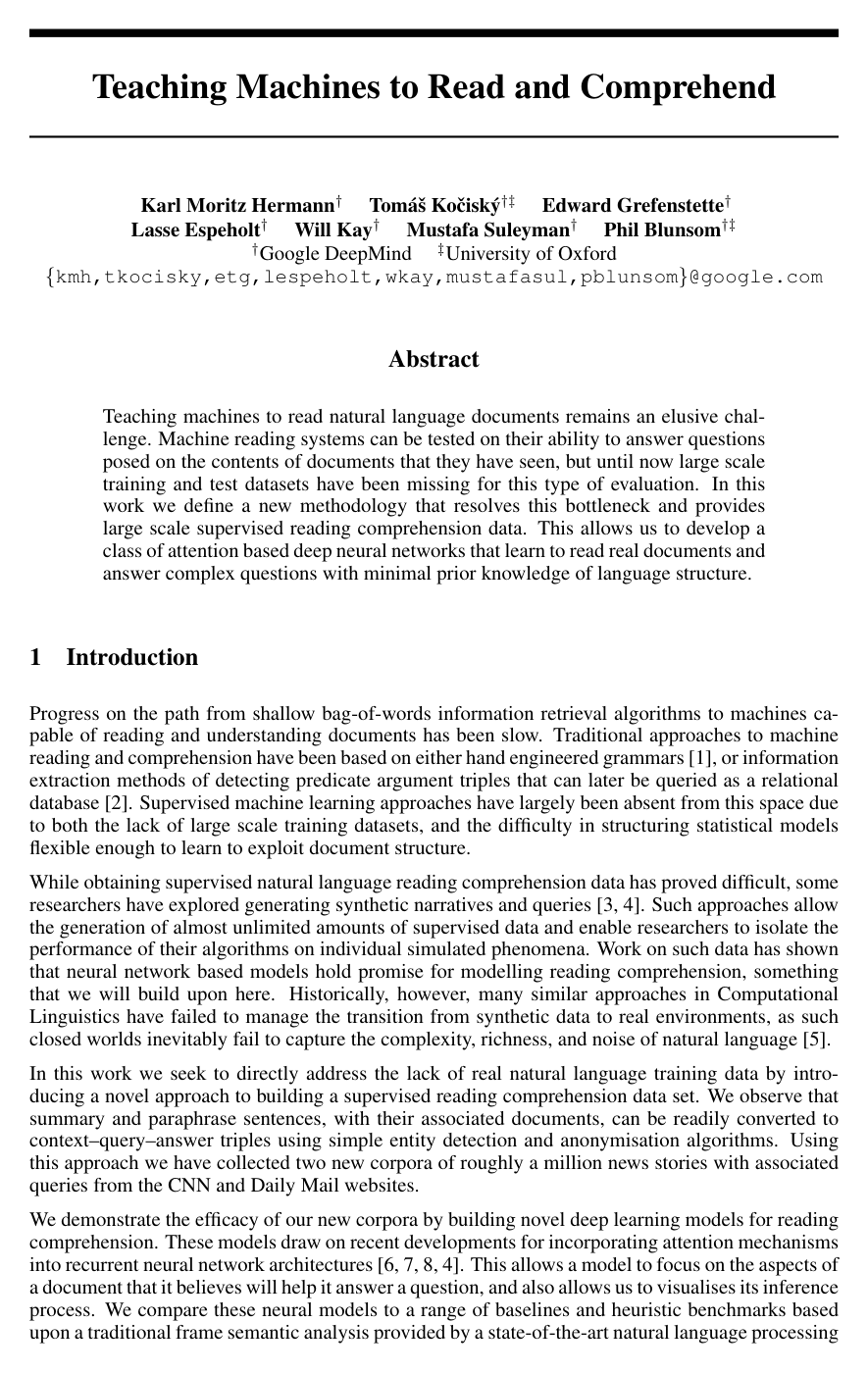
Teaching Machines to Read and Comprehend
Karl Moritz Hermann, Tomáš Kočiský, Edward Grefenstette, Lasse Espeholt, Will Kay, Mustafa Suleyman, Phil Blunsom
Why you should read this
Introduces large-scale supervised reading comprehension datasets derived from news corpora alongside attention-based neural networks that learn to answer complex document-level questions without hand-crafted linguistic features.
Teaching machines to read natural language documents remains an elusive challenge. Machine reading systems can be tested on their ability to answer questions posed on the contents of documents that they have seen, but until now large scale training and test datasets have been missing for this type of evaluation. In this work we define a new methodology that resolves this bottleneck and provides large scale supervised reading comprehension data. This allows us to develop a class of attention based deep neural networks that learn to read real documents and answer complex questions with minimal prior knowledge of language structure.
Added
2026-09-11
Pointer Sentinel Mixture Models
Stephen Merity, Caiming Xiong, James Bradbury, Richard Socher
Why you should read this
Introduces a pointer sentinel mixture architecture that enables language models to copy rare words directly from context, achieving state-of-the-art performance with significantly fewer parameters alongside the release of the standard WikiText benchmark.
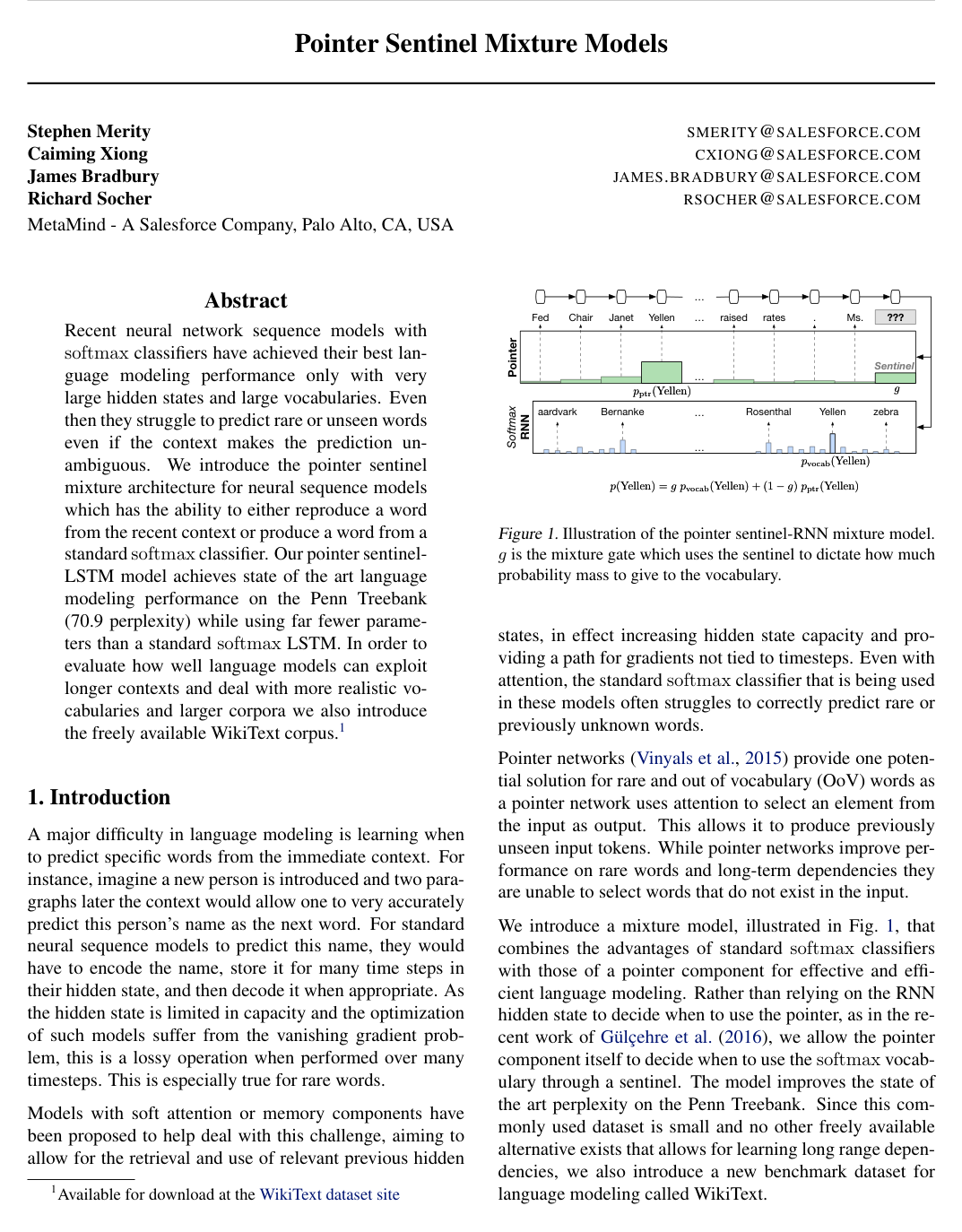
Recent neural network sequence models with softmax classifiers have achieved their best language modeling performance only with very large hidden states and large vocabularies. Even then they struggle to predict rare or unseen words even if the context makes the prediction unambiguous. We introduce the pointer sentinel mixture architecture for neural sequence models which has the ability to either reproduce a word from the recent context or produce a word from a standard softmax classifier. Our pointer sentinel-LSTM model achieves state of the art language modeling performance on the Penn Treebank (70.9 perplexity) while using far fewer parameters than a standard softmax LSTM. In order to evaluate how well language models can exploit longer contexts and deal with more realistic vocabularies and larger corpora we also introduce the freely available WikiText corpus.
Added
2026-09-10
Matching Networks for One Shot Learning
Oriol Vinyals, Charles Blundell, Timothy Lillicrap, Koray Kavukcuoglu, Daan Wierstra
Why you should read this
Introduces Matching Networks, an architecture combining deep metric learning and external memory to classify novel visual and linguistic classes from a single example without requiring task-specific fine-tuning.
Learning from a few examples remains a key challenge in machine learning. Despite recent advances in important domains such as vision and language, the standard supervised deep learning paradigm does not offer a satisfactory solution for learning new concepts rapidly from little data. In this work, we employ ideas from metric learning based on deep neural features and from recent advances that augment neural networks with external memories. Our framework learns a network that maps a small labelled support set and an unlabelled example to its label, obviating the need for fine-tuning to adapt to new class types. We then define one-shot learning problems on vision (using Omniglot, ImageNet) and language tasks. Our algorithm improves one-shot accuracy on ImageNet from 87.6% to 93.2% and from 88.0% to 93.8% on Omniglot compared to competing approaches. We also demonstrate the usefulness of the same model on language modeling by introducing a one-shot task on the Penn Treebank.
Added
2026-09-07
License
Published with permission
A simple neural network module for relational reasoning
Adam Santoro, David Raposo, David G. T. Barrett, Mateusz Malinowski, Razvan Pascanu, Peter W. Battaglia, Timothy P. Lillicrap
Why you should read this
Shows that powerful neural networks surprisingly fail at simple relational questions like "which object is furthest from the red one," but adding a small module that explicitly compares all pairs of objects solves this fundamental limitation and achieves breakthrough results across multiple reasoning tasks.
Relational reasoning is a central component of generally intelligent behavior, but has proven difficult for neural networks to learn. In this paper we describe how to use Relation Networks (RNs) as a simple plug-and-play module to solve problems that fundamentally hinge on relational reasoning. We tested RN-augmented networks on three tasks: visual question answering using a challenging dataset called CLEVR, on which we achieve state-of-the-art, super-human performance; text-based question answering using the bAbI suite of tasks; and complex reasoning about dynamic physical systems. Then, using a curated dataset called Sort-of-CLEVR we show that powerful convolutional networks do not have a general capacity to solve relational questions, but can gain this capacity when augmented with RNs. Our work shows how a deep learning architecture equipped with an RN module can implicitly discover and learn to reason about entities and their relations.
Added
2026-02-21
Order Matters: Sequence to sequence for sets
Oriol Vinyals, Samy Bengio, Manjunath Kudlur
Why you should read this
Reveals that the arbitrary order you feed data to neural networks dramatically affects their performance even when order theoretically shouldn't matter, then provides practical architectures that either ignore order for inputs (using attention mechanisms) or actively search for the best ordering during training for outputs.
Sequences have become first class citizens in supervised learning thanks to the resurgence of recurrent neural networks. Many complex tasks that require mapping from or to a sequence of observations can now be formulated with the sequence-to-sequence (seq2seq) framework which employs the chain rule to efficiently represent the joint probability of sequences. In many cases, however, variable sized inputs and/or outputs might not be naturally expressed as sequences. For instance, it is not clear how to input a set of numbers into a model where the task is to sort them; similarly, we do not know how to organize outputs when they correspond to random variables and the task is to model their unknown joint probability. In this paper, we first show using various examples that the order in which we organize input and/or output data matters significantly when learning an underlying model. We then discuss an extension of the seq2seq framework that goes beyond sequences and handles input sets in a principled way. In addition, we propose a loss which, by searching over possible orders during training, deals with the lack of structure of output sets. We show empirical evidence of our claims regarding ordering, and on the modifications to the seq2seq framework on benchmark language modeling and parsing tasks, as well as two artificial tasks -- sorting numbers and estimating the joint probability of unknown graphical models.
Added
2026-02-21
Pointer networks
Oriol Vinyals, Meire Fortunato, Navdeep Jaitly
Why you should read this
Develops an attention mechanism that outputs discrete indices from the input sequence, allowing models to solve combinatorial problems variable in size.
We introduce a new neural architecture to learn the conditional probability of an output sequence with elements that are discrete tokens corresponding to positions in an input sequence. Such problems cannot be trivially addressed by existent approaches such as sequence-to-sequence [1] and Neural Turing Machines [2], because the number of target classes in each step of the output depends on the length of the input, which is variable. Problems such as sorting variable sized sequences, and various combinatorial optimization problems belong to this class. Our model solves the problem of variable size output dictionaries using a recently proposed mechanism of neural attention. It differs from the previous attention attempts in that, instead of using attention to blend hidden units of an encoder to a context vector at each decoder step, it uses attention as a pointer to select a member of the input sequence as the output. We call this architecture a Pointer Net (Ptr-Net). We show Ptr-Nets can be used to learn approximate solutions to three challenging geometric problems - finding planar convex hulls, computing Delaunay triangulations, and the planar Travelling Salesman Problem - using training examples alone. Ptr-Nets not only improve over sequence-to-sequence with input attention, but also allow us to generalize to variable size output dictionaries. We show that the learnt models generalize beyond the maximum lengths they were trained on. We hope our results on these tasks will encourage a broader exploration of neural learning for discrete problems.
Added
2026-02-11
RippleNet: Propagating user preferences on the knowledge graph for recommender systems
Hongwei Wang, Fuzheng Zhang, Jialin Wang, Miao Zhao, Wenjie Li, Xing Xie, Minyi Guo
Why you should read this
Introduces Ripple Network, a novel approach that propagates user preferences through knowledge graph structures like ripples on water, elegantly solving the cold start problem in recommendation systems by automatically discovering user interests along entity connections rather than relying on explicit path-based or embedding methods alone.
To address the sparsity and cold start problem of collaborative filtering, researchers usually make use of side information, such as social networks or item attributes, to improve recommendation performance. This paper considers the knowledge graph as the source of side information. To address the limitations of existing embedding-based and path-based methods for knowledge-graph-aware recommendation, we propose Ripple Network, an end-to-end framework that naturally incorporates the knowledge graph into recommender systems. Similar to actual ripples propagating on the surface of water, Ripple Network stimulates the propagation of user preferences over the set of knowledge entities by automatically and iteratively extending a user's potential interests along links in the knowledge graph. The multiple "ripples" activated by a user's historically clicked items are thus superposed to form the preference distribution of the user with respect to a candidate item, which could be used for predicting the final clicking probability. Through extensive experiments on real-world datasets, we demonstrate that Ripple Network achieves substantial gains in a variety of scenarios, including movie, book and news recommendation, over several state-of-the-art baselines.
Added
2026-01-25
Titans: Learning to Memorize at Test Time
Ali Behrouz, Peilin Zhong, Vahab Mirrokni
Why you should read this
Introduces Titans, a novel family of deep learning architectures integrating specialized short-term (attention) and long-term (neural memory) modules to efficiently handle context windows exceeding 2 million tokens.
Over more than a decade there has been an extensive research effort of how effectively utilize recurrent models and attentions. While recurrent models aim to compress the data into a fixed-size memory (called hidden state), attention allows attending to the entire context window, capturing the direct dependencies of all tokens. This more accurate modeling of dependencies, however, comes with a quadratic cost, limiting the model to a fixed-length context. We present a new neural long-term memory module that learns to memorize historical context and helps an attention to attend to the current context while utilizing long past information. We show that this neural memory has the advantage of a fast parallelizable training while maintaining a fast inference. From a memory perspective, we argue that attention due to its limited context but accurate dependency modeling performs as a short-term memory, while neural memory due to its ability to memorize the data, acts as a long-term, more persistent, memory. Based on these two modules, we introduce a new family of architectures, called Titans, and present three variants to address how one can effectively incorporate memory into this architecture. Our experimental results on language modeling, common-sense reasoning, genomics, and time series tasks show that Titans are more effective than Transformers and recent modern linear recurrent models. They further can effectively scale to larger than 2M context window size with higher accuracy in needle-in-haystack tasks compared to baselines.
Added
2025-12-01
