
keyword
memory consolidation
Memory consolidation is a biological and computational process through which temporary, newly acquired information is stabilized and transformed into durable, long-term memory. In cognitive neuroscience, it occurs at both the synaptic level, where local cellular and molecular changes strengthen neuronal connections shortly after learning, and the systems level, where fast-learning regions such as the hippocampus gradually replay and integrate memories into slower-learning neocortical networks. This ongoing reorganization protects information from decay and prevents interference between old and new knowledge. In artificial intelligence and cognitive modeling, the principles of memory consolidation inform mechanisms like experience replay and parameter regularization, allowing learning systems to accumulate new skills and data continuously without catastrophically forgetting previously learned representations.
5 items
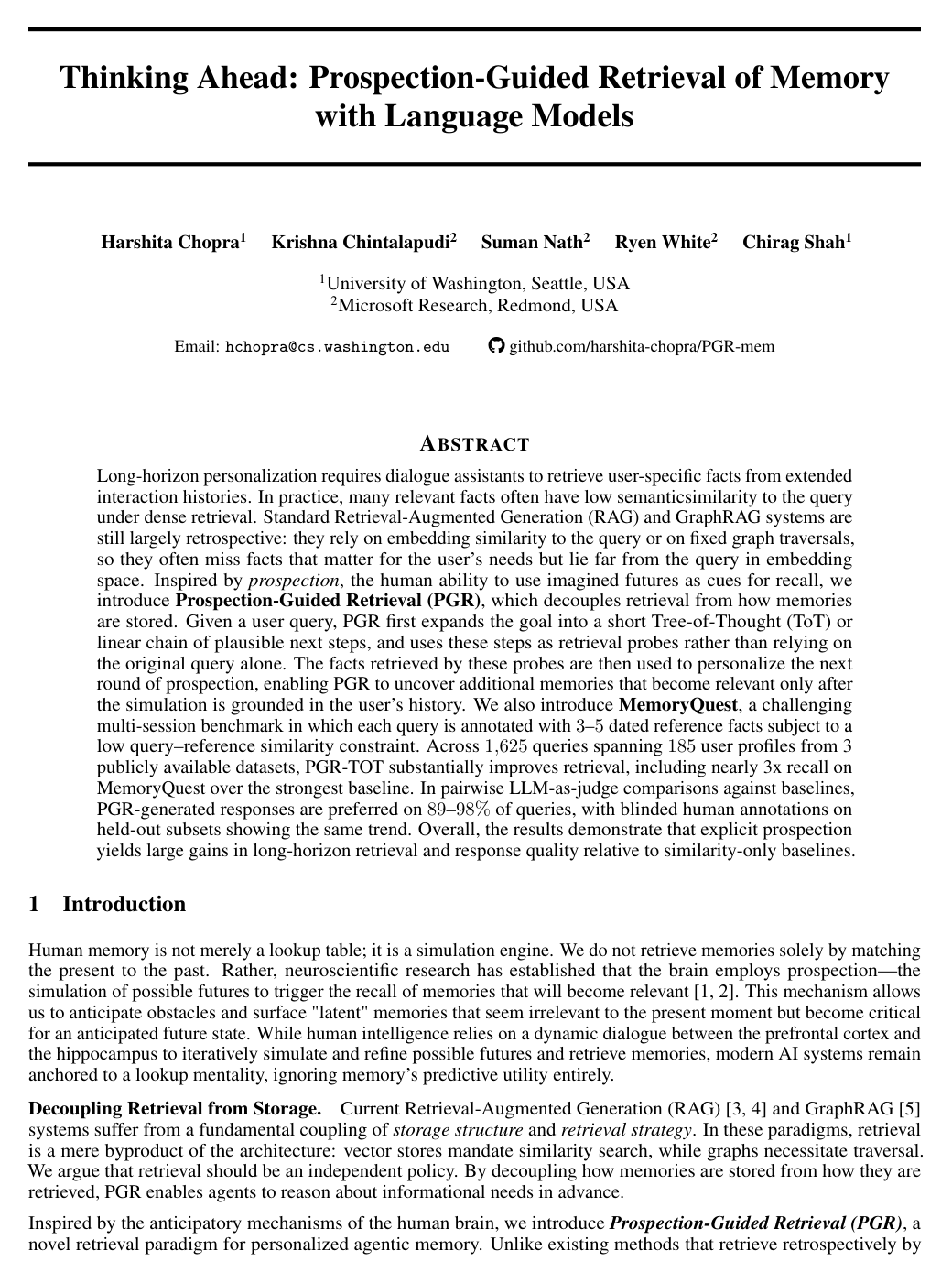
Thinking Ahead: Prospection-Guided Retrieval of Memory with Language Models
Harshita Chopra, Krishna Chintalapudi, Suman Nath, Ryen W. White, Chirag Shah
Why you should read this
Proposes Prospection-Guided Retrieval, a framework that expands user queries into simulated future actions to retrieve semantically distant interaction memories, nearly tripling recall compared to standard retrieval-augmented generation on long-horizon dialogue tasks.
Long-horizon personalization requires dialogue assistants to retrieve user-specific facts from extended interaction histories. In practice, many relevant facts often have low semanticsimilarity to the query under dense retrieval. Standard Retrieval-Augmented Generation (RAG) and GraphRAG systems are still largely retrospective: they rely on embedding similarity to the query or on fixed graph traversals, so they often miss facts that matter for the user's needs but lie far from the query in embedding space. Inspired by prospection, the human ability to use imagined futures as cues for recall, we introduce Prospection-Guided Retrieval (PGR), which decouples retrieval from how memories are stored. Given a user query, PGR first expands the goal into a short Tree-of-Thought (ToT) or linear chain of plausible next steps, and uses these steps as retrieval probes rather than relying on the original query alone. The facts retrieved by these probes are then used to personalize the next round of prospection, enabling PGR to uncover additional memories that become relevant only after the simulation is grounded in the user's history. We also introduce MemoryQuest, a challenging multi-session benchmark in which each query is annotated with 3--5 dated reference facts subject to a low query-reference similarity constraint. Across 1,625 queries spanning 185 user profiles from 3 publicly available datasets, PGR-TOT substantially improves retrieval, including nearly 3x recall on MemoryQuest over the strongest baseline. In pairwise LLM-as-judge comparisons against baselines, PGR-generated responses are preferred on 89--98% of queries, with blinded human annotations on held-out subsets showing the same trend. Overall, the results demonstrate that explicit prospection yields large gains in long-horizon retrieval and response quality relative to similarity-only baselines.
Added
2026-09-29
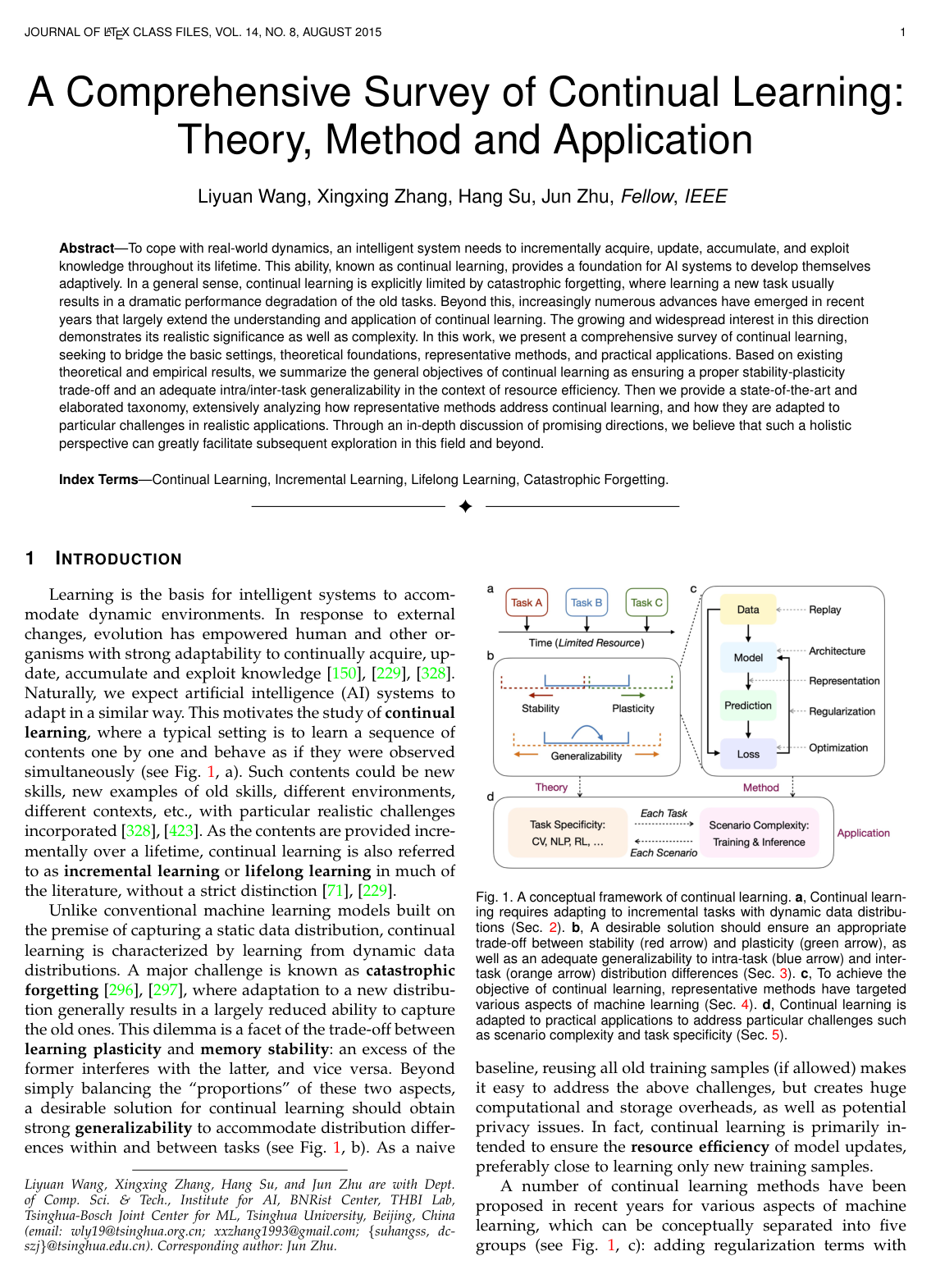
A Comprehensive Survey of Continual Learning: Theory, Method and Application
Liyuan Wang, Xingxing Zhang, Hang Su, Jun Zhu
Why you should read this
Presents a systematic taxonomy of continual learning that bridges theoretical foundations, methods for overcoming catastrophic forgetting, and practical applications across real-world dynamic environments.
To cope with real-world dynamics, an intelligent system needs to incrementally acquire, update, accumulate, and exploit knowledge throughout its lifetime. This ability, known as continual learning, provides a foundation for AI systems to develop themselves adaptively. In a general sense, continual learning is explicitly limited by catastrophic forgetting, where learning a new task usually results in a dramatic performance degradation of the old tasks. Beyond this, increasingly numerous advances have emerged in recent years that largely extend the understanding and application of continual learning. The growing and widespread interest in this direction demonstrates its realistic significance as well as complexity. In this work, we present a comprehensive survey of continual learning, seeking to bridge the basic settings, theoretical foundations, representative methods, and practical applications. Based on existing theoretical and empirical results, we summarize the general objectives of continual learning as ensuring a proper stability-plasticity trade-off and an adequate intra/inter-task generalizability in the context of resource efficiency. Then we provide a state-of-the-art and elaborated taxonomy, extensively analyzing how representative methods address continual learning, and how they are adapted to particular challenges in realistic applications. Through an in-depth discussion of promising directions, we believe that such a holistic perspective can greatly facilitate subsequent exploration in this field and beyond.
Added
2026-09-24
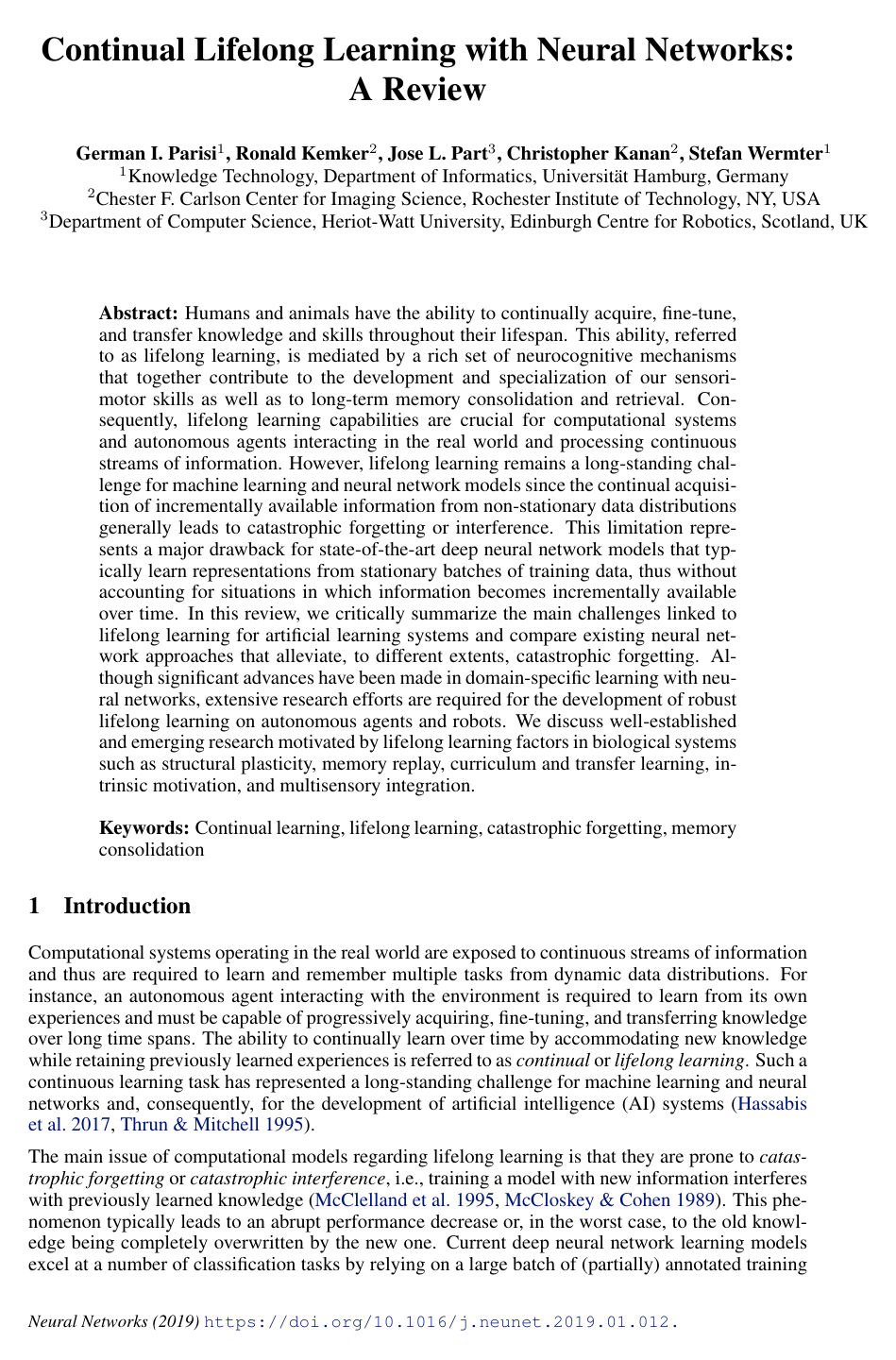
Continual Lifelong Learning with Neural Networks: A Review
German I. Parisi, Ronald Kemker, Jose L. Part, Christopher Kanan, Stefan Wermter
Why you should read this
Synthesizes neural network approaches for preventing catastrophic forgetting in continual learning and connects these algorithmic strategies to biological mechanisms such as structural plasticity and memory replay.
Humans and animals have the ability to continually acquire, fine-tune, and transfer knowledge and skills throughout their lifespan. This ability, referred to as lifelong learning, is mediated by a rich set of neurocognitive mechanisms that together contribute to the development and specialization of our sensorimotor skills as well as to long-term memory consolidation and retrieval. Consequently, lifelong learning capabilities are crucial for autonomous agents interacting in the real world and processing continuous streams of information. However, lifelong learning remains a long-standing challenge for machine learning and neural network models since the continual acquisition of incrementally available information from non-stationary data distributions generally leads to catastrophic forgetting or interference. This limitation represents a major drawback for state-of-the-art deep neural network models that typically learn representations from stationary batches of training data, thus without accounting for situations in which information becomes incrementally available over time. In this review, we critically summarize the main challenges linked to lifelong learning for artificial learning systems and compare existing neural network approaches that alleviate, to different extents, catastrophic forgetting. We discuss well-established and emerging research motivated by lifelong learning factors in biological systems such as structural plasticity, memory replay, curriculum and transfer learning, intrinsic motivation, and multisensory integration.
Added
2026-09-11
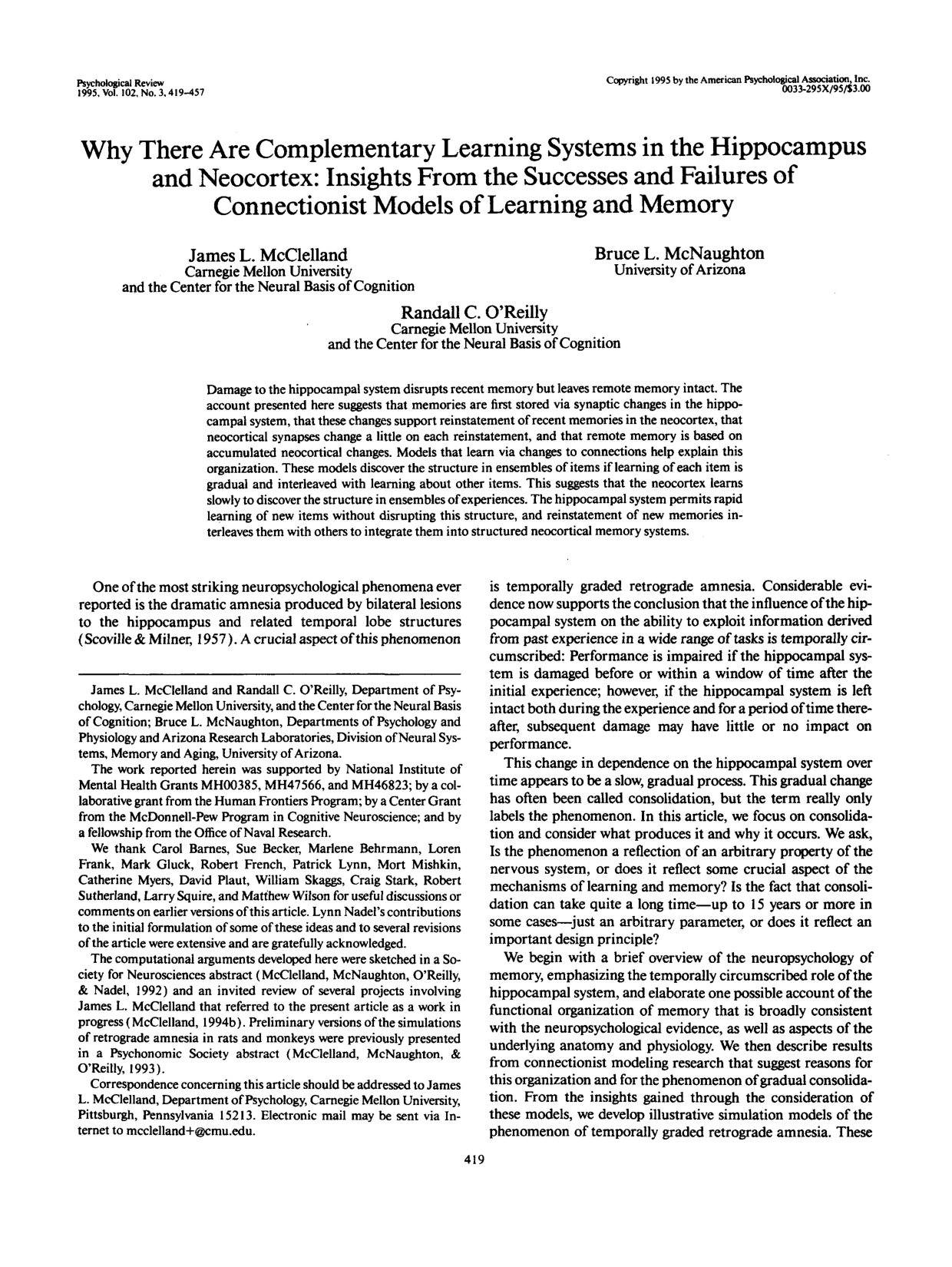
Why There Are Complementary Learning Systems in the Hippocampus and Neocortex
James L. McClelland, Bruce L. McNaughton, Randall C. O'Reilly
Why you should read this
Explains why the brain evolved separate hippocampal and neocortical memory systems by showing that rapid learning of new information inevitably interferes with extracting general patterns from experience unless memories are initially stored elsewhere and only gradually integrated over time.
Damage to the hippocampal system disrupts recent memory but leaves remote memory intact. The account presented here suggests that memories are first stored via synaptic changes in the hippocampal system, that these changes support reinstatement of recent memories in the neocortex, that neocortical synapses change a little on each reinstatement, and that remote memory is based on accumulated neocortical changes. Models that learn via changes to connections help explain this organization. These models discover the structure in ensembles of items if learning of each item is gradual and interleaved with learning about other items. This suggests that the neocortex learns slowly to discover the structure in ensembles of experiences. The hippocampal system permits rapid learning of new items without disrupting this structure, and reinstatement of new memories interleaves them with others to integrate them into structured neocortical memory systems.
Added
2026-02-21
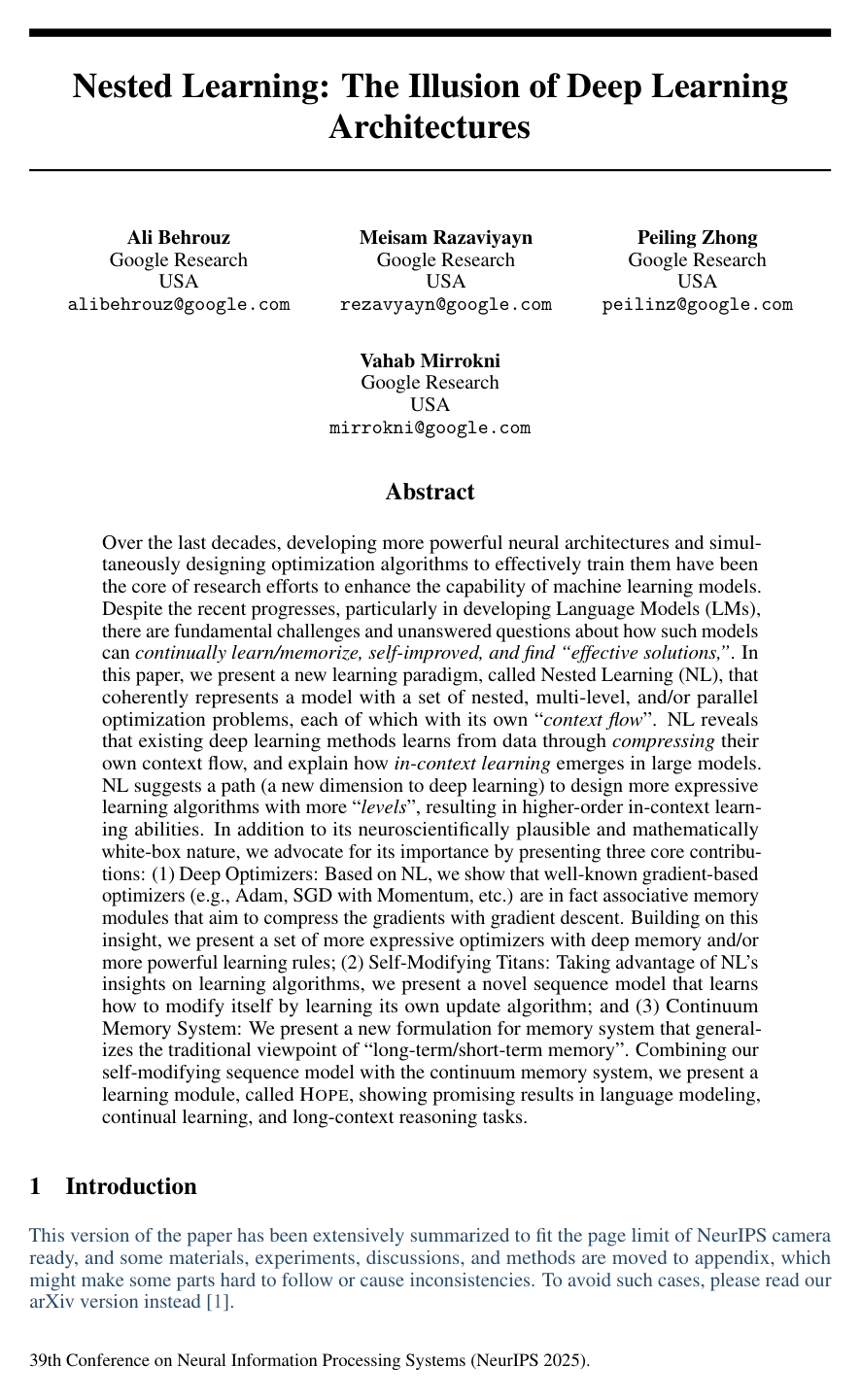
Nested Learning: The Illusion of Deep Learning Architectures
Ali Behrouz, Meisam Razaviyayn, Peiling Zhong, Vahab Mirrokni
Why you should read this
Introduces Nested Learning (NL), a new paradigm that unifies existing optimizers and explains the emergence of in-context learning by viewing deep models as nested optimization problems.
Over the last decades, developing more powerful neural architectures and simul- taneously designing optimization algorithms to effectively train them have been the core of research efforts to enhance the capability of machine learning models. Despite the recent progresses, particularly in developing Language Models (LMs), there are fundamental challenges and unanswered questions about how such models can continually learn/memorize, self-improved, and find “effective solutions,” . In this paper, we present a new learning paradigm, called Nested Learning (NL), that coherently represents a model with a set of nested, multi-level, and/or parallel optimization problems, each of which with its own “ context flow ”. NL reveals that existing deep learning methods learns from data through compressing their own context flow, and explain how in-context learning emerges in large models. NL suggests a path (a new dimension to deep learning) to design more expressive learning algorithms with more “ levels ”, resulting in higher-order in-context learn- ing abilities. In addition to its neuroscientifically plausible and mathematically white-box nature, we advocate for its importance by presenting three core contribu- tions: (1) Deep Optimizers: Based on NL, we show that well-known gradient-based optimizers (e.g., Adam, SGD with Momentum, etc.) are in fact associative memory modules that aim to compress the gradients with gradient descent. Building on this insight, we present a set of more expressive optimizers with deep memory and/or more powerful learning rules; (2) Self-Modifying Titans: Taking advantage of NL’s insights on learning algorithms, we present a novel sequence model that learns how to modify itself by learning its own update algorithm; and (3) Continuum Memory System: We present a new formulation for memory system that general- izes the traditional viewpoint of “long-term/short-term memory”. Combining our self-modifying sequence model with the continuum memory system, we present a learning module, called H OPE , showing promising results in language modeling, continual learning, and long-context reasoning tasks.
Added
2025-12-15
License
Published with permission