
keyword
meeting summarization
Meeting summarization is the process of condensing a meeting’s discussion into a shorter account of its main points. It typically captures key information such as decisions, conclusions, and relevant contributions while preserving their meaning and avoiding unsupported details.
3 items
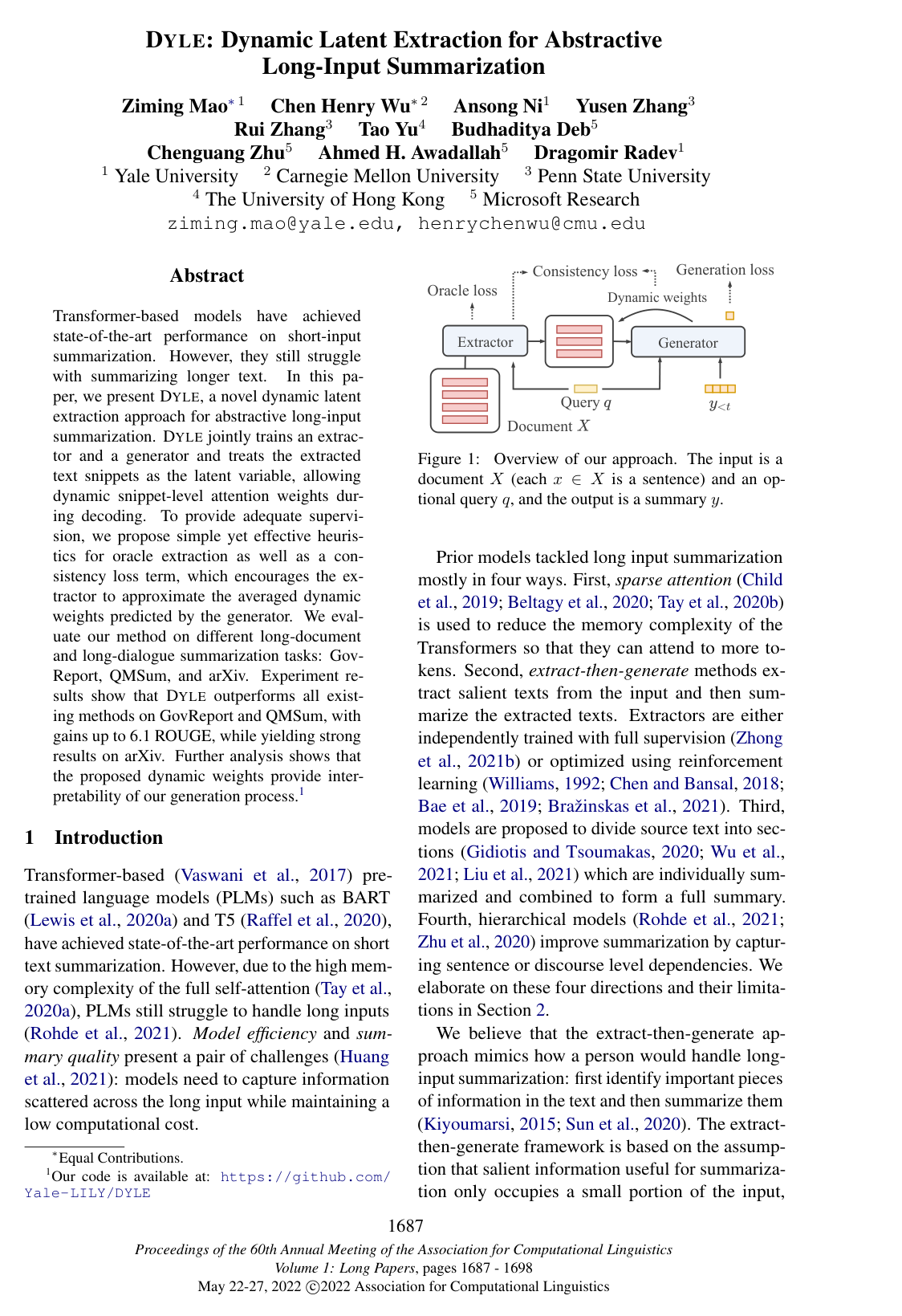
DYLE: Dynamic Latent Extraction for Abstractive Long-Input Summarization
Ziming Mao, Chen Henry Wu, Ansong Ni, Yusen Zhang, Rui Zhang, Tao Yu, Budhaditya Deb, Chenguang Zhu, Ahmed Hassan Awadallah, Dragomir R. Radev
Why you should read this
Proposes a dynamic latent extraction framework that jointly trains an extractor and generator using snippet-level dynamic weights and consistency loss, substantially outperforming prior methods on long-document and long-dialogue summarization benchmarks.
Added
2026-10-03
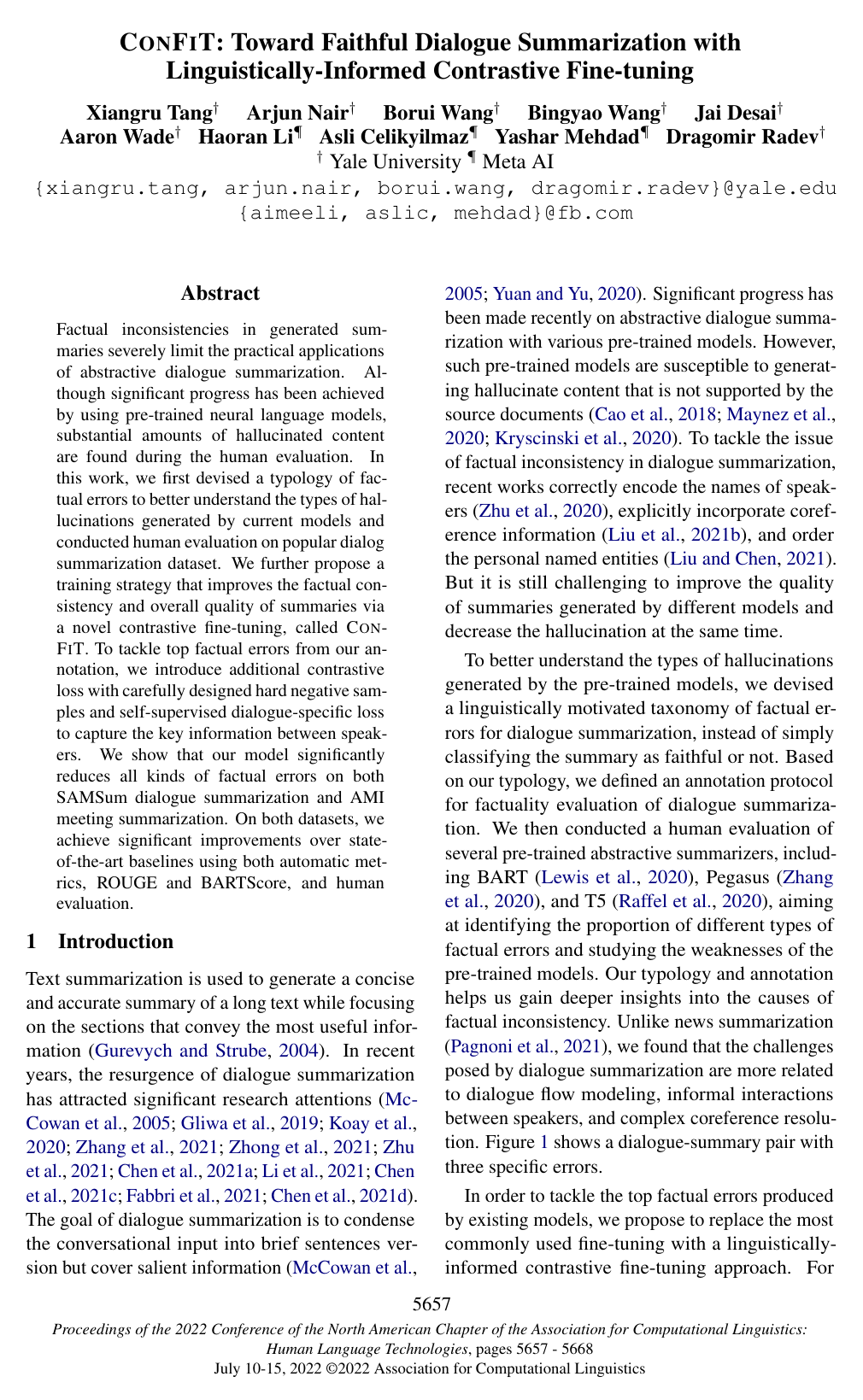
CONFIT: Toward Faithful Dialogue Summarization with Linguistically-Informed Contrastive Fine-tuning
Xiangru Tang, Arjun Nair, Borui Wang, Bingyao Wang, Jai Desai, Aaron Wade, Haoran Li, Asli Celikyilmaz, Yashar Mehdad, Dragomir R. Radev
Why you should read this
Introduces a linguistically motivated taxonomy of factual errors in abstractive dialogue summarization alongside CONFIT, a contrastive fine-tuning method with targeted hard negative samples that substantially reduces model hallucinations on the SAMSum and AMI benchmarks.
Factual inconsistencies in generated summaries severely limit the practical applications of abstractive dialogue summarization. Although significant progress has been achieved by using pre-trained neural language models, substantial amounts of hallucinated content are found during the human evaluation. In this work, we first devised a typology of factual errors to better understand the types of hallucinations generated by current models and conducted human evaluation on popular dialog summarization dataset. We further propose a training strategy that improves the factual consistency and overall quality of summaries via a novel contrastive fine-tuning, called CONFIT. To tackle top factual errors from our annotation, we introduce additional contrastive loss with carefully designed hard negative samples and self-supervised dialogue-specific loss to capture the key information between speakers. We show that our model significantly reduces all kinds of factual errors on both SAMSum dialogue summarization and AMI meeting summarization. On both datasets, we achieve significant improvements over state-of-the-art baselines using both automatic metrics, ROUGE and BARTScore, and human evaluation.
Added
2026-09-26
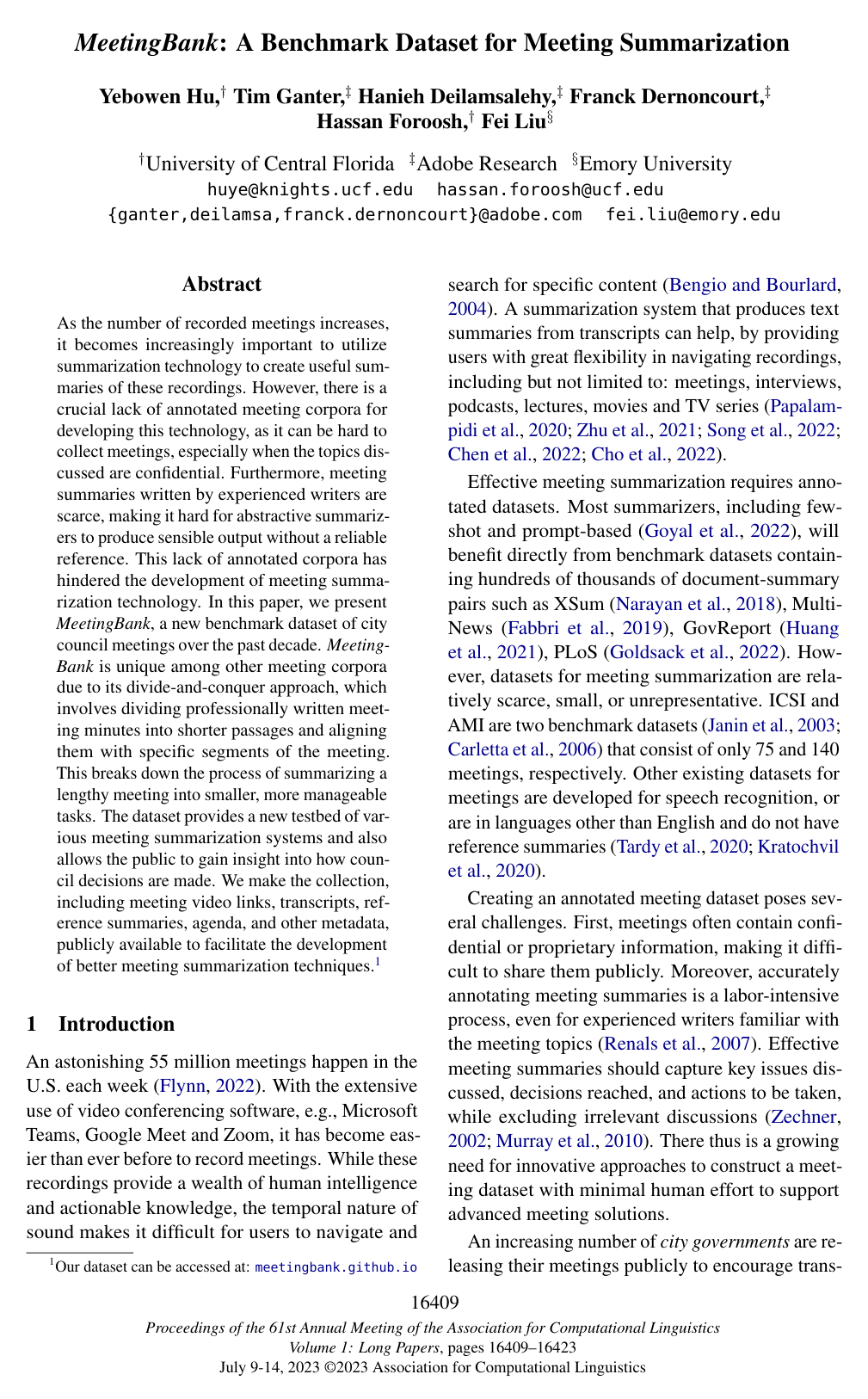
MeetingBank: A Benchmark Dataset for Meeting Summarization
Yebowen Hu, Timothy Ganter, Hanieh Deilamsalehy, Franck Dernoncourt, Hassan Foroosh, Fei Liu
Why you should read this
Presents MeetingBank, a benchmark dataset of 1,366 city council meetings with over 3,500 hours of video and segment-aligned professional minutes, addressing the critical shortage of large-scale, real-world data for meeting summarization research.
As the number of recorded meetings increases, it becomes increasingly important to utilize summarization technology to create useful summaries of these recordings. However, there is a crucial lack of annotated meeting corpora for developing this technology, as it can be hard to collect meetings, especially when the topics discussed are confidential. Furthermore, meeting summaries written by experienced writers are scarce, making it hard for abstractive summarizers to produce sensible output without a reliable reference. This lack of annotated corpora has hindered the development of meeting summarization technology. In this paper, we present MeetingBank, a new benchmark dataset of city council meetings over the past decade. MeetingBank is unique among other meeting corpora due to its divide-and-conquer approach, which involves dividing professionally written meeting minutes into shorter passages and aligning them with specific segments of the meeting. This breaks down the process of summarizing a lengthy meeting into smaller, more manageable tasks. The dataset provides a new testbed of various meeting summarization systems and also allows the public to gain insight into how council decisions are made. We make the collection, including meeting video links, transcripts, reference summaries, agenda, and other metadata, publicly available to facilitate the development of better meeting summarization techniques.
Added
2026-09-26