
keyword
Maximum Margin Matrix Factorization
Maximum Margin Matrix Factorization is a machine learning method for collaborative filtering and matrix completion that adapts the large-margin principles of support vector machines to matrix decomposition. Rather than restricting the dimensionality or rank of the latent factor matrices directly, it regularizes the factorization through a low-norm constraint, typically minimizing the trace norm of the reconstructed matrix, while optimizing margin-based loss functions such as the hinge loss on observed entries. This formulation encourages wide margins between predicted preference boundaries, making it effective for binary, discrete, and ordinal rating prediction tasks from sparse, partially observed data, and enabling optimization through convex semidefinite programming or scalable gradient-based algorithms.
2 items
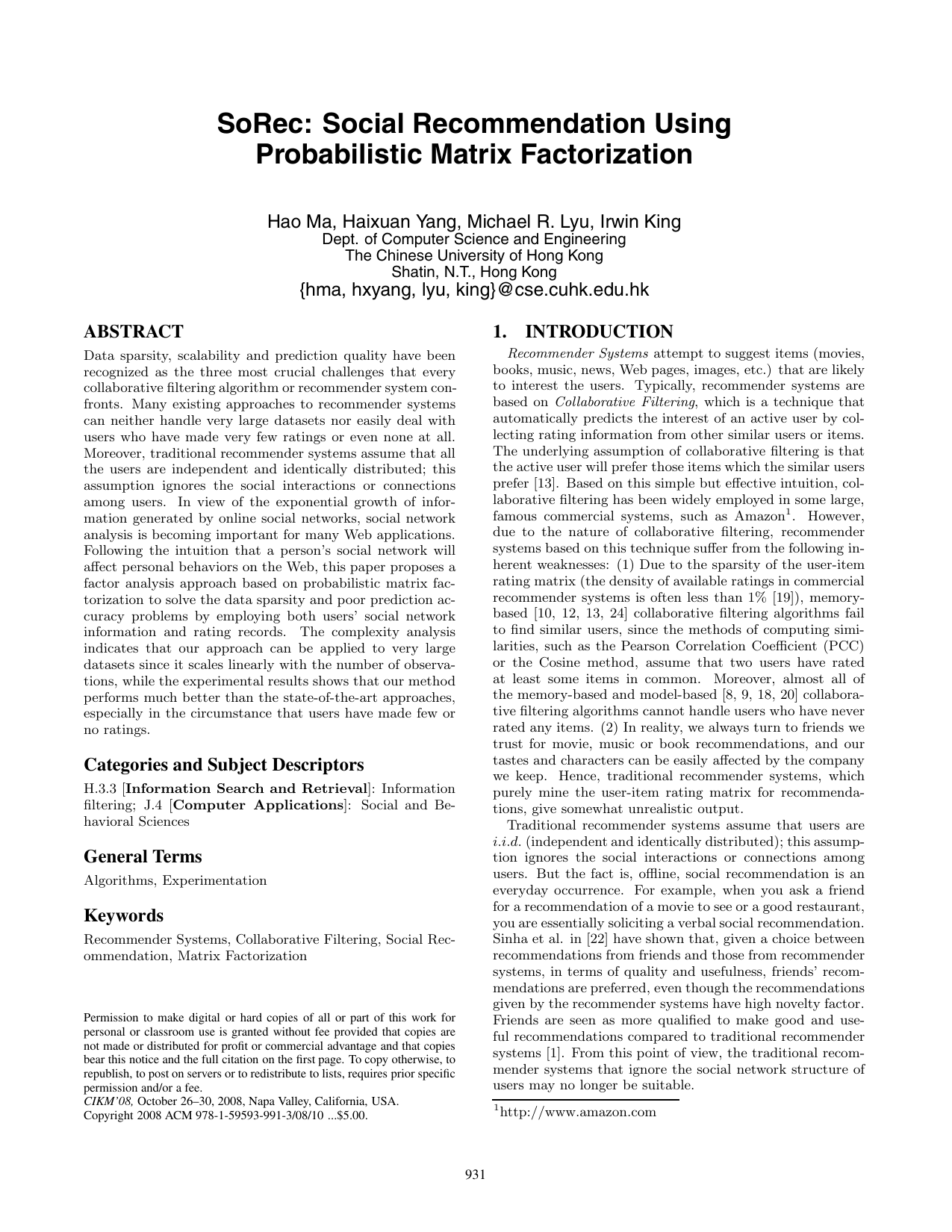
SoRec: social recommendation using probabilistic matrix factorization
Hao Ma, Haixuan Yang, Michael R. Lyu, Irwin King
Why you should read this
Proposes a scalable probabilistic matrix factorization framework that fuses user social network relations with rating matrices to improve recommendation accuracy for users with sparse or missing feedback.
Data sparsity, scalability and prediction quality have been recognized as the three most crucial challenges that every collaborative filtering algorithm or recommender system confronts. Many existing approaches to recommender systems can neither handle very large datasets nor easily deal with users who have made very few ratings or even none at all. Moreover, traditional recommender systems assume that all the users are independent and identically distributed; this assumption ignores the social interactions or connections among users. In view of the exponential growth of information generated by online social networks, social network analysis is becoming important for many Web applications. Following the intuition that a person's social network will affect personal behaviors on the Web, this paper proposes a factor analysis approach based on probabilistic matrix factorization to solve the data sparsity and poor prediction accuracy problems by employing both users' social network information and rating records. The complexity analysis indicates that our approach can be applied to very large datasets since it scales linearly with the number of observations, while the experimental results shows that our method performs much better than the state-of-the-art approaches, especially in the circumstance that users have made few or no ratings.
Added
2026-09-24
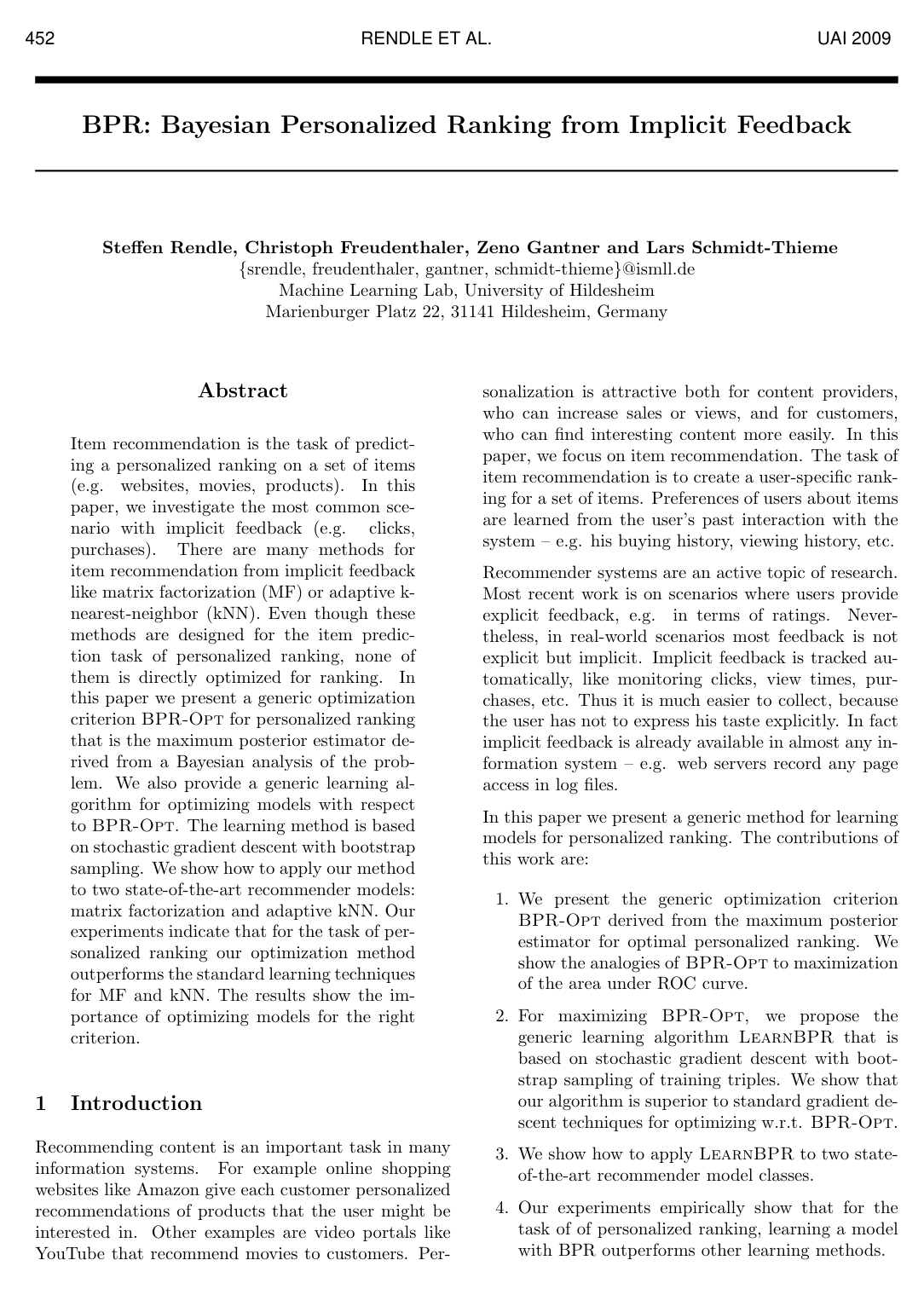
BPR: Bayesian Personalized Ranking from Implicit Feedback
Steffen Rendle, Christoph Freudenthaler, Zeno Gantner, Lars Schmidt-Thieme
Why you should read this
Formulates a groundbreaking pairwise ranking optimization criterion that mathematically shifts the learning objective from predicting relative numerical ratings to correctly predicting the ranked order of items.
Item recommendation is the task of predicting a personalized ranking on a set of items (e.g. websites, movies, products). In this paper, we investigate the most common scenario with implicit feedback (e.g. clicks, purchases). There are many methods for item recommendation from implicit feedback like matrix factorization (MF) or adaptive knearest-neighbor (kNN). Even though these methods are designed for the item prediction task of personalized ranking, none of them is directly optimized for ranking. In this paper we present a generic optimization criterion BPR-Opt for personalized ranking that is the maximum posterior estimator derived from a Bayesian analysis of the problem. We also provide a generic learning algorithm for optimizing models with respect to BPR-Opt. The learning method is based on stochastic gradient descent with bootstrap sampling. We show how to apply our method to two state-of-the-art recommender models: matrix factorization and adaptive kNN. Our experiments indicate that for the task of personalized ranking our optimization method outperforms the standard learning techniques for MF and kNN. The results show the importance of optimizing models for the right criterion.
Added
2026-01-25