
keyword
mask annotations
Mask annotations are pixel-level labels applied to digital images to delineate the exact boundaries, shapes, and spatial extent of specific objects or regions. Unlike bounding boxes that enclose items within coarse rectangular frames, a mask annotation indicates whether each individual pixel belongs to a particular category or distinct object instance, typically represented as a binary matrix, polygon, or bitmap. These detailed ground-truth labels serve as training data for computer vision tasks such as semantic segmentation, instance segmentation, and panoptic segmentation, enabling machine learning models to perform fine-grained visual recognition, separate individual objects, and distinguish target entities from their background environments.
2 items
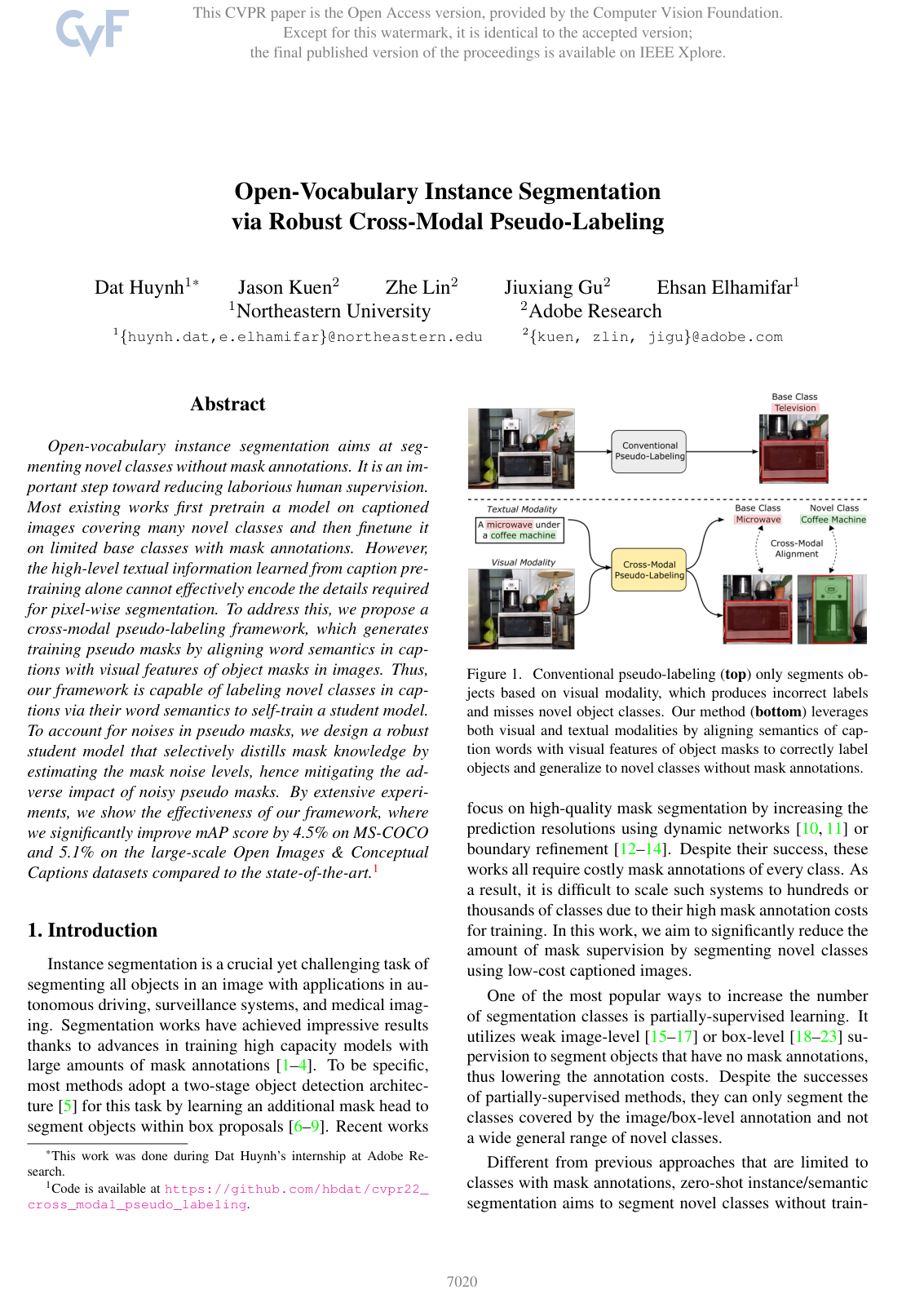
Open-Vocabulary Instance Segmentation via Robust Cross-Modal Pseudo-Labeling
Dat Huynh, Jason Kuen, Zhe Lin, Jiuxiang Gu, Ehsan Elhamifar
Why you should read this
Proposes a cross-modal pseudo-labeling framework that aligns caption words with visual mask features and filters label noise to segment novel object classes without mask annotations.
Open-vocabulary instance segmentation aims at segmenting novel classes without mask annotations. It is an important step toward reducing laborious human supervision. Most existing works first pretrain a model on captioned images covering many novel classes and then finetune it on limited base classes with mask annotations. However, the high-level textual information learned from caption pre-training alone cannot effectively encode the details required for pixel-wise segmentation. To address this, we propose a cross-modal pseudo-labeling framework, which generates training pseudo masks by aligning word semantics in captions with visual features of object masks in images. Thus, our framework is capable of labeling novel classes in captions via their word semantics to self-train a student model. To account for noises in pseudo masks, we design a robust student model that selectively distills mask knowledge by estimating the mask noise levels, hence mitigating the adverse impact of noisy pseudo masks. By extensive experiments, we show the effectiveness of our framework, where we significantly improve mAP score by 4.5% on MS-COCO and 5.1% on the large-scale Open Images & Conceptual Captions datasets compared to the state-of-the-art.
Added
2026-09-26
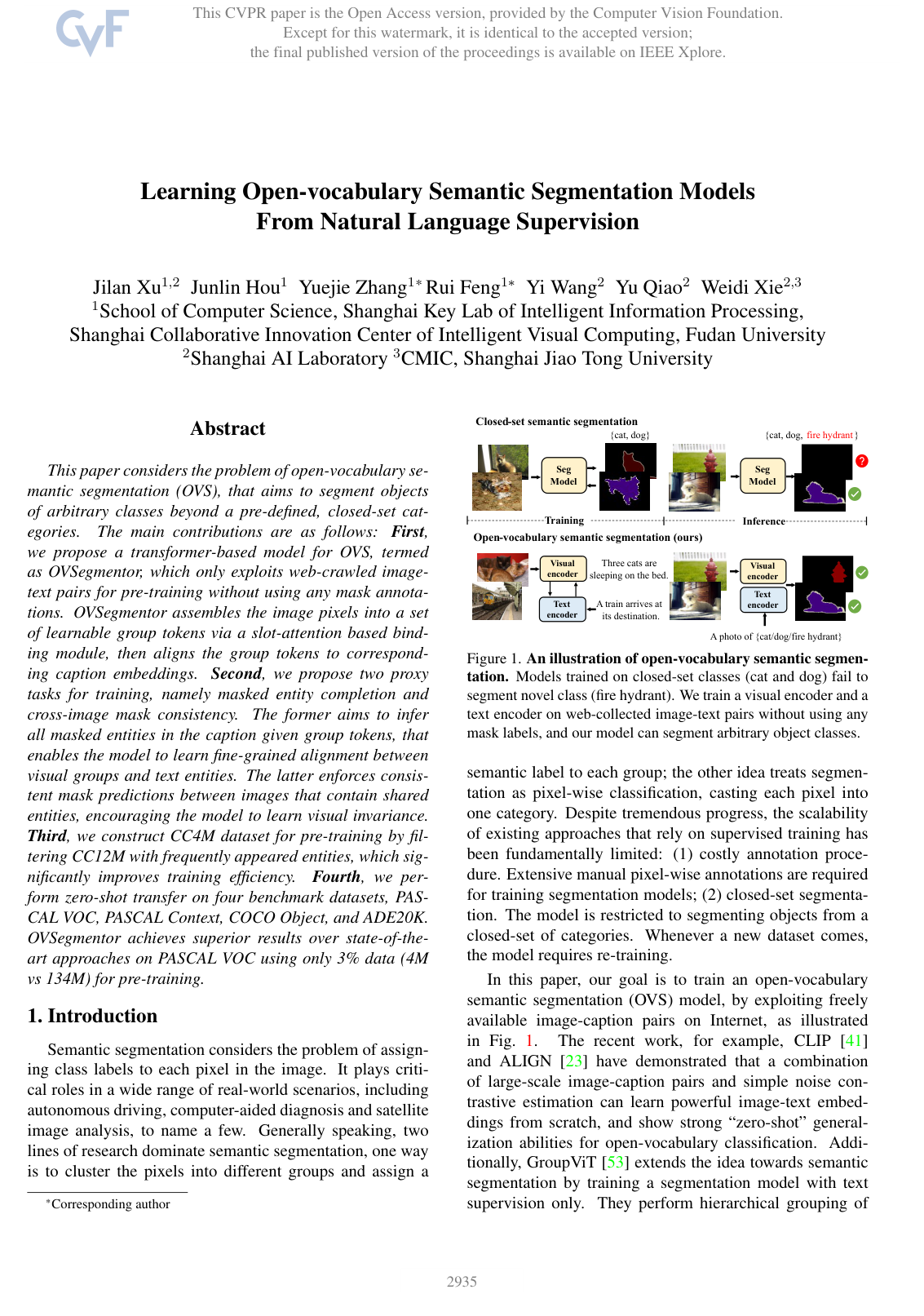
Learning Open-Vocabulary Semantic Segmentation Models From Natural Language Supervision
Jilan Xu, Junlin Hou, Yuejie Zhang, Rui Feng, Yi Wang, Yu Qiao, Weidi Xie
Why you should read this
Presents OVSegmentor, a vision-language framework that learns open-vocabulary semantic segmentation directly from web-scale image-caption pairs without manual mask annotations by using slot-attention group tokens and proxy tasks for masked entity completion and cross-image consistency.
This paper considers the problem of open-vocabulary semantic segmentation (OVS), that aims to segment objects of arbitrary classes beyond a pre-defined, closed-set categories. The main contributions are as follows: First, we propose a transformer-based model for OVS, termed as OVSegmentor, which only exploits web-crawled image-text pairs for pre-training without using any mask annotations. OVSegmentor assembles the image pixels into a set of learnable group tokens via a slot-attention based binding module, then aligns the group tokens to corresponding caption embeddings. Second, we propose two proxy tasks for training, namely masked entity completion and cross-image mask consistency. The former aims to infer all masked entities in the caption given group tokens, that enables the model to learn fine-grained alignment between visual groups and text entities. The latter enforces consistent mask predictions between images that contain shared entities, encouraging the model to learn visual invariance. Third, we construct CC4M dataset for pre-training by filtering CC12M with frequently appeared entities, which significantly improves training efficiency. Fourth, we perform zero-shot transfer on four benchmark datasets, PASCAL VOC, PASCAL Context, COCO Object, and ADE20K. OVSegmentor achieves superior results over state-of-the-art approaches on PASCAL VOC using only 3% data (4M vs 134M) for pre-training.
Added
2026-09-26