
keyword
margin classifiers
Margin classifiers are machine learning models that determine class labels by establishing a decision boundary while evaluating or maximizing a margin, defined as the distance or confidence separation between data instances and the boundary. Geometrically, the margin represents the distance from the separating boundary to the nearest training samples, where maximizing this separation helps improve model generalization and prevent overfitting on unseen data. Functionally, margin-based algorithms generate real-valued prediction scores where the sign indicates the assigned class and the magnitude reflects the confidence of the classification. Prominent examples include support vector machines, boosting algorithms, and regularized neural networks, all of which utilize margin principles to establish theoretical generalization bounds and solve binary as well as multiclass classification tasks.
8 items
Soft Margins for AdaBoost
Gunnar Rätsch, T. Onoda, Klaus-Robert Müller
Why you should read this
Explains why AdaBoost overfits on noisy data by linking its asymptotic behavior to hard-margin maximization, and proposes soft-margin regularization techniques via gradient descent and mathematical programming to prevent outliers from degrading classification performance.
Recently ensemble methods like ADABOOST have been applied successfully in many problems, while seemingly defying the problems of overfitting. ADABOOST rarely overfits in the low noise regime, however, we show that it clearly does so for higher noise levels. Central to the understanding of this fact is the margin distribution. ADABOOST can be viewed as a constraint gradient descent in an error function with respect to the margin. We find that ADABOOST asymptotically achieves a hard margin distribution, i.e. the algorithm concentrates its resources on a few hard-to-learn patterns that are interestingly very similar to Support Vectors. A hard margin is clearly a sub-optimal strategy in the noisy case, and regularization, in our case a “mistrust” in the data, must be introduced in the algorithm to alleviate the distortions that single difficult patterns (e.g. outliers) can cause to the margin distribution. We propose several regularization methods and generalizations of the original ADABOOST algorithm to achieve a soft margin. In particular we suggest (1) regularized ADABOOSTREG where the gradient decent is done directly with respect to the soft margin and (2) regularized linear and quadratic programming (LP/QP-) ADABOOST, where the soft margin is attained by introducing slack variables. Extensive simulations demonstrate that the proposed regularized ADABOOST-type algorithms are useful and yield competitive results for noisy data.
Added
2026-09-25
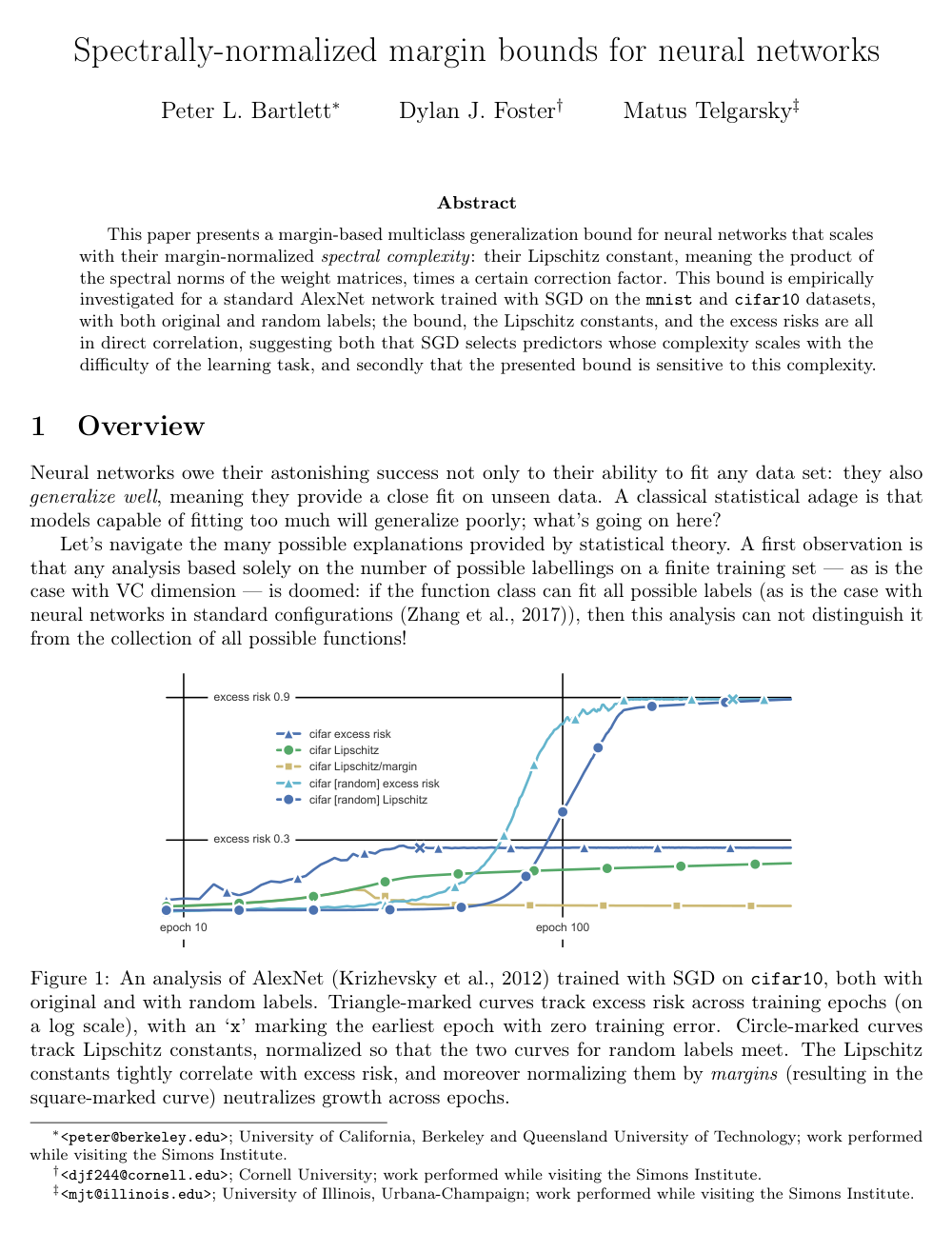
Spectrally-normalized margin bounds for neural networks
Peter Bartlett, Dylan J. Foster, Matus Telgarsky
Why you should read this
Establishes margin-based generalization bounds for deep neural networks based on weight matrix spectral norms, offering theoretical and empirical evidence for why stochastic gradient descent achieves low generalization error.
This paper presents a margin-based multiclass generalization bound for neural networks that scales with their margin-normalized "spectral complexity": their Lipschitz constant, meaning the product of the spectral norms of the weight matrices, times a certain correction factor. This bound is empirically investigated for a standard AlexNet network trained with SGD on the mnist and cifar10 datasets, with both original and random labels; the bound, the Lipschitz constants, and the excess risks are all in direct correlation, suggesting both that SGD selects predictors whose complexity scales with the difficulty of the learning task, and secondly that the presented bound is sensitive to this complexity.
Added
2026-09-25
Reducing Multiclass to Binary: A Unifying Approach for Margin Classifiers
Erin L. Allwein, Rob Schapire, Y. Singer
Why you should read this
Unifies standard multiclass-to-binary reductions under a single framework by introducing margin- and loss-based decoding techniques backed by rigorous error bounds for algorithms like AdaBoost and support vector machines.
We present a unifying framework for studying the solution of multiclass categorization problems by reducing them to multiple binary problems that are then solved using a margin-based binary learning algorithm. The proposed framework unifies some of the most popular approaches in which each class is compared against all others, or in which all pairs of classes are compared to each other, or in which output codes with error-correcting properties are used. We propose a general method for combining the classifiers generated on the binary problems, and we prove a general empirical multiclass loss bound given the empirical loss of the individual binary learning algorithms. The scheme and the corresponding bounds apply to many popular classification learning algorithms including support-vector machines, AdaBoost, regression, logistic regression and decision-tree algorithms. We also give a multiclass generalization error analysis for general output codes with AdaBoost as the binary learner. Experimental results with SVM and AdaBoost show that our scheme provides a viable alternative to the most commonly used multiclass algorithms.
Added
2026-09-24
Transforming classifier scores into accurate multiclass probability estimates
Bianca Zadrozny, Charles Elkan
Why you should read this
Presents a simple, non-parametric calibration method using isotonic regression alongside an ensemble decomposition technique to turn raw classification scores from models like SVMs and naive Bayes into accurate multiclass probability estimates.
Class membership probability estimates are important for many applications of data mining in which classification outputs are combined with other sources of information for decision-making, such as example-dependent misclassification costs, the outputs of other classifiers, or domain knowledge. Previous calibration methods apply only to two-class problems. Here, we show how to obtain accurate probability estimates for multiclass problems by combining calibrated binary probability estimates. We also propose a new method for obtaining calibrated two-class probability estimates that can be applied to any classifier that produces a ranking of examples. Using naive Bayes and support vector machine classifiers, we give experimental results from a variety of two-class and multiclass domains, including direct marketing, text categorization and digit recognition.
Added
2026-09-18
Probability Estimates for Multi-class Classification by Pairwise Coupling
Tingyao Wu, Chih-Jen Lin, Ruby C. Weng
Why you should read this
Develops two pairwise coupling methods that reduce multi-class probability estimation to easily solved linear systems while achieving greater numerical stability than standard voting and iterative approaches.
Pairwise coupling is a popular multi-class classification method that combines all comparisons for each pair of classes. This paper presents two approaches for obtaining class probabilities. Both methods can be reduced to linear systems and are easy to implement. We show conceptually and experimentally that the proposed approaches are more stable than the two existing popular methods: voting and the method by Hastie and Tibshirani (1998).
Added
2026-09-17
In Defense of One-Vs-All Classification
Ryan Rifkin, Aldebaro Klautau
Why you should read this
Demonstrates through rigorous empirical evaluations and theoretical analysis that simple one-vs-all multiclass strategies match the accuracy of far more complex methods when using well-tuned regularized binary classifiers.
We consider the problem of multiclass classification. Our main thesis is that a simple “one-vs-all” scheme is as accurate as any other approach, assuming that the underlying binary classifiers are well-tuned regularized classifiers such as support vector machines. This thesis is interesting in that it disagrees with a large body of recent published work on multiclass classification. We support our position by means of a critical review of the existing literature, a substantial collection of carefully controlled experimental work, and theoretical arguments.
Added
2026-09-16
On the Algorithmic Implementation of Multiclass Kernel-based Vector Machines
Koby Crammer, Yoram Singer
Why you should read this
Develops a direct multiclass support vector machine framework based on a generalized margin that reduces large-scale quadratic optimization into small, single-example subproblems solved via a provably convergent fixed-point algorithm.
In this paper we describe the algorithmic implementation of multiclass kernel-based vector machines. Our starting point is a generalized notion of the margin to multiclass problems. Using this notion we cast multiclass categorization problems as a constrained optimization problem with a quadratic objective function. Unlike most of previous approaches which typically decompose a multiclass problem into multiple independent binary classification tasks, our notion of margin yields a direct method for training multiclass predictors. By using the dual of the optimization problem we are able to incorporate kernels with a compact set of constraints and decompose the dual problem into multiple optimization problems of reduced size. We describe an efficient fixed-point algorithm for solving the reduced optimization problems and prove its convergence. We then discuss technical details that yield significant running time improvements for large datasets. Finally, we describe various experiments with our approach comparing it to previously studied kernel-based methods. Our experiments indicate that for multiclass problems we attain state-of-the-art accuracy.
Added
2026-09-15
Optimizing search engines using clickthrough data
Thorsten Joachims
Why you should read this
Proposes a method for transforming user clickstream logs into relative preference judgments that can be directly used to train ranking support vector machines.
This paper presents an approach to automatically optimizing the retrieval quality of search engines using clickthrough data. Intuitively, a good information retrieval system should present relevant documents high in the ranking, with less relevant documents following below. While previous approaches to learning retrieval functions from examples exist, they typically require training data generated from relevance judgments by experts. This makes them difficult and expensive to apply. The goal of this paper is to develop a method that utilizes clickthrough data for training, namely the query-log of the search engine in connection with the log of links the users clicked on in the presented ranking. Such clickthrough data is available in abundance and can be recorded at very low cost. Taking a Support Vector Machine (SVM) approach, this paper presents a method for learning retrieval functions. From a theoretical perspective, this method is shown to be well-founded in a risk minimization framework. Furthermore, it is shown to be feasible even for large sets of queries and features. The theoretical results are verified in a controlled experiment. It shows that the method can effectively adapt the retrieval function of a meta-search engine to a particular group of users, outperforming Google in terms of retrieval quality after only a couple of hundred training examples.
Added
2026-05-08