
keyword
machine reading comprehension
Machine reading comprehension is a task in natural language processing where an artificial intelligence system is evaluated on its ability to read, interpret, and answer questions about unstructured text passages. Unlike simple keyword matching, the process requires a computational model to understand linguistic context, resolve references, and perform logical, multi-hop, or numerical reasoning across provided text to identify or generate the correct response. Common evaluation formats include extractive span selection, multiple-choice options, cloze completion, and free-form text generation. By simulating human reading and analytical capabilities, machine reading comprehension serves as a foundational benchmark for natural language understanding and underpins real-world technologies such as automated document analysis, intelligent search engines, and question-answering systems.
11 items
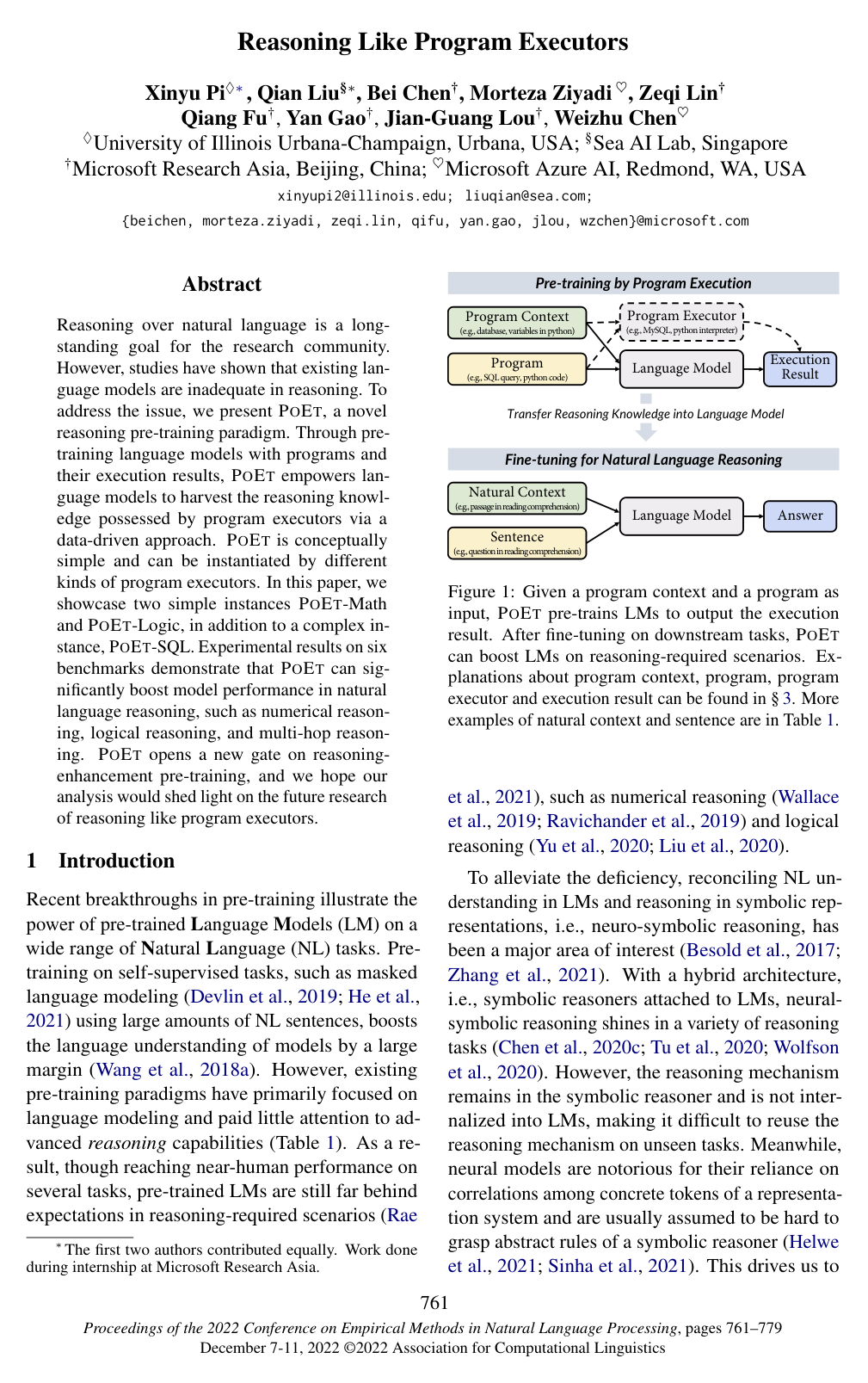
Reasoning Like Program Executors
Xinyu Pi, Qian Liu, Bei Chen, Morteza Ziyadi, Zeqi Lin, Qiang Fu, Yan Gao, Jian-Guang Lou, Weizhu Chen
Why you should read this
Proposes a pre-training paradigm that teaches language models to predict program execution outputs, transferring formal symbolic reasoning capabilities directly into neural models for downstream natural language tasks.
Reasoning over natural language is a long-standing goal for the research community. However, studies have shown that existing language models are inadequate in reasoning. To address the issue, we present PoET, a novel reasoning pre-training paradigm. Through pre-training language models with programs and their execution results, PoET empowers language models to harvest the reasoning knowledge possessed by program executors via a data-driven approach. PoET is conceptually simple and can be instantiated by different kinds of program executors. In this paper, we showcase two simple instances PoET-Math and PoET-Logic, in addition to a complex instance, PoET-SQL. Experimental results on six benchmarks demonstrate that PoET can significantly boost model performance in natural language reasoning, such as numerical reasoning, logical reasoning, and multi-hop reasoning. PoET opens a new gate on reasoning-enhancement pre-training, and we hope our analysis would shed light on the future research of reasoning like program executors.
Added
2026-10-03
The Belebele Benchmark: a Parallel Reading Comprehension Dataset in 122 Language Variants
Lucas Bandarkar, Davis Liang, Benjamin Muller, Mikel Artetxe, Satya Narayan Shukla, Donald Husa, Naman Goyal, Abhinandan Krishnan, Luke Zettlemoyer, Madian Khabsa
Why you should read this
Introduces a fully parallel reading comprehension benchmark across 122 language variants to evaluate and directly compare language models across high-, medium-, and low-resource languages.
We present Belebele, a multiple-choice machine reading comprehension (MRC) dataset spanning 122 language variants. Significantly expanding the language coverage of natural language understanding (NLU) benchmarks, this dataset enables the evaluation of text models in high-, medium-, and low-resource languages. Each question is based on a short passage from the FLORES-200 dataset and has four multiple-choice answers. The questions were carefully curated to discriminate between models with different levels of general language comprehension. The English dataset on its own proves difficult enough to challenge state-of-the-art language models. Being fully parallel, this dataset enables direct comparison of model performance across all languages. We use this dataset to evaluate the capabilities of multilingual masked language models (MLMs) and large language models (LLMs). We present extensive results and findings, notably that despite significant cross-lingual transfer in English-centric LLMs, much smaller MLMs pretrained on balanced multilingual data still understand far more languages. Overall, Belebele opens up new avenues for evaluating and analyzing the multilingual capabilities of NLP systems.
Added
2026-09-28
MetaICL: Learning to Learn In Context
Sewon Min, Mike Lewis, Luke Zettlemoyer, Hannaneh Hajishirzi
Why you should read this
Proposes a meta-training framework that teaches language models how to perform in-context learning across diverse tasks, allowing smaller models to generalize to unseen target tasks and rival fully finetuned baselines without requiring task-specific templates or parameter updates.
We introduce MetaICL (Meta-training for In-Context Learning), a new meta-training framework for few-shot learning where a pretrained language model is tuned to do in-context learning on a large set of training tasks. This meta-training enables the model to more effectively learn a new task in context at test time, by simply conditioning on a few training examples with no parameter updates or task-specific templates. We experiment on a large, diverse collection of tasks consisting of 142 NLP datasets including classification, question answering, natural language inference, paraphrase detection and more, across seven different meta-training/target splits. MetaICL outperforms a range of baselines including in-context learning without meta-training and multi-task learning followed by zero-shot transfer. We find that the gains are particularly significant for target tasks that have domain shifts from the meta-training tasks, and that using a diverse set of the meta-training tasks is key to improvements. We also show that MetaICL approaches (and sometimes beats) the performance of models fully finetuned on the target task, and outperforms much bigger models with nearly 8x parameters. Finally, we show that MetaICL is complementary to human-written instructions, and the best performance can be achieved by combining both approaches.
Added
2026-09-28
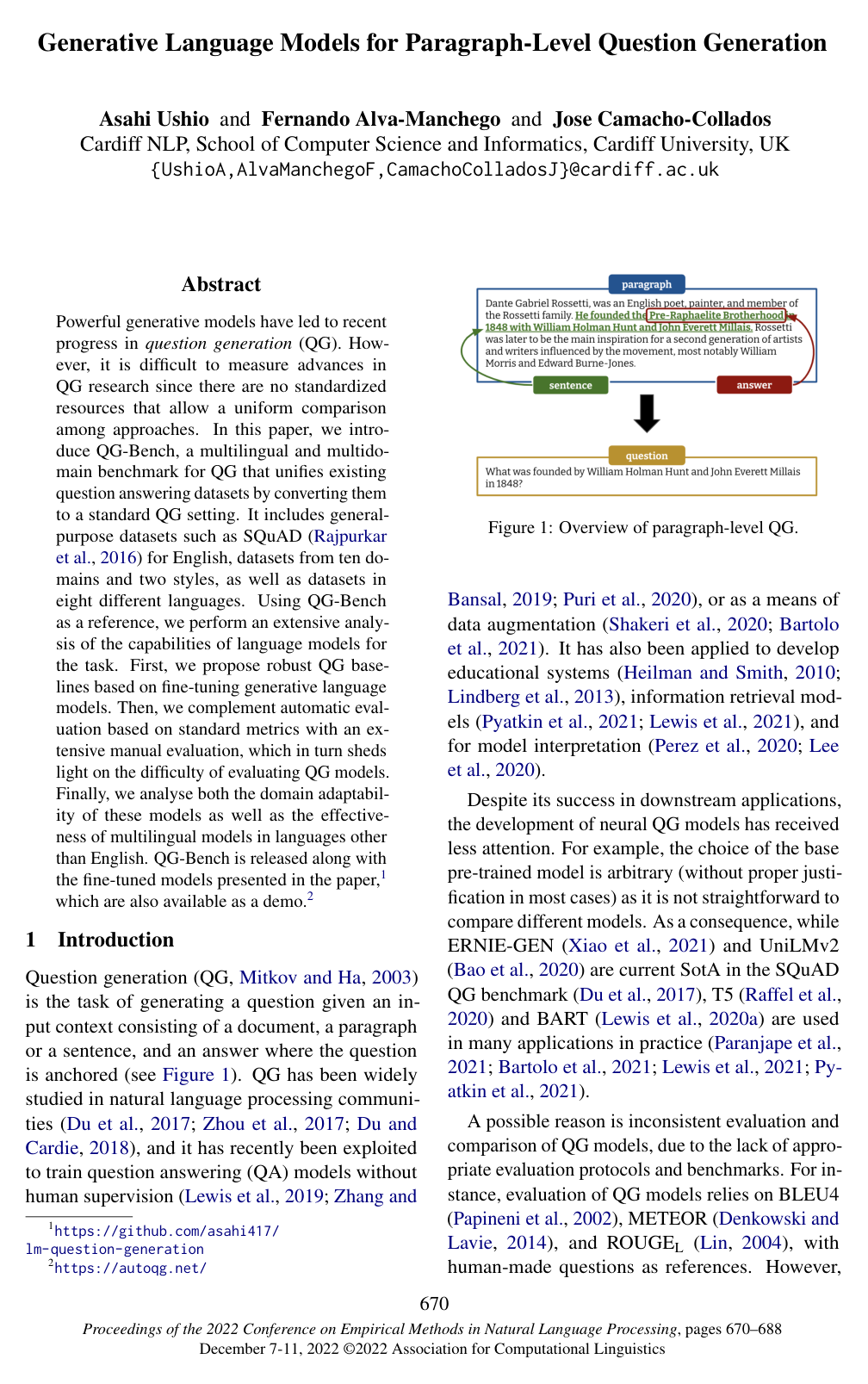
Generative Language Models for Paragraph-Level Question Generation
Asahi Ushio, Fernando Alva-Manchego, José Camacho-Collados
Why you should read this
Introduces QG-Bench, a unified multilingual and multi-domain benchmark that standardizes paragraph-level question generation evaluation across eight languages and multiple domains using sequence-to-sequence language models.
Powerful generative models have led to recent progress in question generation (QG). However, it is difficult to measure advances in QG research since there are no standardized resources that allow a uniform comparison among approaches. In this paper, we introduce QG-Bench, a multilingual and multidomain benchmark for QG that unifies existing question answering datasets by converting them to a standard QG setting. It includes general-purpose datasets such as SQuAD (Rajpurkar et al., 2016) for English, datasets from ten domains and two styles, as well as datasets in eight different languages. Using QG-Bench as a reference, we perform an extensive analysis of the capabilities of language models for the task. First, we propose robust QG baselines based on fine-tuning generative language models. Then, we complement automatic evaluation based on standard metrics with an extensive manual evaluation, which in turn sheds light on the difficulty of evaluating QG models. Finally, we analyse both the domain adaptability of these models as well as the effectiveness of multilingual models in languages other than English. QG-Bench is released along with the fine-tuned models presented in the paper,¹ which are also available as a demo.²
Added
2026-09-26
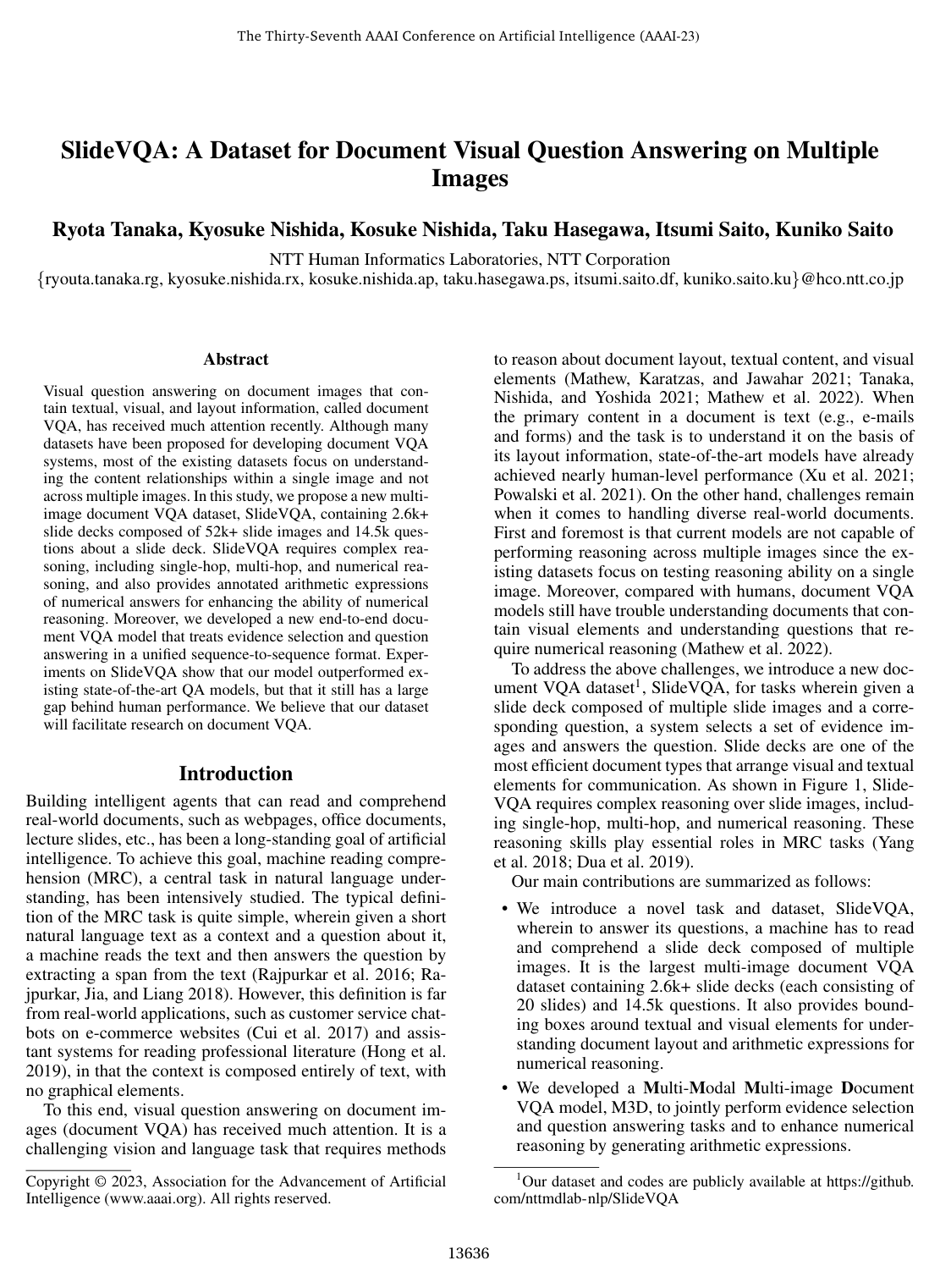
SlideVQA: A Dataset for Document Visual Question Answering on Multiple Images
Ryota Tanaka, Kyosuke Nishida, Kosuke Nishida, Taku Hasegawa, Itsumi Saito, Kuniko Saito
Why you should read this
Introduces SlideVQA, a large-scale multi-image benchmark paired with a unified sequence-to-sequence model that challenges document visual question answering systems to perform multi-hop and numerical reasoning across multi-page slide decks.
Visual question answering on document images that contain textual, visual, and layout information, called document VQA, has received much attention recently. Although many datasets have been proposed for developing document VQA systems, most of the existing datasets focus on understanding the content relationships within a single image and not across multiple images. In this study, we propose a new multi-image document VQA dataset, SlideVQA, containing 2.6k+ slide decks composed of 52k+ slide images and 14.5k questions about a slide deck. SlideVQA requires complex reasoning, including single-hop, multi-hop, and numerical reasoning, and also provides annotated arithmetic expressions of numerical answers for enhancing the ability of numerical reasoning. Moreover, we developed a new end-to-end document VQA model that treats evidence selection and question answering in a unified sequence-to-sequence format. Experiments on SlideVQA show that our model outperformed existing state-of-the-art QA models, but that it still has a large gap behind human performance. We believe that our dataset will facilitate research on document VQA.
Added
2026-09-26
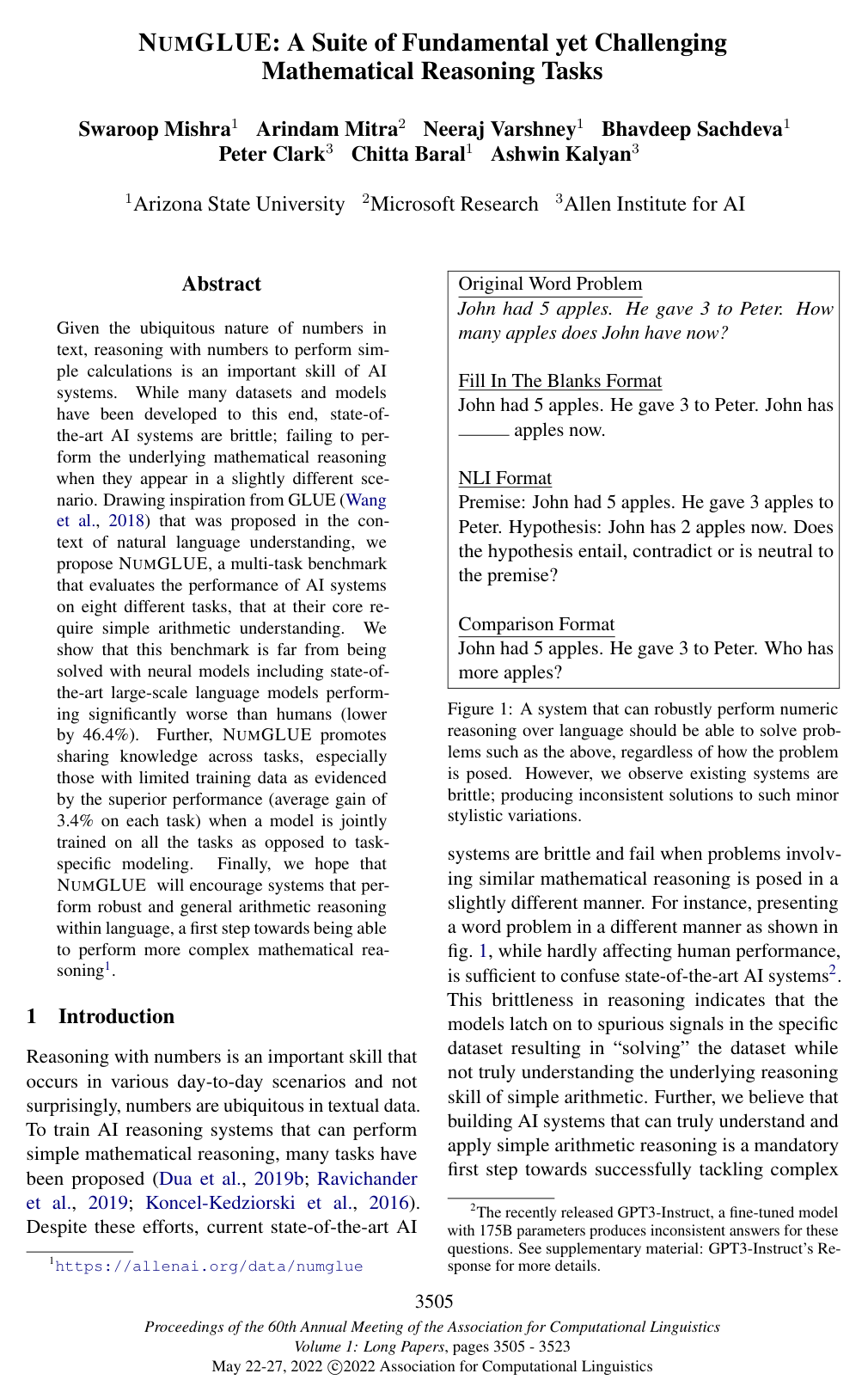
NumGLUE: A Suite of Fundamental yet Challenging Mathematical Reasoning Tasks
Swaroop Mishra, Arindam Mitra, Neeraj Varshney, Bhavdeep Singh Sachdeva, Peter Clark, Chitta Baral, Ashwin Kalyan
Why you should read this
Presents NUMGLUE, an eight-task benchmark spanning roughly 100,000 problems that exposes large language models' severe arithmetic brittleness compared to human reasoning while showing that joint multi-task training significantly boosts numerical performance across diverse question formats.
Given the ubiquitous nature of numbers in text, reasoning with numbers to perform simple calculations is an important skill of AI systems. While many datasets and models have been developed to this end, state-of-the-art AI systems are brittle; failing to perform the underlying mathematical reasoning when they appear in a slightly different scenario. Drawing inspiration from GLUE (Wang et al., 2018) that was proposed in the context of natural language understanding, we propose NUMGLUE, a multi-task benchmark that evaluates the performance of AI systems on eight different tasks, that at their core require simple arithmetic understanding. We show that this benchmark is far from being solved with neural models including state-of-the-art large-scale language models performing significantly worse than humans (lower by 46.4%). Further, NUMGLUE promotes sharing knowledge across tasks, especially those with limited training data as evidenced by the superior performance (average gain of 3.4% on each task) when a model is jointly trained on all the tasks as opposed to task-specific modeling. Finally, we hope that NUMGLUE will encourage systems that perform robust and general arithmetic reasoning within language, a first step towards being able to perform more complex mathematical reasoning.
Added
2026-09-26
Multi-Task Deep Neural Networks for Natural Language Understanding
Xiaodong Liu, Pengcheng He, Weizhu Chen, Jianfeng Gao
Why you should read this
Introduces MT-DNN, a framework that integrates multi-task learning with pre-trained BERT representations to achieve state-of-the-art results across ten natural language understanding benchmarks while requiring significantly fewer labeled examples for domain adaptation.
In this paper, we present a Multi-Task Deep Neural Network (MT-DNN) for learning representations across multiple natural language understanding (NLU) tasks. MT-DNN not only leverages large amounts of cross-task data, but also benefits from a regularization effect that leads to more general representations in order to adapt to new tasks and domains. MT-DNN extends the model proposed in Liu et al. (2015) by incorporating a pre-trained bidirectional transformer language model, known as BERT (Devlin et al., 2018). MT-DNN obtains new state-of-the-art results on ten NLU tasks, including SNLI, SciTail, and eight out of nine GLUE tasks, pushing the GLUE benchmark to 82.7% (2.2% absolute improvement). We also demonstrate using the SNLI and SciTail datasets that the representations learned by MT-DNN allow domain adaptation with substantially fewer in-domain labels than the pre-trained BERT representations. The code and pre-trained models are publicly available at this https URL.
Added
2026-09-25
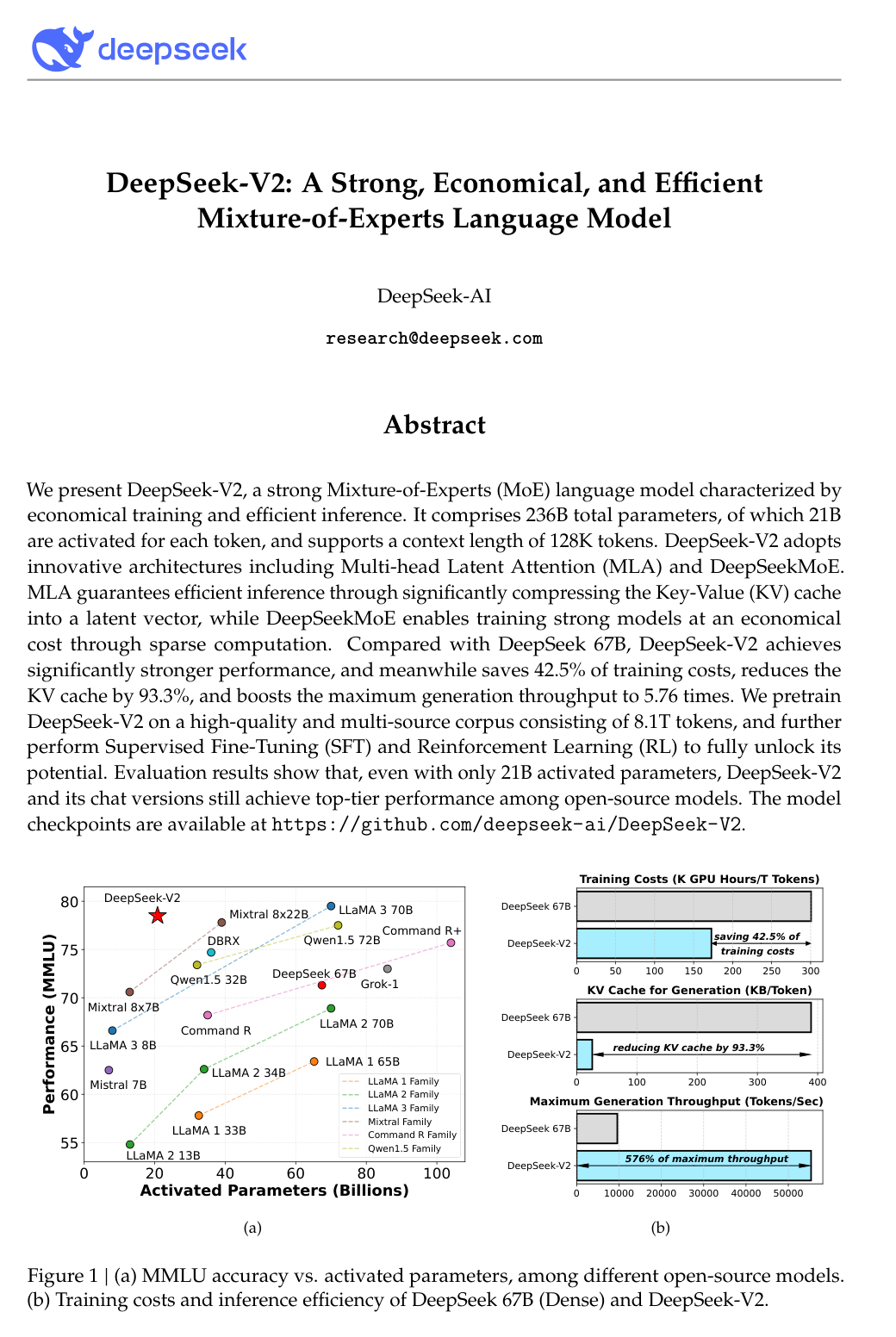
DeepSeek-V2: A Strong, Economical, and Efficient Mixture-of-Experts Language Model
Zhihong Shao, Damai Dai, Daya Guo, Zihan Wang, Huajian Xin
Why you should read this
Introduces DeepSeek-V2, a 236-billion-parameter Mixture-of-Experts model that activates only 21 billion parameters per token and uses Multi-head Latent Attention to reduce Key-Value cache memory by 93.3% while achieving top-tier open-source performance at significantly lower training and inference costs.
We present DeepSeek-V2, a strong Mixture-of-Experts (MoE) language model characterized by economical training and efficient inference. It comprises 236B total parameters, of which 21B are activated for each token, and supports a context length of 128K tokens. DeepSeek-V2 adopts innovative architectures including Multi-head Latent Attention (MLA) and DeepSeekMoE. MLA guarantees efficient inference through significantly compressing the Key-Value (KV) cache into a latent vector, while DeepSeekMoE enables training strong models at an economical cost through sparse computation. Compared with DeepSeek 67B, DeepSeek-V2 achieves significantly stronger performance, and meanwhile saves 42.5% of training costs, reduces the KV cache by 93.3%, and boosts the maximum generation throughput to 5.76 times. We pretrain DeepSeek-V2 on a high-quality and multi-source corpus consisting of 8.1T tokens, and further perform Supervised Fine-Tuning (SFT) and Reinforcement Learning (RL) to fully unlock its potential. Evaluation results show that, even with only 21B activated parameters, DeepSeek-V2 and its chat versions still achieve top-tier performance among open-source models.
Added
2026-09-25
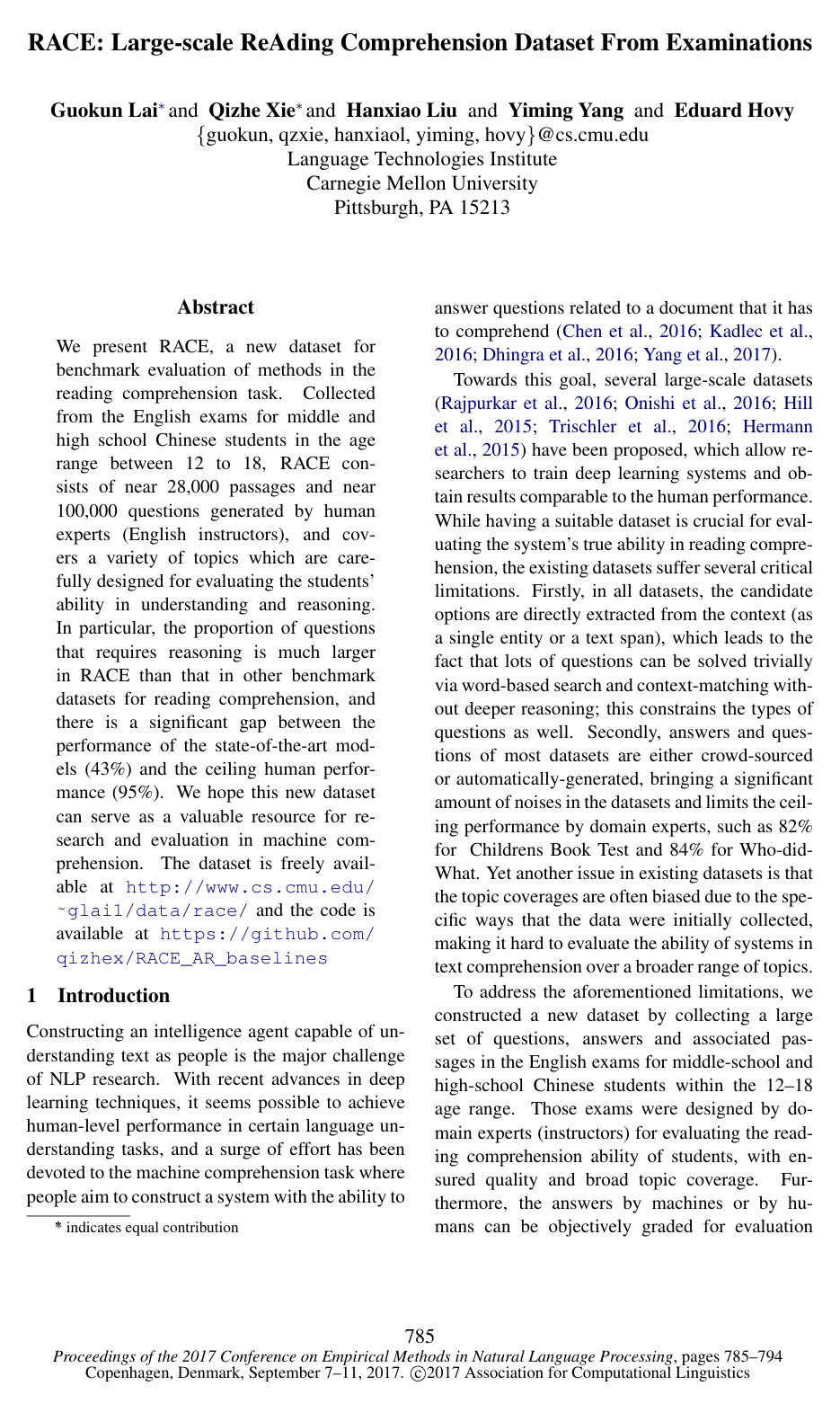
RACE: Large-scale ReAding Comprehension Dataset From Examinations
Guokun Lai, Qizhe Xie, Hanxiao Liu, Yiming Yang, Eduard Hovy
Why you should read this
Introduces RACE, a challenging reading comprehension benchmark built from real school English examinations that tests multi-sentence reasoning and reveals a massive performance gap between existing language models and human comprehension.
We present RACE, a new dataset for benchmark evaluation of methods in the reading comprehension task. Collected from the English exams for middle and high school Chinese students in the age range between 12 to 18, RACE consists of near 28,000 passages and near 100,000 questions generated by human experts (English instructors), and covers a variety of topics which are carefully designed for evaluating the students' ability in understanding and reasoning. In particular, the proportion of questions that requires reasoning is much larger in RACE than that in other benchmark datasets for reading comprehension, and there is a significant gap between the performance of the state-of-the-art models (43%) and the ceiling human performance (95%). We hope this new dataset can serve as a valuable resource for research and evaluation in machine comprehension. The dataset is freely available at this http URL and the code is available at this https URL.
Added
2026-09-24
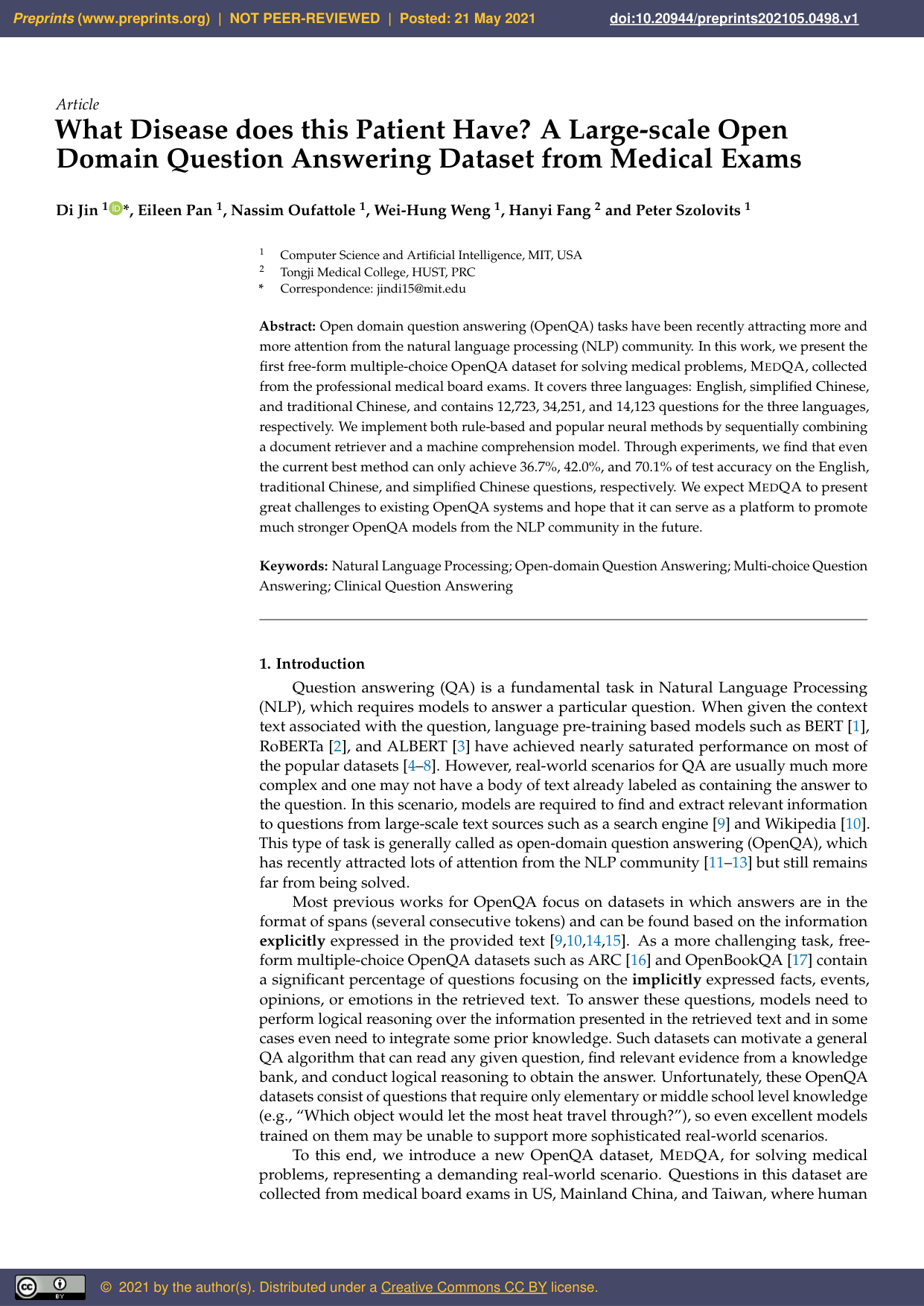
What Disease does this Patient Have? A Large-scale Open Domain Question Answering Dataset from Medical Exams
Di Jin, Eileen Pan, Nassim Oufattole, Wei-Hung Weng, Hanyi Fang, Peter Szolovits
Why you should read this
Introduces MedQA, a multilingual question-answering dataset derived from real medical board exams in English and Chinese that exposes the severe limitations of current natural language processing models on complex clinical reasoning.
Open domain question answering (OpenQA) tasks have been recently attracting more and more attention from the natural language processing (NLP) community. In this work, we present the first free-form multiple-choice OpenQA dataset for solving medical problems, MedQA, collected from the professional medical board exams. It covers three languages: English, simplified Chinese, and traditional Chinese, and contains 12,723, 34,251, and 14,123 questions for the three languages, respectively. We implement both rule-based and popular neural methods by sequentially combining a document retriever and a machine comprehension model. Through experiments, we find that even the current best method can only achieve 36.7\%, 42.0\%, and 70.1\% of test accuracy on the English, traditional Chinese, and simplified Chinese questions, respectively. We expect MedQA to present great challenges to existing OpenQA systems and hope that it can serve as a platform to promote much stronger OpenQA models from the NLP community in the future.
Added
2026-09-16
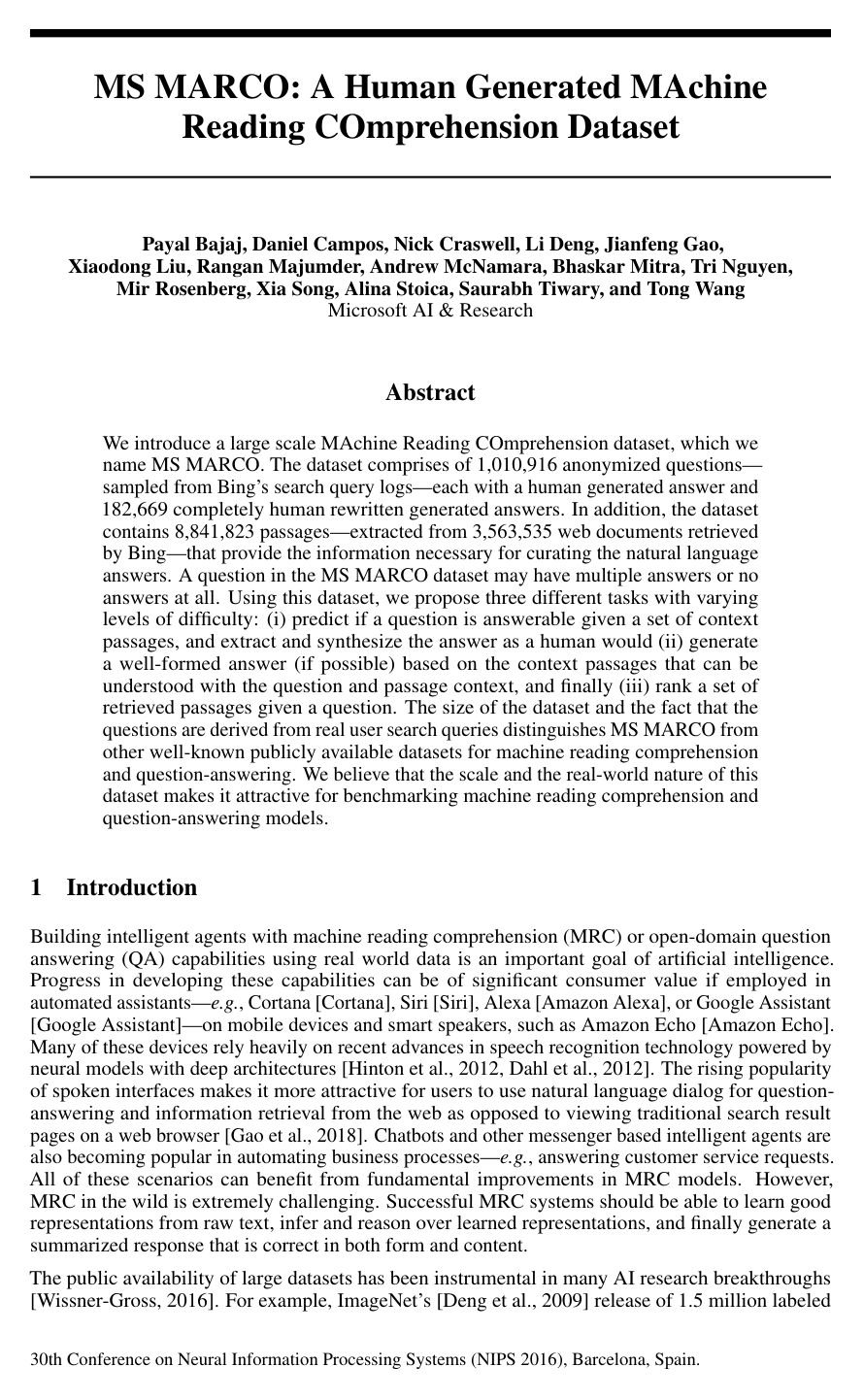
MS MARCO: A Human Generated MAchine Reading COmprehension Dataset
Daniel Fernando Campos, Tri Nguyen, Mir Rosenberg, Xia Song, Jianfeng Gao, Saurabh Tiwary, Rangan Majumder, Li Deng, Bhaskar Mitra
Why you should read this
Introduces MS MARCO, a large-scale dataset of over one million real search queries paired with human-written answers across millions of web passages, providing essential benchmarks for neural information retrieval and machine reading comprehension.
We introduce a large scale MAchine Reading COmprehension dataset, which we name MS MARCO. The dataset comprises of 1,010,916 anonymized questions---sampled from Bing's search query logs---each with a human generated answer and 182,669 completely human rewritten generated answers. In addition, the dataset contains 8,841,823 passages---extracted from 3,563,535 web documents retrieved by Bing---that provide the information necessary for curating the natural language answers. A question in the MS MARCO dataset may have multiple answers or no answers at all. Using this dataset, we propose three different tasks with varying levels of difficulty: (i) predict if a question is answerable given a set of context passages, and extract and synthesize the answer as a human would (ii) generate a well-formed answer (if possible) based on the context passages that can be understood with the question and passage context, and finally (iii) rank a set of retrieved passages given a question. The size of the dataset and the fact that the questions are derived from real user search queries distinguishes MS MARCO from other well-known publicly available datasets for machine reading comprehension and question-answering. We believe that the scale and the real-world nature of this dataset makes it attractive for benchmarking machine reading comprehension and question-answering models.
Added
2026-09-11