
keyword
machine intelligence
Machine intelligence is a machine’s capacity to learn, reason, and act effectively in pursuit of goals across different environments. It can be understood broadly as a general ability to achieve goals, rather than skill at only one specific task.
2 items
From AGI to ASI
Tim Genewein, Matija Franklin, Alexander Lerchner, Laurent Orseau, Samuel Albanie, Adam Bales, Cole Wyeth, Stephanie Chan, Iason Gabriel, Joel Z. Leibo, Allan Dafoe, Marcus Hutter, Thore Graepel, Shane Legg
Why you should read this
Investigates four potential pathways—scaling, paradigm shifts, recursive improvement, and multi-agent collectives—that could lead from artificial general intelligence to artificial general superintelligence, outlining critical frictions and open research questions in this progression.
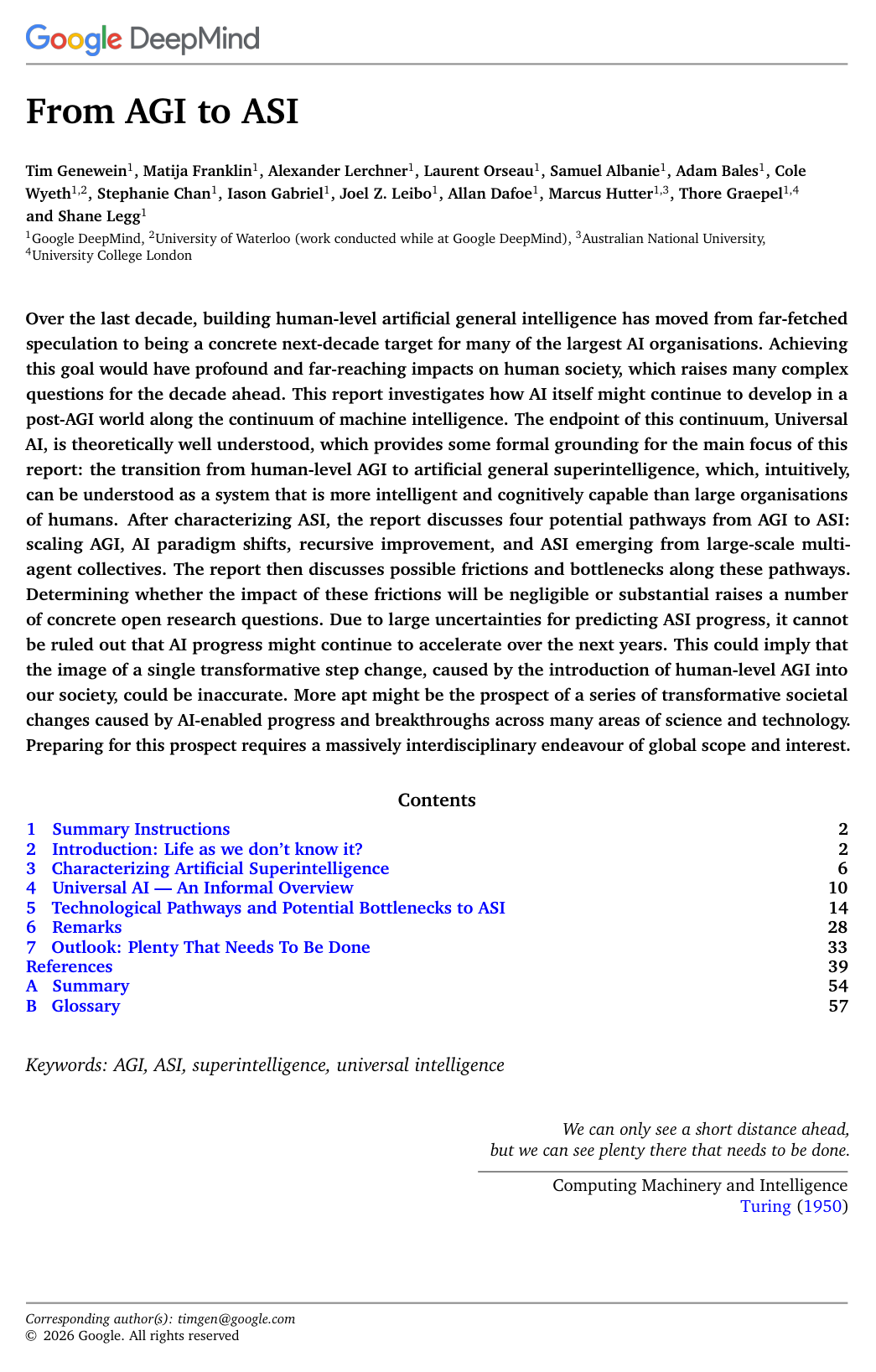
Over the last decade, building human-level artificial general intelligence has moved from far-fetched speculation to being a concrete next-decade target for many of the largest AI organisations. Achieving this goal would have profound and far-reaching impacts on human society, which raises many complex questions for the decade ahead. This report investigates how AI itself might continue to develop in a post-AGI world along the continuum of machine intelligence. The endpoint of this continuum, Universal AI, is theoretically well understood, which provides some formal grounding for the main focus of this report: the transition from human-level AGI to artificial general superintelligence, which, intuitively, can be understood as a system that is more intelligent and cognitively capable than large organisations of humans. After characterizing ASI, the report discusses four potential pathways from AGI to ASI: scaling AGI, AI paradigm shifts, recursive improvement, and ASI emerging from large-scale multi-agent collectives. The report then discusses possible frictions and bottlenecks along these pathways. Determining whether the impact of these frictions will be negligible or substantial raises a number of concrete open research questions. Due to large uncertainties for predicting ASI progress, it cannot be ruled out that AI progress might continue to accelerate over the next years. This could imply that the image of a single transformative step change, caused by the introduction of human-level AGI into our society, could be inaccurate. More apt might be the prospect of a series of transformative societal changes caused by AI-enabled progress and breakthroughs across many areas of science and technology. Preparing for this prospect requires a massively interdisciplinary endeavour of global scope and interest.
Added
2026-06-25

Universal Intelligence: A Definition of Machine Intelligence
Shane Legg, Marcus Hutter
Why you should read this
Develops a mathematically rigorous definition of intelligence that applies to any agent—biological or artificial—by formalizing the intuition that intelligence means succeeding at a wide variety of tasks weighted by their complexity.
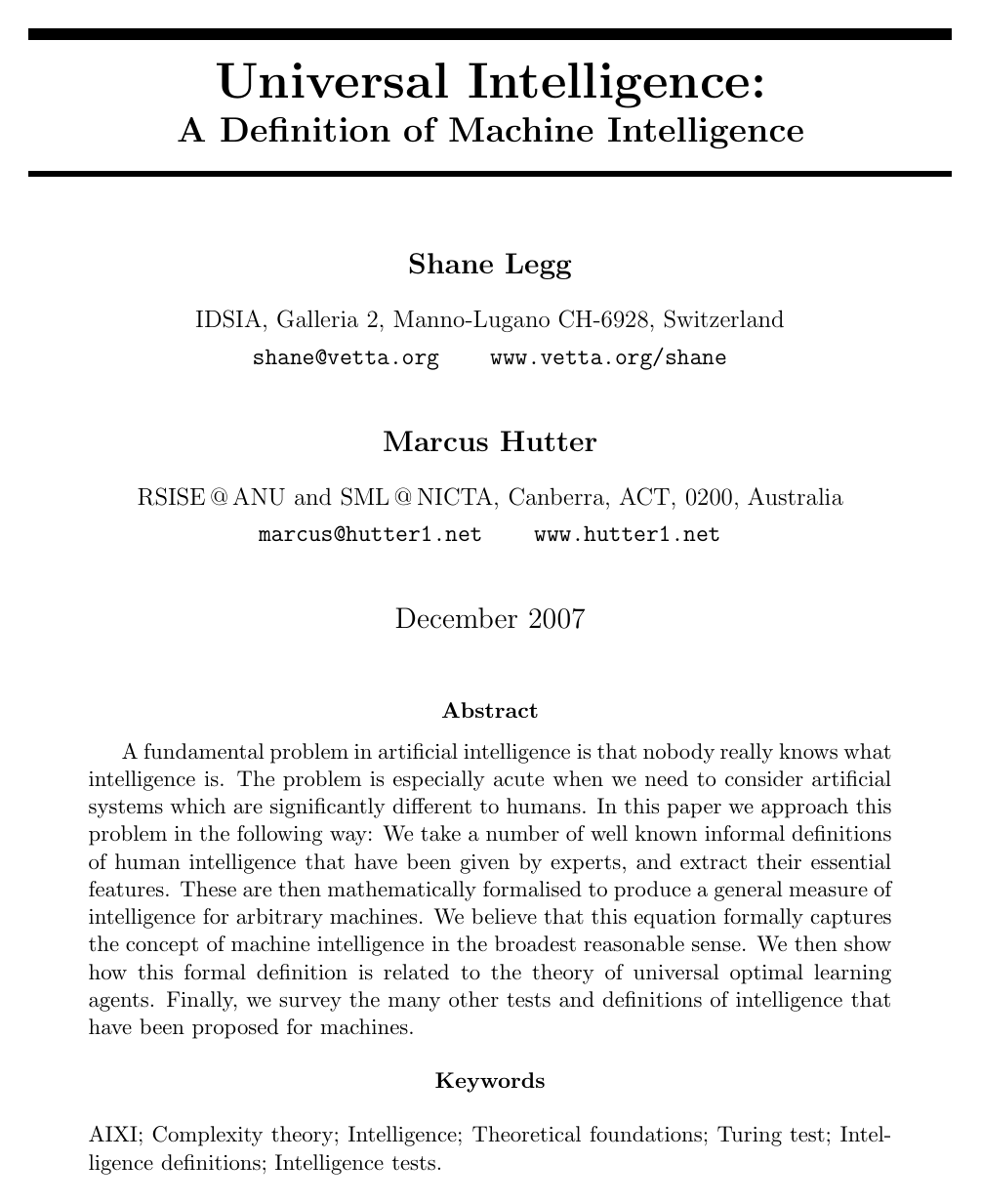
A fundamental problem in artificial intelligence is that nobody really knows what intelligence is. The problem is especially acute when we need to consider artificial systems which are significantly different to humans. In this paper we approach this problem in the following way: We take a number of well known informal definitions of human intelligence that have been given by experts, and extract their essential features. These are then mathematically formalised to produce a general measure of intelligence for arbitrary machines. We believe that this equation formally captures the concept of machine intelligence in the broadest reasonable sense. We then show how this formal definition is related to the theory of universal optimal learning agents. Finally, we survey the many other tests and definitions of intelligence that have been proposed for machines.
Added
2026-02-21