
keyword
Low-resource languages
Low-resource languages are languages that have limited digital, linguistic, or computational resources, such as large-scale text corpora, transcribed audio recordings, parallel translation datasets, and annotated benchmarks, necessary for building and training modern natural language processing and speech recognition systems. Although these languages encompass the overwhelming majority of the world's spoken and written languages, computational technologies and artificial intelligence models have predominantly concentrated on a small fraction of data-rich languages. Due to the scarcity of both labeled and unlabeled training data, developing effective technological support for low-resource languages typically requires specialized machine learning approaches, including cross-lingual transfer learning, massively multilingual pretraining, self-supervised representation learning, synthetic data generation, and few-shot in-context adaptation.
20 items
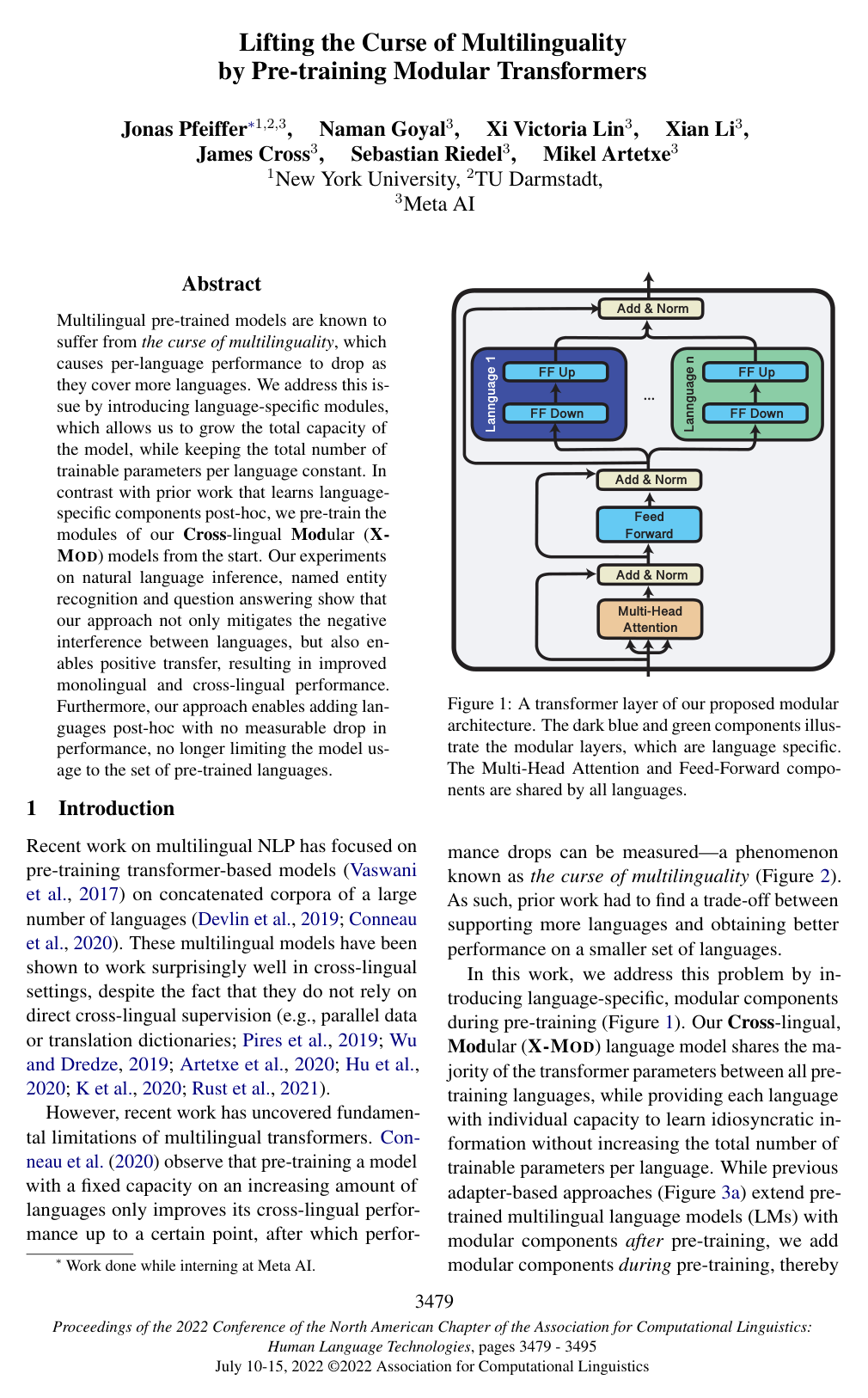
Lifting the Curse of Multilinguality by Pre-training Modular Transformers
Jonas Pfeiffer, Naman Goyal, Xi Victoria Lin, Xian Li, James Cross, Sebastian Riedel, Mikel Artetxe
Why you should read this
Proposes pre-training multilingual transformers with dedicated language-specific modules from the start, preventing capacity dilution across languages and enabling post-hoc extension to new languages without performance degradation.
Multilingual pre-trained models are known to suffer from the curse of multilinguality, which causes per-language performance to drop as they cover more languages. We address this issue by introducing language-specific modules, which allows us to grow the total capacity of the model, while keeping the total number of trainable parameters per language constant. In contrast with prior work that learns language-specific components post-hoc, we pre-train the modules of our Cross-lingual Modular (X-Mod) models from the start. Our experiments on natural language inference, named entity recognition and question answering show that our approach not only mitigates the negative interference between languages, but also enables positive transfer, resulting in improved monolingual and cross-lingual performance. Furthermore, our approach enables adding languages post-hoc with no measurable drop in performance, no longer limiting the model usage to the set of pre-trained languages.
Added
2026-10-05
GigaSpeech 2: An Evolving, Large-Scale and Multi-domain ASR Corpus for Low-Resource Languages with Automated Crawling, Transcription and Refinement
Yifan Yang, Zheshu Song, Jianheng Zhuo, Mingyu Cui, Jinpeng Li, Bo Yang, Yexing Du, Ziyang Ma, Xunying Liu, Ziyuan Wang, Ke Li, Shuai Fan, Kai Yu, Wei-Qiang Zhang, Guoguo Chen, Xie Chen
Why you should read this
Presents an automated crawling, transcription, and refinement pipeline alongside a 30,000-hour speech corpus for Thai, Indonesian, and Vietnamese, enabling models with a fraction of Whisper large-v3's parameters to significantly cut word error rates across realistic low-resource benchmarks.
The evolution of speech technology has been spurred by the rapid increase in dataset sizes. Traditional speech models generally depend on a large amount of labeled training data, which is scarce for low-resource languages. This paper presents GigaSpeech 2, a large-scale, multi-domain, multilingual speech recognition corpus. It is designed for low-resource languages and does not rely on paired speech and text data. GigaSpeech 2 comprises about 30,000 hours of automatically transcribed speech, including Thai, Indonesian, and Vietnamese, gathered from unlabeled YouTube videos. We also introduce an automated pipeline for data crawling, transcription, and label refinement. Specifically, this pipeline involves Whisper for initial transcription, MMS for forced alignment, and multi-dimensional filtering for data quality assurance. A modified Noisy Student Training is developed to further refine flawed pseudo labels iteratively, thereby enhancing model performance. Experimental results on our manually transcribed evaluation set and two public test sets from Common Voice and FLEURS confirm our corpus’s high quality and broad applicability. Notably, ASR models trained on GigaSpeech 2 can reduce the word error rate for Thai, Indonesian, and Vietnamese on our challenging and realistic YouTube test set by 25% to 40% compared to Whisper large-v3, with merely 10% model parameters. Furthermore, our ASR models trained on GigaSpeech 2 yield superior performance compared to commercial services. We hope that our newly introduced corpus and pipeline will open a new avenue for low-resource speech recognition and significantly facilitate research in this area.
Added
2026-10-05
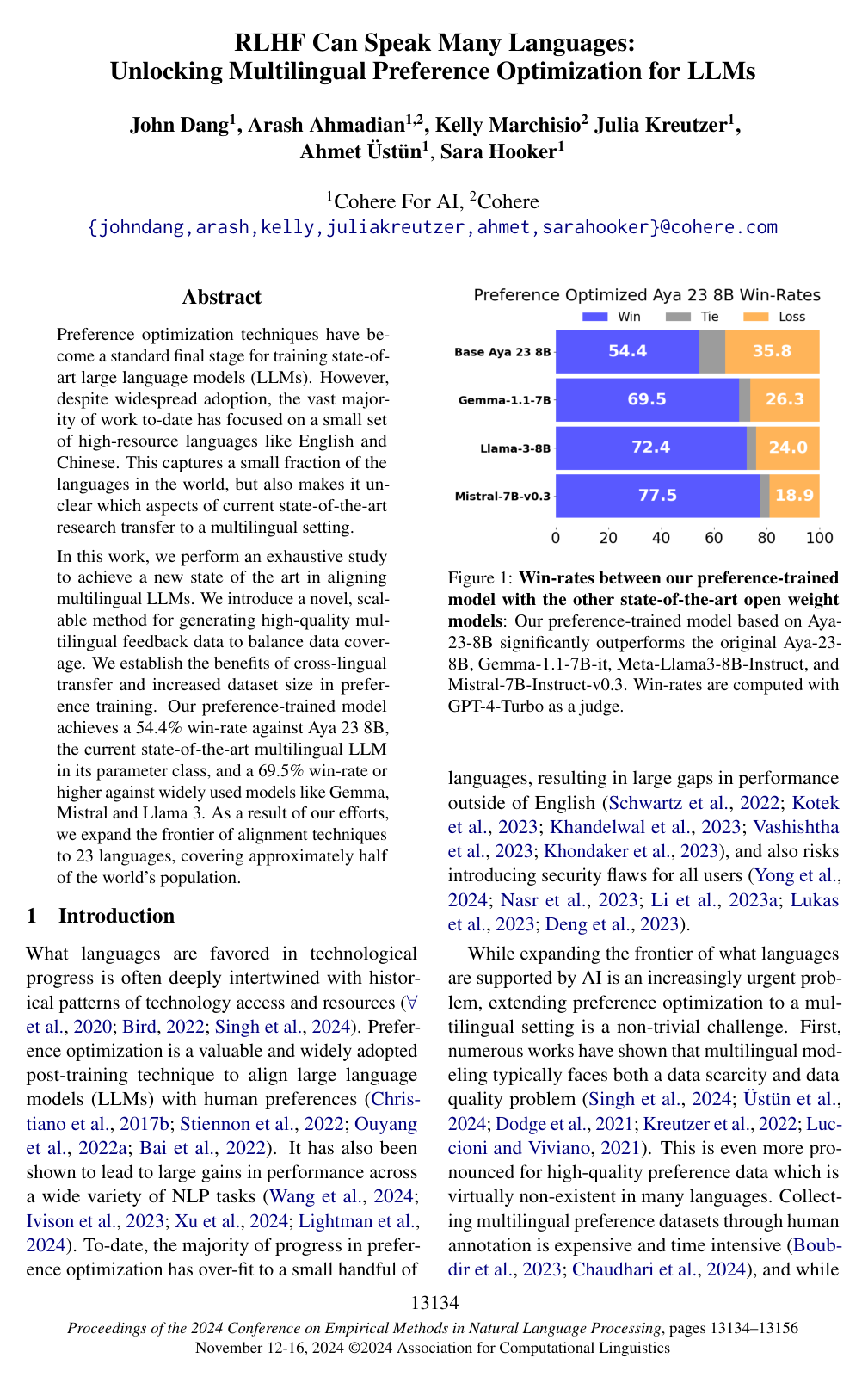
RLHF Can Speak Many Languages: Unlocking Multilingual Preference Optimization for LLMs
John Dang, Arash Ahmadian, Kelly Marchisio, Julia Kreutzer, Ahmet Üstün, Sara Hooker
Why you should read this
Demonstrates how to effectively scale reinforcement learning from human feedback across 23 languages by generating high-quality multilingual preference data, establishing that online optimization algorithms yield substantial cross-lingual transfer and outperform strong open-weight baselines.
Preference optimization techniques have become a standard final stage for training state-of-art large language models (LLMs). However, despite widespread adoption, the vast majority of work to-date has focused on a small set of high-resource languages like English and Chinese. This captures a small fraction of the languages in the world, but also makes it unclear which aspects of current state-of-the-art research transfer to a multilingual setting. In this work, we perform an exhaustive study to achieve a new state of the art in aligning multilingual LLMs. We introduce a novel, scalable method for generating high-quality multilingual feedback data to balance data coverage. We establish the benefits of cross-lingual transfer and increased dataset size in preference training. Our preference-trained model achieves a 54.4% win-rate against Aya 23 8B, the current state-of-the-art multilingual LLM in its parameter class, and a 69.5% win-rate or higher against widely used models like Gemma, Mistral and Llama 3. As a result of our efforts, we expand the frontier of alignment techniques to 23 languages, covering approximately half of the world’s population.
Added
2026-10-04

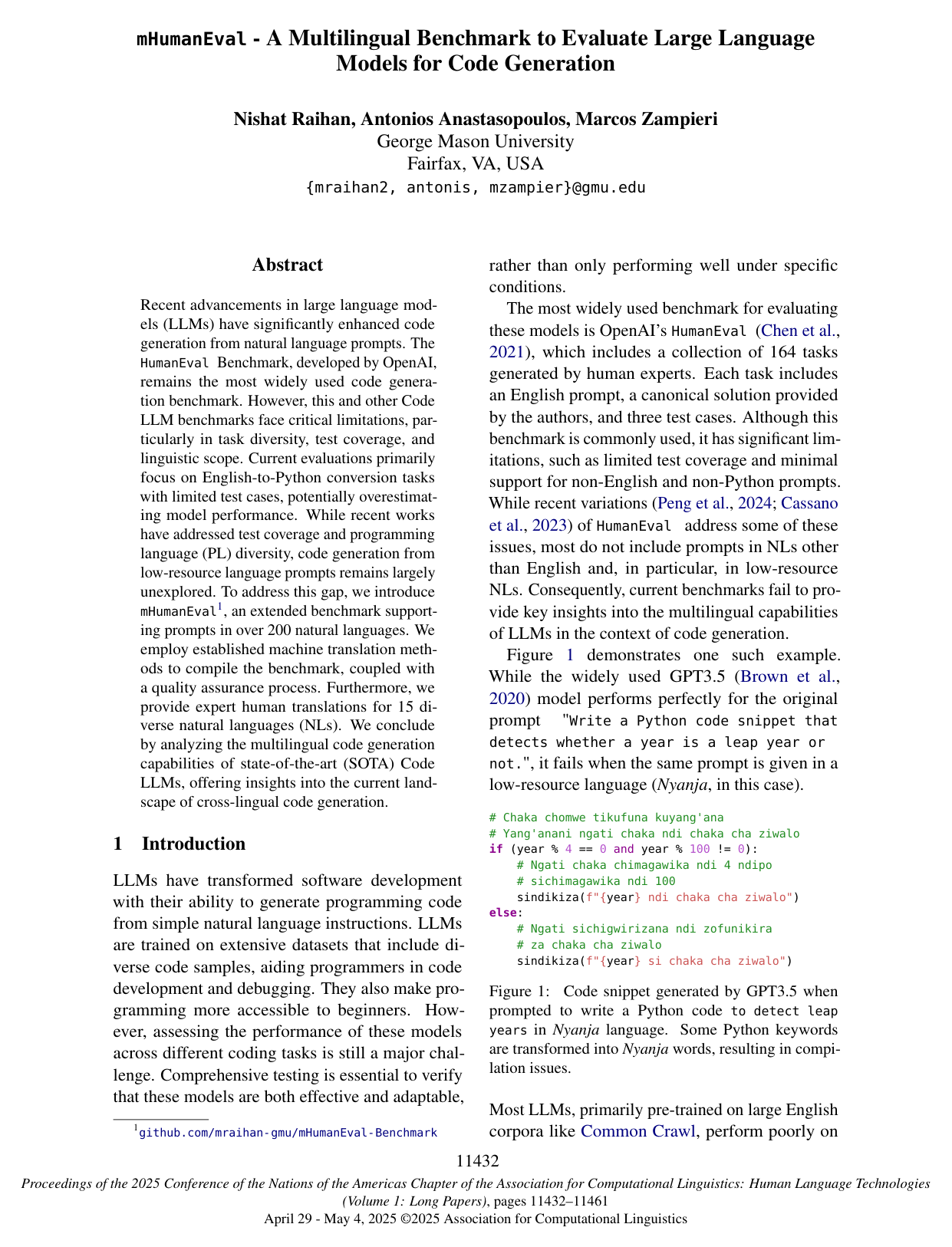
mHumanEval - A Multilingual Benchmark to Evaluate Large Language Models for Code Generation
Md. Nishat Raihan, Antonios Anastasopoulos, Marcos Zampieri
Why you should read this
Presents mHumanEval, the first massively multilingual code generation benchmark spanning 204 natural languages and 25 programming languages, enabling researchers to rigorously assess how well code LLMs understand prompts across high-, mid-, and low-resource languages.
Recent advancements in large language models (LLMs) have significantly enhanced code generation from natural language prompts. The HumanEval Benchmark, developed by OpenAI, remains the most widely used code generation benchmark. However, this and other Code LLM benchmarks face critical limitations, particularly in task diversity, test coverage, and linguistic scope. Current evaluations primarily focus on English-to-Python conversion tasks with limited test cases, potentially overestimating model performance. While recent works have addressed test coverage and programming language (PL) diversity, code generation from low-resource language prompts remains largely unexplored. To address this gap, we introduce mHumanEval¹, an extended benchmark supporting prompts in over 200 natural languages. We employ established machine translation methods to compile the benchmark, coupled with a quality assurance process. Furthermore, we provide expert human translations for 15 diverse natural languages (NLs). We conclude by analyzing the multilingual code generation capabilities of state-of-the-art (SOTA) Code LLMs, offering insights into the current landscape of cross-lingual code generation.
Added
2026-10-04
Towards Robust Speech Representation Learning for Thousands of Languages
William Chen, Wangyou Zhang, Yifan Peng, Xinjian Li, Jinchuan Tian, Jiatong Shi, Xuankai Chang, Soumi Maiti, Karen Livescu, Shinji Watanabe
Why you should read this
Presents XEUS, a fully open self-supervised speech encoder pre-trained on over one million hours of audio across 4,057 languages that incorporates an acoustic dereverberation objective to achieve state-of-the-art multilingual speech recognition performance.
Self-supervised learning (SSL) has helped extend speech technologies to more languages by reducing the need for labeled data. However, models are still far from supporting the world’s 7000+ languages. We propose XEUS, a Cross-lingual Encoder for Universal Speech, trained on over 1 million hours of data across 4057 languages, extending the language coverage of SSL models 4-fold. We combine 1 million hours of speech from existing publicly accessible corpora with a newly created corpus of 7400+ hours from 4057 languages, which will be publicly released. To handle the diverse conditions of multilingual speech data, we augment the typical SSL masked prediction approach with a novel dereverberation objective, increasing robustness. We evaluate XEUS on several benchmarks, and show that it consistently outperforms or achieves comparable results to state-of-the-art (SOTA) SSL models across a variety of tasks. XEUS sets a new SOTA on the ML-SUPERB benchmark: it outperforms MMS 1B and w2v-BERT 2.0 v2 by 0.8% and 4.4% respectively, despite having less parameters or pre-training data. Checkpoints, code, and data are found in https://www.wavlab.org/activities/2024/xeus/.
Added
2026-10-03
IGLUE: A Benchmark for Transfer Learning across Modalities, Tasks, and Languages
Emanuele Bugliarello, Fangyu Liu, Jonas Pfeiffer, Siva Reddy, Desmond Elliott, Edoardo Maria Ponti, Ivan Vulic
Why you should read this
Presents the IGLUE benchmark to evaluate cross-lingual transfer in vision-and-language models across 20 diverse languages and four core tasks in zero-shot and few-shot settings, revealing critical performance gaps between English and lower-resource languages.
Reliable evaluation benchmarks designed for replicability and comprehensiveness have driven progress in machine learning. Due to the lack of a multilingual benchmark, however, vision-and-language research has mostly focused on English language tasks. To fill this gap, we introduce the Image-Grounded Language Understanding Evaluation benchmark. IGLUE brings together—by both aggregating pre-existing datasets and creating new ones—visual question answering, cross-modal retrieval, grounded reasoning, and grounded entailment tasks across 20 diverse languages. Our benchmark enables the evaluation of multilingual multimodal models for transfer learning, not only in a zero-shot setting, but also in newly defined few-shot learning setups. Based on the evaluation of the available state-of-the-art models, we find that translate-test transfer is superior to zero-shot transfer and that few-shot learning is hard to harness for many tasks. Moreover, downstream performance is partially explained by the amount of available unlabelled textual data for pretraining, and only weakly by the typological distance of target–source languages. We hope to encourage future research efforts in this area by releasing the benchmark to the community.
Added
2026-10-02
LLMs Are Few-Shot In-Context Low-Resource Language Learners
Samuel Cahyawijaya, Holy Lovenia, Pascale Fung
Why you should read this
Demonstrates the limitations of label alignment across 25 low-resource languages and proposes query alignment as a superior cross-lingual in-context learning strategy to bridge the performance gap with large language models.
In-context learning (ICL) empowers large language models (LLMs) to perform diverse tasks in underrepresented languages using only short in-context information, offering a crucial avenue for narrowing the gap between high-resource and low-resource languages. Nonetheless, there is only a handful of works explored ICL for low-resource languages with most of them focusing on relatively high-resource languages, such as French and Spanish. In this work, we extensively study ICL and its cross-lingual variation (X-ICL) on 25 low-resource and 7 relatively higher-resource languages. Our study not only assesses the effectiveness of ICL with LLMs in low-resource languages but also identifies the shortcomings of in-context label alignment, and introduces a more effective alternative: query alignment. Moreover, we provide valuable insights into various facets of ICL for low-resource languages. Our study concludes the significance of few-shot in-context information on enhancing the low-resource understanding quality of LLMs through semantically relevant information by closing the language gap in the target language and aligning the semantics between the targeted low-resource and the high-resource language that the model is proficient in. Our work highlights the importance of advancing ICL research, particularly for low-resource languages. Our code is publicly released at https://github.com/SamuelCahyawijaya/ in-context-alignment.
Added
2026-10-02
BLOOM+1: Adding Language Support to BLOOM for Zero-Shot Prompting
Zheng Xin Yong, Hailey Schoelkopf, Niklas Muennighoff, Alham Fikri Aji, David Ifeoluwa Adelani, Khalid Almubarak, M. Saiful Bari, Lintang Sutawika, Jungo Kasai, Ahmed Baruwa, Genta Indra Winata, Stella Biderman, Edward Raff, Dragomir Radev, Vassilina Nikoulina
Why you should read this
Demonstrates that parameter-efficient adapter finetuning outperforms continued pretraining when adapting large multilingual models like BLOOM to unseen languages in resource-constrained, zero-shot prompting settings.
The BLOOM model is a large publicly available multilingual language model, but its pretraining was limited to 46 languages. To extend the benefits of BLOOM to other languages without incurring prohibitively large costs, it is desirable to adapt BLOOM to new languages not seen during pretraining. In this work, we apply existing language adaptation strategies to BLOOM and benchmark its zero-shot prompting performance on eight new languages in a resource-constrained setting. We find language adaptation to be effective at improving zero-shot performance in new languages. Surprisingly, we find that adapter-based finetuning is more effective than continued pretraining for large models. In addition, we discover that prompting performance is not significantly affected by language specifics, such as the writing system. It is primarily determined by the size of the language adaptation data. We also add new languages to BLOOMZ, which is a multitask finetuned version of BLOOM capable of following task instructions zero-shot. We find including a new language in the multitask fine-tuning mixture to be the most effective method to teach BLOOMZ a new language. We conclude that with sufficient training data language adaptation can generalize well to diverse languages. Our code is available at https://github.com/bigscience-workshop/multilingual-modeling.
Added
2026-10-01
Litmus (Re)Agent: A Benchmark and Agentic System for Predictive Evaluation of Multilingual Models
Avni Mittal, Shanu Kumar, Sandipan Dandapat, Monojit Choudhury
Why you should read this
Introduces a 1,500-question benchmark and a DAG-orchestrated agentic system to accurately predict multilingual model performance across target languages and tasks when direct evaluation data is missing from published literature.
We study predictive multilingual evaluation: estimating how well a model will perform on a task in a target language when direct benchmark results are missing. This problem is common in multilingual deployment, where evaluation coverage is sparse and published evidence is uneven across languages, tasks, and model families. We introduce a controlled benchmark of 1,500 questions spanning six tasks and five evidence scenarios. The benchmark separates accessible evidence from ground truth, enabling evaluation of systems that must infer missing results from incomplete literature evidence. We also present Litmus (Re)Agent, a DAG-orchestrated agentic system that decomposes queries into hypotheses, retrieves evidence, and synthesises predictions through feature-aware aggregation. Across six systems, Litmus (Re)Agent achieves the best overall performance, with the largest gains in transfer-heavy scenarios where direct evidence is weak or absent. These results show that structured agentic reasoning is a promising approach to multilingual performance estimation under incomplete evidence.
Added
2026-09-30
Towards a Common Understanding of Contributing Factors for Cross-Lingual Transfer in Multilingual Language Models: A Review
Fred Philippy, Siwen Guo, Shohreh Haddadan
Why you should read this
Categorizes and synthesizes empirical findings across five key drivers of cross-lingual transfer in multilingual language models to reconcile conflicting literature and guide more effective zero-shot cross-lingual adaptation.
In recent years, pre-trained Multilingual Language Models (MLLMs) have shown a strong ability to transfer knowledge across different languages. However, given that the aspiration for such an ability has not been explicitly incorporated in the design of the majority of MLLMs, it is challenging to obtain a unique and straightforward explanation for its emergence. In this review paper, we survey literature that investigates different factors contributing to the capacity of MLLMs to perform zero-shot cross-lingual transfer and subsequently outline and discuss these factors in detail. To enhance the structure of this review and to facilitate consolidation with future studies, we identify five categories of such factors. In addition to providing a summary of empirical evidence from past studies, we identify consensuses among studies with consistent findings and resolve conflicts among contradictory ones. Our work contextualizes and unifies existing research streams which aim at explaining the cross-lingual potential of MLLMs. This review provides, first, an aligned reference point for future research and, second, guidance for a better-informed and more efficient way of leveraging the cross-lingual capacity of MLLMs.
Added
2026-09-26
Make the Best of Cross-lingual Transfer: Evidence from POS Tagging with over 100 Languages
Wietse de Vries, Martijn Wieling, Malvina Nissim
Why you should read this
Evaluates zero-shot cross-lingual transfer across 65 source and 105 target languages to identify the key linguistic and pre-training factors that determine successful transfer to low-resource languages.
Cross-lingual transfer learning with large multilingual pre-trained models can be an effective approach for low-resource languages with no labeled training data. Existing evaluations of zero-shot cross-lingual generalisability of large pre-trained models use datasets with English training data, and test data in a selection of target languages. We explore a more extensive transfer learning setup with 65 different source languages and 105 target languages for part-of-speech tagging. Through our analysis, we show that pre-training of both source and target language, as well as matching language families, writing systems, word order systems, and lexical-phonetic distance significantly impact cross-lingual performance. The findings described in this paper can be used as indicators of which factors are important for effective zero-shot cross-lingual transfer to zero- and low-resource languages.
Added
2026-09-26
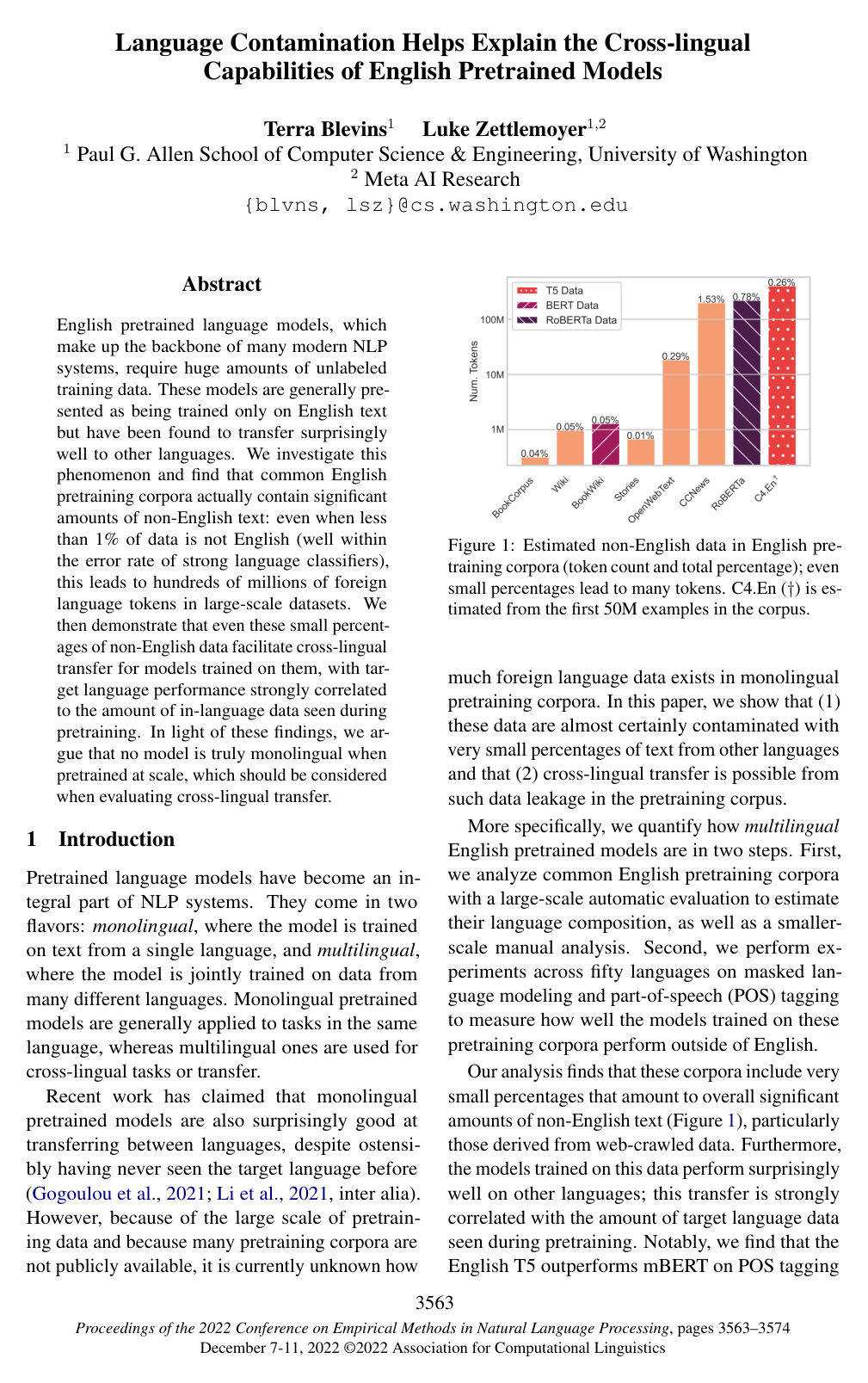
Language Contamination Helps Explains the Cross-lingual Capabilities of English Pretrained Models
Terra Blevins, Luke Zettlemoyer
Why you should read this
Demonstrates that supposedly monolingual English pretraining corpora contain hundreds of millions of foreign-language tokens, revealing that unintentional multilingual contamination largely drives the zero-shot cross-lingual transfer capabilities of English language models.
English pretrained language models, which make up the backbone of many modern NLP systems, require huge amounts of unlabeled training data. These models are generally presented as being trained only on English text but have been found to transfer surprisingly well to other languages. We investigate this phenomenon and find that common English pretraining corpora actually contain significant amounts of non-English text: even when less than 1% of data is not English (well within the error rate of strong language classifiers), this leads to hundreds of millions of foreign language tokens in large-scale datasets. We then demonstrate that even these small percentages of non-English data facilitate cross-lingual transfer for models trained on them, with target language performance strongly correlated to the amount of in-language data seen during pretraining. In light of these findings, we argue that no model is truly monolingual when pretrained at scale, which should be considered when evaluating cross-lingual transfer.
Added
2026-09-26
Expanding Pretrained Models to Thousands More Languages via Lexicon-based Adaptation
Xinyi Wang, Sebastian Ruder, Graham Neubig
Why you should read this
Proposes a data augmentation framework using widely available bilingual lexicons to adapt multilingual pretrained models to under-represented languages with little to no existing text corpora.
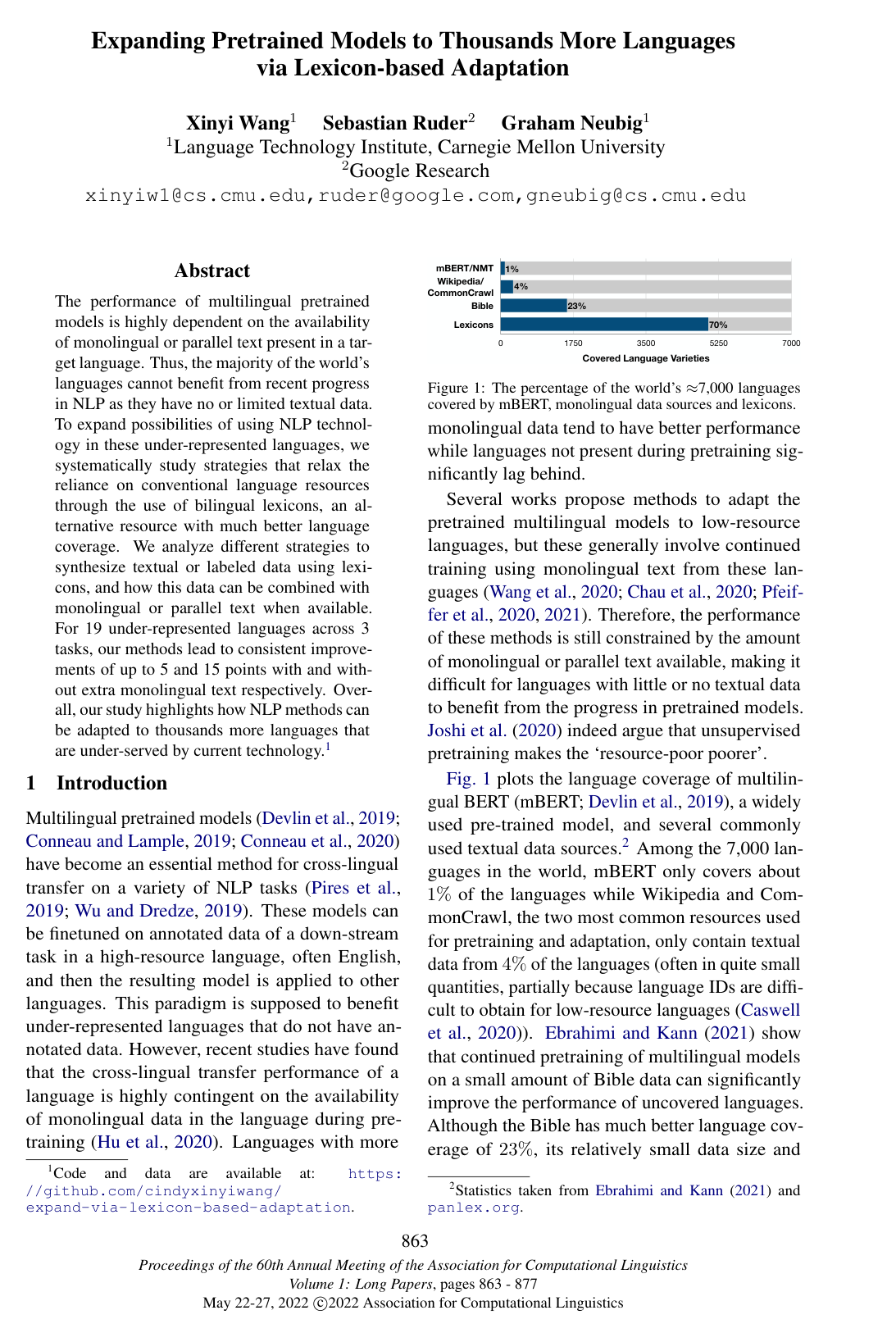
The performance of multilingual pretrained models is highly dependent on the availability of monolingual or parallel text present in a target language. Thus, the majority of the world’s languages cannot benefit from recent progress in NLP as they have no or limited textual data. To expand possibilities of using NLP technology in these under-represented languages, we systematically study strategies that relax the reliance on conventional language resources through the use of bilingual lexicons, an alternative resource with much better language coverage. We analyze different strategies to synthesize textual or labeled data using lexicons, and how this data can be combined with monolingual or parallel text when available. For 19 under-represented languages across 3 tasks, our methods lead to consistent improvements of up to 5 and 15 points with and without extra monolingual text respectively. Overall, our study highlights how NLP methods can be adapted to thousands more languages that are under-served by current technology.1
Added
2026-09-26
Language Ranker: A Metric for Quantifying LLM Performance Across High and Low-Resource Languages
Zihao Li, Yucheng Shi, Zirui Liu, Fan Yang, Ali Payani, Ninghao Liu, Mengnan Du
Why you should read this
Proposes Language Ranker, a metric that quantifies and benchmarks multilingual large language model capabilities across low- and high-resource languages by measuring cosine similarity between internal hidden representations and an English baseline.
The development of Large Language Models (LLMs) relies on extensive text corpora, which are often unevenly distributed across languages. This imbalance results in LLMs performing significantly better on high-resource languages like English, German, and French, while their capabilities in low-resource languages remain inadequate. Currently, there is a lack of quantitative methods to evaluate the performance of LLMs in these low-resource languages. To address this gap, we propose the Language Ranker, an intrinsic metric designed to benchmark and rank languages based on LLM performance using internal representations. By comparing the LLM’s internal representation of various languages against a baseline derived from English, we can assess the model’s multilingual capabilities in a robust and language-agnostic manner. Our analysis reveals that high-resource languages exhibit higher similarity scores with English, demonstrating superior performance, while low-resource languages show lower similarity scores, underscoring the effectiveness of our metric in assessing language-specific capabilities. Besides, the experiments show that there is a strong correlation between the LLM’s performance in different languages and the proportion of those languages in its pre-training corpus. These insights underscore the efficacy of the Language Ranker as a tool for evaluating LLM performance across different languages, particularly those with limited resources.
Added
2026-09-26
Revisiting Machine Translation for Cross-lingual Classification
Mikel Artetxe, Vedanuj Goswami, Shruti Bhosale, Angela Fan, Luke Zettlemoyer
Why you should read this
Demonstrates that modern machine translation combined with domain adaptation allows simple translate-test pipelines to outperform multilingual pretrained models on complex cross-lingual classification benchmarks like XNLI.
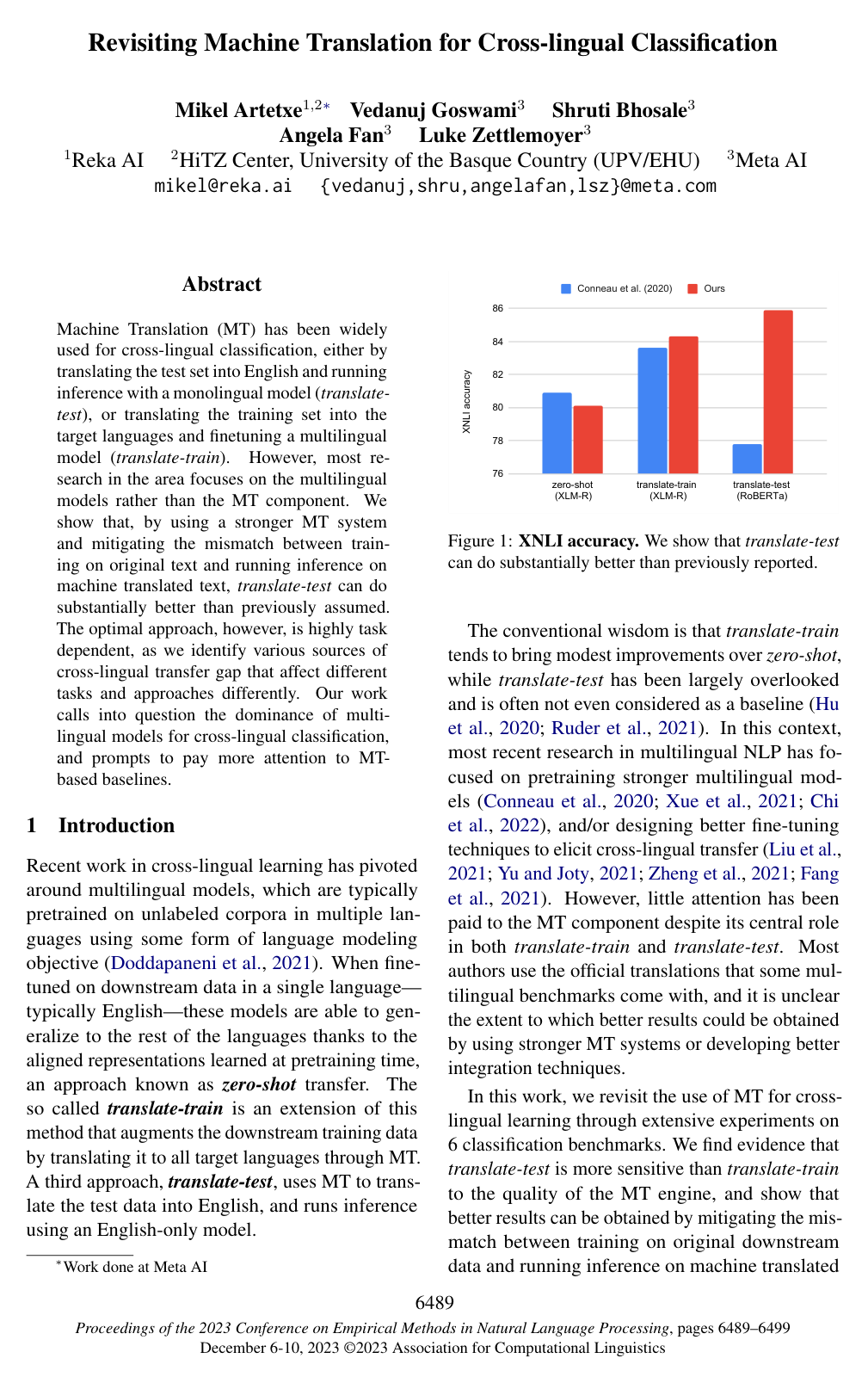
Machine Translation (MT) has been widely used for cross-lingual classification, either by translating the test set into English and running inference with a monolingual model (translate-test), or translating the training set into the target languages and finetuning a multilingual model (translate-train). However, most research in the area focuses on the multilingual models rather than the MT component. We show that, by using a stronger MT system and mitigating the mismatch between training on original text and running inference on machine translated text, translate-test can do substantially better than previously assumed. The optimal approach, however, is highly task dependent, as we identify various sources of cross-lingual transfer gap that affect different tasks and approaches differently. Our work calls into question the dominance of multilingual models for cross-lingual classification, and prompts to pay more attention to MT-based baselines.
Added
2026-09-26
Do Llamas Work in English? On the Latent Language of Multilingual Transformers
Chris Wendler, Veniamin Veselovsky, Giovanni Monea, Robert West
Why you should read this
Reveals through logit lens analysis that multilingual transformer models route non-English inputs through an internal, English-aligned concept space in intermediate layers before decoding them into the target language.
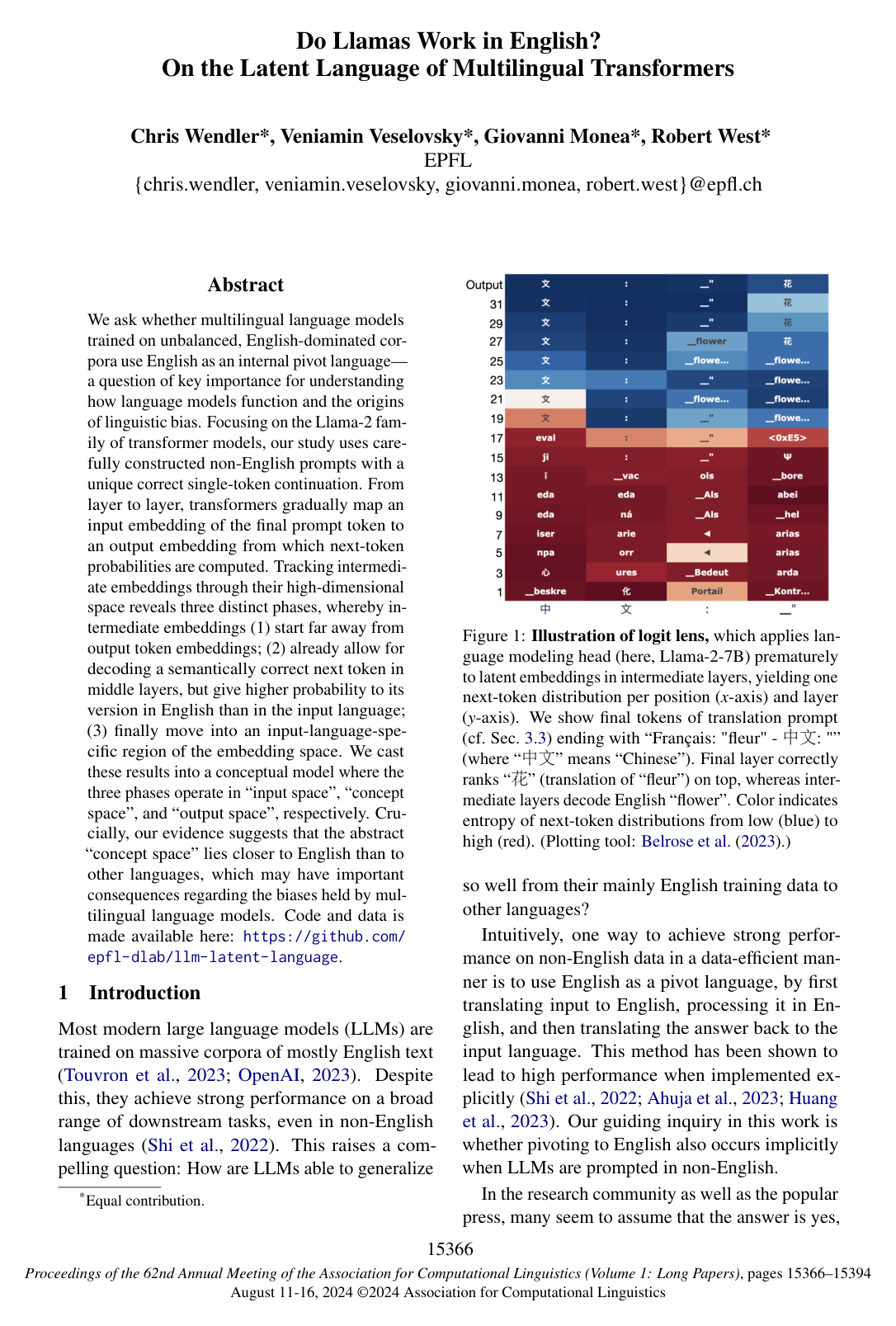
We ask whether multilingual language models trained on unbalanced, English-dominated corpora use English as an internal pivot language—a question of key importance for understanding how language models function and the origins of linguistic bias. Focusing on the Llama-2 family of transformer models, our study uses carefully constructed non-English prompts with a unique correct single-token continuation. From layer to layer, transformers gradually map an input embedding of the final prompt token to an output embedding from which next-token probabilities are computed. Tracking intermediate embeddings through their high-dimensional space reveals three distinct phases, whereby intermediate embeddings (1) start far away from output token embeddings; (2) already allow for decoding a semantically correct next token in middle layers, but give higher probability to its version in English than in the input language; (3) finally move into an input-language-specific region of the embedding space. We cast these results into a conceptual model where the three phases operate in “input space”, “concept space”, and “output space”, respectively. Crucially, our evidence suggests that the abstract “concept space” lies closer to English than to other languages, which may have important consequences regarding the biases held by multilingual language models. Code and data is made available here: https://github.com/epfl-dlab/llm-latent-language.
Added
2026-09-26
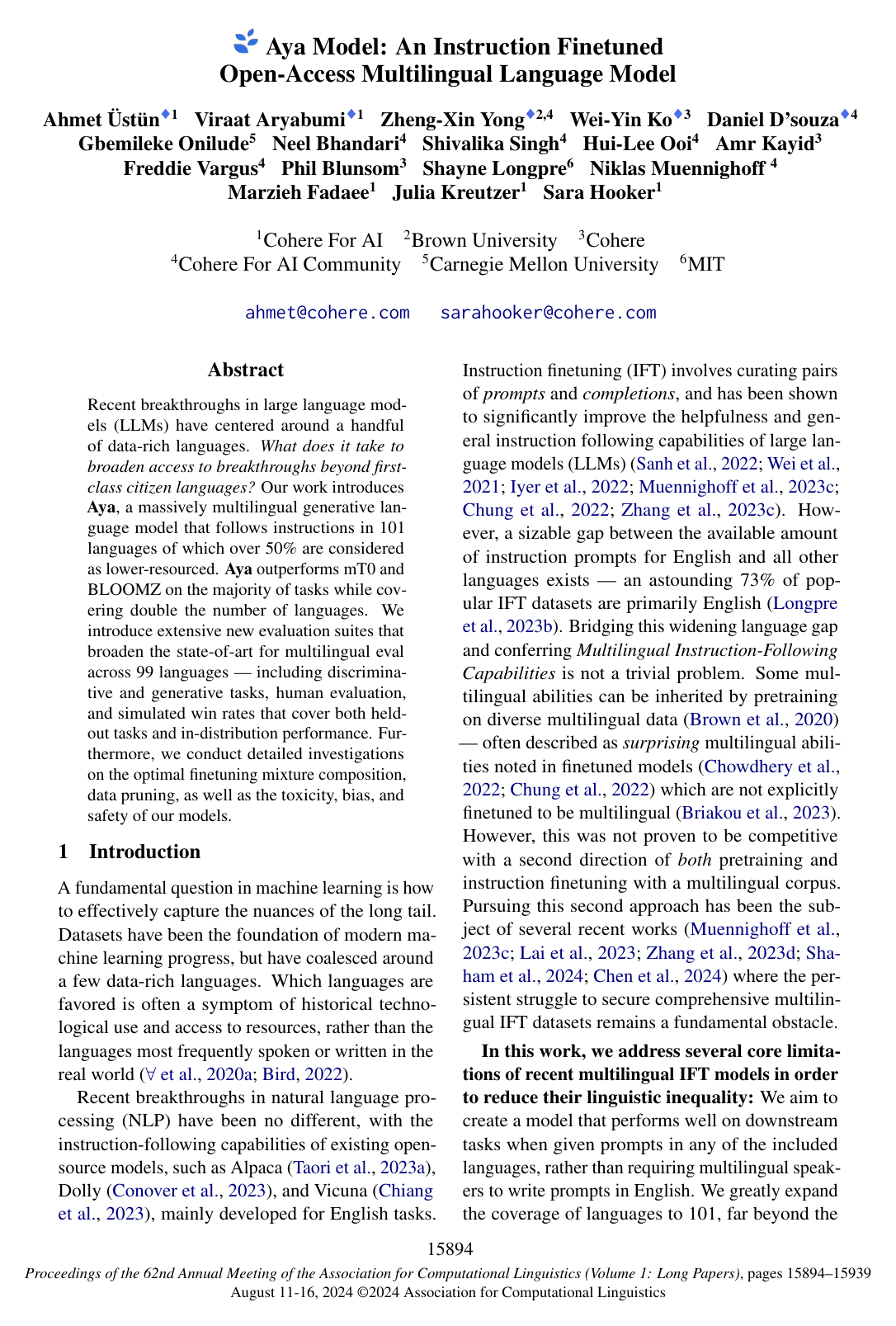
Aya Model: An Instruction Finetuned Open-Access Multilingual Language Model
Ahmet Üstün, Viraat Aryabumi, Zheng Xin Yong, Wei-Yin Ko, Daniel D'souza, Gbemileke Onilude, Neel Bhandari, Shivalika Singh, Hui-Lee Ooi, Amr Kayid, Freddie Vargus, Phil Blunsom, Shayne Longpre, Niklas Muennighoff, Marzieh Fadaee, Julia Kreutzer, Sara Hooker
Why you should read this
Presents Aya, an open-access instruction-finetuned language model spanning 101 languages—over half of which are lower-resourced—that consistently outperforms mT0 and BLOOMZ across both discriminative and generative benchmarks.
Recent breakthroughs in large language models (LLMs) have centered around a handful of data-rich languages. What does it take to broaden access to breakthroughs beyond first-class citizen languages? Our work introduces Aya, a massively multilingual generative language model that follows instructions in 101 languages of which over 50% are considered lower-resourced. Aya outperforms mT0 and BLOOMZ on the majority of tasks while covering double the number of languages. We introduce extensive new evaluation suites that broaden the state-of-art for multilingual eval across 99 languages — including discriminative and generative tasks, human evaluation, and simulated win rates that cover both held-out tasks and in-distribution performance. Furthermore, we conduct detailed investigations on the optimal finetuning mixture composition, data pruning, as well as the toxicity, bias, and safety of our models.
Added
2026-09-26
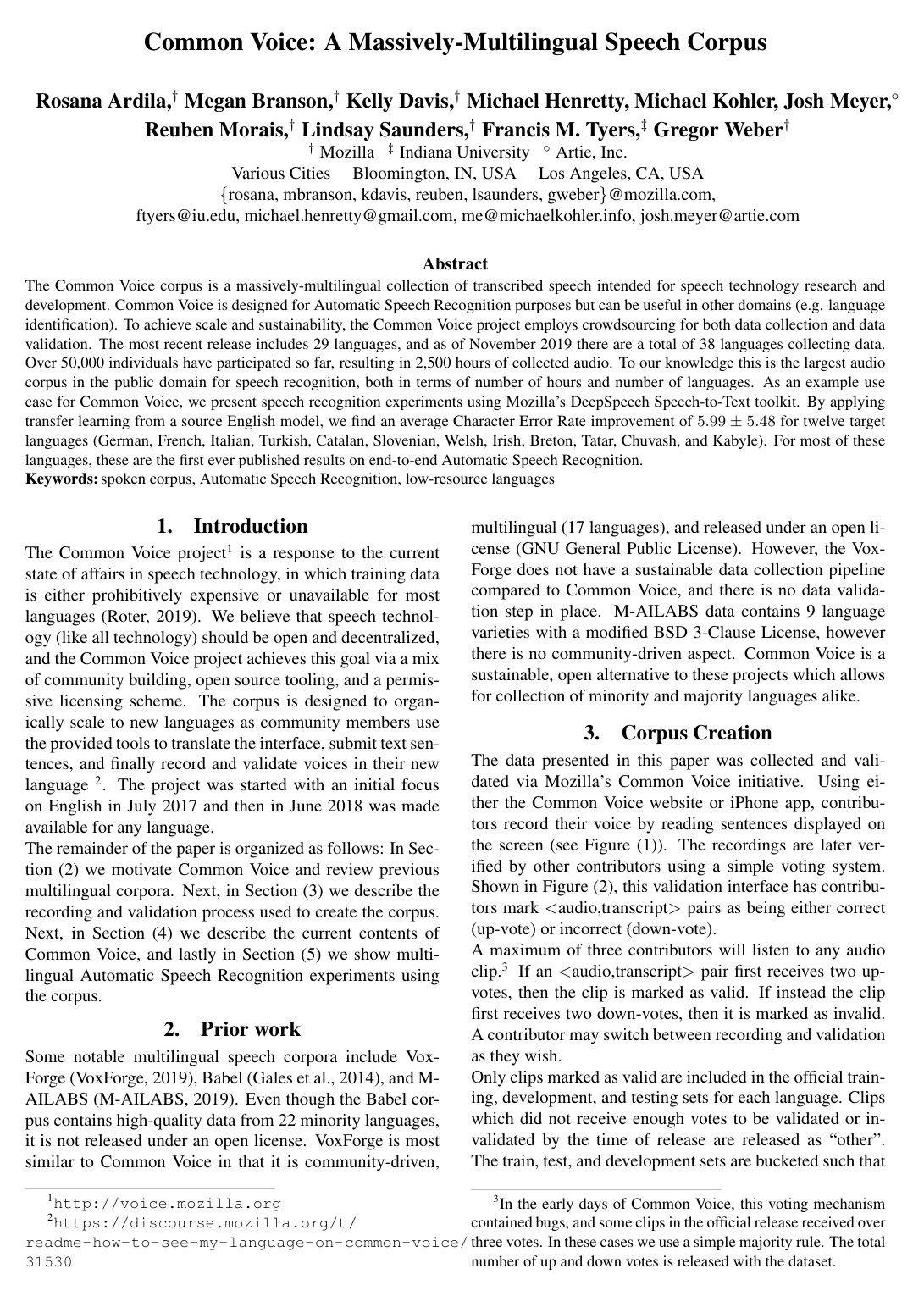
Common Voice: A Massively-Multilingual Speech Corpus
Rosana Ardila, Megan Branson, Kelly Davis, Michael Henretty, Michael Kohler, Josh Meyer, Reuben Morais, Lindsay Saunders, Francis M. Tyers, Gregor Weber
Why you should read this
Introduces Common Voice, a massively multilingual and publicly accessible speech corpus of over 2,500 hours across dozens of languages, and establishes baseline transfer-learning results that yield the first published end-to-end speech recognition benchmarks for several under-resourced languages.
The Common Voice corpus is a massively-multilingual collection of transcribed speech intended for speech technology research and development. Common Voice is designed for Automatic Speech Recognition purposes but can be useful in other domains (e.g. language identification). To achieve scale and sustainability, the Common Voice project employs crowdsourcing for both data collection and data validation. The most recent release includes 29 languages, and as of November 2019 there are a total of 38 languages collecting data. Over 50,000 individuals have participated so far, resulting in 2,500 hours of collected audio. To our knowledge this is the largest audio corpus in the public domain for speech recognition, both in terms of number of hours and number of languages. As an example use case for Common Voice, we present speech recognition experiments using Mozilla's DeepSpeech Speech-to-Text toolkit. By applying transfer learning from a source English model, we find an average Character Error Rate improvement of 5.99 +/- 5.48 for twelve target languages (German, French, Italian, Turkish, Catalan, Slovenian, Welsh, Irish, Breton, Tatar, Chuvash, and Kabyle). For most of these languages, these are the first ever published results on end-to-end Automatic Speech Recognition.
Added
2026-09-14
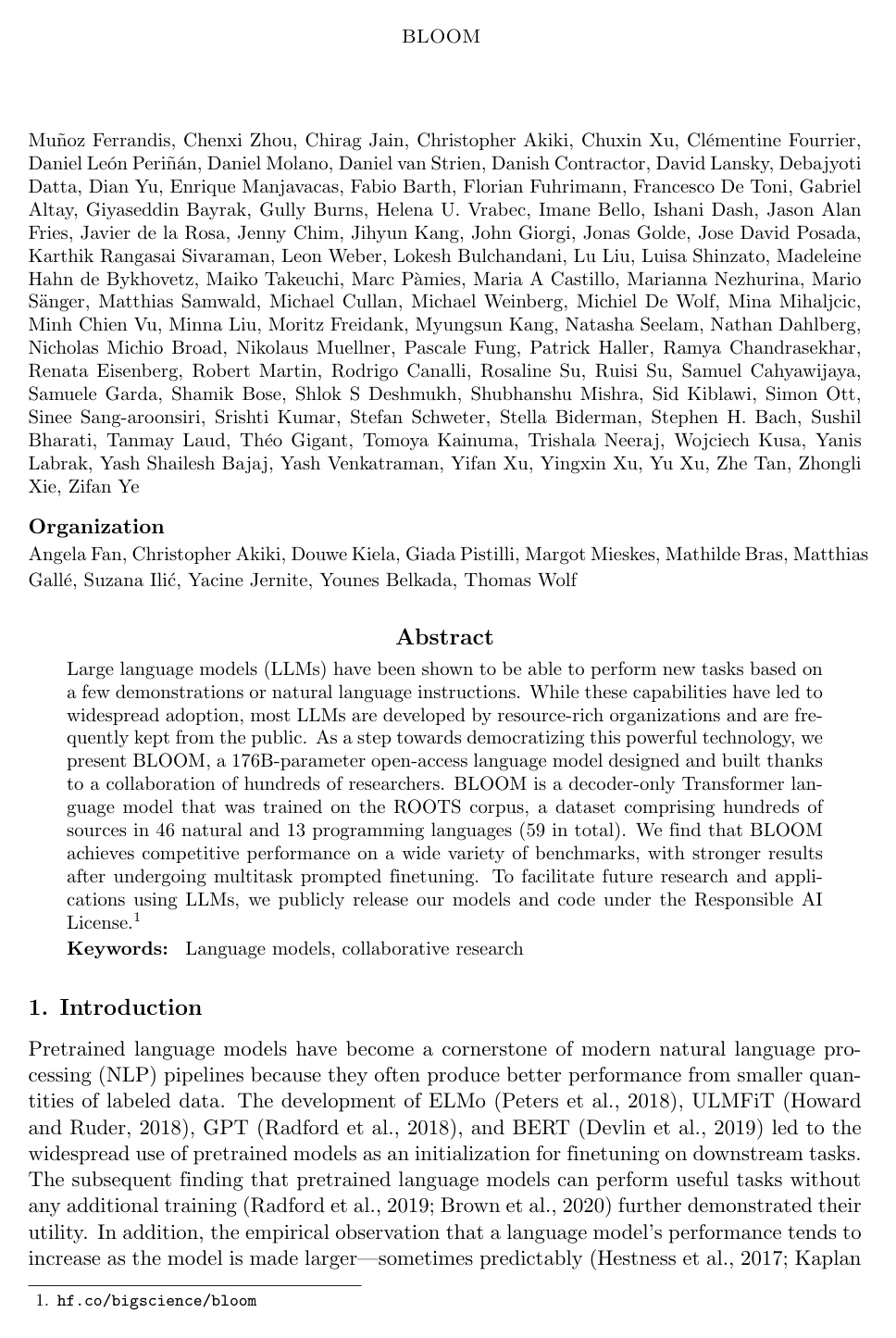
BLOOM: A 176B-Parameter Open-Access Multilingual Language Model
BigScience Workshop
Why you should read this
Presents BLOOM, an open-access 176-billion-parameter multilingual language model trained across 46 natural and 13 programming languages to provide the broader scientific community with a fully available alternative to proprietary large language models.
Large language models (LLMs) have been shown to be able to perform new tasks based on a few demonstrations or natural language instructions. While these capabilities have led to widespread adoption, most LLMs are developed by resource-rich organizations and are frequently kept from the public. As a step towards democratizing this powerful technology, we present BLOOM, a 176B-parameter open-access language model designed and built thanks to a collaboration of hundreds of researchers. BLOOM is a decoder-only Transformer language model that was trained on the ROOTS corpus, a dataset comprising hundreds of sources in 46 natural and 13 programming languages (59 in total). We find that BLOOM achieves competitive performance on a wide variety of benchmarks, with stronger results after undergoing multitask prompted finetuning. To facilitate future research and applications using LLMs, we publicly release our models and code under the Responsible AI License.
Added
2026-09-13
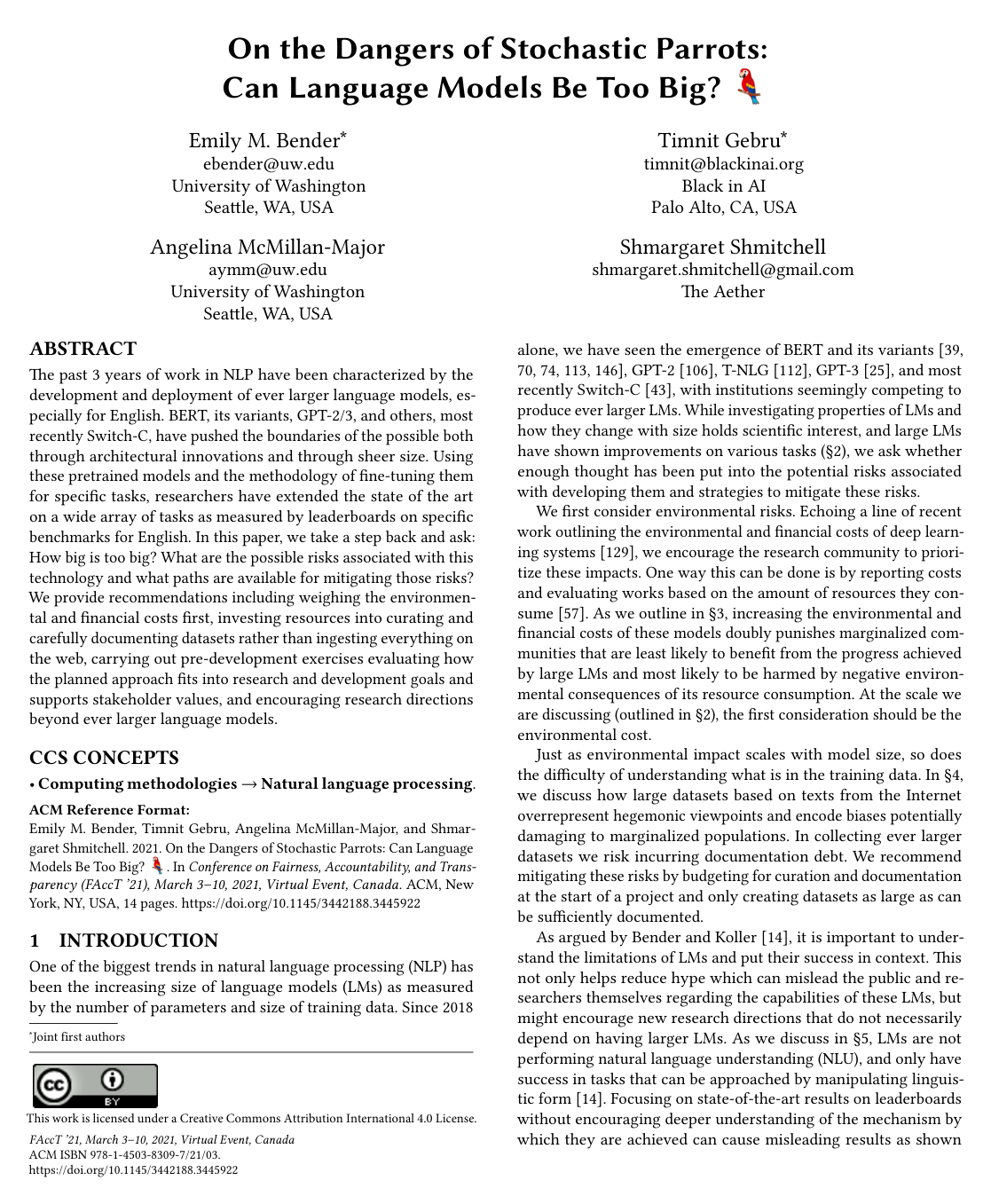
On the Dangers of Stochastic Parrots: Can Language Models Be Too Big? 🦜
Emily M. Bender, Timnit Gebru, Angelina McMillan-Major, Shmargaret Shmitchell
Why you should read this
Articulates the seminal critique regarding the compounding environmental costs, encoded representation biases, and severe hallucination risks inherent in scaling immense language models.
The past 3 years of work in NLP have been characterized by the development and deployment of ever larger language models, especially for English. BERT, its variants, GPT-2/3, and others, most recently Switch-C, have pushed the boundaries of the possible both through architectural innovations and through sheer size. Using these pretrained models and the methodology of fine-tuning them for specific tasks, researchers have extended the state of the art on a wide array of tasks as measured by leaderboards on specific benchmarks for English. In this paper, we take a step back and ask: How big is too big? What are the possible risks associated with this technology and what paths are available for mitigating those risks? We provide recommendations including weighing the environmental and financial costs first, investing resources into curating and carefully documenting datasets rather than ingesting everything on the web, carrying out pre-development exercises evaluating how the planned approach fits into research and development goals and supports stakeholder values, and encouraging research directions beyond ever larger language models.
Added
2026-06-02