
keyword
low-rank adaptation
Low-rank adaptation is a parameter-efficient fine-tuning technique in machine learning that customizes large pretrained neural networks for specific tasks while keeping the original model weights frozen. Instead of updating all parameters across the network, it introduces small, trainable pairs of low-rank decomposition matrices alongside targeted weight layers, such as those within transformer architectures. The product of these low-rank matrices approximates the necessary parameter updates, substantially reducing memory consumption, computational overhead, and storage requirements during training. Because the learned adapter matrices can be merged directly back into the base weights after training, this method allows models to achieve performance comparable to full fine-tuning without adding computational latency during inference.
28 items
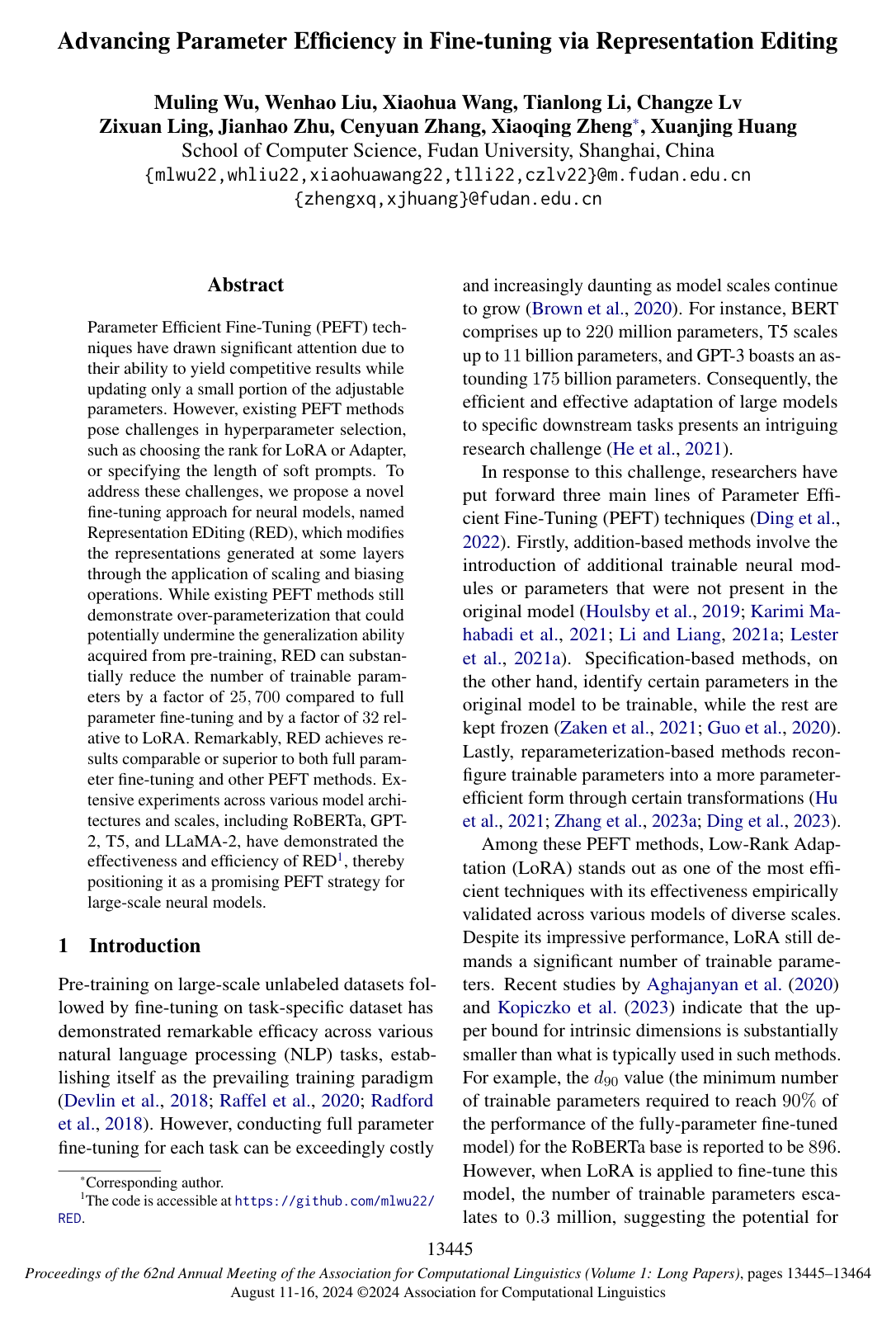
Advancing Parameter Efficiency in Fine-tuning via Representation Editing
Muling Wu, Wenhao Liu, Xiaohua Wang, Tianlong Li, Changze Lv, Zixuan Ling, Jianhao Zhu, Cenyuan Zhang, Xiaoqing Zheng, Xuanjing Huang
Why you should read this
Proposes a parameter-efficient fine-tuning method that scales and biases intermediate representations to match full fine-tuning performance across diverse language models while requiring 32 times fewer trainable parameters than LoRA and eliminating complex hyperparameter tuning.
Parameter Efficient Fine-Tuning (PEFT) techniques have drawn significant attention due to their ability to yield competitive results while updating only a small portion of the adjustable parameters. However, existing PEFT methods pose challenges in hyperparameter selection, such as choosing the rank for LoRA or Adapter, or specifying the length of soft prompts. To address these challenges, we propose a novel fine-tuning approach for neural models, named Representation EDiting (RED), which modifies the representations generated at some layers through the application of scaling and biasing operations. While existing PEFT methods still demonstrate over-parameterization that could potentially undermine the generalization ability acquired from pre-training, RED can substantially reduce the number of trainable parameters by a factor of 25,700 compared to full parameter fine-tuning and by a factor of 32 relative to LoRA. Remarkably, RED achieves results comparable or superior to both full parameter fine-tuning and other PEFT methods. Extensive experiments across various model architectures and scales, including RoBERTa, GPT-2, T5, and LLaMA-2, have demonstrated the effectiveness and efficiency of RED¹, thereby positioning it as a promising PEFT strategy for large-scale neural models.
Added
2026-10-05
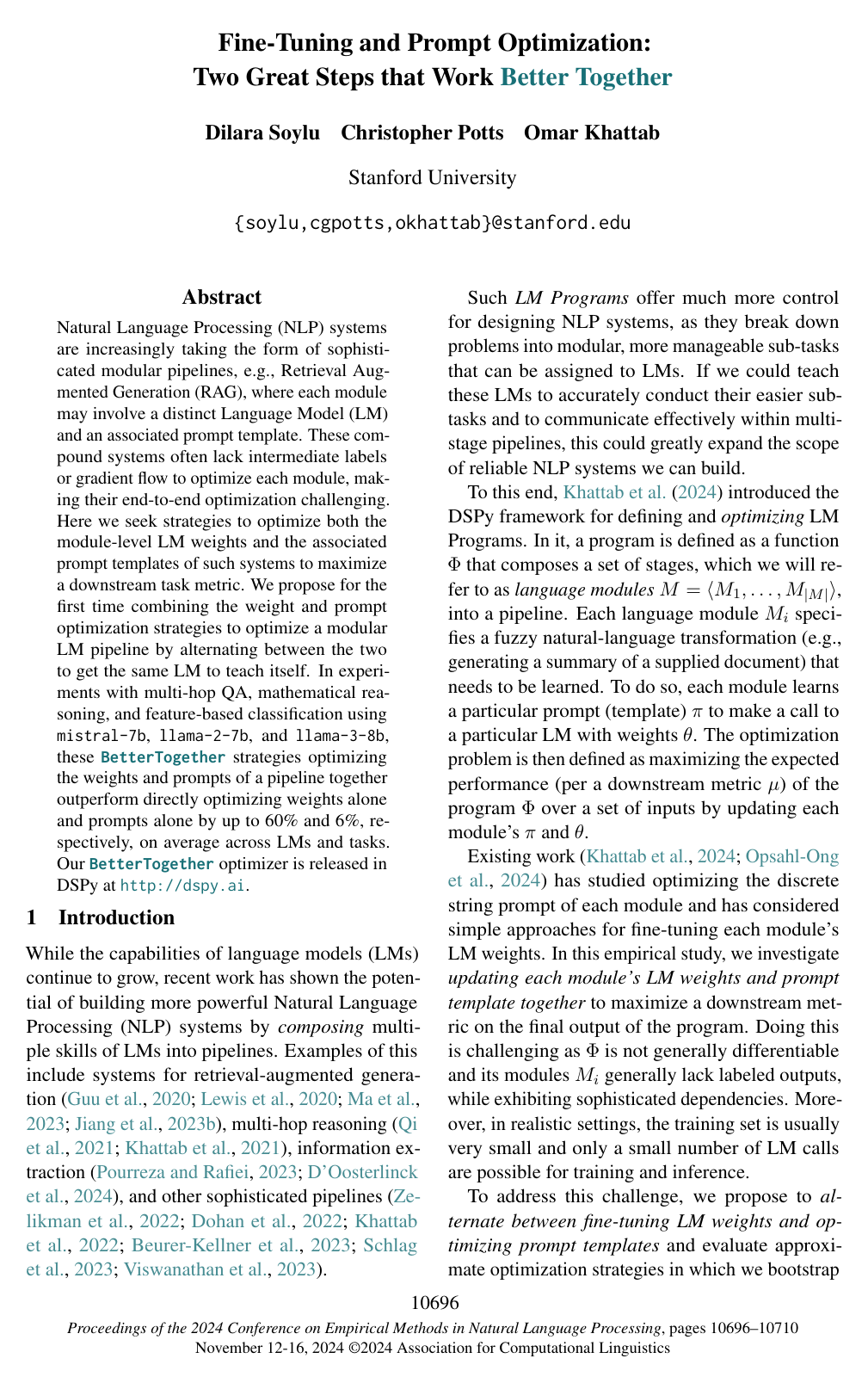
Fine-Tuning and Prompt Optimization: Two Great Steps that Work Better Together
Dilara Soylu, Christopher Potts, Omar Khattab
Why you should read this
Demonstrates that alternating between prompt optimization and model weight fine-tuning enables modular language model pipelines to teach themselves, substantially outperforming either approach used alone across complex reasoning and retrieval tasks.
Natural Language Processing (NLP) systems are increasingly taking the form of sophisticated modular pipelines, e.g., Retrieval Augmented Generation (RAG), where each module may involve a distinct Language Model (LM) and an associated prompt template. These compound systems often lack intermediate labels or gradient flow to optimize each module, making their end-to-end optimization challenging. Here we seek strategies to optimize both the module-level LM weights and the associated prompt templates of such systems to maximize a downstream task metric. We propose for the first time combining the weight and prompt optimization strategies to optimize a modular LM pipeline by alternating between the two to get the same LM to teach itself. In experiments with multi-hop QA, mathematical reasoning, and feature-based classification using mistral-7b, llama-2-7b, and llama-3-8b, these BetterTogether strategies optimizing the weights and prompts of a pipeline together outperform directly optimizing weights alone and prompts alone by up to 60% and 6%, respectively, on average across LMs and tasks. Our BetterTogether optimizer is released in DSPy at http://dspy.ai.
Added
2026-10-05
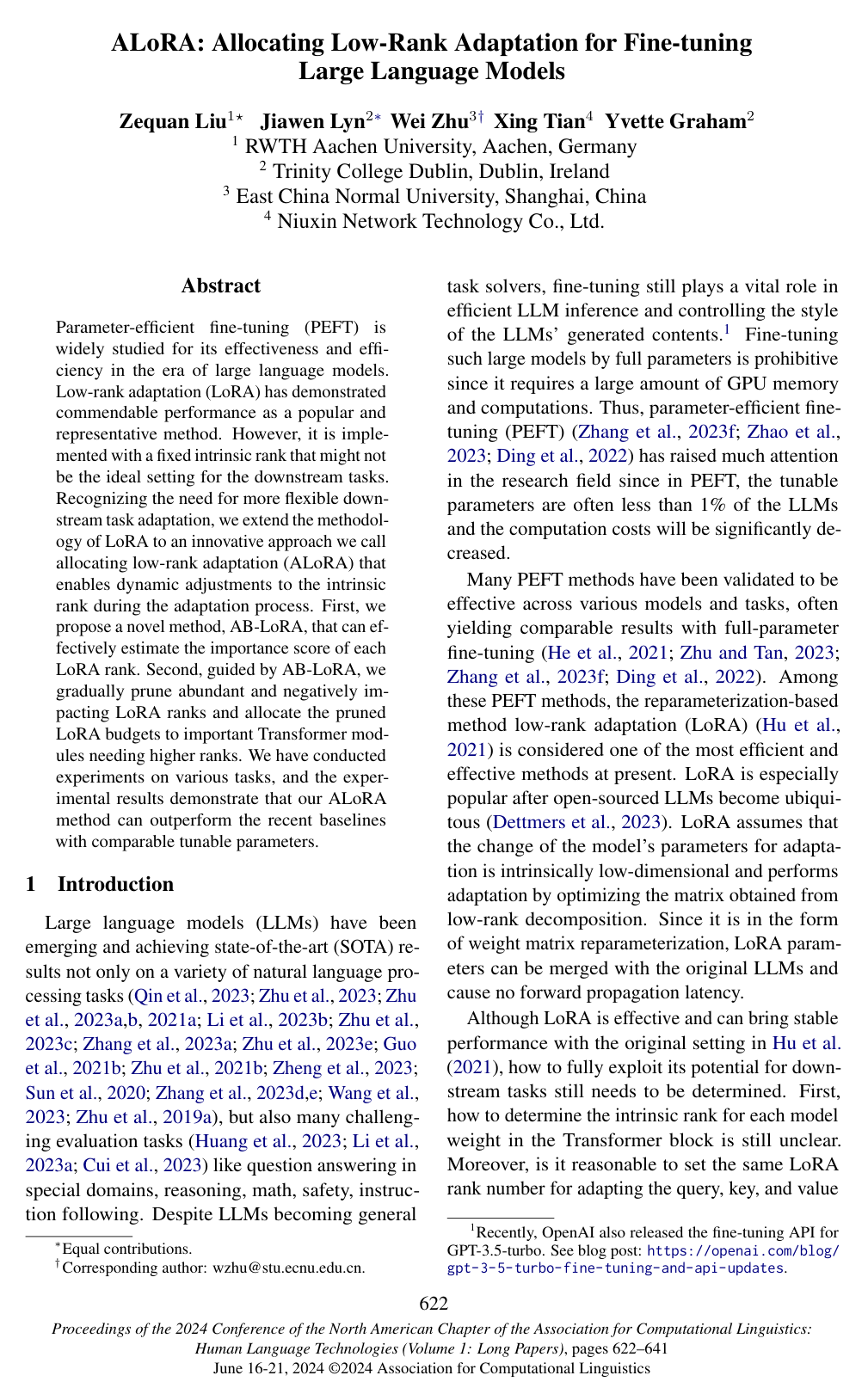
ALoRA: Allocating Low-Rank Adaptation for Fine-tuning Large Language Models
Zequan Liu, Jiawen Lyn, Wei Zhu, Xing Tian, Yvette Graham
Why you should read this
Proposes ALoRA, a dynamic fine-tuning framework that measures individual rank importance to prune ineffective parameters and reallocate capacity to critical Transformer layers, consistently outperforming standard low-rank adaptation methods under equal parameter budgets.
Parameter-efficient fine-tuning (PEFT) is widely studied for its effectiveness and efficiency in the era of large language models. Low-rank adaptation (LoRA) has demonstrated commendable performance as a popular and representative method. However, it is implemented with a fixed intrinsic rank that might not be the ideal setting for the downstream tasks. Recognizing the need for more flexible downstream task adaptation, we extend the methodology of LoRA to an innovative approach we call allocating low-rank adaptation (ALoRA) that enables dynamic adjustments to the intrinsic rank during the adaptation process. First, we propose a novel method, AB-LoRA, that can effectively estimate the importance score of each LoRA rank. Second, guided by AB-LoRA, we gradually prune abundant and negatively impacting LoRA ranks and allocate the pruned LoRA budgets to important Transformer modules needing higher ranks. We have conducted experiments on various tasks, and the experimental results demonstrate that our ALoRA method can outperform the recent baselines with comparable tunable parameters.
Added
2026-10-04
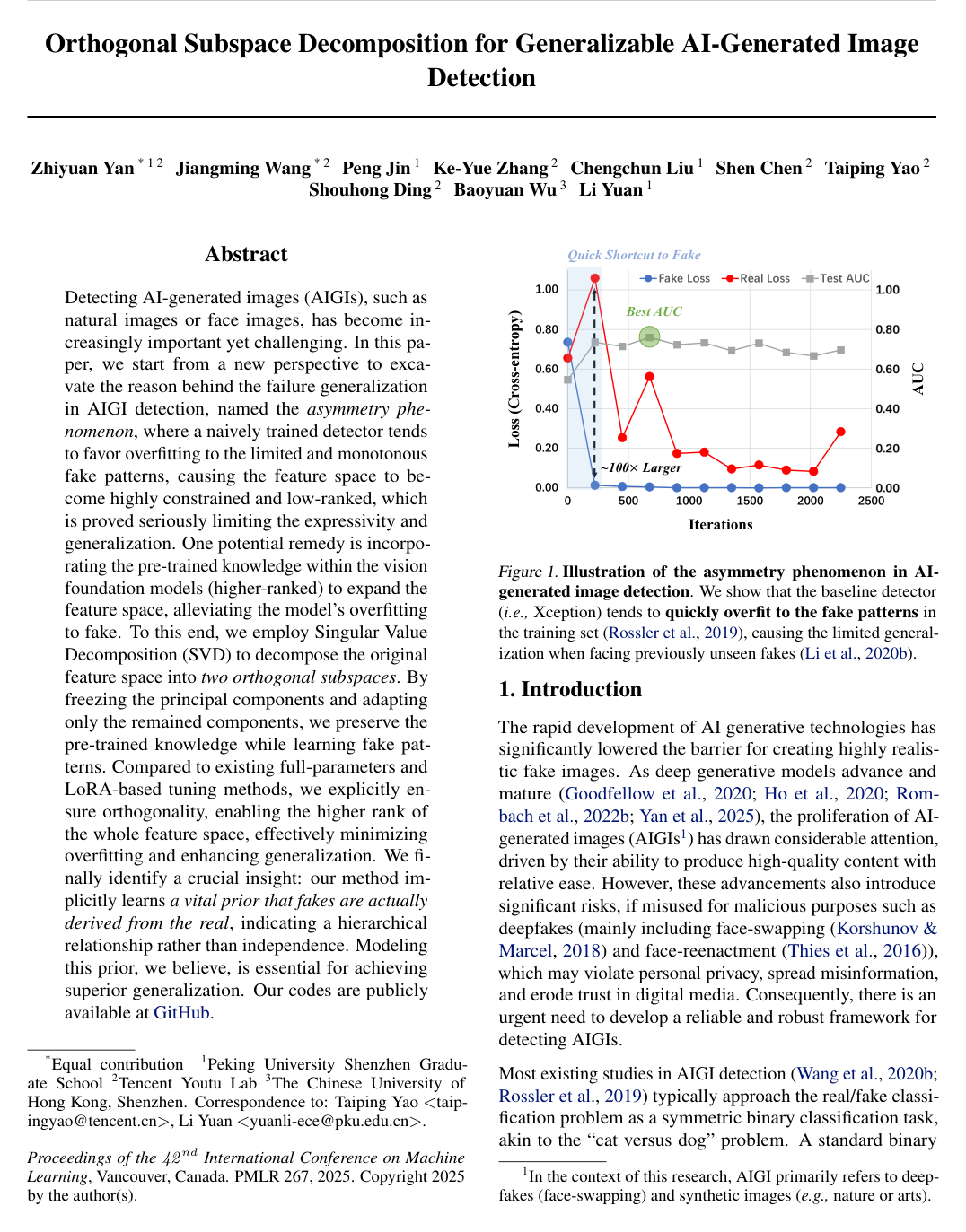
Orthogonal Subspace Decomposition for Generalizable AI-Generated Image Detection
Zhiyuan Yan, Jiangming Wang, Peng Jin, Ke-Yue Zhang, Chengchun Liu, Shen Chen, Taiping Yao, Shouhong Ding, Baoyuan Wu, Li Yuan
Why you should read this
Proposes an orthogonal subspace decomposition method via Singular Value Decomposition that preserves rich pre-trained representations in foundation models while adapting remaining components to prevent detectors from overfitting to seen fake patterns.
Detecting AI-generated images (AIGIs), such as natural images or face images, has become increasingly important yet challenging. In this paper, we start from a new perspective to excavate the reason behind the failure generalization in AIGI detection, named the asymmetry phenomenon, where a naively trained detector tends to favor overfitting to the limited and monotonous fake patterns, causing the feature space to become highly constrained and low-ranked, which is proved seriously limiting the expressivity and generalization. One potential remedy is incorporating the pre-trained knowledge within the vision foundation models (higher-ranked) to expand the feature space, alleviating the model’s overfitting to fake. To this end, we employ Singular Value Decomposition (SVD) to decompose the original feature space into two orthogonal subspaces. By freezing the principal components and adapting only the remained components, we preserve the pre-trained knowledge while learning fake patterns. Compared to existing full-parameters and LoRA-based tuning methods, we explicitly ensure orthogonality, enabling the higher rank of the whole feature space, effectively minimizing overfitting and enhancing generalization. We finally identify a crucial insight: our method implicitly learns a vital prior that fakes are actually derived from the real, indicating a hierarchical relationship rather than independence. Modeling this prior, we believe, is essential for achieving superior generalization. Our codes are publicly available at GitHub.
Added
2026-10-03
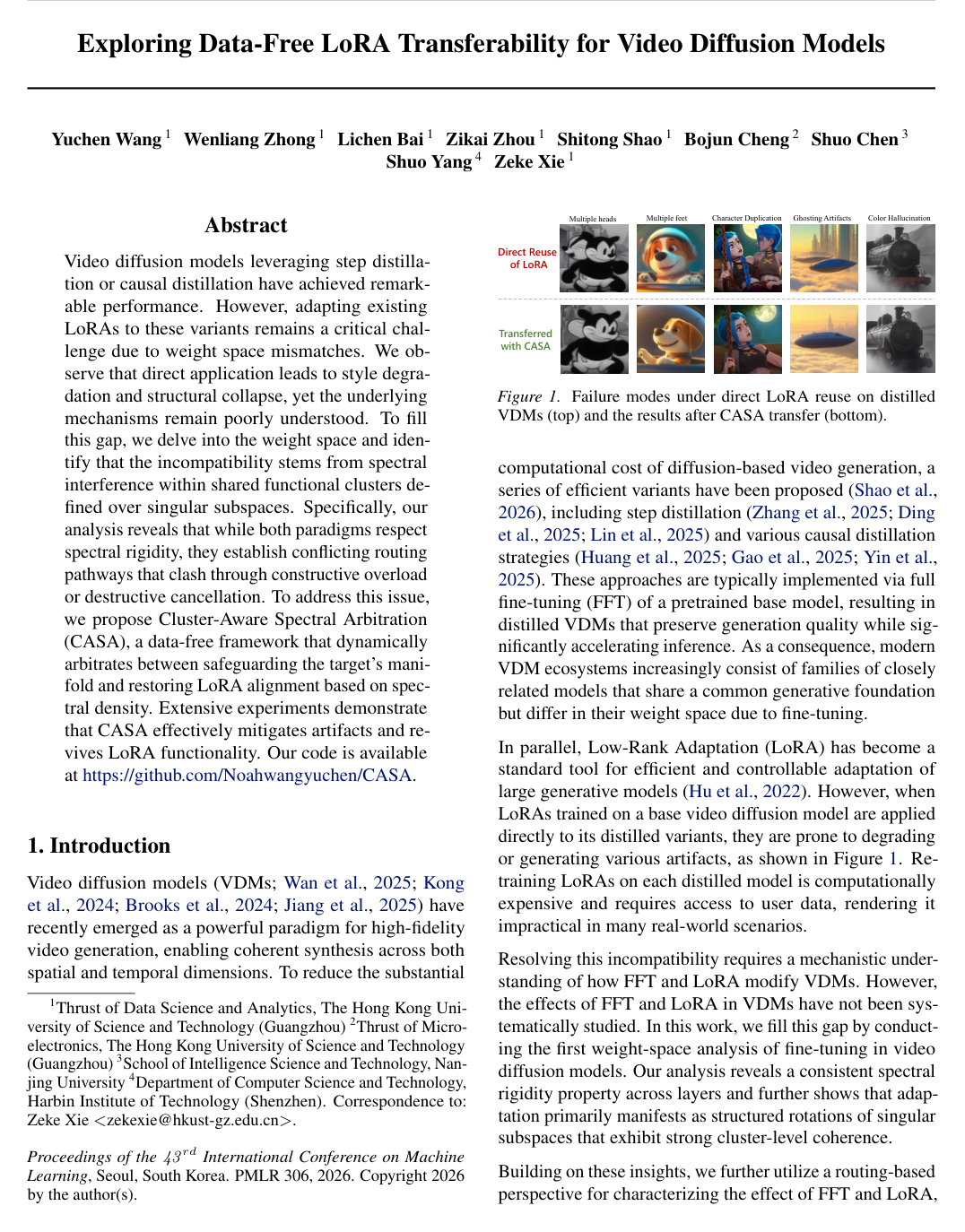
Exploring Data-Free LoRA Transferability for Video Diffusion Models
Yuchen Wang, Wenliang Zhong, Lichen Bai, Zikai Zhou, Shitong Shao, Bo-Xun Cheng, Shuo Chen, Shuo Yang, Zeke Xie
Why you should read this
Proposes Cluster-Aware Spectral Arbitration (CASA), a data-free framework that resolves weight-space spectral interference to enable the direct reuse of pretrained LoRAs across distilled video diffusion models without retraining.
Video diffusion models leveraging step distillation or causal distillation have achieved remarkable performance. However, adapting existing LoRAs to these variants remains a critical challenge due to weight space mismatches. We observe that direct application leads to style degradation and structural collapse, yet the underlying mechanisms remain poorly understood. To fill this gap, we delve into the weight space and identify that the incompatibility stems from spectral interference within shared functional clusters defined over singular subspaces. Specifically, our analysis reveals that while both paradigms respect spectral rigidity, they establish conflicting routing pathways that clash through constructive overload or destructive cancellation. To address this issue, we propose Cluster-Aware Spectral Arbitration (CASA), a data-free framework that dynamically arbitrates between safeguarding the target's manifold and restoring LoRA alignment based on spectral density. Extensive experiments demonstrate that CASA effectively mitigates artifacts and revives LoRA functionality. Our code is available at this https URL
Added
2026-09-30

Reward Models Inherit Value Biases from Pretraining
Brian Christian, Jessica A.F. Thompson, Elle, Vincent Adam, Hannah Rose Kirk, Christopher Summerfield, Tsvetomira Dumbalska
Why you should read this
Demonstrates that reward models inherit persistent value biases directly from their pretrained base language models, causing architectures like Llama and Gemma to diverge systematically across psychological dimensions regardless of identical preference training.
Reward models (RMs) are central to aligning large language models (LLMs) with human values but have received less attention than pretrained and post-trained LLMs themselves. Because RMs are initialized from LLMs, they inherit representations that shape their behavior, but the nature and extent of this influence remain understudied. In a comprehensive study of 10 leading open-weight RMs using validated psycholinguistic corpora, we show that RMs exhibit significant differences along multiple dimensions of human value as a function of their base model. Using the "Big Two" psychological axes, we show a robust preference of Llama RMs for "agency" and a corresponding robust preference of Gemma RMs for "communion." This phenomenon holds even when the preference data and finetuning process are identical, and we trace it back to the logits of the respective instruction-tuned and pretrained models. These log-probability differences themselves can be formulated as an implicit RM; we derive usable implicit reward scores and show that they exhibit the very same agency/communion difference. We run experiments training RMs with ablations for preference data source and quantity, which demonstrate that this effect is not only repeatable but surprisingly durable. Despite RMs being designed to represent human preferences, our evidence shows that their outputs are influenced by the pretrained LLMs on which they are based. This work underscores the importance of safety and alignment efforts at the pretraining stage, and makes clear that open-source developers' choice of base model is as much a consideration of values as of performance.
Added
2026-09-29
What to Ignore, What to React: Visually Robust RL Fine-Tuning of VLA Models
Yu Peng, Jingjing Fu, Chuheng Zhang, Li Zhao, Jiang Bian, Mingyu Liu, Ling Zhang, Jun Zhang, Rui Wang
Why you should read this
Proposes PAIR-VLA, a reinforcement learning framework that optimizes vision-language-action models through paired invariance and sensitivity objectives, enabling robotic policies to ignore visual distractors while reacting appropriately to task-critical scene changes under out-of-distribution shifts.
Reinforcement learning (RL) fine-tuning has shown promise for Vision-Language-Action (VLA) models in robotic manipulation, but deployment-time visual shifts pose practical challenges. A key difficulty is that standard task rewards supervise task success, but offer limited guidance on whether a visual change is task-irrelevant or changes the behavior required for manipulation. We propose PAIR-VLA (Paired Action Invariance & Sensitivity for Visually Robust VLA), an RL fine-tuning framework to address this difficulty by adding two auxiliary objectives over paired visual variants during PPO optimization: an invariance term that reduces the discrepancy between action distributions for a task-preserving pair (e.g., different distractors), and a sensitivity objective that encourages separable action distributions for a task-altering pair (e.g., target object in a different pose). Together, these objectives turn visual variants from mere observation diversity into behavior-level guidance on policy responses during RL fine-tuning. We evaluate on ManiSkill3 across two representative VLA architectures, OpenVLA and , under diverse out-of-distribution visual shifts including unseen distractors, texture changes, target object pose variation, viewpoint shifts, and lighting changes. Our method consistently improves over standard PPO, achieving average improvements of 16.62% on and 9.10% on OpenVLA. Notably, ablations further show generalization across visual shifts: invariance guidance learned from distractor and texture variants transfers to target-pose and lighting shifts, while adding sensitivity guidance on target-pose variants further improves robustness to nuisance shifts, highlighting the broader transferability of behavior-level RL guidance.
Added
2026-09-29
In-context Vectors: Making In Context Learning More Effective and Controllable Through Latent Space Steering
Sheng Liu, Haotian Ye, Lei Xing, James Y. Zou
Why you should read this
Proposes replacing prompt demonstrations with in-context vectors that steer language model latent states directly, significantly cutting context length while enabling precise behavioral control and multi-task composition through vector arithmetic.
Large language models (LLMs) demonstrate emergent in-context learning capabilities, where they adapt to new tasks based on example demonstrations. However, in-context learning has seen limited effectiveness in many settings, is difficult to quantitatively control and takes up context window space. To overcome these limitations, we propose an alternative approach that recasts in-context learning as in-context vectors (ICV). Using ICV has two steps. We first use a forward pass on demonstration examples to create the in-context vector from the latent embedding of the LLM. This vector captures essential information about the intended task. On a new query, instead of adding demonstrations to the prompt, we shift the latent states of the LLM using the ICV. The ICV approach has several benefits: 1) it enables the LLM to more effectively follow the demonstration examples; 2) it's easy to control by adjusting the magnitude of the ICV; 3) it reduces the length of the prompt by removing the in-context demonstrations; 4) ICV is computationally much more efficient than fine-tuning. We demonstrate that ICV achieves better performance compared to standard in-context learning and fine-tuning on diverse tasks including safety, style transfer, role-playing and formatting. Moreover, we show that we can flexibly teach LLM to simultaneously follow different types of instructions by simple vector arithmetics on the corresponding ICVs.
Added
2026-09-28
Mitigating the Alignment Tax of RLHF
Yong Lin, Hangyu Lin, Wei Xiong, Shizhe Diao, Jianmeng Liu, Jipeng Zhang, Rui Pan, Haoxiang Wang, Wenbin Hu, Hanning Zhang, Hanze Dong, Renjie Pi, Han Zhao, Nan Jiang, Heng Ji, Yuan Yao, Tong Zhang
Why you should read this
Proposes Heterogeneous Model Averaging, a layer-adaptive weight interpolation technique between pre- and post-RLHF models that optimizes alignment rewards while preserving general NLP capabilities across diverse model scales.
LLMs acquire a wide range of abilities during pre-training, but aligning LLMs under Reinforcement Learning with Human Feedback (RLHF) can lead to forgetting pretrained abilities, which is also known as the alignment tax. To investigate alignment tax, we conducted experiments with existing RLHF algorithms using OpenLLaMA-3B, which revealed a pronounced alignment tax in NLP tasks. Whereas, despite various techniques to mitigate forgetting, they are often at odds with the RLHF performance, leading to a trade-off between alignment performance and forgetting mitigation, leading to an alignment-forgetting trade-off. In this paper we show that model averaging, which simply interpolates between pre and post RLHF model weights, surprisingly achieves the most strongest alignment-forgetting Pareto front among a wide range of competing methods. To understand its effectiveness, we offer theoretical insights into model averaging, revealing that it enhances performance Pareto front by increasing feature diversity on the layers where tasks share overlapped feature spaces. Empirical evidence corroborates our analysis by showing the benefits of averaging low-level transformer layers. Building on the analysis and the observation that averaging different layers of the transformer leads to significantly different alignment-forgetting trade-offs, we propose Heterogeneous Model Averaging (HMA) to Heterogeneously find various combination ratios of model layers. HMA seeks to maximize the alignment performance while incurring minimal alignment tax. Moreover, we validate HMA’s performance across a range of RLHF algorithms over OpenLLaMA-3B and further extend our findings to Mistral-7B which is evaluated by open-sourced preference model and GPT4. Code available here¹.
Added
2026-09-26
RoSA: Accurate Parameter-Efficient Fine-Tuning via Robust Adaptation
Mahdi Nikdan, Soroush Tabesh, Elvir Crncevic, Dan Alistarh
Why you should read this
Proposes RoSA, a parameter-efficient fine-tuning method combining parallel low-rank and sparse adapters with custom GPU kernels to match full fine-tuning performance on challenging language tasks under tight parameter and memory constraints.
We investigate parameter-efficient fine-tuning (PEFT) methods that can provide good accuracy under limited computational and memory budgets in the context of large language models (LLMs). We present a new PEFT method called Robust Adaptation (RoSA) inspired by robust principal component analysis that jointly trains low-rank and highly-sparse components on top of a set of fixed pretrained weights to efficiently approximate the performance of a full-fine-tuning (FFT) solution. Across a series of challenging generative tasks such as grade-school math and SQL query generation, which require fine-tuning for good performance, we show that RoSA outperforms LoRA, pure sparse fine-tuning, and alternative hybrid methods at the same parameter budget, and can even recover the performance of FFT on some tasks. We provide system support for RoSA to complement the training algorithm, specifically in the form of sparse GPU kernels which enable memory- and computationally-efficient training, and show that it is also compatible with low-precision base weights, resulting in the first joint representation combining quantization, low-rank and sparse approximations. Our code is available at https://github.com/IST-DASLab/RoSA.
Added
2026-09-26
SVGDreamer: Text Guided SVG Generation with Diffusion Model
Ximing Xing, Haitao Zhou, Chuang Wang, Jing Zhang, Dong Xu, Qian Yu
Why you should read this
Proposes a text-guided vector graphics generation framework that decomposes visual elements into editable foreground and background layers and uses particle-based score distillation to produce diverse, high-quality SVGs across multiple artistic styles.
Recently, text-guided scalable vector graphics (SVGs) synthesis has shown promise in domains such as iconography and sketch. However, existing text-to-SVG generation methods lack editability and struggle with visual quality and result diversity. To address these limitations, we propose a novel text-guided vector graphics synthesis method called SVGDreamer. SVGDreamer incorporates a semantic-driven image vectorization (SIVE) process that enables the decomposition of synthesis into foreground objects and background, thereby enhancing editability. Specifically, the SIVE process introduces attention-based primitive control and an attention-mask loss function for effective control and manipulation of individual elements. Additionally, we propose a Vectorized Particle-based Score Distillation (VPSD) approach to address issues of shape over-smoothing, color over-saturation, limited diversity, and slow convergence of the existing text-to-SVG generation methods by modeling SVGs as distributions of control points and colors. Furthermore, VPSD leverages a reward model to re-weight vector particles, which improves aesthetic appeal and accelerates convergence. Extensive experiments are conducted to validate the effectiveness of SVGDreamer, demonstrating its superiority over baseline methods in terms of editability, visual quality, and diversity. Project page: https://ximing.github.io/SVGDreamer-project/
Added
2026-09-26
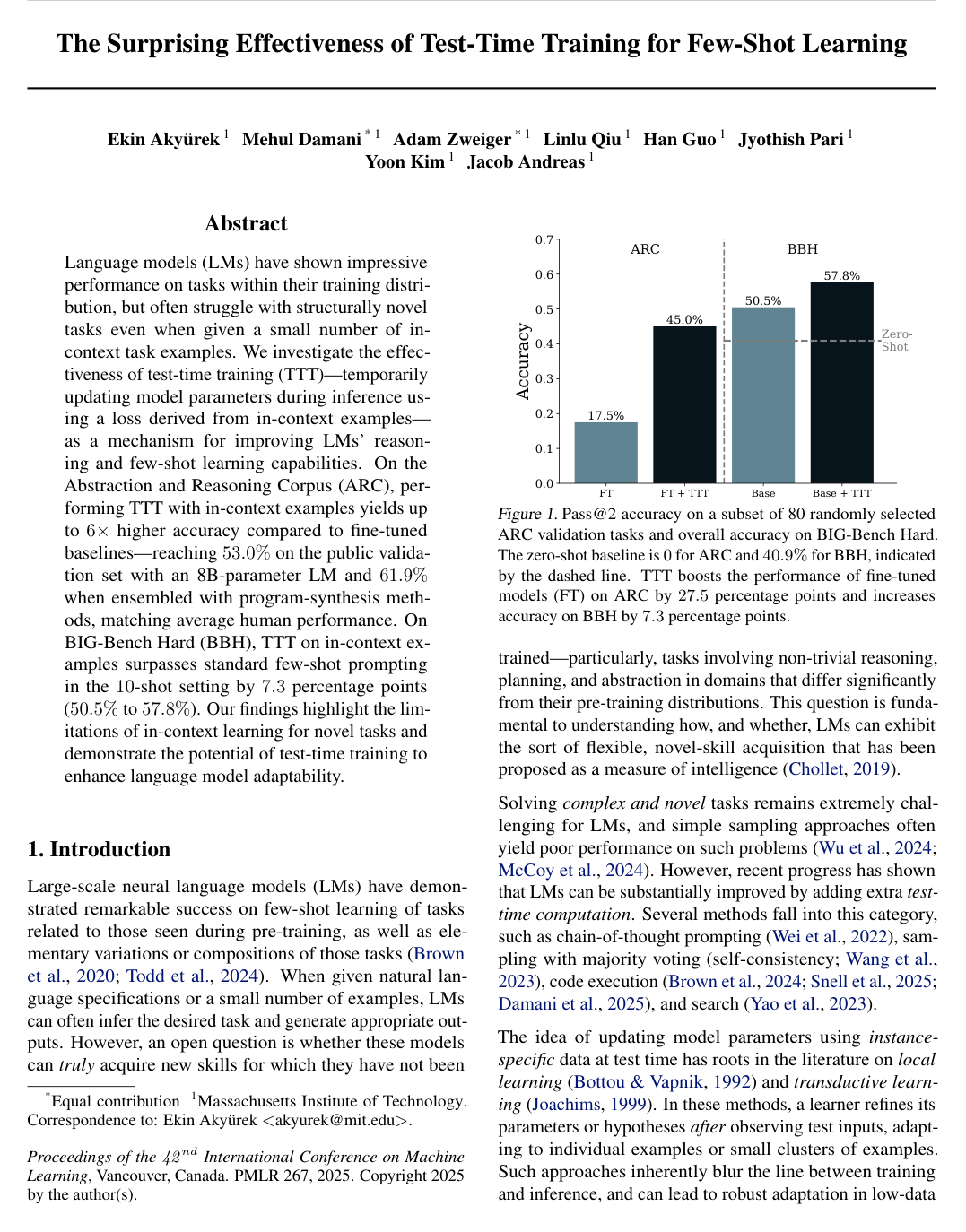
The Surprising Effectiveness of Test-Time Training for Few-Shot Learning
Ekin Akyrek, Mehul Damani, Adam Zweiger, Linlu Qiu, Han Guo, Jyothish Pari, Yoon Kim, Jacob Andreas
Why you should read this
Demonstrates that updating language model parameters at inference time using losses derived from in-context examples dramatically improves reasoning performance on out-of-distribution tasks, achieving human-level accuracy on the Abstraction and Reasoning Corpus.
Language models (LMs) have shown impressive performance on tasks within their training distribution, but often struggle with structurally novel tasks even when given a small number of in-context task examples. We investigate the effectiveness of test-time training (TTT)—temporarily updating model parameters during inference using a loss derived from in-context examples—as a mechanism for improving LMs’ reasoning and few-shot learning capabilities. On the Abstraction and Reasoning Corpus (ARC), performing TTT with in-context examples yields up to 6× higher accuracy compared to fine-tuned baselines—reaching 53.0% on the public validation set with an 8B-parameter LM and 61.9% when ensembled with program-synthesis methods, matching average human performance. On BIG-Bench Hard (BBH), TTT on in-context examples surpasses standard few-shot prompting in the 10-shot setting by 7.3 percentage points (50.5% to 57.8%). Our findings highlight the limitations of in-context learning for novel tasks and demonstrate the potential of test-time training to enhance language model adaptability.
Added
2026-09-26
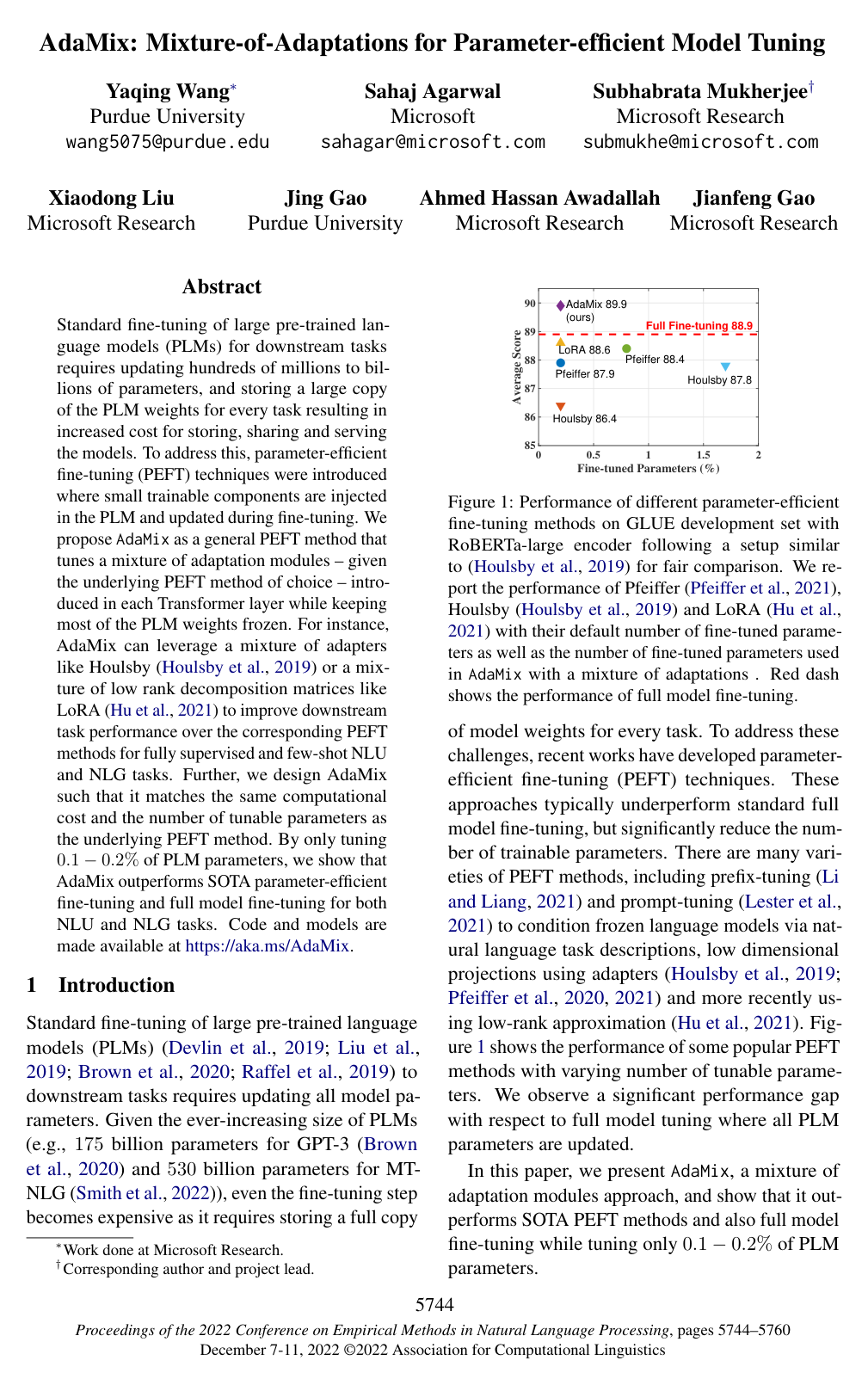
AdaMix: Mixture-of-Adaptations for Parameter-efficient Model Tuning
Yaqing Wang, Sahaj Agarwal, Subhabrata Mukherjee, Xiaodong Liu, Jing Gao, Ahmed Hassan Awadallah, Jianfeng Gao
Why you should read this
Proposes AdaMix, a general parameter-efficient fine-tuning method that uses stochastic routing and module merging across multiple adaptation components to outperform full model fine-tuning on natural language understanding and generation benchmarks while tuning only 0.1 to 0.2 percent of parameters.
Standard fine-tuning of large pre-trained language models (PLMs) for downstream tasks requires updating hundreds of millions to billions of parameters, and storing a large copy of the PLM weights for every task resulting in increased cost for storing, sharing and serving the models. To address this, parameter-efficient fine-tuning (PEFT) techniques were introduced where small trainable components are injected in the PLM and updated during fine-tuning. We propose AdaMix as a general PEFT method that tunes a mixture of adaptation modules – given the underlying PEFT method of choice – introduced in each Transformer layer while keeping most of the PLM weights frozen. For instance, AdaMix can leverage a mixture of adapters like Houlsby (Houlsby et al., 2019) or a mixture of low rank decomposition matrices like LoRA (Hu et al., 2021) to improve downstream task performance over the corresponding PEFT methods for fully supervised and few-shot NLU and NLG tasks. Further, we design AdaMix such that it matches the same computational cost and the number of tunable parameters as the underlying PEFT method. By only tuning 0.1 – 0.2% of PLM parameters, we show that AdaMix outperforms SOTA parameter-efficient fine-tuning and full model fine-tuning for both NLU and NLG tasks. Code and models are made available at https://aka.ms/AdaMix.
Added
2026-09-26
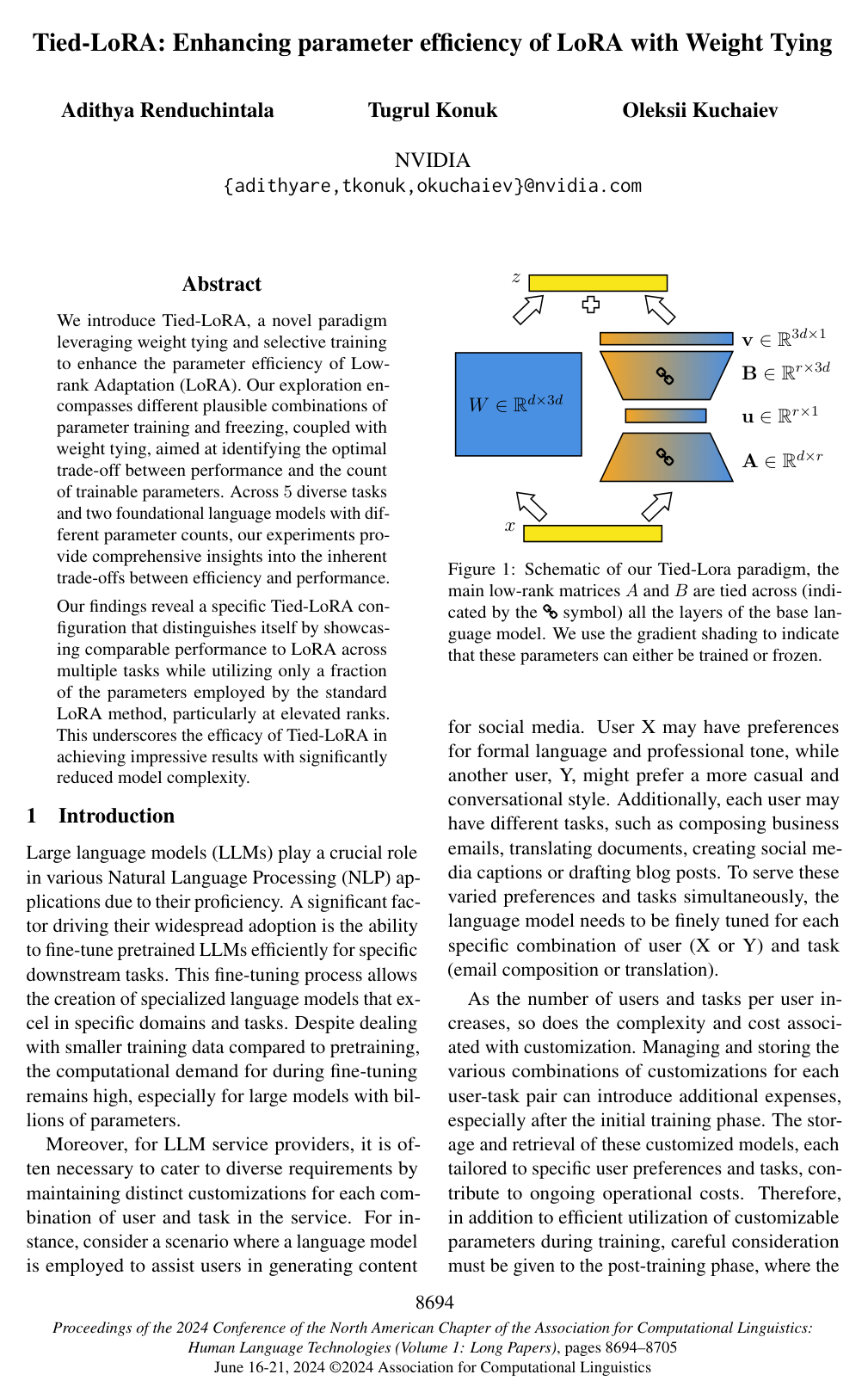
Tied-LoRA: Enhancing parameter efficiency of LoRA with Weight Tying
Adithya Renduchintala, Tugrul Konuk, Oleksii Kuchaiev
Why you should read this
Proposes Tied-LoRA, a parameter-efficient fine-tuning framework that combines layer-shared projection matrices with selective training to match standard LoRA performance across diverse tasks while using up to 87.5% fewer trainable parameters.
We introduce Tied-LoRA, a novel paradigm leveraging weight tying and selective training to enhance the parameter efficiency of Low-rank Adaptation (LoRA). Our exploration encompasses different plausible combinations of parameter training and freezing, coupled with weight tying, aimed at identifying the optimal trade-off between performance and the count of trainable parameters. Across 5 diverse tasks and two foundational language models with different parameter counts, our experiments provide comprehensive insights into the inherent trade-offs between efficiency and performance. Our findings reveal a specific Tied-LoRA configuration that distinguishes itself by showcasing comparable performance to LoRA across multiple tasks while utilizing only a fraction of the parameters employed by the standard LoRA method, particularly at elevated ranks. This underscores the efficacy of Tied-LoRA in achieving impressive results with significantly reduced model complexity.
Added
2026-09-26
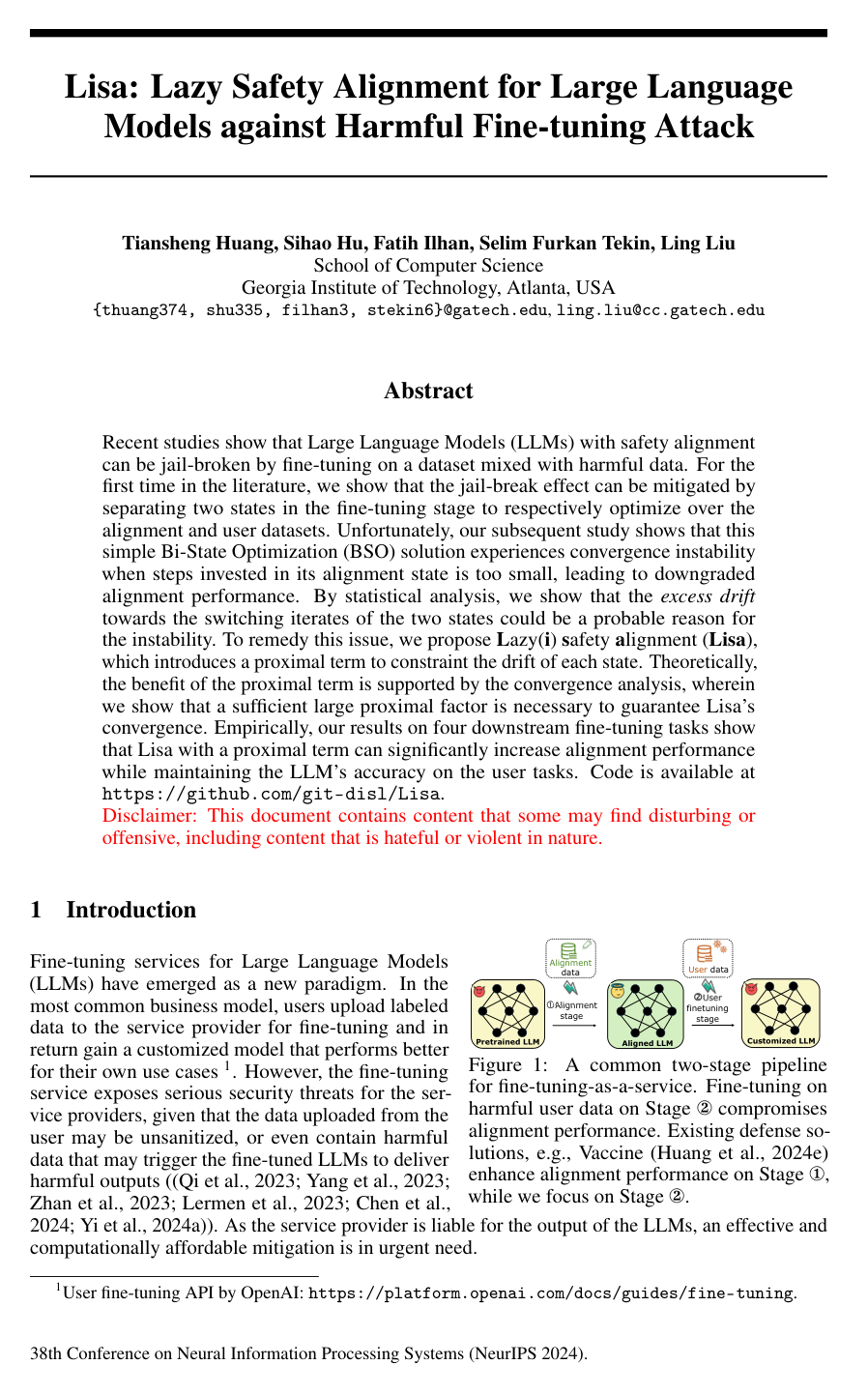
Lisa: Lazy Safety Alignment for Large Language Models against Harmful Fine-tuning Attack
Tiansheng Huang, Sihao Hu, Fatih Ilhan, Selim F. Tekin, Ling Liu
Why you should read this
Proposes a bi-state optimization method incorporating a proximal constraint to protect large language models against harmful fine-tuning attacks without degrading downstream task performance.
Recent studies show that Large Language Models (LLMs) with safety alignment can be jail-broken by fine-tuning on a dataset mixed with harmful data. For the first time in the literature, we show that the jail-break effect can be mitigated by separating two states in the fine-tuning stage to respectively optimize over the alignment and user datasets. Unfortunately, our subsequent study shows that this simple Bi-State Optimization (BSO) solution experiences convergence instability when steps invested in its alignment state is too small, leading to downgraded alignment performance. By statistical analysis, we show that the excess drift towards the switching iterates of the two states could be a probable reason for the instability. To remedy this issue, we propose Lazy(i) safety alignment (Lisa), which introduces a proximal term to constraint the drift of each state. Theoretically, the benefit of the proximal term is supported by the convergence analysis, wherein we show that a sufficient large proximal factor is necessary to guarantee Lisa’s convergence. Empirically, our results on four downstream fine-tuning tasks show that Lisa with a proximal term can significantly increase alignment performance while maintaining the LLM’s accuracy on the user tasks. Code is available at https://github.com/git-disl/Lisa. Disclaimer: This document contains content that some may find disturbing or offensive, including content that is hateful or violent in nature.
Added
2026-09-26
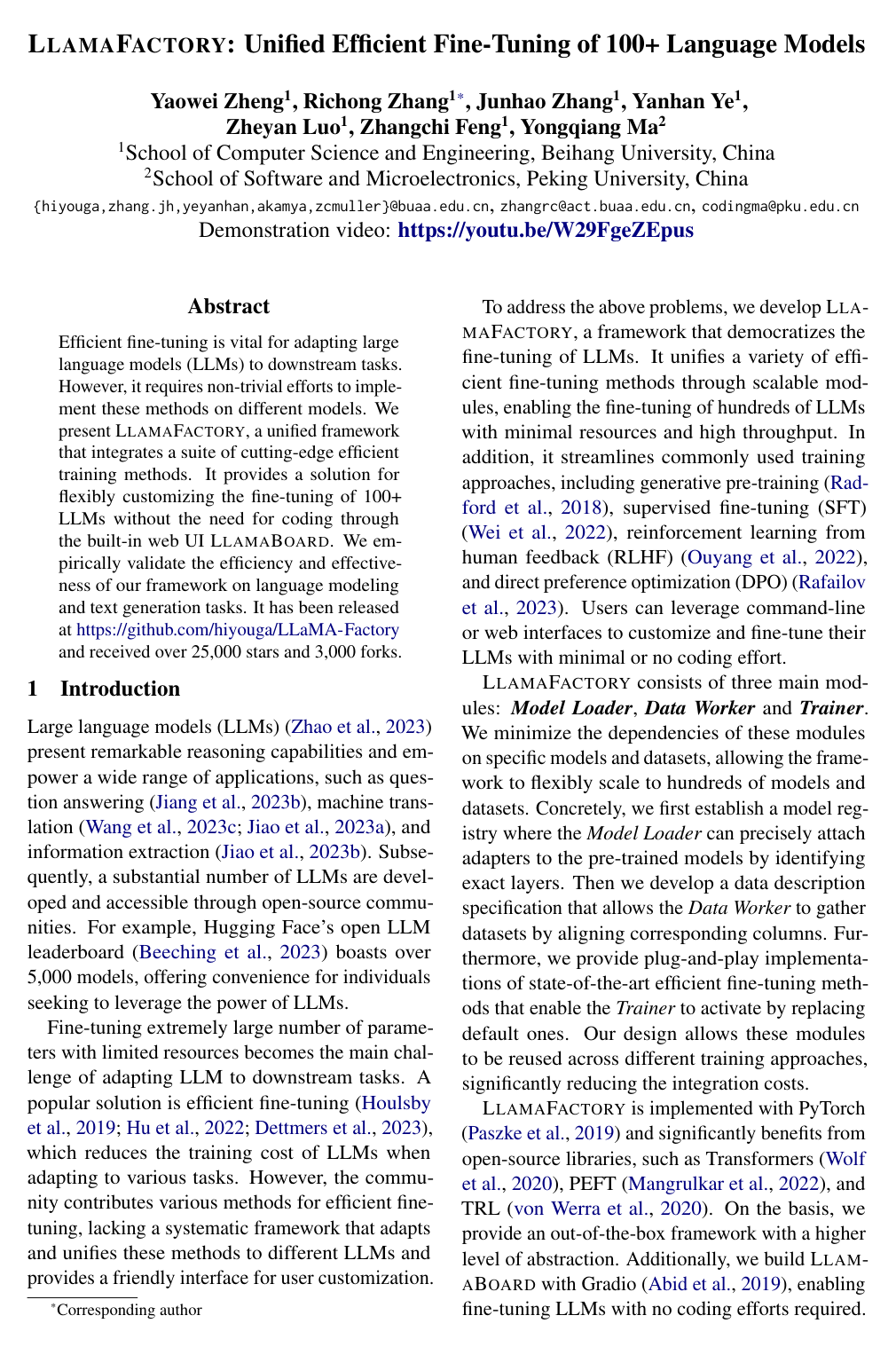
LlamaFactory: Unified Efficient Fine-Tuning of 100+ Language Models
Yaowei Zheng, Richong Zhang, Junhao Zhang, Yanhan Ye, Zheyan Luo, Yongqiang Ma
Why you should read this
Introduces LlamaFactory, a unified framework integrating cutting-edge efficient training methods to enable code-free fine-tuning across more than 100 large language models via an interactive web interface.
Efficient fine-tuning is vital for adapting large language models (LLMs) to downstream tasks. However, it requires non-trivial efforts to implement these methods on different models. We present LlamaFactory, a unified framework that integrates a suite of cutting-edge efficient training methods. It provides a solution for flexibly customizing the fine-tuning of 100+ LLMs without the need for coding through the built-in web UI LlamaBoard. We empirically validate the efficiency and effectiveness of our framework on language modeling and text generation tasks. It has been released at this https URL and received over 25,000 stars and 3,000 forks.
Added
2026-09-18
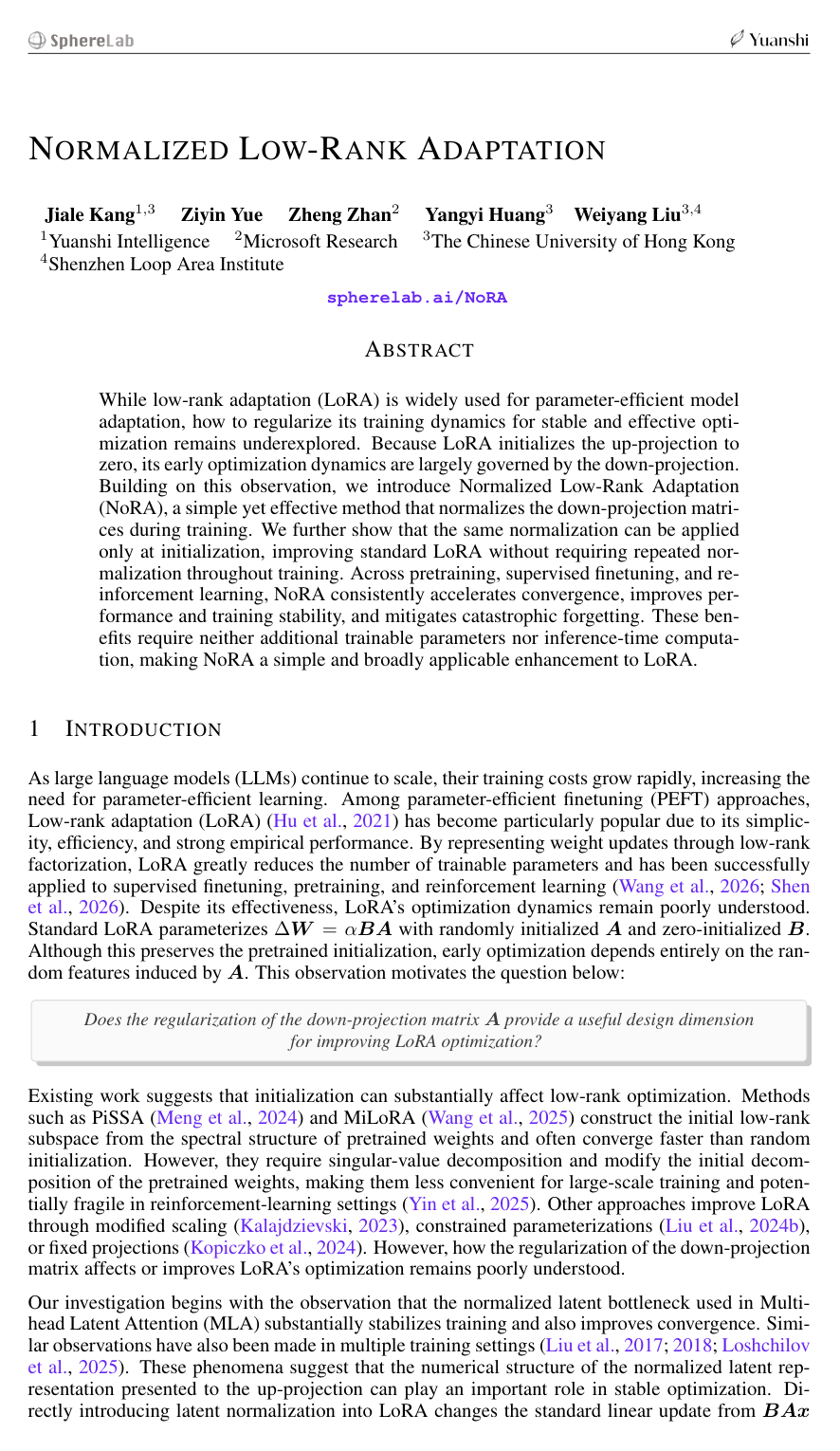
Normalized Low-Rank Adaptation
Jiale Kang, Ziyin Yue, Zheng Zhan, Yangyi Huang, Weiyang Liu
Why you should read this
Proposes Normalized Low-Rank Adaptation (NoRA), a technique that normalizes down-projection matrices to accelerate convergence, stabilize training, and mitigate catastrophic forgetting across pretraining, supervised finetuning, and reinforcement learning without introducing parameter or inference overhead.
While low-rank adaptation (LoRA) is widely used for parameter-efficient model adaptation, how to regularize its training dynamics for stable and effective optimization remains underexplored. Because LoRA initializes the up-projection to zero, its early optimization dynamics are largely governed by the down-projection. Building on this observation, we introduce Normalized Low-Rank Adaptation (NoRA), a simple yet effective method that normalizes the down-projection matrices during training. We further show that the same normalization can be applied only at initialization, improving standard LoRA without requiring repeated normalization throughout training. Across pretraining, supervised finetuning, and reinforcement learning, NoRA consistently accelerates convergence, improves performance and training stability, and mitigates catastrophic forgetting. These benefits require neither additional trainable parameters nor inference-time computation, making NoRA a simple and broadly applicable enhancement to LoRA.
Added
2026-09-07
License
Published with permission
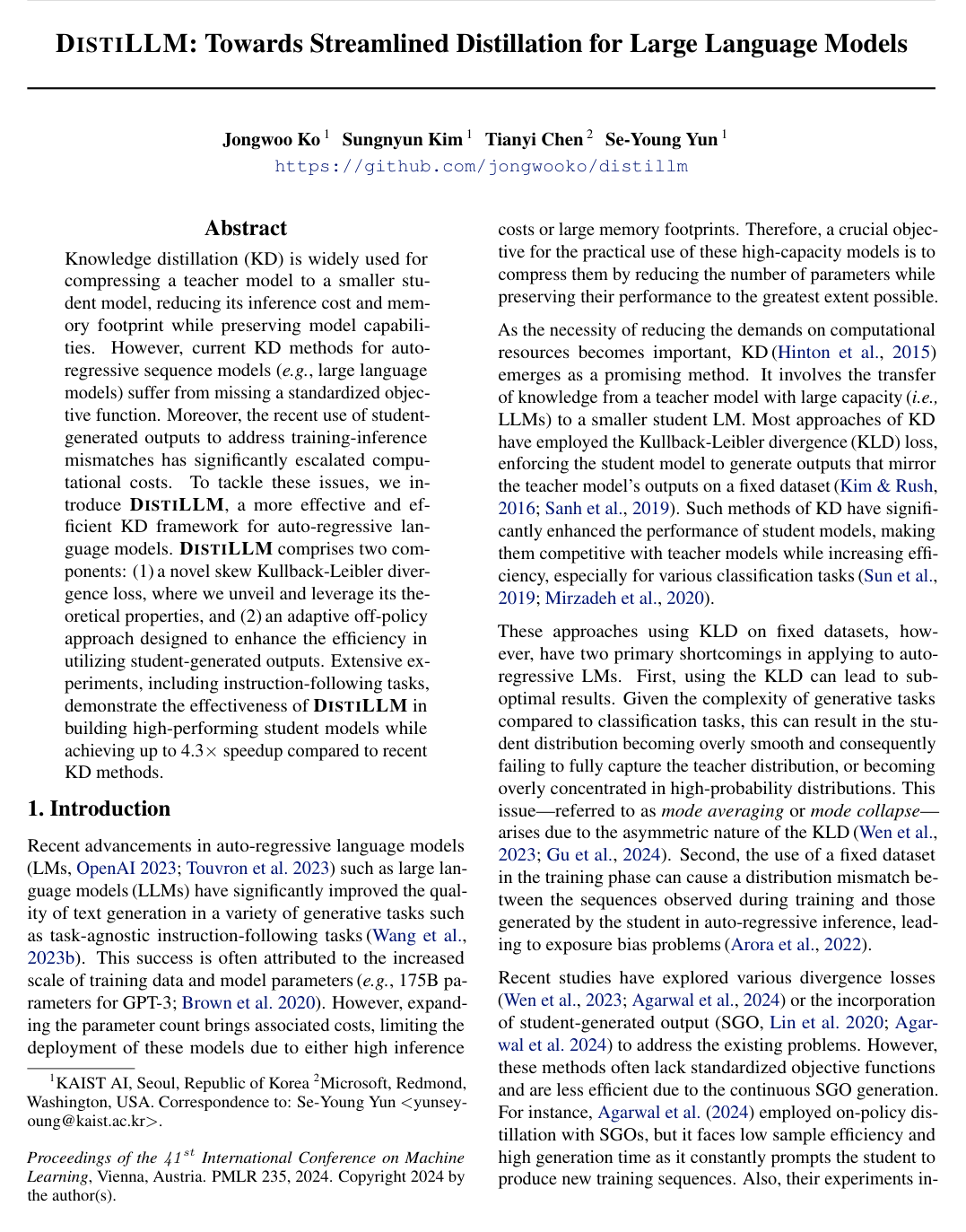
DistiLLM: Towards Streamlined Distillation for Large Language Models
Jongwoo Ko, Sungnyun Kim, Tianyi Chen, Se-Young Yun
Why you should read this
Develops DistiLLM, an autoregressive language model distillation framework combining a skew Kullback-Leibler divergence objective with an adaptive off-policy strategy to resolve exposure bias and achieve up to a 4.3-fold training speedup over existing methods.
Knowledge distillation (KD) is widely used for compressing a teacher model to a smaller student model, reducing its inference cost and memory footprint while preserving model capabilities. However, current KD methods for auto-regressive sequence models (e.g., large language models) suffer from missing a standardized objective function. Moreover, the recent use of student-generated outputs to address training-inference mismatches has significantly escalated computational costs. To tackle these issues, we introduce DistiLLM, a more effective and efficient KD framework for auto-regressive language models. DistiLLM comprises two components: (1) a novel skew Kullback-Leibler divergence loss, where we unveil and leverage its theoretical properties, and (2) an adaptive off-policy approach designed to enhance the efficiency in utilizing student-generated outputs. Extensive experiments, including instruction-following tasks, demonstrate the effectiveness of DistiLLM in building high-performing student models while achieving up to 4.3 speedup compared to recent KD methods.
Added
2026-09-03
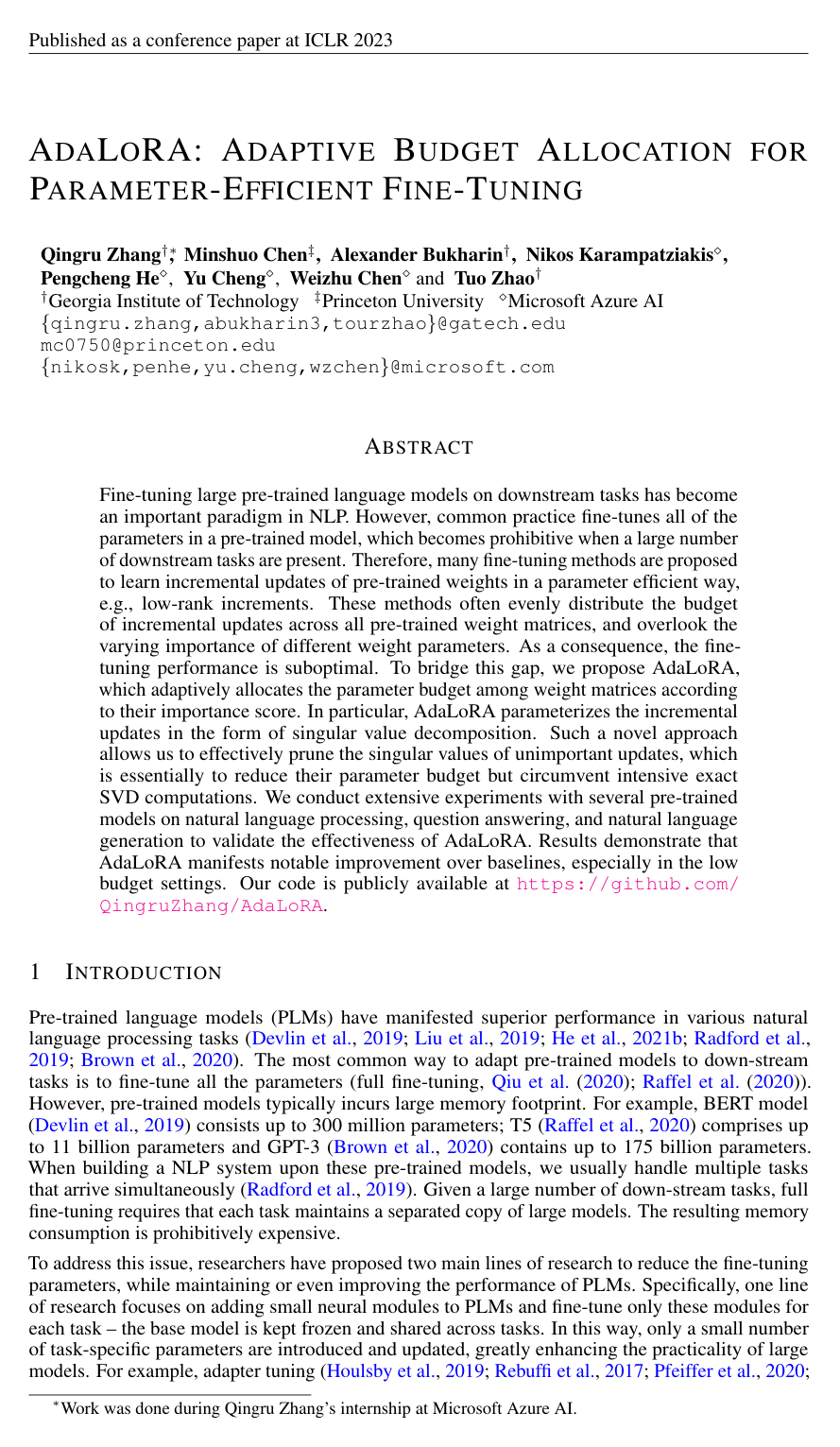
AdaLoRA: Adaptive Budget Allocation for Parameter-Efficient Fine-Tuning
Qingru Zhang, Minshuo Chen, Alexander Bukharin, Karampatziakis, Nikos, Pengcheng He, Yu Cheng, Weizhu Chen, Tuo Zhao
Why you should read this
Develops a strategy to dynamically allocate parameter budgets across transformer layers using sensitivity-based importance scores derived from singular value decomposition.
Fine-tuning large pre-trained language models on downstream tasks has become an important paradigm in NLP. However, common practice fine-tunes all of the parameters in a pre-trained model, which becomes prohibitive when a large number of downstream tasks are present. Therefore, many fine-tuning methods are proposed to learn incremental updates of pre-trained weights in a parameter efficient way, e.g., low-rank increments. These methods often evenly distribute the budget of incremental updates across all pre-trained weight matrices, and overlook the varying importance of different weight parameters. As a consequence, the fine-tuning performance is suboptimal. To bridge this gap, we propose AdaLoRA, which adaptively allocates the parameter budget among weight matrices according to their importance score. In particular, AdaLoRA parameterizes the incremental updates in the form of singular value decomposition. Such a novel approach allows us to effectively prune the singular values of unimportant updates, which is essentially to reduce their parameter budget but circumvent intensive exact SVD computations. We conduct extensive experiments with several pre-trained models on natural language processing, question answering, and natural language generation to validate the effectiveness of AdaLoRA. Results demonstrate that AdaLoRA manifests notable improvement over baselines, especially in the low budget settings. Our code is publicly available at https://github.com/QingruZhang/AdaLoRA .
Added
2026-06-23
License
Published with permission
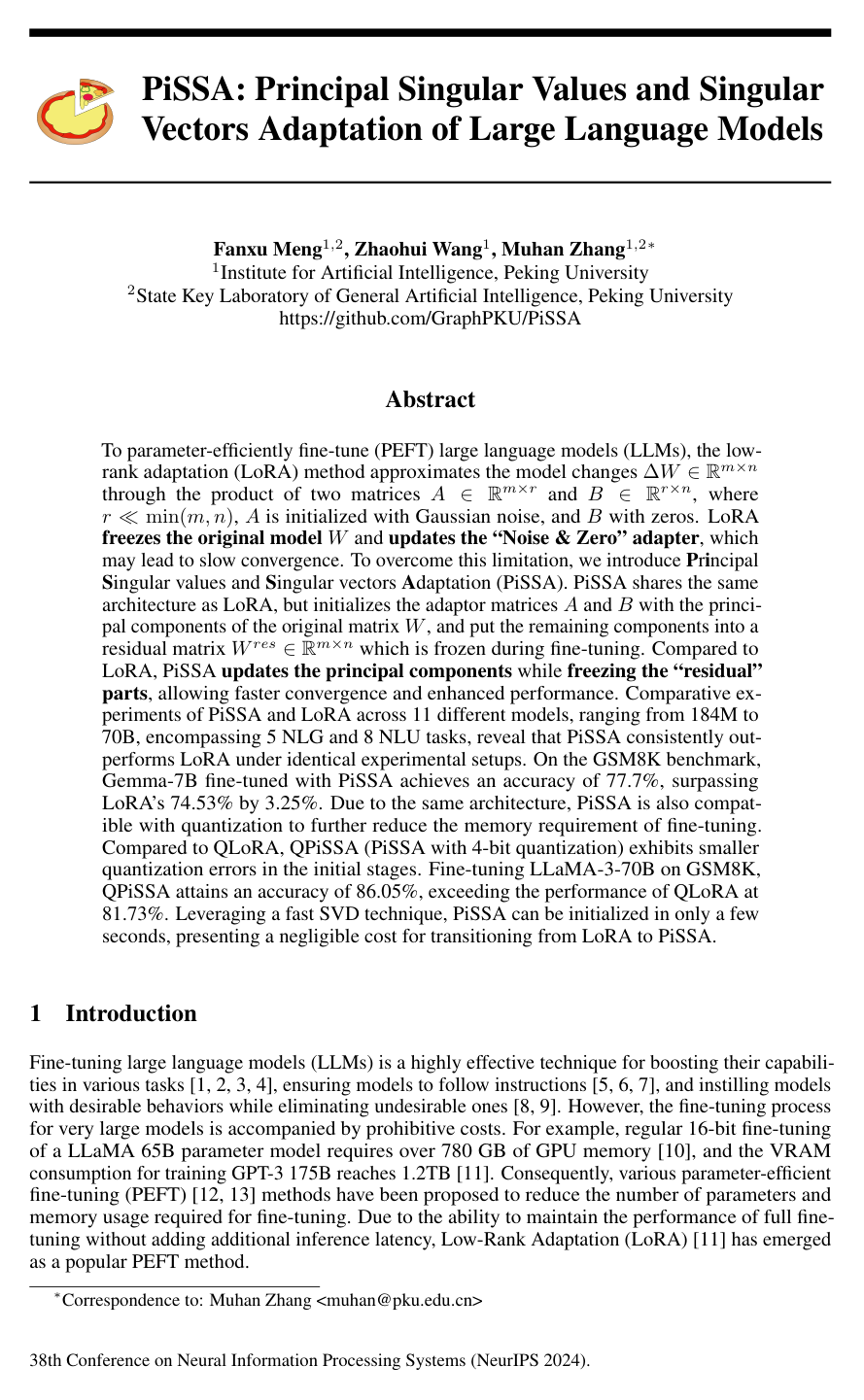
PiSSA: Principal Singular Values and Singular Vectors Adaptation of Large Language Models
Fanxu Meng, Zhaohui Wang, Muhan Zhang
Why you should read this
Introduces PiSSA, a novel adaptation method for LLMs that outperforms LoRA and QLoRA in convergence speed and performance across diverse tasks and model sizes by intelligently initializing adapter matrices with principal components and freezing residual parts.
To parameter-efficiently fine-tune (PEFT) large language models (LLMs), the low-rank adaptation (LoRA) method approximates the model changes through the product of two matrices and , where , is initialized with Gaussian noise, and with zeros. LoRA freezes the original model and updates the "Noise & Zero" adapter, which may lead to slow convergence. To overcome this limitation, we introduce Principal Singular values and Singular vectors Adaptation (PiSSA). PiSSA shares the same architecture as LoRA, but initializes the adaptor matrices and with the principal components of the original matrix , and put the remaining components into a residual matrix which is frozen during fine-tuning. Compared to LoRA, PiSSA updates the principal components while freezing the "residual" parts, allowing faster convergence and enhanced performance. Comparative experiments of PiSSA and LoRA across 12 different models, ranging from 184M to 70B, encompassing 5 NLG and 8 NLU tasks, reveal that PiSSA consistently outperforms LoRA under identical experimental setups. On the GSM8K benchmark, Mistral-7B fine-tuned with PiSSA achieves an accuracy of 72.86%, surpassing LoRA's 67.7% by 5.16%. Due to the same architecture, PiSSA is also compatible with quantization to further reduce the memory requirement of fine-tuning. Compared to QLoRA, QPiSSA exhibits smaller quantization errors in the initial stages. Fine-tuning LLaMA-3-70B on GSM8K, QPiSSA attains an accuracy of 86.05%, exceeding the performances of QLoRA at 81.73%. Leveraging a fast SVD technique, PiSSA can be initialized in only a few seconds, presenting a negligible cost for transitioning from LoRA to PiSSA. Code is available at this https URL.
Added
2026-06-22