Built independently by an author, for readers. Read the story and support ChapterPal

keyword

lossy image compression

Lossy image compression is a data encoding process that reduces the file size of a digital image by permanently discarding redundant or imperceptible visual information. Unlike lossless compression, which perfectly reconstructs the original pixel data, lossy compression achieves significantly higher compression ratios at the expense of an irreversible reduction in exact image fidelity. This technique typically uses mathematical transforms, quantization, and entropy coding—or modern machine learning architectures—to optimize the trade-off between bit rate and perceived visual quality, making it the standard approach for transmitting and storing digital photos across web platforms and consumer devices.

1 item

ELIC: Efficient Learned Image Compression with Unevenly Grouped Space-Channel Contextual Adaptive Coding

ELIC: Efficient Learned Image Compression with Unevenly Grouped Space-Channel Contextual Adaptive Coding

Dailan He, Ziming Yang, Weikun Peng, Rui Ma, Hongwei Qin, Yan Wang

OrganizationsSenseTimeTsinghua University

Why you should read this

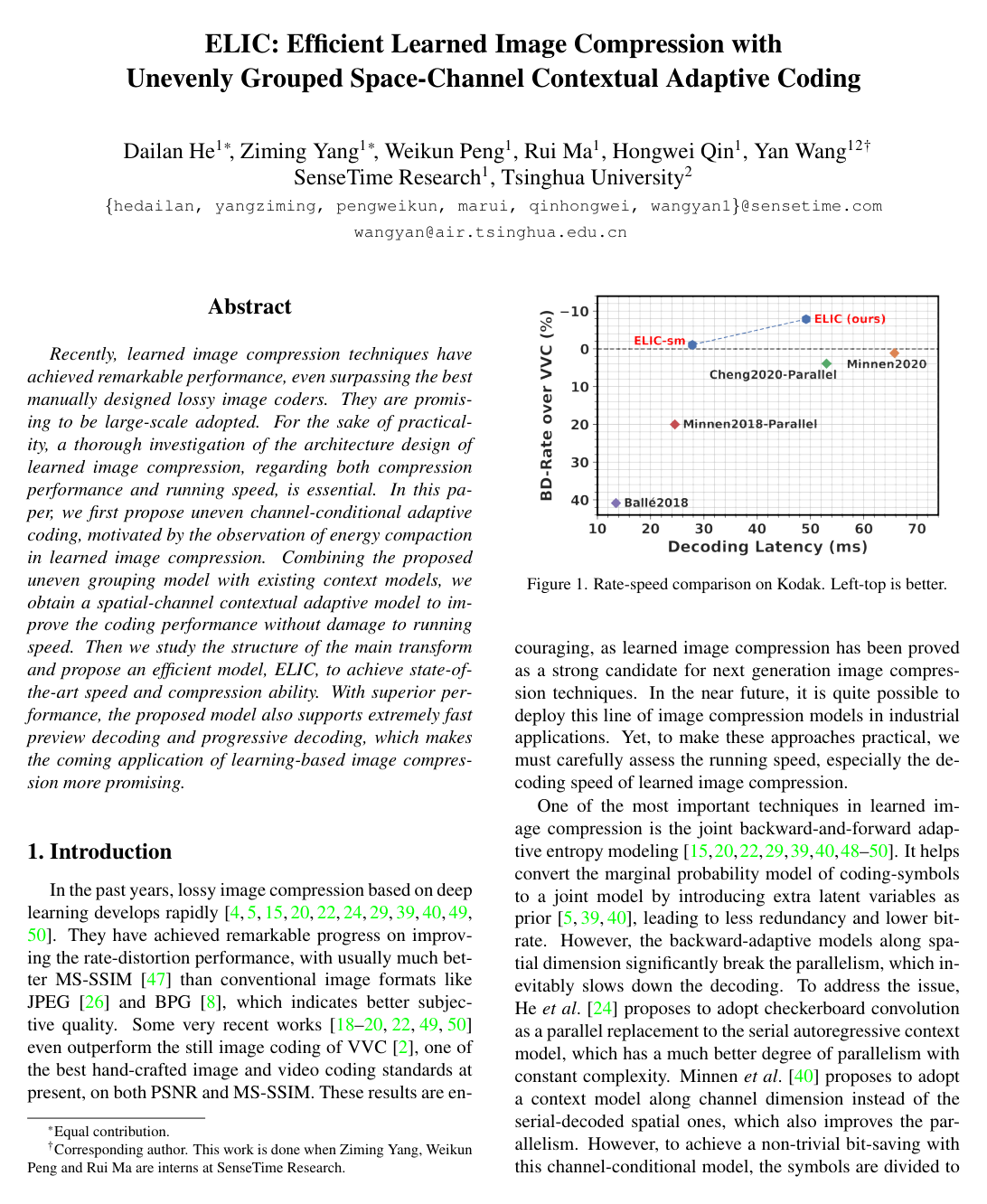
Presents ELIC, a learned image compression architecture that combines uneven space-channel contextual coding with efficient transform design to achieve state-of-the-art rate-distortion performance alongside fast inference, preview decoding, and progressive decoding.

Recently, learned image compression techniques have achieved remarkable performance, even surpassing the best manually designed lossy image coders. They are promising to be large-scale adopted. For the sake of practicality, a thorough investigation of the architecture design of learned image compression, regarding both compression performance and running speed, is essential. In this paper, we first propose uneven channel-conditional adaptive coding, motivated by the observation of energy compaction in learned image compression. Combining the proposed uneven grouping model with existing context models, we obtain a spatial-channel contextual adaptive model to improve the coding performance without damage to running speed. Then we study the structure of the main transform and propose an efficient model, ELIC, to achieve state-of-the-art speed and compression ability. With superior performance, the proposed model also supports extremely fast preview decoding and progressive decoding, which makes the coming application of learning-based image compression more promising.

Added

2026-09-26