Built independently by an author, for readers. Read the story and support ChapterPal

keyword

lookahead heuristics

Lookahead heuristics are algorithmic search and decision-making strategies that estimate future costs, rewards, or constraint satisfaction by evaluating potential downstream states beyond the immediate next step. Drawing foundational principles from informed search methods such as A-star search, these heuristics provide predictive evaluations that guide intermediate choices toward paths most likely to produce valid, globally optimal, or goal-compliant outcomes. In computational fields such as automated planning, graph search, and sequential text generation, lookahead heuristics allow decoding and exploration procedures to anticipate downstream requirements, helping systems avoid dead ends, adhere to complex logical constraints, and balance computational efficiency with foresighted path selection.

1 item

NeuroLogic A*esque Decoding: Constrained Text Generation with Lookahead Heuristics

NeuroLogic A*esque Decoding: Constrained Text Generation with Lookahead Heuristics

Ximing Lu, Sean Welleck, Peter West, Liwei Jiang, Jungo Kasai, Daniel Khashabi, Ronan Le Bras, Lianhui Qin, Youngjae Yu, Rowan Zellers, Noah A. Smith, Yejin Choi

OrganizationsAllen Institute for AIUniversity of Washington

Why you should read this

Proposes an A*-inspired decoding algorithm with efficient lookahead heuristics that enables autoregressive language models to satisfy complex lexical constraints and achieve state-of-the-art performance across multiple text generation benchmarks without task-specific training data.

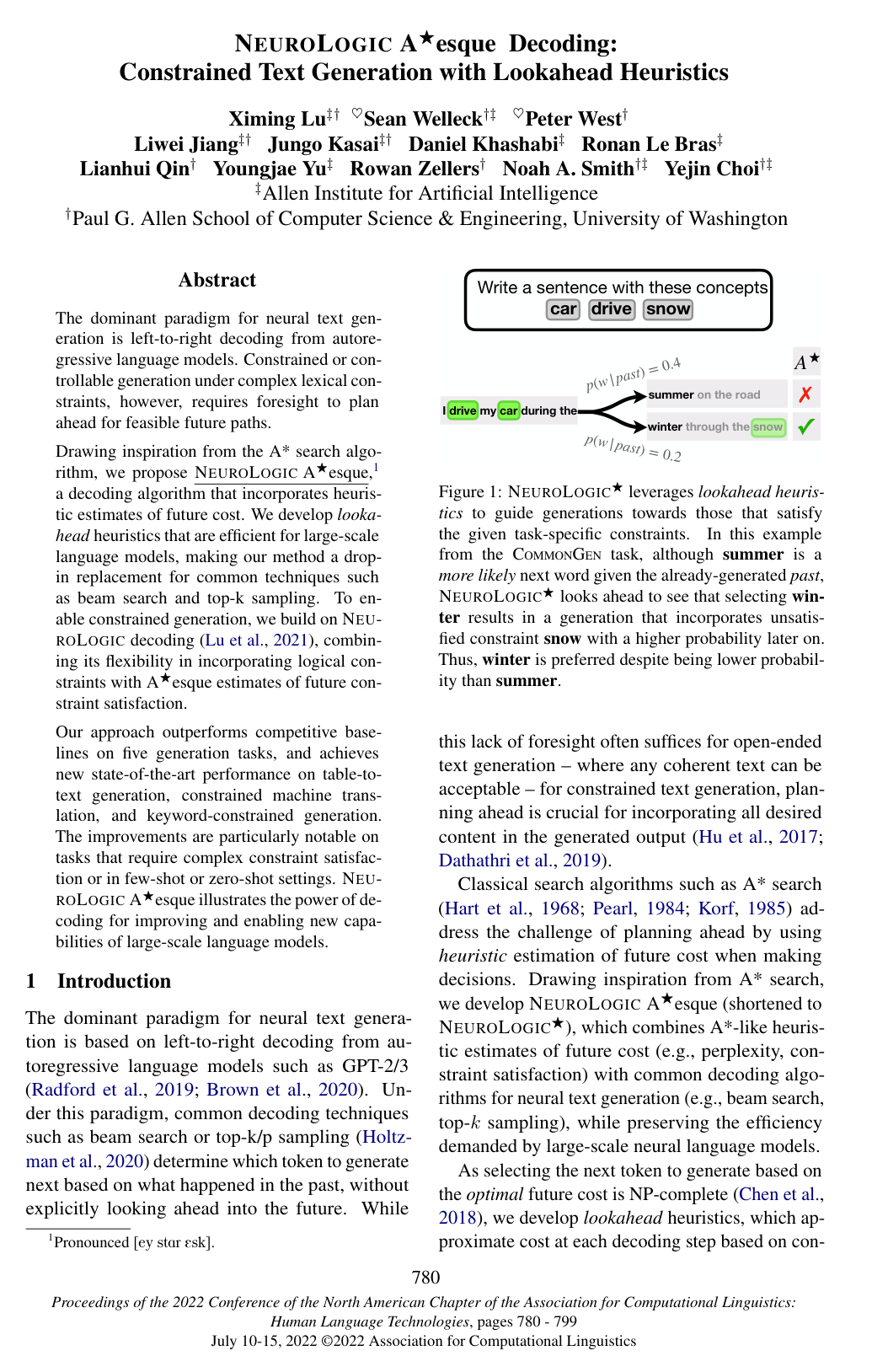
The dominant paradigm for neural text generation is left-to-right decoding from autoregressive language models. Constrained or controllable generation under complex lexical constraints, however, requires foresight to plan ahead for feasible future paths. Drawing inspiration from the A* search algorithm, we propose NEUROLOGIC A★esque,1 a decoding algorithm that incorporates heuristic estimates of future cost. We develop lookahead heuristics that are efficient for large-scale language models, making our method a drop-in replacement for common techniques such as beam search and top-k sampling. To enable constrained generation, we build on NEUROLOGIC decoding (Lu et al., 2021), combining its flexibility in incorporating logical constraints with A★esque estimates of future constraint satisfaction. Our approach outperforms competitive baselines on five generation tasks, and achieves new state-of-the-art performance on table-to-text generation, constrained machine translation, and keyword-constrained generation. The improvements are particularly notable on tasks that require complex constraint satisfaction or in few-shot or zero-shot settings. NEUROLOGIC A★esque illustrates the power of decoding for improving and enabling new capabilities of large-scale language models.

Added

2026-09-28