
keyword
Long-text generation
Long-text generation is a natural language processing task in which computational models, such as large language models, automatically produce extended, continuous passages of natural language text spanning multiple paragraphs or long sequences of tokens. Unlike short-text generation tasks that focus on brief phrases, single sentences, or concise answers, long-text generation encompasses applications such as drafting comprehensive reports, composing essays, generating detailed explanations, and synthesizing narrative or technical documents. This task requires models to maintain global semantic coherence, logical discourse structure, and factual consistency across the entire output, while managing challenges such as compounding errors, thematic drift, repetitive phrasing, and context degradation over prolonged sequence generation.
3 items
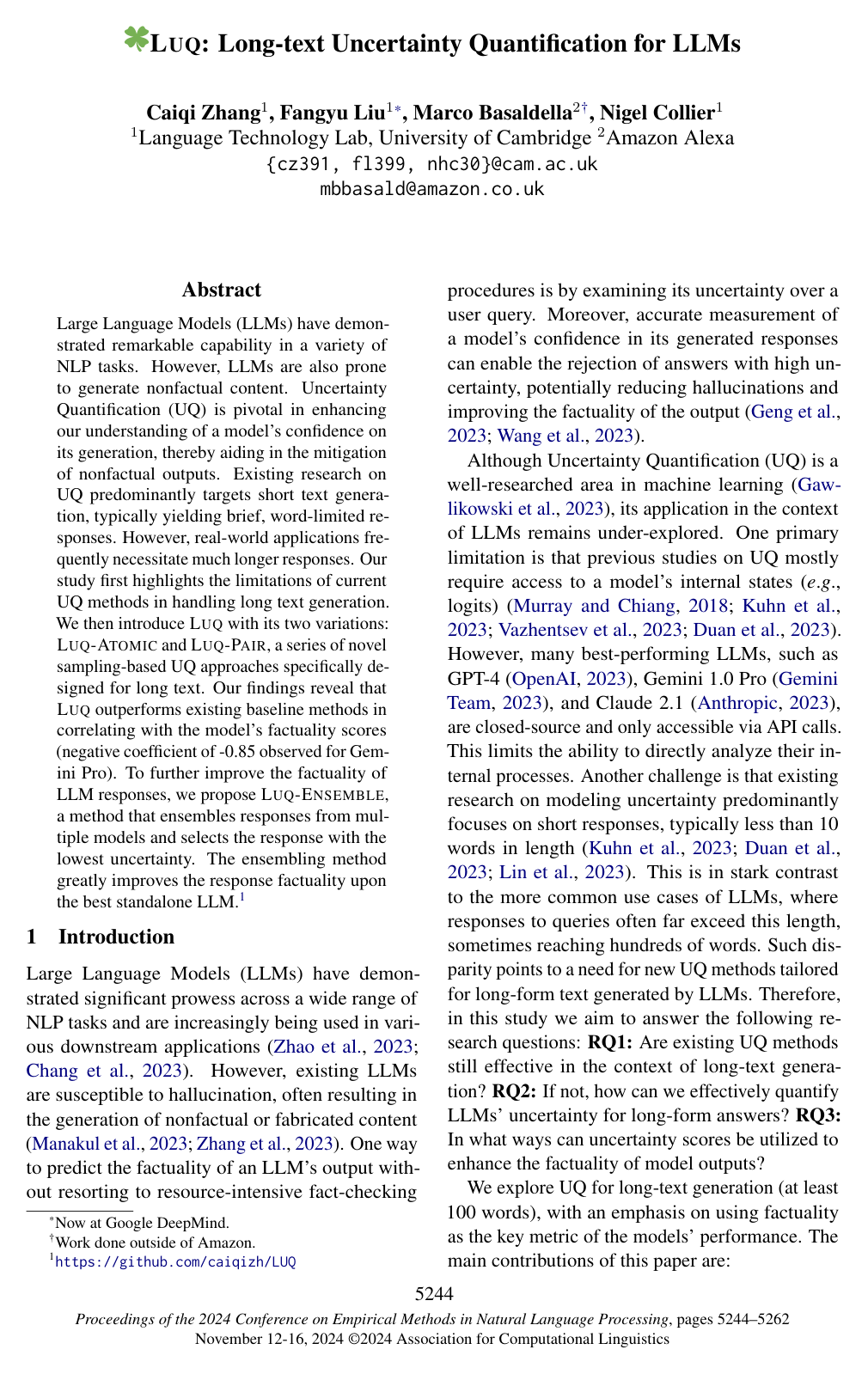
LUQ: Long-text Uncertainty Quantification for LLMs
Caiqi Zhang, Fangyu Liu, Marco Basaldella, Nigel Collier
Why you should read this
Introduces LUQ, a sampling-based uncertainty quantification framework designed for long-form language model outputs, demonstrating strong negative correlation with factual errors and enabling multi-model ensembles that boost overall response factuality.
Large Language Models (LLMs) have demonstrated remarkable capability in a variety of NLP tasks. However, LLMs are also prone to generate nonfactual content. Uncertainty Quantification (UQ) is pivotal in enhancing our understanding of a model’s confidence on its generation, thereby aiding in the mitigation of nonfactual outputs. Existing research on UQ predominantly targets short text generation, typically yielding brief, word-limited responses. However, real-world applications frequently necessitate much longer responses. Our study first highlights the limitations of current UQ methods in handling long text generation. We then introduce LUQ with its two variations: LUQ-ATOMIC and LUQ-PAIR, a series of novel sampling-based UQ approaches specifically designed for long text. Our findings reveal that LUQ outperforms existing baseline methods in correlating with the model’s factuality scores (negative coefficient of -0.85 observed for Gemini Pro). To further improve the factuality of LLM responses, we propose LUQ-ENSEMBLE, a method that ensembles responses from multiple models and selects the response with the lowest uncertainty. The ensembling method greatly improves the response factuality upon the best standalone LLM.
Added
2026-10-02
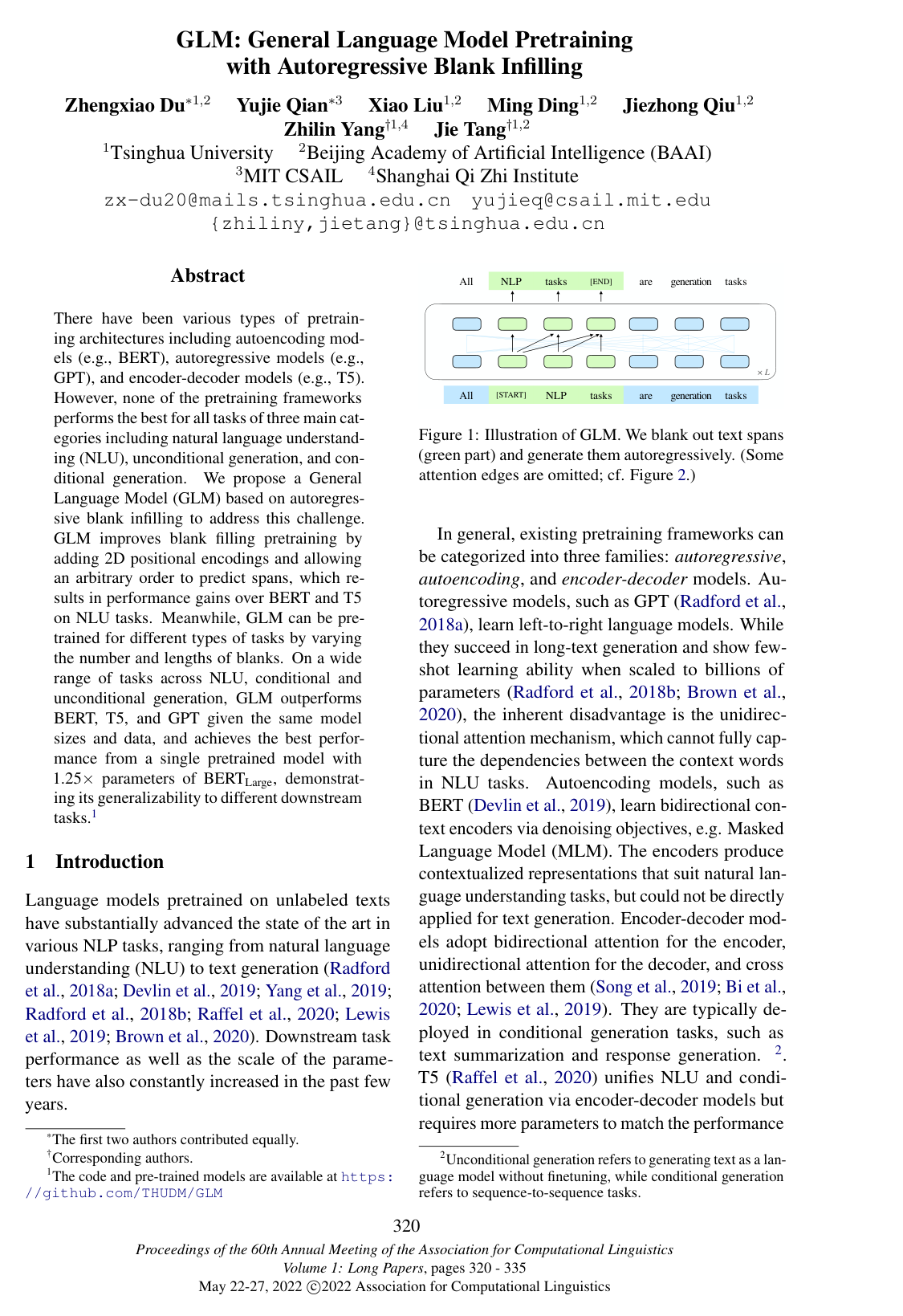
GLM: General Language Model Pretraining with Autoregressive Blank Infilling
Zhengxiao Du, Yujie Qian, Xiao Liu, Ming Ding, Jiezhong Qiu, Zhilin Yang, Jie Tang
Why you should read this
Introduces an autoregressive blank-infilling pretraining framework with 2D positional encodings that unifies natural language understanding, conditional generation, and unconditional generation while outperforming BERT, T5, and GPT across equivalent model scales.
There have been various types of pretraining architectures including autoencoding models (e.g., BERT), autoregressive models (e.g., GPT), and encoder-decoder models (e.g., T5). However, none of the pretraining frameworks performs the best for all tasks of three main categories including natural language understanding (NLU), unconditional generation, and conditional generation. We propose a General Language Model (GLM) based on autoregressive blank infilling to address this challenge. GLM improves blank filling pretraining by adding 2D positional encodings and allowing an arbitrary order to predict spans, which results in performance gains over BERT and T5 on NLU tasks. Meanwhile, GLM can be pretrained for different types of tasks by varying the number and lengths of blanks. On a wide range of tasks across NLU, conditional and unconditional generation, GLM outperforms BERT, T5, and GPT given the same model sizes and data, and achieves the best performance from a single pretrained model with 1.25x parameters of BERT Large , demonstrating its generalizability to different downstream tasks.
Added
2026-09-18
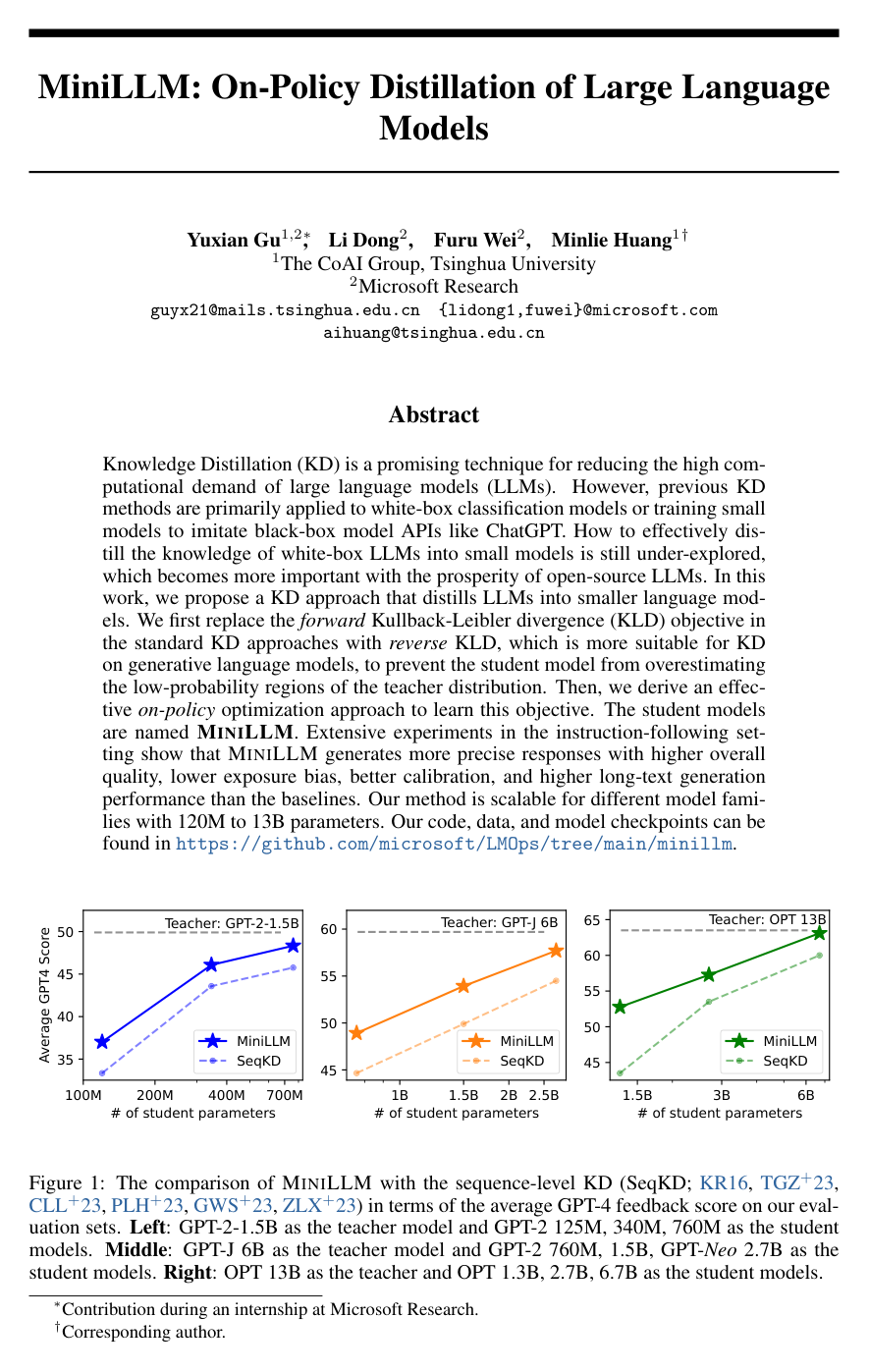
MiniLLM: On-Policy Distillation of Large Language Models
Yuxian Gu, Li Dong, Furu Wei, Minlie Huang
Why you should read this
Proposes an on-policy distillation framework using reverse Kullback-Leibler divergence to compress large generative models into compact student models that generate higher-quality, better-calibrated text without overestimating unlikely outputs.
Knowledge Distillation (KD) is a promising technique for reducing the high computational demand of large language models (LLMs). However, previous KD methods are primarily applied to white-box classification models or training small models to imitate black-box model APIs like ChatGPT. How to effectively distill the knowledge of white-box LLMs into small models is still under-explored, which becomes more important with the prosperity of open-source LLMs. In this work, we propose a KD approach that distills LLMs into smaller language models. We first replace the forward Kullback-Leibler divergence (KLD) objective in the standard KD approaches with reverse KLD, which is more suitable for KD on generative language models, to prevent the student model from overestimating the low-probability regions of the teacher distribution. Then, we derive an effective on-policy optimization approach to learn this objective. The student models are named MiniLLM. Extensive experiments in the instruction-following setting show that MiniLLM generates more precise responses with higher overall quality, lower exposure bias, better calibration, and higher long-text generation performance than the baselines. Our method is scalable for different model families with 120M to 13B parameters. Our code, data, and model checkpoints can be found in this https URL.
Added
2026-09-03
License
Published with permission