
keyword
long-term series forecasting
Long-term series forecasting is the task of predicting future values of a time series across an extended horizon based on historical sequential observations. Unlike short-term forecasting, which primarily focuses on immediate next-step projections using local variations, long-term forecasting requires capturing broader temporal dynamics, such as multi-scale periodicities, underlying trends, and long-range dependencies across substantial spans of time. Modern computational methods for this task frequently employ deep learning architectures designed to maintain accuracy and computational efficiency over long horizons while mitigating error accumulation across distant time steps. This capability is essential for strategic planning and risk management in domains such as energy grid operations, climate and weather projection, economic planning, and traffic management.
2 items
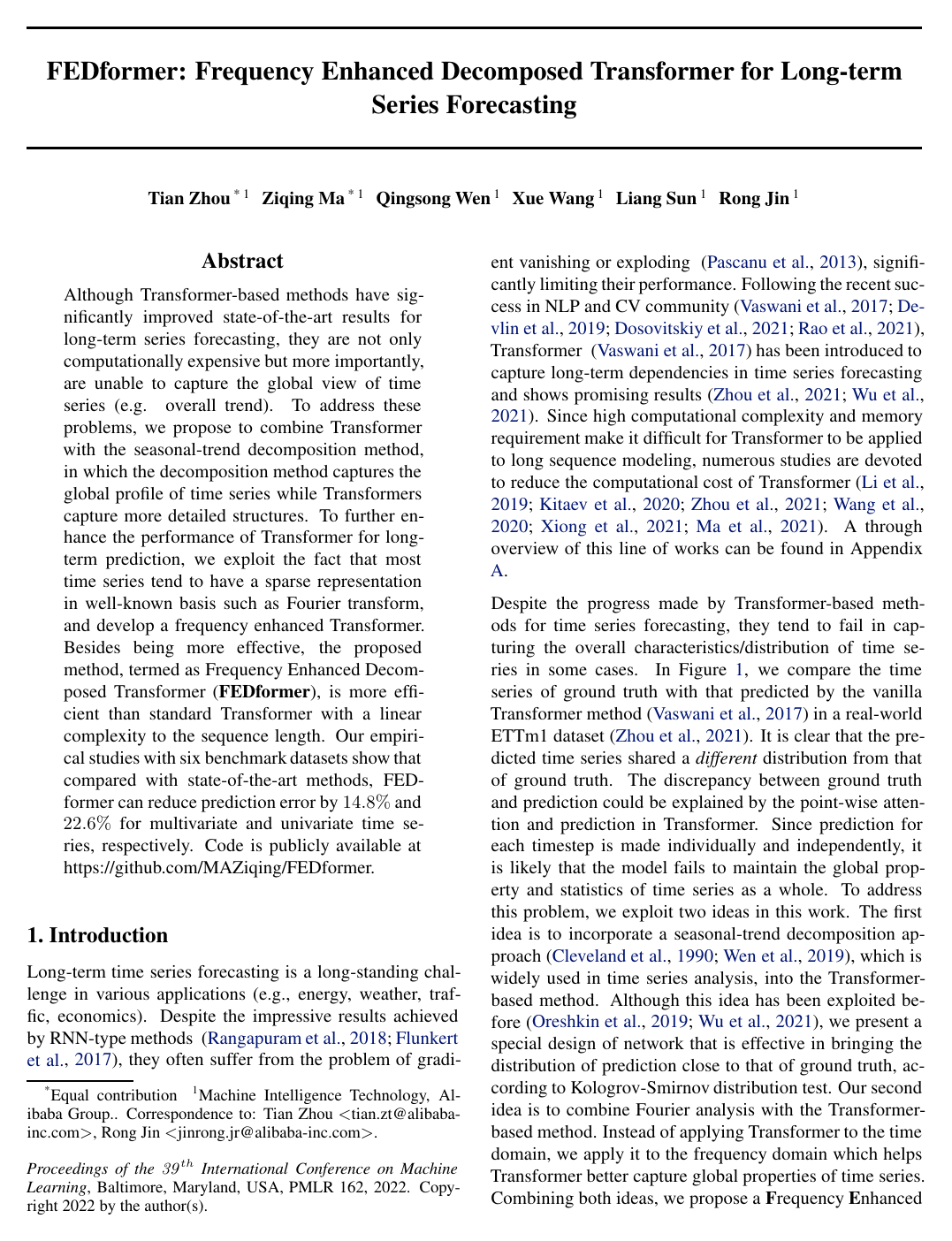
FEDformer: Frequency Enhanced Decomposed Transformer for Long-term Series Forecasting
Tian Zhou, Ziqing Ma, Qingsong Wen, Xue Wang, Liang Sun, Rong Jin
Why you should read this
Proposes FEDformer, a long-term time series forecasting architecture that pairs seasonal-trend decomposition with frequency-domain attention to achieve linear computational complexity and significantly reduce prediction errors over standard Transformers.
Although Transformer-based methods have significantly improved state-of-the-art results for long-term series forecasting, they are not only computationally expensive but more importantly, are unable to capture the global view of time series (e.g. overall trend). To address these problems, we propose to combine Transformer with the seasonal-trend decomposition method, in which the decomposition method captures the global profile of time series while Transformers capture more detailed structures. To further enhance the performance of Transformer for long-term prediction, we exploit the fact that most time series tend to have a sparse representation in well-known basis such as Fourier transform, and develop a frequency enhanced Transformer. Besides being more effective, the proposed method, termed as Frequency Enhanced Decomposed Transformer ({\bf FEDformer}), is more efficient than standard Transformer with a linear complexity to the sequence length. Our empirical studies with six benchmark datasets show that compared with state-of-the-art methods, FEDformer can reduce prediction error by and for multivariate and univariate time series, respectively. Code is publicly available at this https URL.
Added
2026-09-11
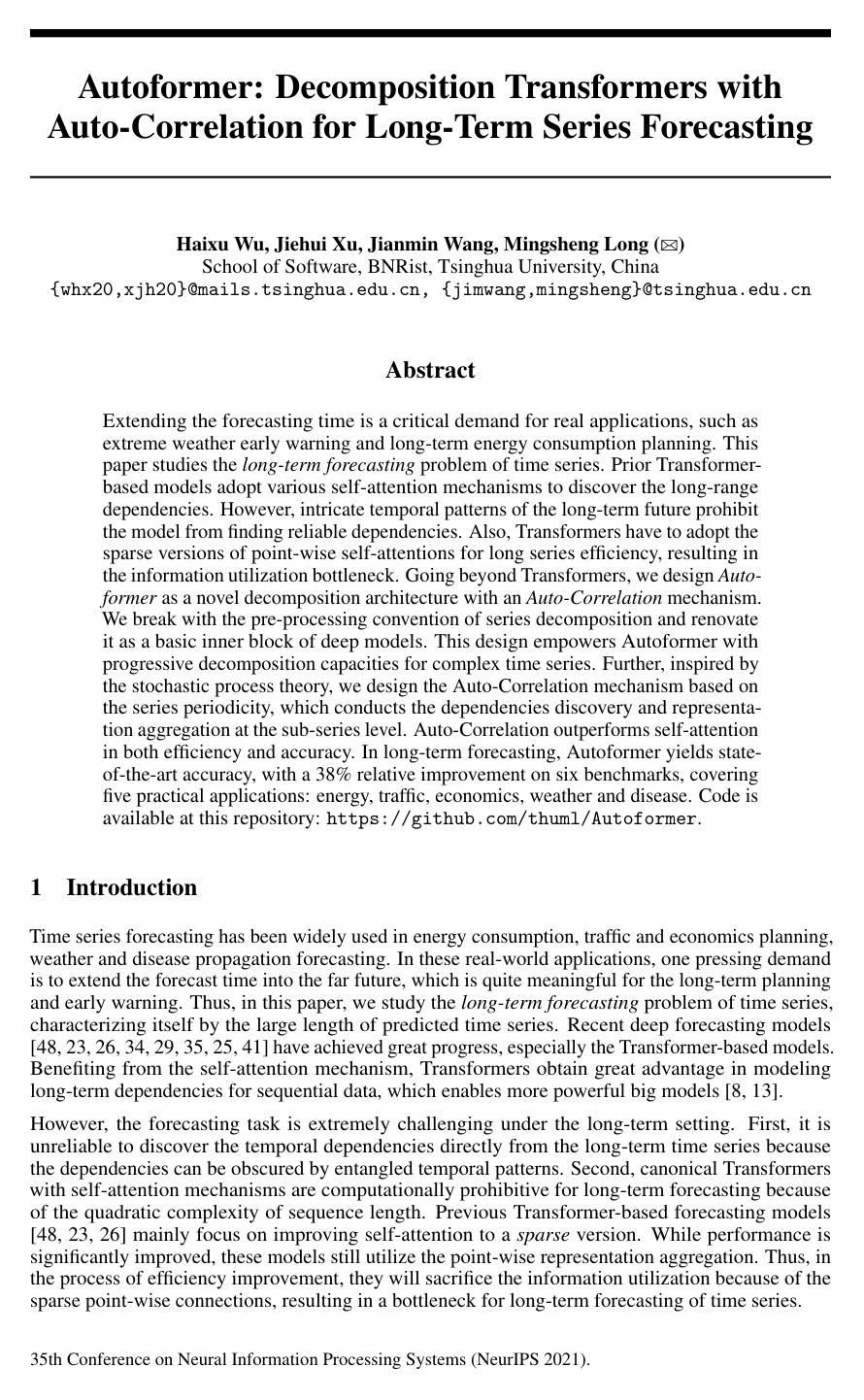
Autoformer: Decomposition Transformers with Auto-Correlation for Long-Term Series Forecasting
Haixu Wu, Jiehui Xu, Jianmin Wang, Mingsheng Long
Why you should read this
Presents Autoformer, a deep architecture that embeds progressive series decomposition and a periodicity-based Auto-Correlation mechanism to overcome the efficiency and accuracy bottlenecks of self-attention in long-term time series forecasting.
Extending the forecasting time is a critical demand for real applications, such as extreme weather early warning and long-term energy consumption planning. This paper studies the long-term forecasting problem of time series. Prior Transformer-based models adopt various self-attention mechanisms to discover the long-range dependencies. However, intricate temporal patterns of the long-term future prohibit the model from finding reliable dependencies. Also, Transformers have to adopt the sparse versions of point-wise self-attentions for long series efficiency, resulting in the information utilization bottleneck. Going beyond Transformers, we design Autoformer as a novel decomposition architecture with an Auto-Correlation mechanism. We break with the pre-processing convention of series decomposition and renovate it as a basic inner block of deep models. This design empowers Autoformer with progressive decomposition capacities for complex time series. Further, inspired by the stochastic process theory, we design the Auto-Correlation mechanism based on the series periodicity, which conducts the dependencies discovery and representation aggregation at the sub-series level. Auto-Correlation outperforms self-attention in both efficiency and accuracy. In long-term forecasting, Autoformer yields state-of-the-art accuracy, with a 38% relative improvement on six benchmarks, covering five practical applications: energy, traffic, economics, weather and disease. Code is available at this repository: \url{this https URL}.
Added
2026-09-09