
keyword
long-term forecasting
Long-term forecasting is a data science and machine learning task that involves predicting the future values of sequential data over an extended time horizon based on historical observations. Unlike short-term forecasting, which targets only immediate or near-term steps, long-term forecasting requires models to generate predictions across dozens, hundreds, or thousands of future time points. This objective demands the ability to capture global trends, multi-period cyclical patterns, and long-range temporal dependencies across univariate or multivariate series while mitigating error accumulation, computational bottlenecks, and distribution shifts over prolonged prediction windows.
12 items
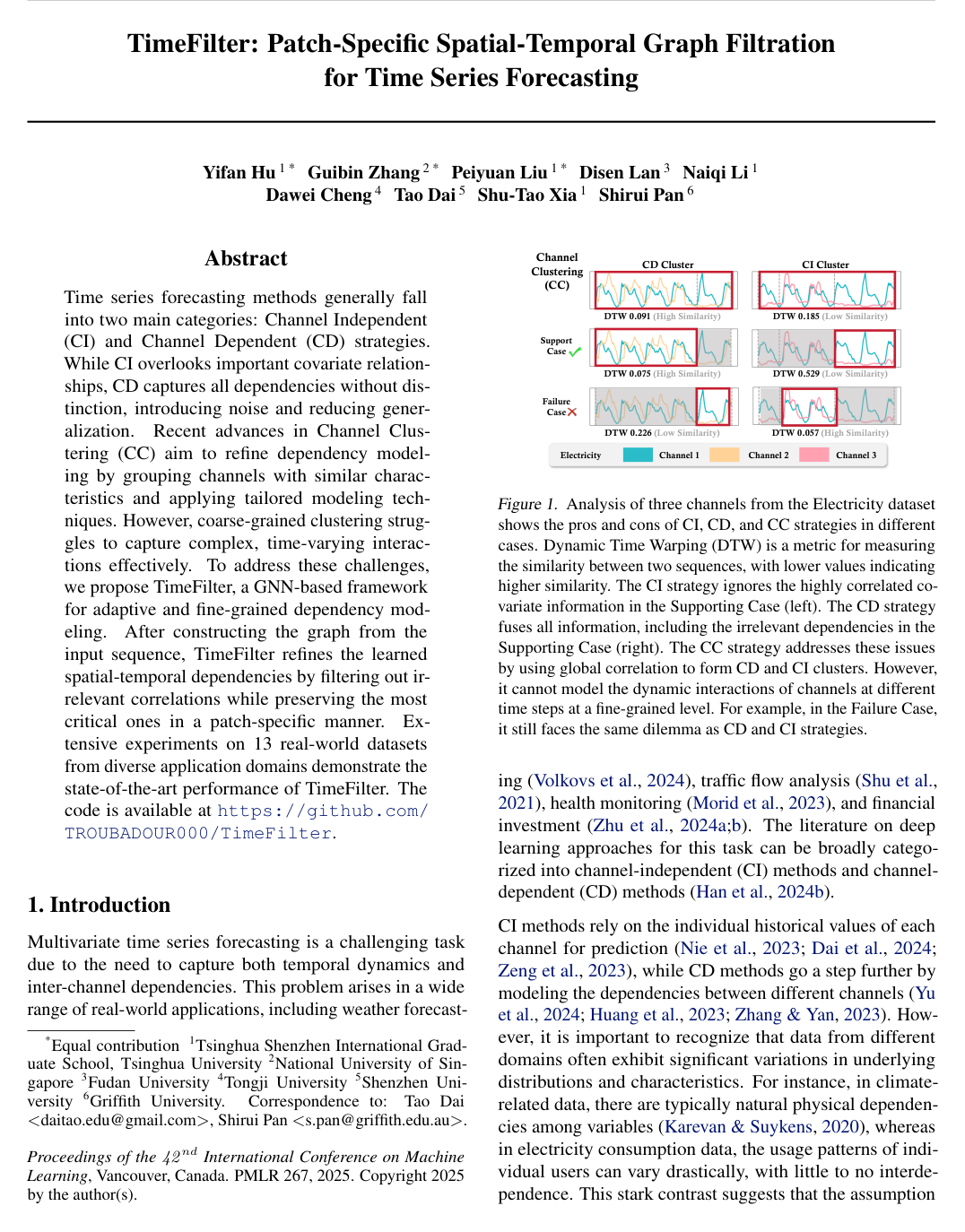
TimeFilter: Patch-Specific Spatial-Temporal Graph Filtration for Time Series Forecasting
Yifan Hu, Guibin Zhang, Peiyuan Liu, Disen Lan, Naiqi Li, Dawei Cheng, Tao Dai, Shu-Tao Xia, Shirui Pan
Why you should read this
Proposes TimeFilter, a graph neural network framework that uses dynamic mixture-of-experts routing to filter out noisy spatial-temporal dependencies at the patch level, improving both short- and long-term multivariate time series forecasting.
Time series forecasting methods generally fall into two main categories: Channel Independent (CI) and Channel Dependent (CD) strategies. While CI overlooks important covariate relationships, CD captures all dependencies without distinction, introducing noise and reducing generalization. Recent advances in Channel Clustering (CC) aim to refine dependency modeling by grouping channels with similar characteristics and applying tailored modeling techniques. However, coarse-grained clustering struggles to capture complex, time-varying interactions effectively. To address these challenges, we propose TimeFilter, a GNN-based framework for adaptive and fine-grained dependency modeling. After constructing the graph from the input sequence, TimeFilter refines the learned spatial-temporal dependencies by filtering out irrelevant correlations while preserving the most critical ones in a patch-specific manner. Extensive experiments on 13 real-world datasets from diverse application domains demonstrate the state-of-the-art performance of TimeFilter. The code is available at https://github.com/TROUBADOUR000/TimeFilter.
Added
2026-10-05

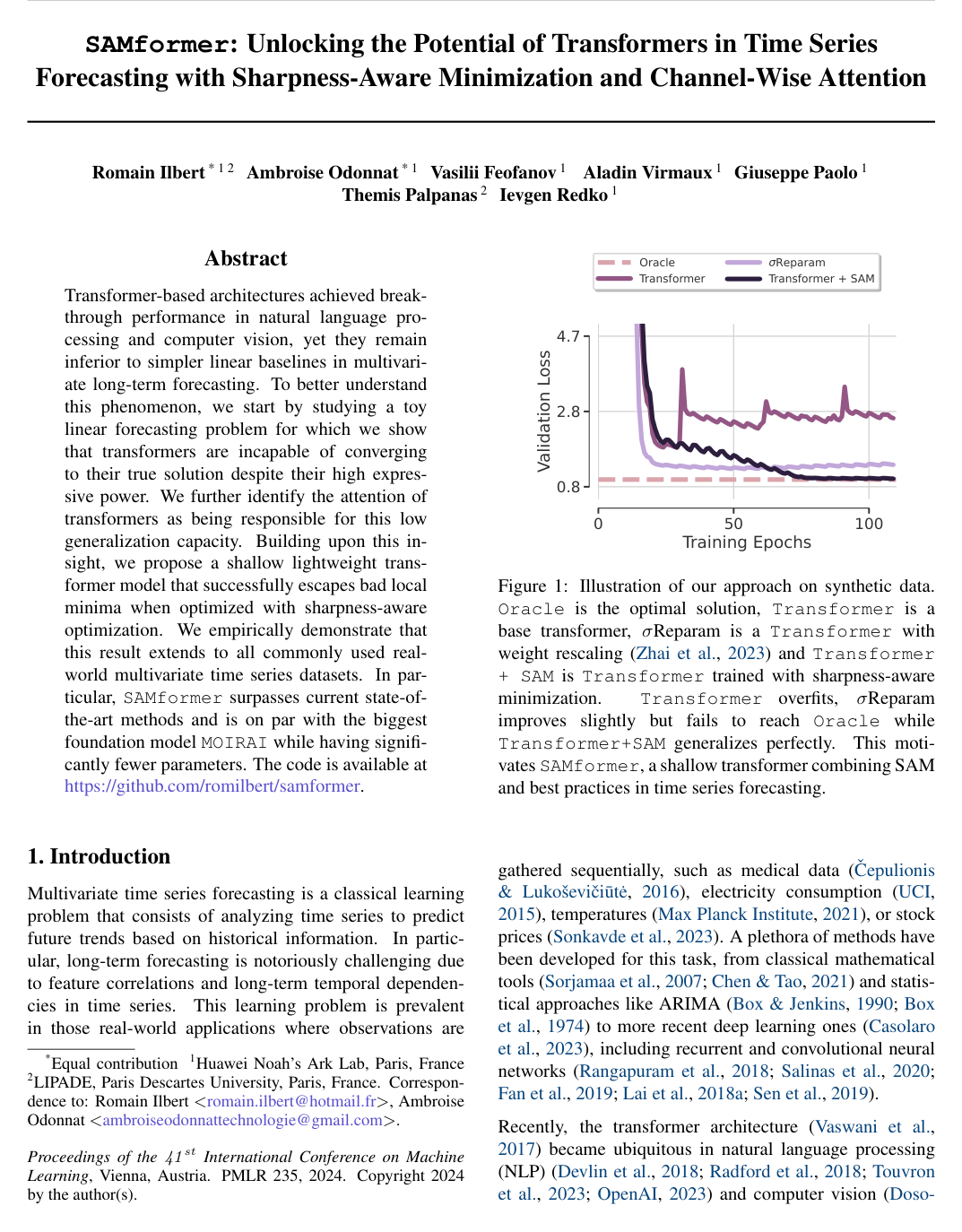
SAMformer: Unlocking the Potential of Transformers in Time Series Forecasting with Sharpness-Aware Minimization and Channel-Wise Attention
Romain Ilbert, Ambroise Odonnat, Vasilii Feofanov, Aladin Virmaux, Giuseppe Paolo, Themis Palpanas, Ievgen Redko
Why you should read this
Demonstrates why standard attention mechanisms cause transformers to fail at multivariate time series forecasting and introduces SAMformer, a lightweight channel-wise architecture trained with sharpness-aware minimization that matches large foundation models using substantially fewer parameters.
Transformer-based architectures achieved breakthrough performance in natural language processing and computer vision, yet they remain inferior to simpler linear baselines in multivariate long-term forecasting. To better understand this phenomenon, we start by studying a toy linear forecasting problem for which we show that transformers are incapable of converging to their true solution despite their high expressive power. We further identify the attention of transformers as being responsible for this low generalization capacity. Building upon this insight, we propose a shallow lightweight transformer model that successfully escapes bad local minima when optimized with sharpness-aware optimization. We empirically demonstrate that this result extends to all commonly used real-world multivariate time series datasets. In particular, SAMformer surpasses current state-of-the-art methods and is on par with the biggest foundation model MOIRAI while having significantly fewer parameters. The code is available at https://github.com/romilbert/samformer.
Added
2026-10-03
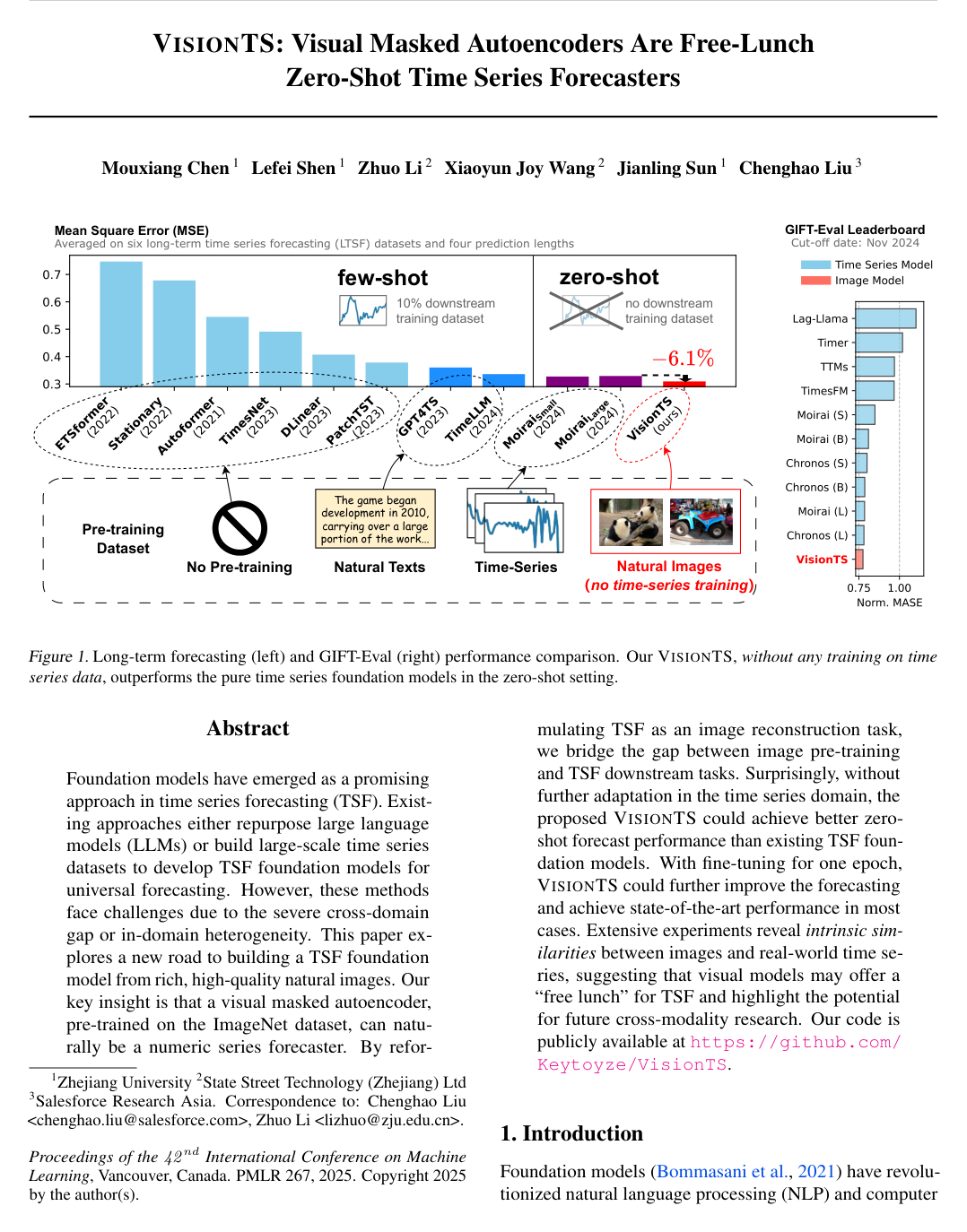
VisionTS: Visual Masked Autoencoders Are Free-Lunch Zero-Shot Time Series Forecasters
Mouxiang Chen, Lefei Shen, Zhuo Li, Xiaoyun Joy Wang, Jianling Sun, Chenghao Liu
Why you should read this
Demonstrates that off-the-shelf visual masked autoencoders pre-trained on ImageNet can outperform dedicated time series foundation models in zero-shot forecasting by casting 1D sequences into 2D masked image reconstruction tasks without requiring domain-specific pre-training.
Foundation models have emerged as a promising approach in time series forecasting (TSF). Existing approaches either repurpose large language models (LLMs) or build large-scale time series datasets to develop TSF foundation models for universal forecasting. However, these methods face challenges due to the severe cross-domain gap or in-domain heterogeneity. This paper explores a new road to building a TSF foundation model from rich, high-quality natural images. Our key insight is that a visual masked autoencoder, pre-trained on the ImageNet dataset, can naturally be a numeric series forecaster. By reformulating TSF as an image reconstruction task, we bridge the gap between image pre-training and TSF downstream tasks. Surprisingly, without further adaptation in the time series domain, the proposed VisionTS could achieve better zero-shot forecast performance than existing TSF foundation models. With fine-tuning for one epoch, VisionTS could further improve the forecasting and achieve state-of-the-art performance in most cases. Extensive experiments reveal intrinsic similarities between images and real-world time series, suggesting that visual models may offer a “free lunch” for TSF and highlight the potential for future cross-modality research. Our code is publicly available at https://github.com/Keytoyze/VisionTS.
Added
2026-10-02
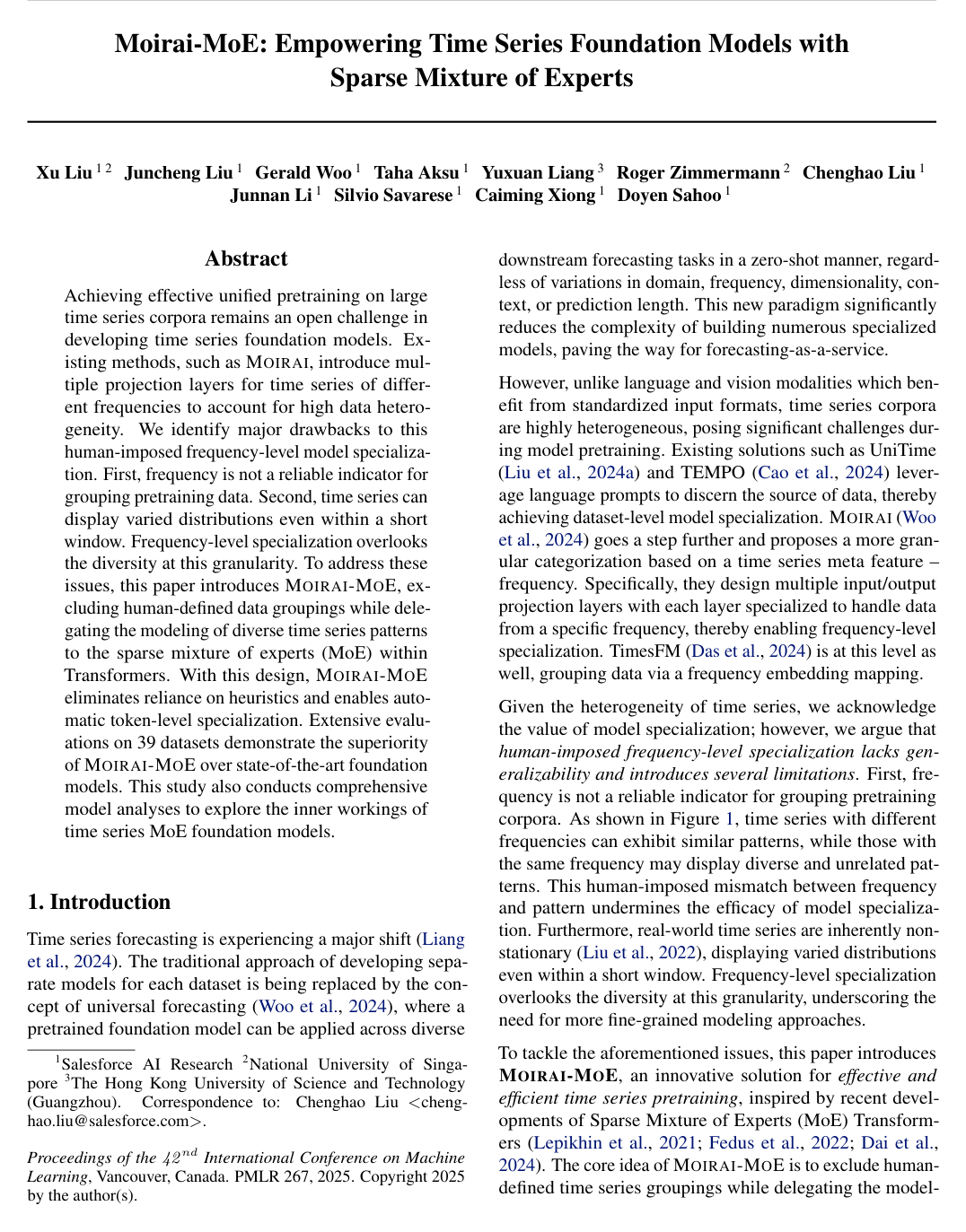
Moirai-MoE: Empowering Time Series Foundation Models with Sparse Mixture of Experts
Xu Liu, Juncheng Liu, Gerald Woo, Taha Aksu, Yuxuan Liang, Roger Zimmermann, Chenghao Liu, Junnan Li, Silvio Savarese, Caiming Xiong, Doyen Sahoo
Why you should read this
Proposes a sparse mixture-of-experts time series foundation model that replaces rigid frequency-based groupings with dynamic token-level specialization, achieving superior zero-shot forecasting across 39 datasets while activating up to 65 times fewer parameters.
Existing pretrained models for time series forecasting typically operate under a unified framework using fixed parameters during inference. Yet different formulations have been proposed depending on the specifics of data variety and complexity, making them unsuitable for diverse datasets distribution shift. The presence of varying frequencies patterns as well as temporal distributions introduces complexities requiring the learning process accommodates yet remains robust through unseen variations. Such constraints make generalist approaches difficult while specialized variants handle granular aspects poorly considering broad coverage demands.
Added
2026-10-02
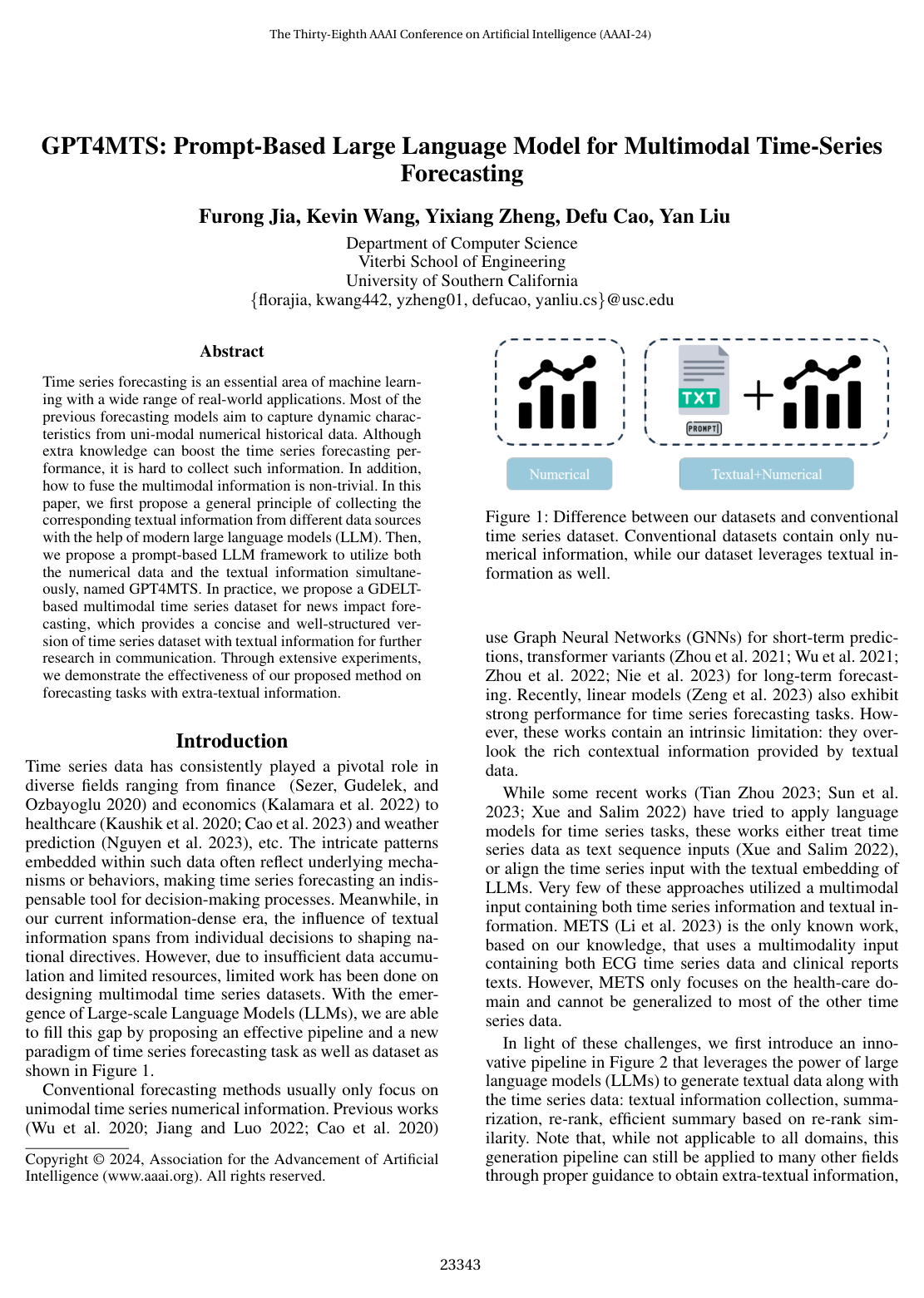
GPT4MTS: Prompt-based Large Language Model for Multimodal Time-series Forecasting
Furong Jia, Kevin Wang, Yixiang Zheng, Defu Cao, Yan Liu
Why you should read this
Proposes a prompt-tuning framework alongside an automated text-collection pipeline to integrate textual news summaries with numerical data for multimodal time-series forecasting.
Time series forecasting is an essential area of machine learning with a wide range of real-world applications. Most of the previous forecasting models aim to capture dynamic characteristics from uni-modal numerical historical data. Although extra knowledge can boost the time series forecasting performance, it is hard to collect such information. In addition, how to fuse the multimodal information is non-trivial. In this paper, we first propose a general principle of collecting the corresponding textual information from different data sources with the help of modern large language models (LLM). Then, we propose a prompt-based LLM framework to utilize both the numerical data and the textual information simultaneously, named GPT4MTS. In practice, we propose a GDELT-based multimodal time series dataset for news impact forecasting, which provides a concise and well-structured version of time series dataset with textual information for further research in communication. Through extensive experiments, we demonstrate the effectiveness of our proposed method on forecasting tasks with extra-textual information.
Added
2026-09-26
TimesURL: Self-Supervised Contrastive Learning for Universal Time Series Representation Learning
Jiexi Liu, Songcan Chen
Why you should read this
Proposes TimesURL, a self-supervised framework combining frequency-temporal data augmentations, synthesized Universum hard negatives, and a joint reconstruction objective to learn universal time series representations that achieve state-of-the-art results across six distinct downstream tasks.
Learning universal time series representations applicable to various types of downstream tasks is challenging but valuable in real applications. Recently, researchers have attempted to leverage the success of self-supervised contrastive learning (SSCL) in Computer Vision(CV) and Natural Language Processing(NLP) to tackle time series representation. Nevertheless, due to the special temporal characteristics, relying solely on empirical guidance from other domains may be ineffective for time series and difficult to adapt to multiple downstream tasks. To this end, we review three parts involved in SSCL including 1) designing augmentation methods for positive pairs, 2) constructing (hard) negative pairs, and 3) designing SSCL loss. For 1) and 2), we find that unsuitable positive and negative pair construction may introduce inappropriate inductive biases, which neither preserve temporal properties nor provide sufficient discriminative features. For 3), just exploring segment- or instance-level semantics information is not enough for learning universal representation. To remedy the above issues, we propose a novel self-supervised framework named TimesURL. Specifically, we first introduce a frequency-temporal-based augmentation to keep the temporal property unchanged. And then, we construct double Universums as a special kind of hard negative to guide better contrastive learning. Additionally, we introduce time reconstruction as a joint optimization objective with contrastive learning to capture both segment-level and instance-level information. As a result, TimesURL can learn high-quality universal representations and achieve state-of-the-art performance in 6 different downstream tasks, including short- and long-term forecasting, imputation, classification, anomaly detection and transfer learning.
Added
2026-09-26
Transformers in Time Series: A Survey
Qingsong Wen, Tian Zhou, Chao Zhang, Weiqiu Chen, Ziqing Ma, Junchi Yan, Liang Sun
Why you should read this
Presents a systematic taxonomy of Transformer adaptations for time series forecasting, anomaly detection, and classification alongside empirical analyses of model size and seasonal decomposition to guide future architectural designs.
Transformers have achieved superior performances in many tasks in natural language processing and computer vision, which also triggered great interest in the time series community. Among multiple advantages of Transformers, the ability to capture long-range dependencies and interactions is especially attractive for time series modeling, leading to exciting progress in various time series applications. In this paper, we systematically review Transformer schemes for time series modeling by highlighting their strengths as well as limitations. In particular, we examine the development of time series Transformers in two perspectives. From the perspective of network structure, we summarize the adaptations and modifications that have been made to Transformers in order to accommodate the challenges in time series analysis. From the perspective of applications, we categorize time series Transformers based on common tasks including forecasting, anomaly detection, and classification. Empirically, we perform robust analysis, model size analysis, and seasonal-trend decomposition analysis to study how Transformers perform in time series. Finally, we discuss and suggest future directions to provide useful research guidance. To the best of our knowledge, this paper is the first work to comprehensively and systematically summarize the recent advances of Transformers for modeling time series data. We hope this survey will ignite further research interests in time series Transformers.
Added
2026-09-24
Enhancing the Locality and Breaking the Memory Bottleneck of Transformer on Time Series Forecasting
SHIYANG LI, Xiaoyong Jin, Yao Xuan, Xiyou Zhou, Wenhu Chen, Yu-Xiang Wang, Xifeng Yan
Why you should read this
Proposes convolutional self-attention and a LogSparse Transformer architecture that reduces memory complexity to O(L(log L)^2), solving the key challenges of local context insensitivity and quadratic memory bottlenecks in long-sequence time series forecasting.
Time series forecasting is an important problem across many domains, including predictions of solar plant energy output, electricity consumption, and traffic jam situation. In this paper, we propose to tackle such forecasting problem with Transformer [1]. Although impressed by its performance in our preliminary study, we found its two major weaknesses: (1) locality-agnostics: the point-wise dot-product self-attention in canonical Transformer architecture is insensitive to local context, which can make the model prone to anomalies in time series; (2) memory bottleneck: space complexity of canonical Transformer grows quadratically with sequence length , making directly modeling long time series infeasible. In order to solve these two issues, we first propose convolutional self-attention by producing queries and keys with causal convolution so that local context can be better incorporated into attention mechanism. Then, we propose LogSparse Transformer with only memory cost, improving forecasting accuracy for time series with fine granularity and strong long-term dependencies under constrained memory budget. Our experiments on both synthetic data and real-world datasets show that it compares favorably to the state-of-the-art.
Added
2026-09-17
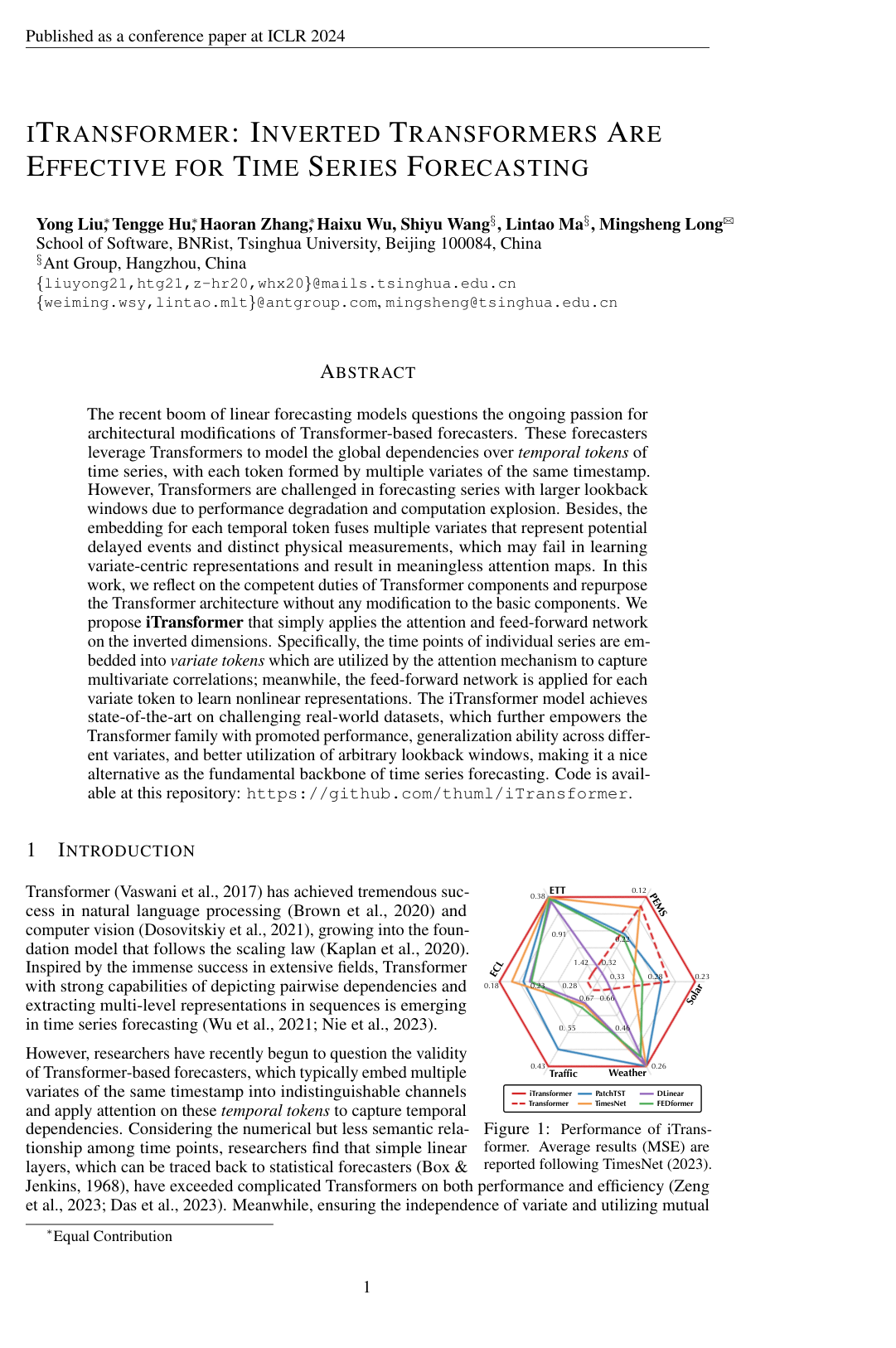
iTransformer: Inverted Transformers Are Effective for Time Series Forecasting
Yong Liu, Tengge Hu, Haoran Zhang, Haixu Wu, Shiyu Wang, Lintao Ma, Mingsheng Long
Why you should read this
Proposes iTransformer, an architecture that inverts conventional attention by embedding entire time series into individual variate tokens, outperforming both linear baselines and standard Transformers on long-sequence multivariate forecasting.
The recent boom of linear forecasting models questions the ongoing passion for architectural modifications of Transformer-based forecasters. These forecasters leverage Transformers to model the global dependencies over temporal tokens of time series, with each token formed by multiple variates of the same timestamp. However, Transformers are challenged in forecasting series with larger lookback windows due to performance degradation and computation explosion. Besides, the embedding for each temporal token fuses multiple variates that represent potential delayed events and distinct physical measurements, which may fail in learning variate-centric representations and result in meaningless attention maps. In this work, we reflect on the competent duties of Transformer components and repurpose the Transformer architecture without any modification to the basic components. We propose iTransformer that simply applies the attention and feed-forward network on the inverted dimensions. Specifically, the time points of individual series are embedded into variate tokens which are utilized by the attention mechanism to capture multivariate correlations; meanwhile, the feed-forward network is applied for each variate token to learn nonlinear representations. The iTransformer model achieves state-of-the-art on challenging real-world datasets, which further empowers the Transformer family with promoted performance, generalization ability across different variates, and better utilization of arbitrary lookback windows, making it a nice alternative as the fundamental backbone of time series forecasting. Code is available at this repository: this https URL.
Added
2026-09-16
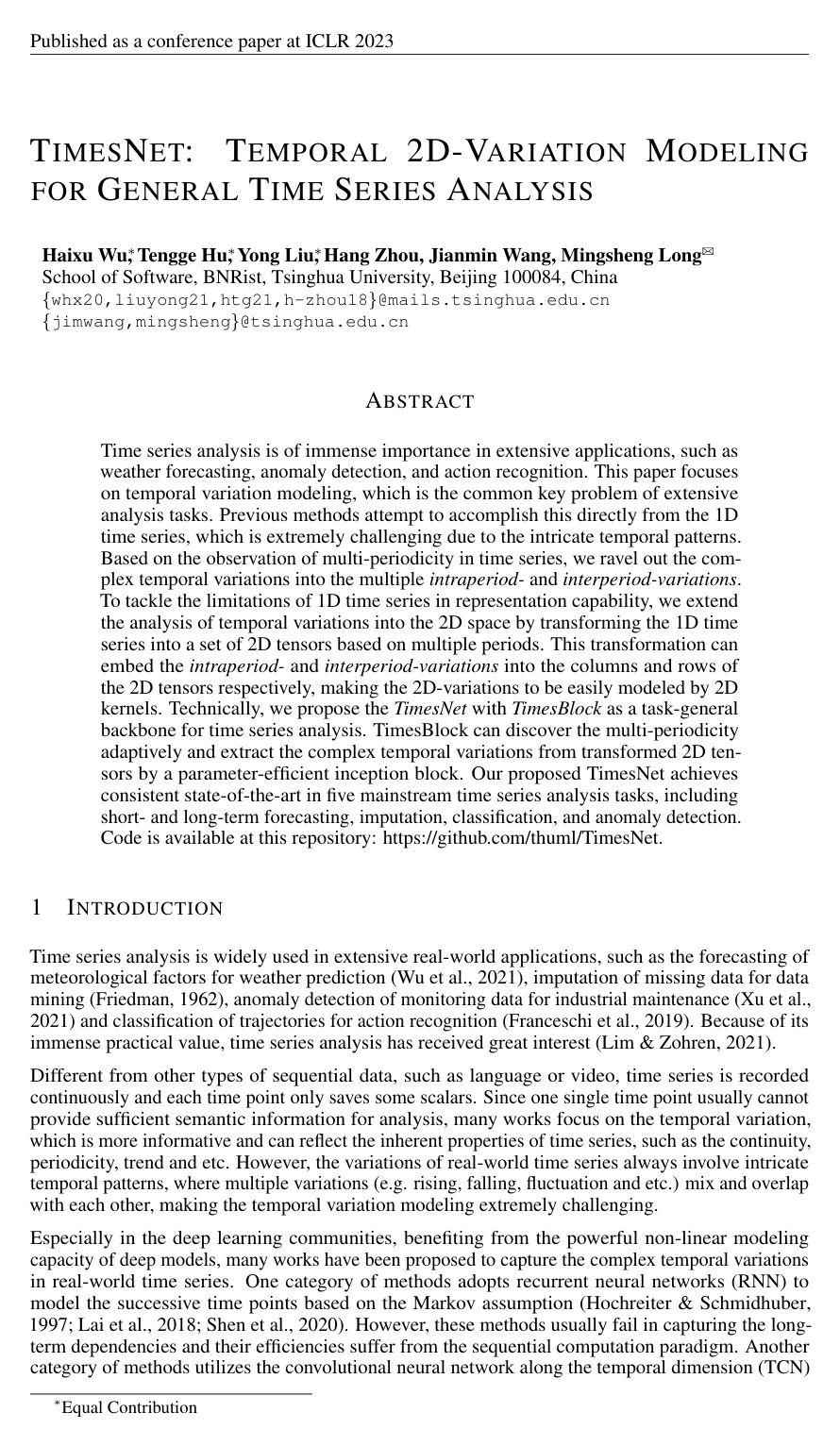
TimesNet: Temporal 2D-Variation Modeling for General Time Series Analysis
Haixu Wu, Teng Hu, Yong Liu, Hang Zhou, Jianmin Wang, Mingsheng Long
Why you should read this
Proposes TimesNet, a general time series backbone that transforms 1D signals into multi-periodic 2D tensors to capture intra- and inter-period variations using 2D kernels, achieving state-of-the-art performance across forecasting, imputation, classification, and anomaly detection.
Time series analysis is of immense importance in extensive applications, such as weather forecasting, anomaly detection, and action recognition. This paper focuses on temporal variation modeling, which is the common key problem of extensive analysis tasks. Previous methods attempt to accomplish this directly from the 1D time series, which is extremely challenging due to the intricate temporal patterns. Based on the observation of multi-periodicity in time series, we ravel out the complex temporal variations into the multiple intraperiod- and interperiod-variations. To tackle the limitations of 1D time series in representation capability, we extend the analysis of temporal variations into the 2D space by transforming the 1D time series into a set of 2D tensors based on multiple periods. This transformation can embed the intraperiod- and interperiod-variations into the columns and rows of the 2D tensors respectively, making the 2D-variations to be easily modeled by 2D kernels. Technically, we propose the TimesNet with TimesBlock as a task-general backbone for time series analysis. TimesBlock can discover the multi-periodicity adaptively and extract the complex temporal variations from transformed 2D tensors by a parameter-efficient inception block. Our proposed TimesNet achieves consistent state-of-the-art in five mainstream time series analysis tasks, including short- and long-term forecasting, imputation, classification, and anomaly detection. Code is available at this repository: this https URL.
Added
2026-09-14
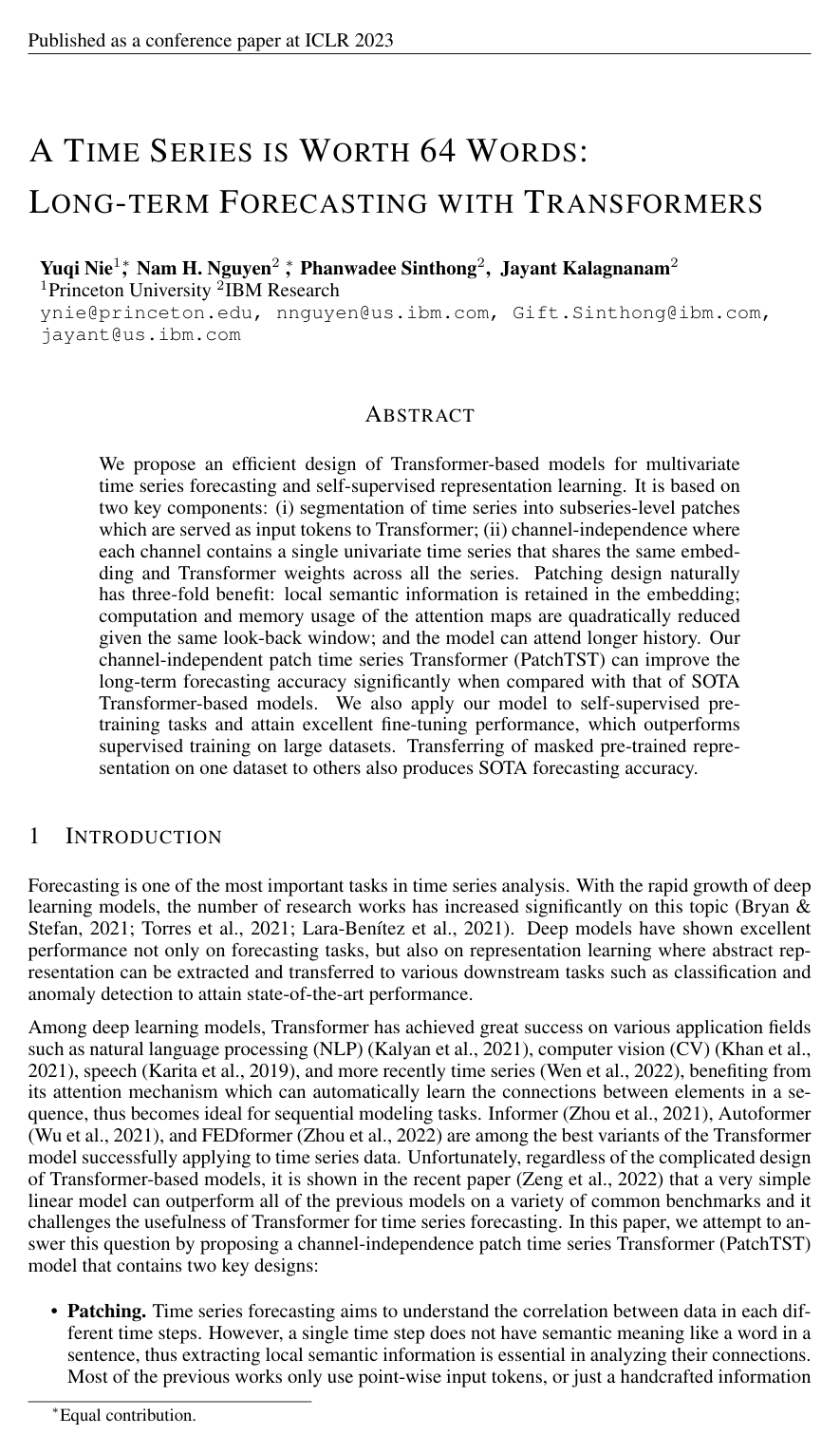
A Time Series is Worth 64 Words: Long-term Forecasting with Transformers
Yuqi Nie, Nam H. Nguyen, Phanwadee Sinthong, Jayant Kalagnanam
Why you should read this
Establishes a revolutionary state-of-the-art framework by intelligently patching time series segments into distinct tokens to preserve local semantics while simultaneously conquering the quadratic memory bottleneck of long-range transformers.
We propose an efficient design of Transformer-based models for multivariate time series forecasting and self-supervised representation learning. It is based on two key components: (i) segmentation of time series into subseries-level patches which are served as input tokens to Transformer; (ii) channel-independence where each channel contains a single univariate time series that shares the same embedding and Transformer weights across all the series. Patching design naturally has three-fold benefit: local semantic information is retained in the embedding; computation and memory usage of the attention maps are quadratically reduced given the same look-back window; and the model can attend longer history. Our channel-independent patch time series Transformer (PatchTST) can improve the long-term forecasting accuracy significantly when compared with that of SOTA Transformer-based models. We also apply our model to self-supervised pre-training tasks and attain excellent fine-tuning performance, which outperforms supervised training on large datasets. Transferring of masked pre-trained representation on one dataset to others also produces SOTA forecasting accuracy. Code is available at: https://github.com/yuqinie98/PatchTST.
Added
2026-06-27
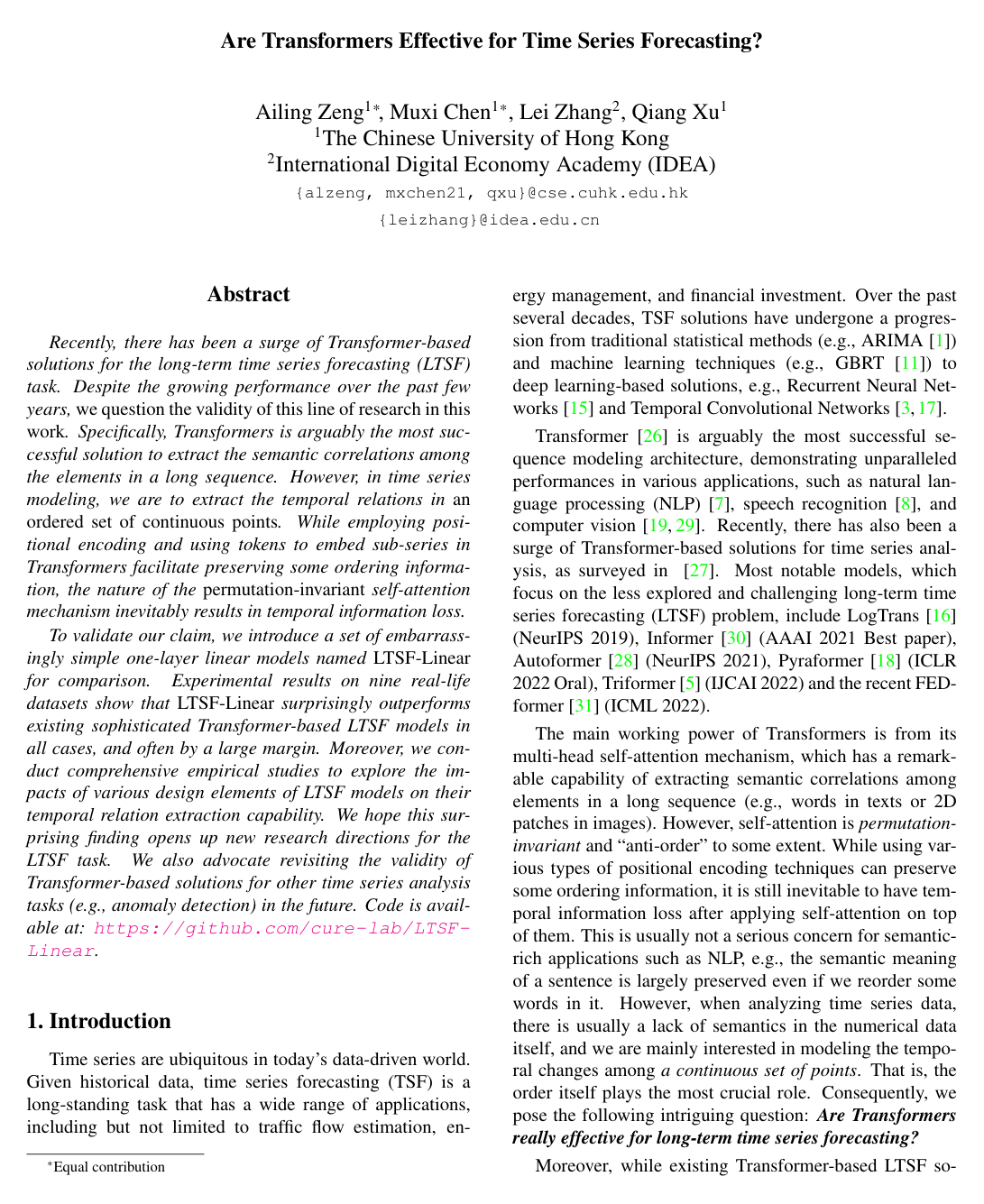
Are Transformers Effective for Time Series Forecasting?
Ailing Zeng, Muxi Chen, Lei Zhang, Qiang Xu
Why you should read this
Demonstrates that embarrassingly simple one-layer linear models consistently outperform sophisticated Transformer-based architectures in long-term time series forecasting, challenging the prevailing research trend by revealing that complex attention mechanisms often fail to capture temporal dependencies as effectively as basic linear baselines.
Recently, there has been a surge of Transformer-based solutions for the long-term time series forecasting (LTSF) task. Despite the growing performance over the past few years, we question the validity of this line of research in this work. Specifically, Transformers is arguably the most successful solution to extract the semantic correlations among the elements in a long sequence. However, in time series modeling, we are to extract the temporal relations in an ordered set of continuous points. While employing positional encoding and using tokens to embed sub-series in Transformers facilitate preserving some ordering information, the nature of the permutation-invariant self-attention mechanism inevitably results in temporal information loss. To validate our claim, we introduce a set of embarrassingly simple one-layer linear models named LTSF-Linear for comparison. Experimental results on nine real-life datasets show that LTSF-Linear surprisingly outperforms existing sophisticated Transformer-based LTSF models in all cases, and often by a large margin. Moreover, we conduct comprehensive empirical studies to explore the impacts of various design elements of LTSF models on their temporal relation extraction capability. We hope this surprising finding opens up new research directions for the LTSF task. We also advocate revisiting the validity of Transformer-based solutions for other time series analysis tasks (e.g., anomaly detection) in the future.
Added
2026-05-18