
keyword
long-horizon memory
Long-horizon memory refers to the architectural and computational capability of an artificial intelligence system to retain, organize, and dynamically utilize information across extended timeframes, multi-step execution paths, or long sequences of interaction. Unlike fixed, short-term context windows that only manage immediate observations, long-horizon memory allows autonomous agents and generative models to preserve evolving states, track temporal relationships, and selectively reconstruct pertinent historical evidence over prolonged operational periods. This enables continuous systems to maintain consistency, perform complex causal reasoning across distant events, and execute extended workflows without suffering from memory degradation or excessive computational overhead.
3 items
SentinelBench: A Benchmark for Long-Running Monitoring Agents
Matheus Kunzler Maldaner, Adam Fourney, Amanda Swearngin, Hussein Mozannar, Gagan Bansal, Maya Murad, Rafah Hosn, Saleema Amershi
Why you should read this
Introduces SentinelBench, an open-source benchmark of 100 dynamic web tasks that evaluates how effectively autonomous agents monitor changing interfaces and balance reaction speed against resource consumption over extended periods.
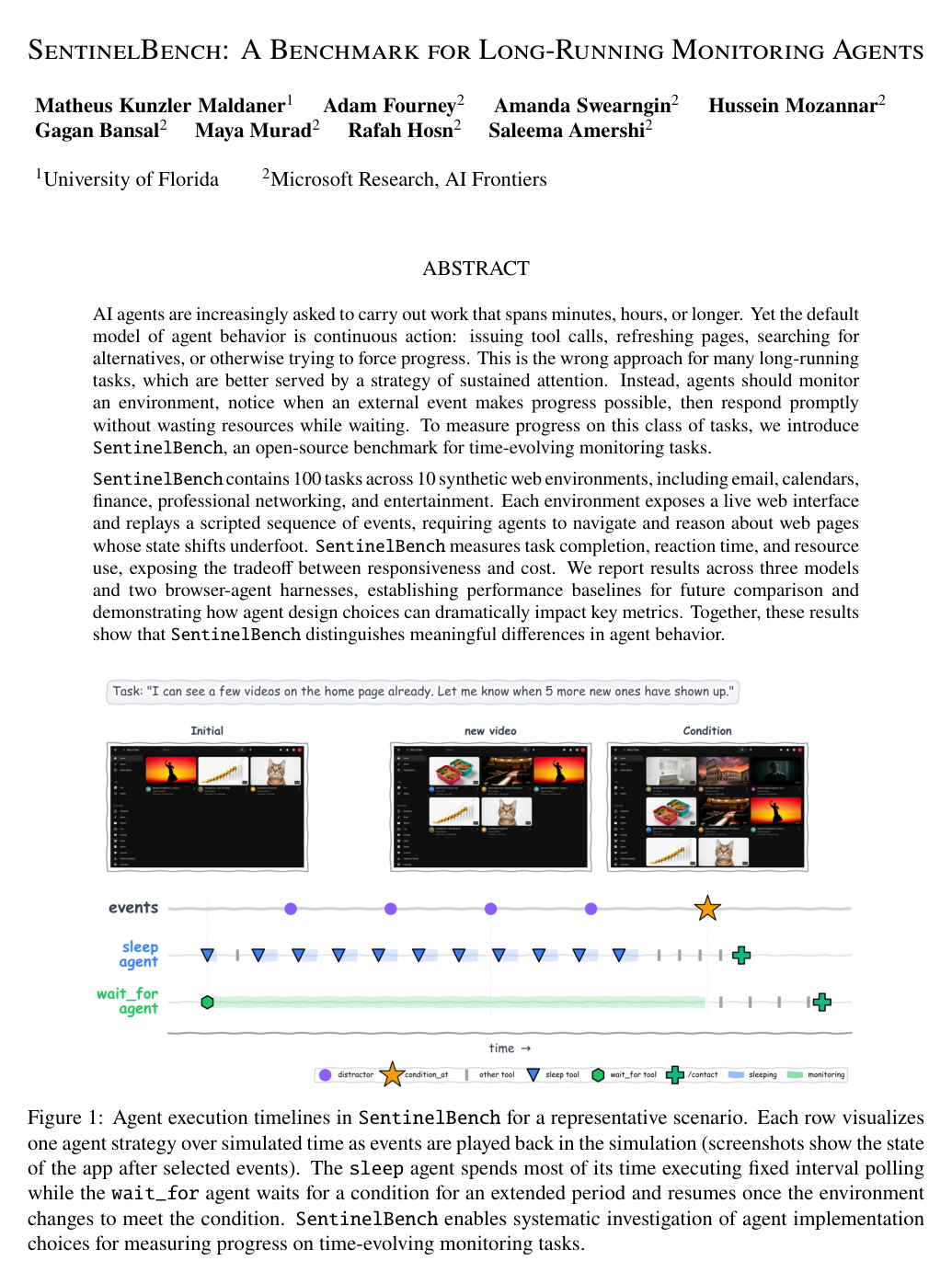
AI agents are increasingly asked to carry out work that spans minutes, hours, or longer. Yet the default model of agent behavior is continuous action: issuing tool calls, refreshing pages, searching for alternatives, or otherwise trying to force progress. This is the wrong approach for many long-running tasks, which are better served by a strategy of sustained attention. Instead, agents should monitor an environment, notice when an external event makes progress possible, then respond promptly without wasting resources while waiting. To measure progress on this class of tasks, we introduce SentinelBench, an open-source benchmark for time-evolving monitoring tasks. SentinelBench contains 100 tasks across 10 synthetic web environments, including email, calendars, finance, professional networking, and entertainment. Each environment exposes a live web interface and replays a scripted sequence of events, requiring agents to navigate and reason about web pages whose state shifts underfoot. SentinelBench measures task completion, reaction time, and resource use, exposing the tradeoff between responsiveness and cost. We report results across three models and two browser-agent harnesses, establishing performance baselines for future comparison and demonstrating how agent design choices can dramatically impact key metrics. Together, these results show that SentinelBench distinguishes meaningful differences in agent behavior.
Added
2026-09-29
History-Guided Video Diffusion
Kiwhan Song, Boyuan Chen, Max Simchowitz, Yilun Du, Russ Tedrake, Vincent Sitzmann
Why you should read this
Proposes the Diffusion Forcing Transformer and History Guidance framework, enabling video diffusion models to condition on flexible, variable-length history frames across time and frequency bands to achieve stable, high-quality long-video generation.
Classifier-free guidance (CFG) is a key technique for improving conditional generation in diffusion models, enabling more accurate control while enhancing sample quality. It is natural to extend this technique to video diffusion, which generates video conditioned on a variable number of context frames, collectively referred to as history. However, we find two key challenges to guiding with variable-length history: architectures that only support fixed-size conditioning, and the empirical observation that CFG-style history dropout performs poorly. To address this, we propose the Diffusion Forcing Transformer (DFoT), a video diffusion architecture and theoretically grounded training objective that jointly enable conditioning on a flexible number of history frames. We then introduce History Guidance, a family of guidance methods uniquely enabled by DFoT. We show that its simplest form, vanilla history guidance, already significantly improves video generation quality and temporal consistency. A more advanced method, history guidance across time and frequency further enhances motion dynamics, enables compositional generalization to out-of-distribution history, and can stably roll out extremely long videos. Project website: https://boyuan.space/history-guidance
Added
2026-09-26
Memory is Reconstructed, Not Retrieved: Graph Memory for LLM Agents
Shuo Ji, Yibo Li, Bryan Hooi
Why you should read this
Develops MRAgent, a framework that uniquely integrates an associative memory graph with active reconstruction, enabling LLM agents to dynamically adapt memory access to reasoning contexts for enhanced performance in long-horizon tasks while reducing computational costs.
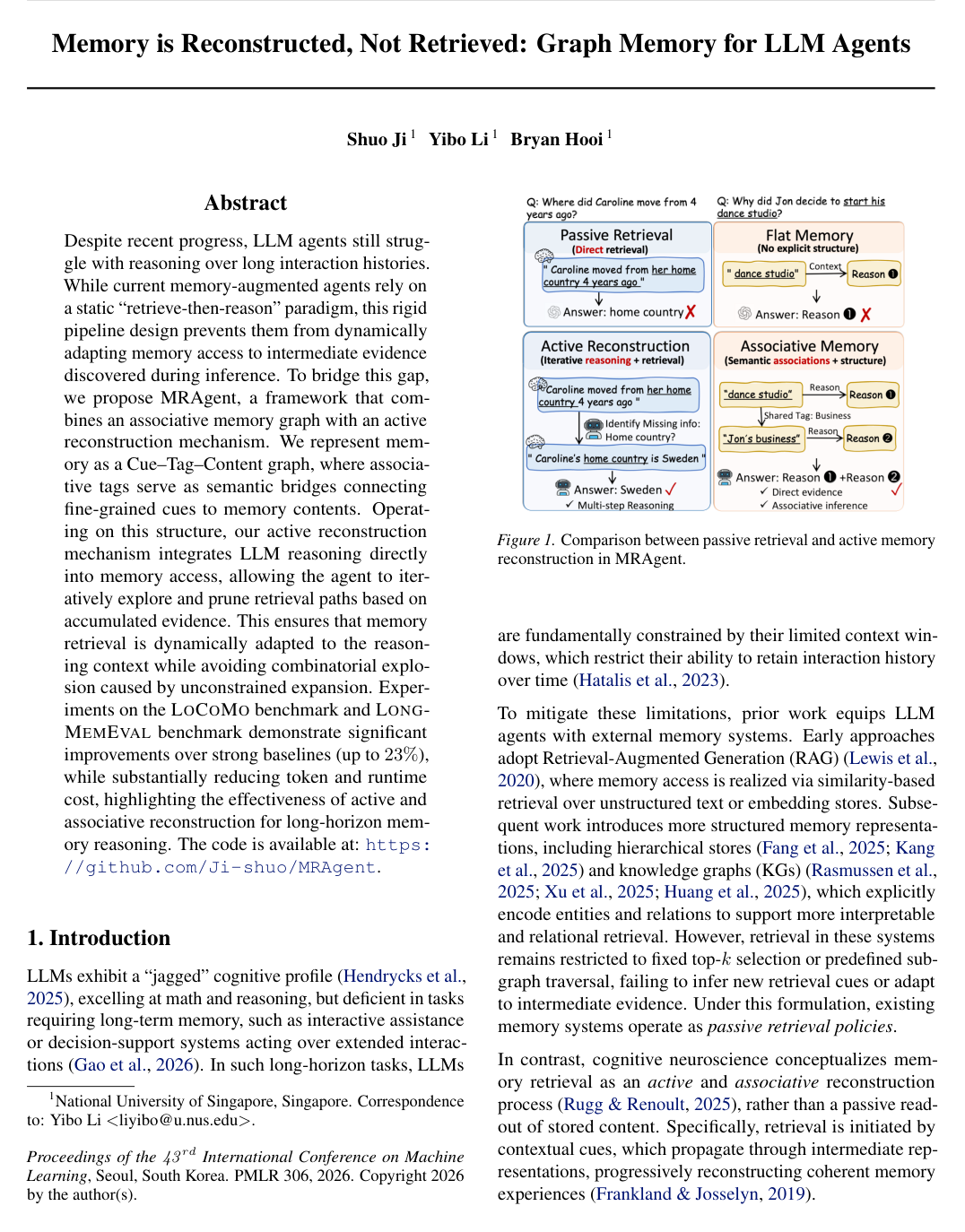
Despite recent progress, LLM agents still struggle with reasoning over long interaction histories. While current memory-augmented agents rely on a static retrieve-then-reason paradigm, this rigid pipeline design prevents them from dynamically adapting memory access to intermediate evidence discovered during inference. To bridge this gap, we propose MRAgent, a framework that combines an associative memory graph with an active reconstruction mechanism. We represent memory as a Cue-Tag-Content graph, where associative tags serve as semantic bridges connecting fine-grained cues to memory contents. Operating on this structure, our active reconstruction mechanism integrates LLM reasoning directly into memory access, allowing the agent to iteratively explore and prune retrieval paths based on accumulated evidence. This ensures that memory retrieval is dynamically adapted to the reasoning context while avoiding combinatorial explosion caused by unconstrained expansion. Experiments on the LoCoMo benchmark and LongMemEval benchmark demonstrate significant improvements over strong baselines (up to 23%), while substantially reducing token and runtime cost, highlighting the effectiveness of active and associative reconstruction for long-horizon memory reasoning.
Added
2026-07-09
