
keyword
long-context LLMs
Long-context LLMs are large language models designed to accept and process unusually large amounts of text in a single input. This lets them work across lengthy documents, multiple documents, or extended conversations, though handling long inputs does not by itself guarantee accurate understanding or recall.
4 items
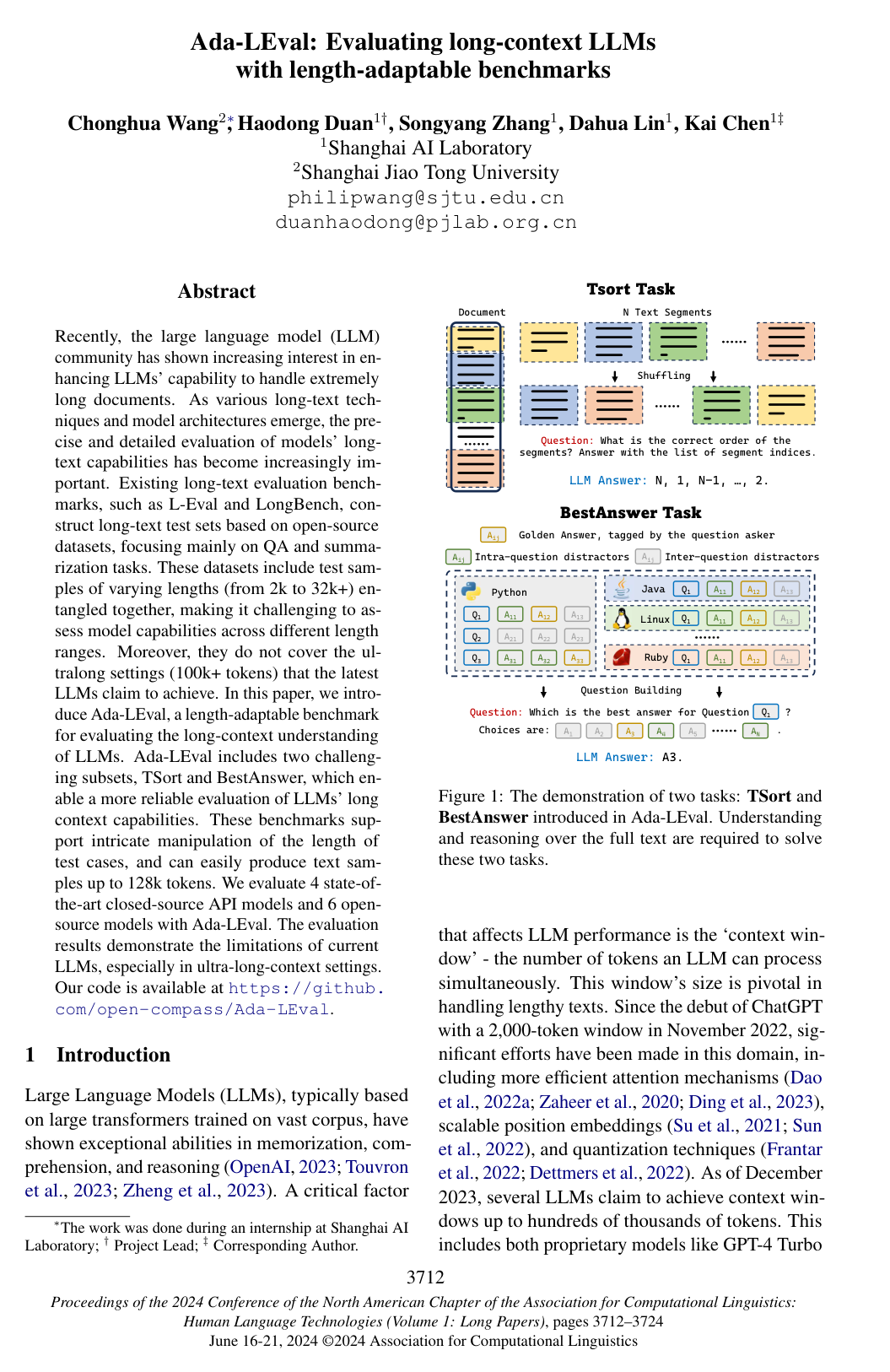
Ada-LEval: Evaluating long-context LLMs with length-adaptable benchmarks
Chonghua Wang, Haodong Duan, Songyang Zhang, Dahua Lin, Kai Chen
Why you should read this
Introduces Ada-LEval, a length-adaptable benchmark scaling up to 128k tokens with two rigorous tasks that require whole-document comprehension, exposing severe performance degradation in leading large language models on ultra-long contexts.
Recently, the large language model (LLM) community has shown increasing interest in enhancing LLMs’ capability to handle extremely long documents. As various long-text techniques and model architectures emerge, the precise and detailed evaluation of models’ long-text capabilities has become increasingly important. Existing long-text evaluation benchmarks, such as L-Eval and LongBench, construct long-text test sets based on open-source datasets, focusing mainly on QA and summarization tasks. These datasets include test samples of varying lengths (from 2k to 32k+) entangled together, making it challenging to assess model capabilities across different length ranges. Moreover, they do not cover the ultra-long settings (100k+ tokens) that the latest LLMs claim to achieve. In this paper, we introduce Ada-LEval, a length-adaptable benchmark for evaluating the long-context understanding of LLMs. Ada-LEval includes two challenging subsets, TSort and BestAnswer, which enable a more reliable evaluation of LLMs’ long context capabilities. These benchmarks support intricate manipulation of the length of test cases, and can easily produce text samples up to 128k tokens. We evaluate 4 state-of-the-art closed-source API models and 6 open-source models with Ada-LEval. The evaluation results demonstrate the limitations of current LLMs, especially in ultra-long-context settings. Our code is available at https://github.com/open-compass/Ada-LEval.
Added
2026-10-05
Summary of a Haystack: A Challenge to Long-Context LLMs and RAG Systems
Philippe Laban, Alexander R. Fabbri, Caiming Xiong, Chien-Sheng Wu
Why you should read this
Introduces SummHay, a synthetic long-context benchmark that exposes critical weaknesses in leading language models and retrieval-augmented generation systems by evaluating their ability to aggregate dispersed insights and accurately cite sources across 100,000-token document collections.
LLMs and RAG systems are now capable of handling millions of input tokens or more. However, evaluating the output quality of such systems on long-context tasks remains challenging, as tasks like Needle-in-a-Haystack lack complexity. In this work, we argue that summarization can play a central role in such evaluation. We design a procedure to synthesize Haystacks of documents, ensuring that specific insights repeat across documents. The “Summary of a Haystack” (SummHay) task then requires a system to process the Haystack and generate, given a query, a summary that identifies the relevant insights and precisely cites the source documents. Since we have precise knowledge of what insights should appear in a haystack summary and what documents should be cited, we implement a highly reproducible automatic evaluation that can score summaries on two aspects – Coverage and Citation. We generate Haystacks in two domains (conversation, news), and perform a large-scale evaluation of 14 LLMs and corresponding 50 RAG systems. Our findings indicate that SummHay is an open challenge for current systems, as even systems provided with an Oracle signal of document relevance lag our estimate of human performance (56%) by 10+ points on a Joint Score. Without a retriever, long-context LLMs like GPT-4o and Claude 3 Opus score below 20% on SummHay. We show SummHay can also be used to study enterprise RAG systems and position bias in long-context models. We hope future systems can equal and surpass human performance on SummHay.
Added
2026-10-02
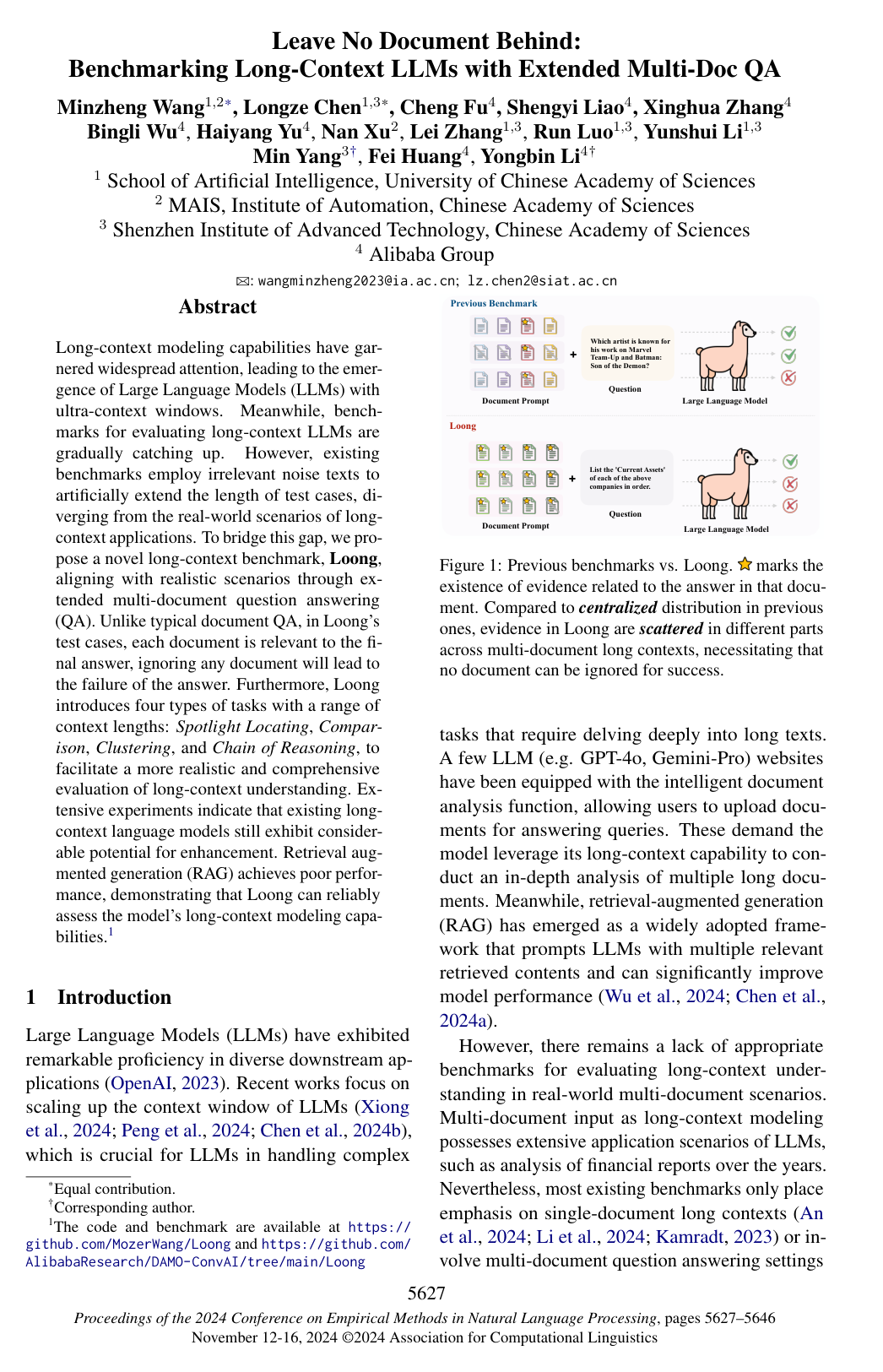
Leave No Document Behind: Benchmarking Long-Context LLMs with Extended Multi-Doc QA
Minzheng Wang, Longze Chen, Fu Cheng, Shengyi Liao, Xinghua Zhang, Bingli Wu, Haiyang Yu, Nan Xu, Lei Zhang, Run Luo, Yunshui Li, Min Yang, Fei Huang, Yongbin Li
Why you should read this
Introduces Loong, a realistic long-context benchmark that tests large language models across distributed multi-document scenarios where every included text is necessary to derive the correct answer.
Long-context modeling capabilities have garnered widespread attention, leading to the emergence of Large Language Models (LLMs) with ultra-context windows. Meanwhile, benchmarks for evaluating long-context LLMs are gradually catching up. However, existing benchmarks employ irrelevant noise texts to artificially extend the length of test cases, diverging from the real-world scenarios of long-context applications. To bridge this gap, we propose a novel long-context benchmark, Loong, aligning with realistic scenarios through extended multi-document question answering (QA). Unlike typical document QA, in Loong's test cases, each document is relevant to the final answer, ignoring any document will lead to the failure of the answer. Furthermore, Loong introduces four types of tasks with a range of context lengths: Spotlight Locating, Comparison, Clustering, and Chain of Reasoning, to facilitate a more realistic and comprehensive evaluation of long-context understanding. Extensive experiments indicate that existing long-context language models still exhibit considerable potential for enhancement. Retrieval augmented generation (RAG) achieves poor performance, demonstrating that Loong can reliably assess the model's long-context modeling capabilities.
Added
2026-09-26
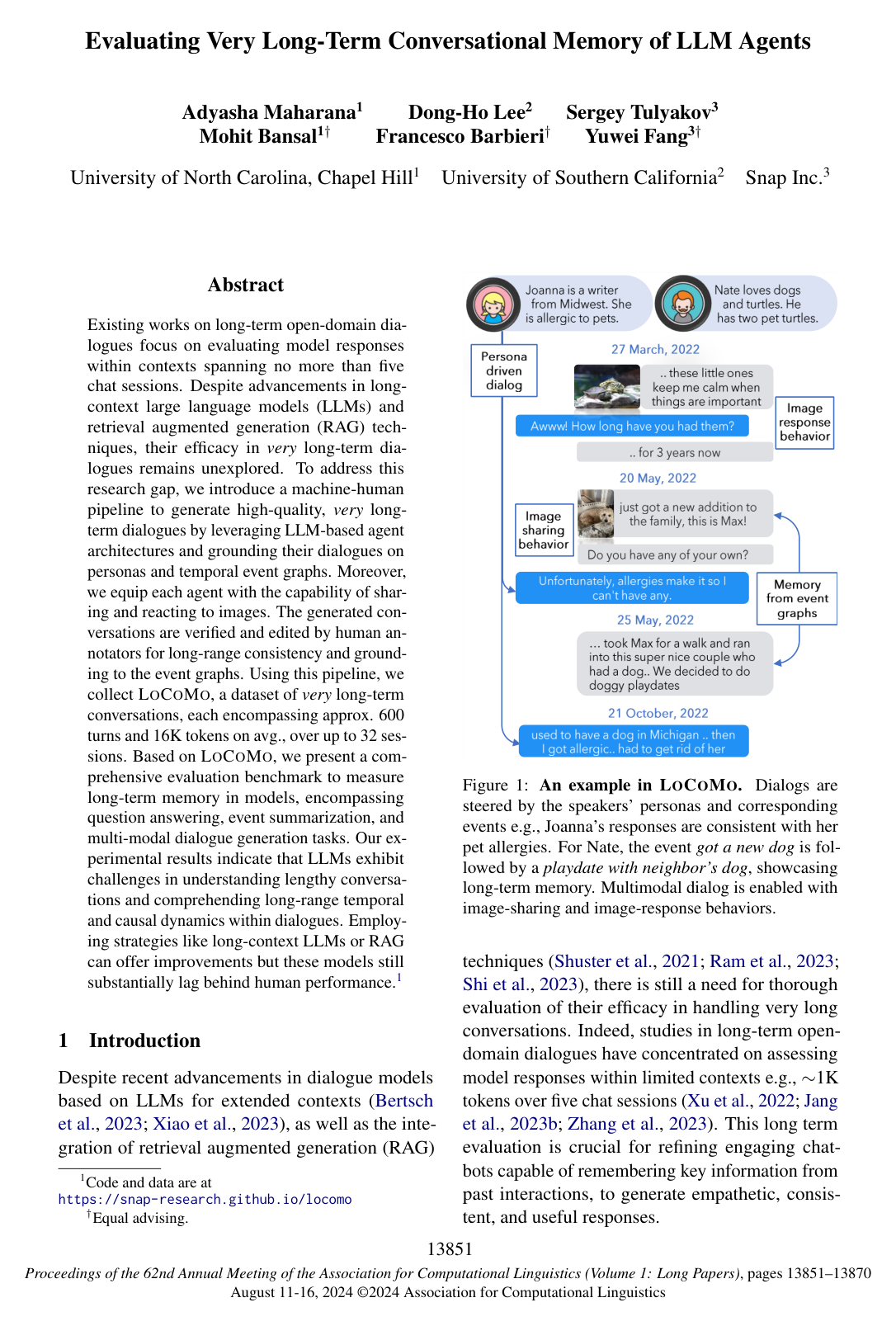
Evaluating Very Long-Term Conversational Memory of LLM Agents
Adyasha Maharana, Dong-Ho Lee, Sergey Tulyakov, Mohit Bansal, Francesco Barbieri, Yuwei Fang
Why you should read this
Introduces LoCoMo, a benchmark of human-verified, multi-modal conversations spanning dozens of sessions, revealing critical deficiencies in how modern long-context models and retrieval-augmented systems track long-range temporal and causal information compared to humans.
Existing works on long-term open-domain dialogues focus on evaluating model responses within contexts spanning no more than five chat sessions. Despite advancements in long-context large language models (LLMs) and retrieval augmented generation (RAG) techniques, their efficacy in very long-term dialogues remains unexplored. To address this research gap, we introduce a machine-human pipeline to generate high-quality, very long-term dialogues by leveraging LLM-based agent architectures and grounding their dialogues on personas and temporal event graphs. Moreover, we equip each agent with the capability of sharing and reacting to images. The generated conversations are verified and edited by human annotators for long-range consistency and grounding to the event graphs. Using this pipeline, we collect LoCoMo, a dataset of very long-term conversations, each encompassing approx. 600 turns and 16K tokens on avg., over up to 32 sessions. Based on LoCoMo, we present a comprehensive evaluation benchmark to measure long-term memory in models, encompassing question answering, event summarization, and multi-modal dialogue generation tasks. Our experimental results indicate that LLMs exhibit challenges in understanding lengthy conversations and comprehending long-range temporal and causal dynamics within dialogues. Employing strategies like long-context LLMs or RAG can offer improvements but these models still substantially lag behind human performance.
Added
2026-09-26