
keyword
long context language models
Long-context language models are artificial intelligence systems engineered to process, comprehend, and generate text from exceptionally long input sequences, typically ranging from tens of thousands to over a million tokens in a single context window. Unlike standard language models with limited input capacities, these models employ specialized positional encodings, distributed computation strategies, and optimized attention mechanisms to ingest entire books, large code repositories, or comprehensive multi-document archives simultaneously. They enable advanced capabilities such as in-context document retrieval, long-horizon reasoning, and extensive summarization without requiring preprocessing through external search databases. Despite expanding technical capacity, effective long-context modeling involves addressing critical challenges, including computational scaling costs, attention dilution across vast token spaces, and positional retrieval degradation when identifying relevant information scattered throughout the input.
8 items
NoLiMa: Long-Context Evaluation Beyond Literal Matching
Ali Modarressi, Hanieh Deilamsalehy, Franck Dernoncourt, Trung Bui, Ryan A. Rossi, Seunghyun Yoon, Hinrich Schtze
Why you should read this
Introduces the NoLiMa benchmark to expose how modern long-context language models fail to retrieve information through latent associations when deprived of surface-level lexical matches.
Recent large language models (LLMs) support long contexts ranging from 128K to 1M tokens. A popular method for evaluating these capabilities is the needle-in-a-haystack (NIAH) test, which involves retrieving a “needle” (relevant information) from a “haystack” (long irrelevant context). Extensions of this approach include increasing distractors, fact chaining, and in-context reasoning. However, in these benchmarks, models can exploit existing literal matches between the needle and haystack to simplify the task. To address this, we introduce NoLiMa, a benchmark extending NIAH with a carefully designed needle set, where questions and needles have minimal lexical overlap, requiring models to infer latent associations to locate the needle within the haystack. We evaluate 13 popular LLMs that claim to support contexts of at least 128K tokens. While they perform well in short contexts (<1K), performance degrades significantly as context length increases. At 32K, for instance, 11 models drop below 50% of their strong short-length baselines. Even GPT-4o, one of the top-performing exceptions, experiences a reduction from an almost-perfect baseline of 99.3% to 69.7%. Our analysis suggests these declines stem from the increased difficulty the attention mechanism faces in longer contexts when literal matches are absent, making it harder to retrieve relevant information. Even models enhanced with reasoning capabilities or CoT prompting struggle to maintain performance in long contexts. We publicly release the dataset and evaluation code at https://github.com/adobe-research/NoLiMa.
Added
2026-10-02
Shuffle the Context: RoPE-Perturbed Self-Distillation for Long-Context Adaptation
Zichong Li, Chen Liang, Liliang Ren, Tuo Zhao, Yelong Shen, Weizhu Chen
Why you should read this
Proposes RoPE-Perturbed Self-Distillation, a training regularizer that enforces prediction consistency across perturbed position embeddings to eliminate positional bias and improve long-context retrieval and extrapolation in large language models.
Large language models (LLMs) increasingly operate in settings that require reliable long-context understanding, such as retrieval-augmented generation and multi-document reasoning. A common strategy is to fine-tune pretrained short-context models at the target sequence length. However, we find that standard long-context adaptation can remain brittle: model accuracy depends strongly on the absolute placement of relevant evidence, exhibiting high positional variance even when controlling for task format and difficulty. We propose RoPE-Perturbed Self-Distillation, a training regularizer that improves positional robustness. The core idea is to form alternative "views" of the same training sequence by perturbing its RoPE indices -- effectively moving parts of the context to different positions -- and to train the model to produce consistent predictions across views via self-distillation. This encourages reliance on semantic signals instead of brittle position dependencies. Experiments on long-context adaptation of Llama-3-8B and Qwen-3-4B demonstrate consistent gains on long-context benchmarks, including up to 12.04% improvement on RULER-64K for Llama-3-8B and 2.71% on RULER-256K for Qwen-3-4B after SFT, alongside improved length extrapolation beyond the training context window.
Added
2026-09-29
LooGLE: Can Long-Context Language Models Understand Long Contexts?
Jiaqi Li, Mengmeng Wang, Zilong Zheng, Muhan Zhang
Why you should read this
Introduces LooGLE, a benchmark built from recent, long-form documents to evaluate whether language models can genuinely reason over extended dependencies across entire texts rather than relying on short-range retrieval.
Large language models (LLMs) are typically limited to processing texts within context-window size, which has spurred significant research efforts into enhancing LLMs’ long-context understanding as well as developing high-quality benchmarks to evaluate the ability. However, prior datasets suffer from shortcomings like short length compared to the context window of modern LLMs; outdated documents that might have data leakage problems; and an emphasis on short dependency tasks only. In this paper, we present LooGLE, a Long Context Generic Language Evaluation benchmark. It features documents post-2022, with over 24,000 tokens per document and 6,000 newly generated questions spanning varying dependency ranges in diverse domains. Human annotators meticulously crafted over 1,100 high-quality question-answer (QA) pairs with thorough cross-validation for a most precise assessment of LLMs’ long dependency capabilities. We conduct a comprehensive evaluation of representative LLMs on LooGLE. The results indicate that most LLMs have shockingly bad long context ability and fail to capture long dependencies in the context, even when their context window size is enough to fit the entire document. Our results shed light on enhancing the “true long-context understanding” ability of LLMs instead of merely enlarging their context window.
Added
2026-09-26
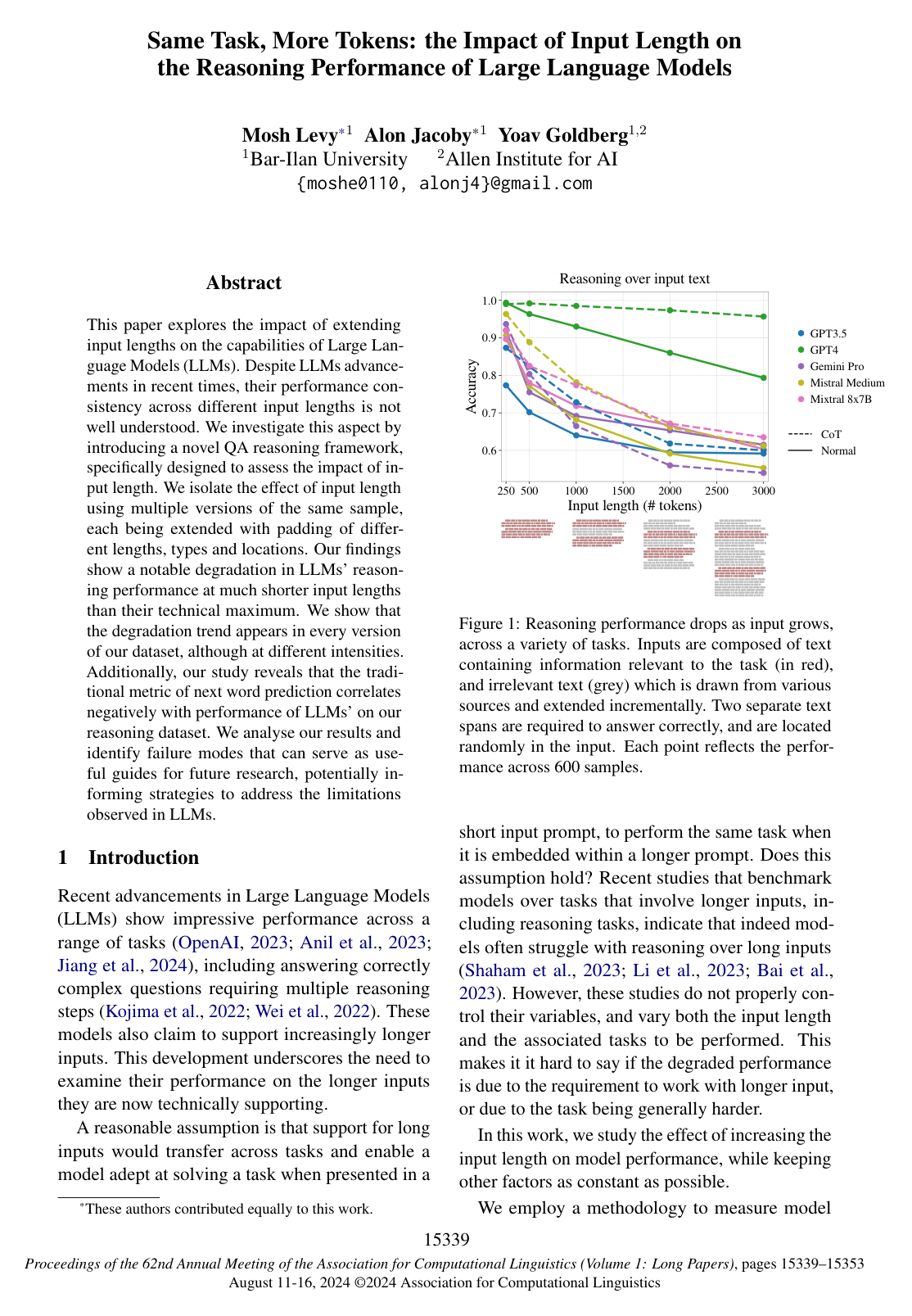
Same Task, More Tokens: the Impact of Input Length on the Reasoning Performance of Large Language Models
Mosh Levy, Alon Jacoby, Yoav Goldberg
Why you should read this
Demonstrates through a controlled question-answering framework that large language models experience sharp declines in multi-step reasoning performance as context length increases, failing well before reaching their technical context limits regardless of padding type or fact placement.
This paper explores the impact of extending input lengths on the capabilities of Large Language Models (LLMs). Despite LLMs advancements in recent times, their performance consistency across different input lengths is not well understood. We investigate this aspect by introducing a novel QA reasoning framework, specifically designed to assess the impact of input length. We isolate the effect of input length using multiple versions of the same sample, each being extended with padding of different lengths, types and locations. Our findings show a notable degradation in LLMs’ reasoning performance at much shorter input lengths than their technical maximum. We show that the degradation trend appears in every version of our dataset, although at different intensities. Additionally, our study reveals that the traditional metric of next word prediction correlates negatively with performance of LLMs’ on our reasoning dataset. We analyse our results and identify failure modes that can serve as useful guides for future research, potentially informing strategies to address the limitations observed in LLMs.
Added
2026-09-26
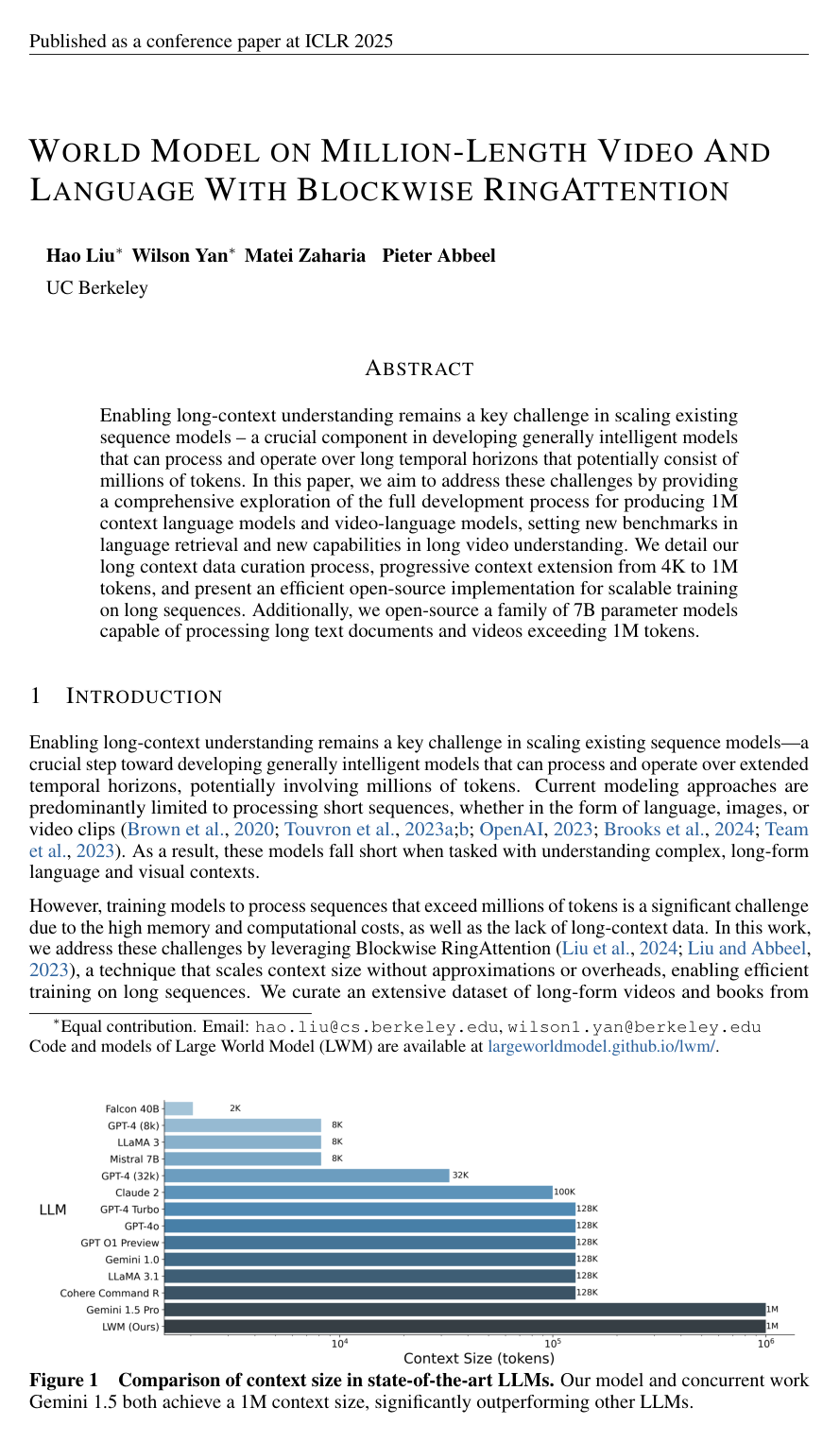
World Model on Million-Length Video And Language With Blockwise RingAttention
Hao Liu, Wilson Yan, Matei Zaharia, Pieter Abbeel
Why you should read this
Presents an open-source training method and 7B parameter model family that scales multimodal context to one million tokens using Blockwise RingAttention, enabling the processing of hour-long videos and massive text sequences.
Enabling long-context understanding remains a key challenge in scaling existing sequence models -- a crucial component in developing generally intelligent models that can process and operate over long temporal horizons that potentially consist of millions of tokens. In this paper, we aim to address these challenges by providing a comprehensive exploration of the full development process for producing 1M context language models and video-language models, setting new benchmarks in language retrieval and new capabilities in long video understanding. We detail our long context data curation process, progressive context extension from 4K to 1M tokens, and present an efficient open-source implementation for scalable training on long sequences. Additionally, we open-source a family of 7B parameter models capable of processing long text documents and videos exceeding 1M tokens.
Added
2026-09-26
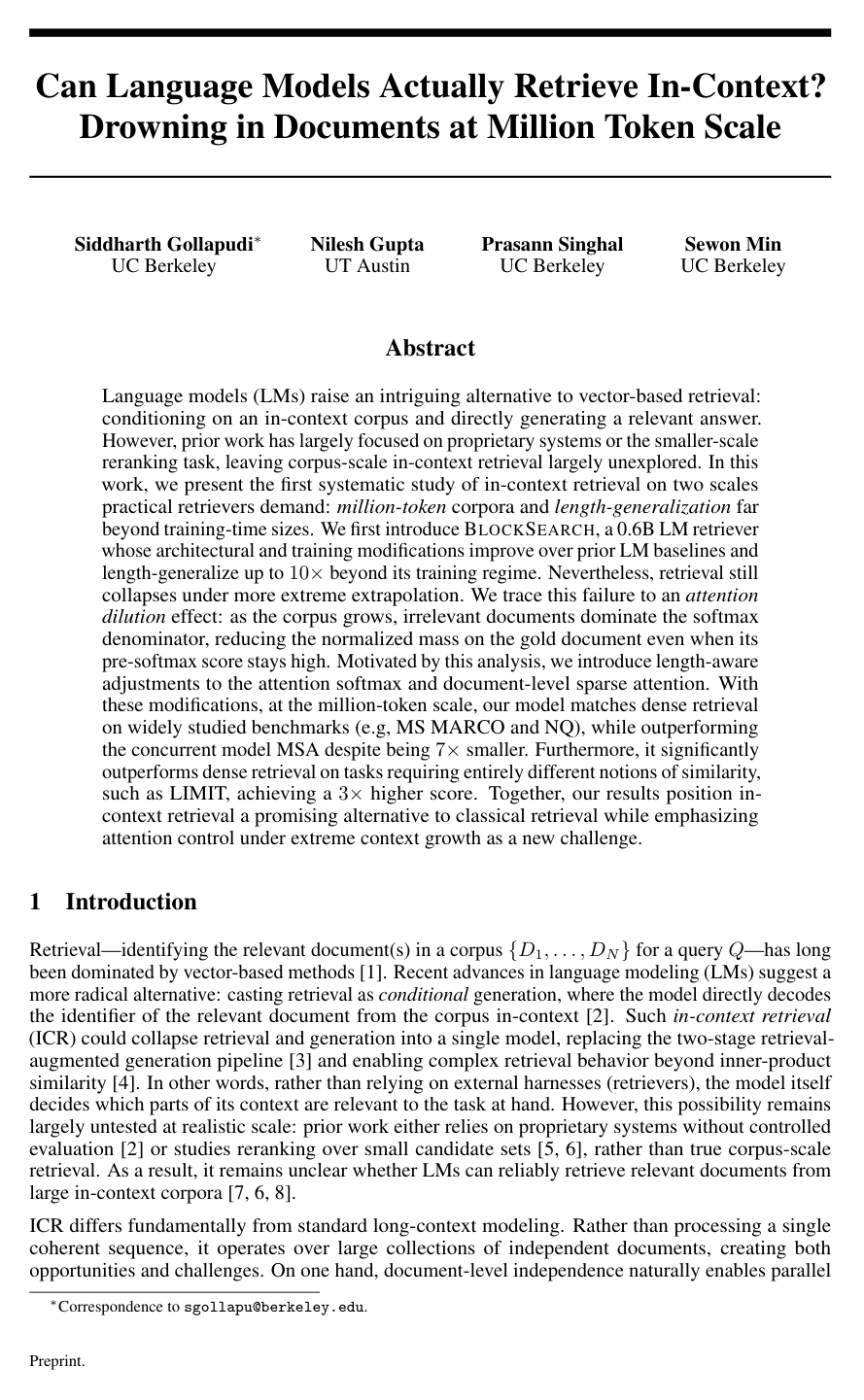
Can Language Models Actually Retrieve In-Context? Drowning in Documents at Million Token Scale
Siddharth Gollapudi, Nilesh Gupta, Prasann Singhal, Sewon Min
Why you should read this
Demonstrates that language models can achieve competitive and superior retrieval performance on million-token scale corpora by mitigating attention dilution through novel architectural and training modifications.
Language models (LMs) raise an intriguing alternative to vector-based retrieval: conditioning on an in-context corpus and directly generating a relevant answer. However, prior work has largely focused on proprietary systems or the smaller-scale reranking task, leaving corpus-scale in-context retrieval largely unexplored. In this work, we present the first systematic study of in-context retrieval on two scales practical retrievers demand: million-token corpora and length-generalization far beyond training-time sizes. We first introduce BlockSearch, a 0.6B LM retriever whose architectural and training modifications improve over prior LM baselines and length-generalize up to 10 times beyond its training regime. Nevertheless, retrieval still collapses under more extreme extrapolation. We trace this failure to an attention dilution effect: as the corpus grows, irrelevant documents dominate the softmax denominator, reducing the normalized mass on the gold document even when its pre-softmax score stays high. Motivated by this analysis, we introduce length-aware adjustments to the attention softmax and document-level sparse attention. With these modifications, at the million-token scale, our model matches dense retrieval on widely studied benchmarks (e.g, MS MARCO and NQ), while outperforming the concurrent model MSA despite being 7 times smaller. Furthermore, it significantly outperforms dense retrieval on tasks requiring entirely different notions of similarity, such as LIMIT, achieving a 3 times higher score. Together, our results position in-context retrieval a promising alternative to classical retrieval while emphasizing attention control under extreme context growth as a new challenge.
Added
2026-07-13

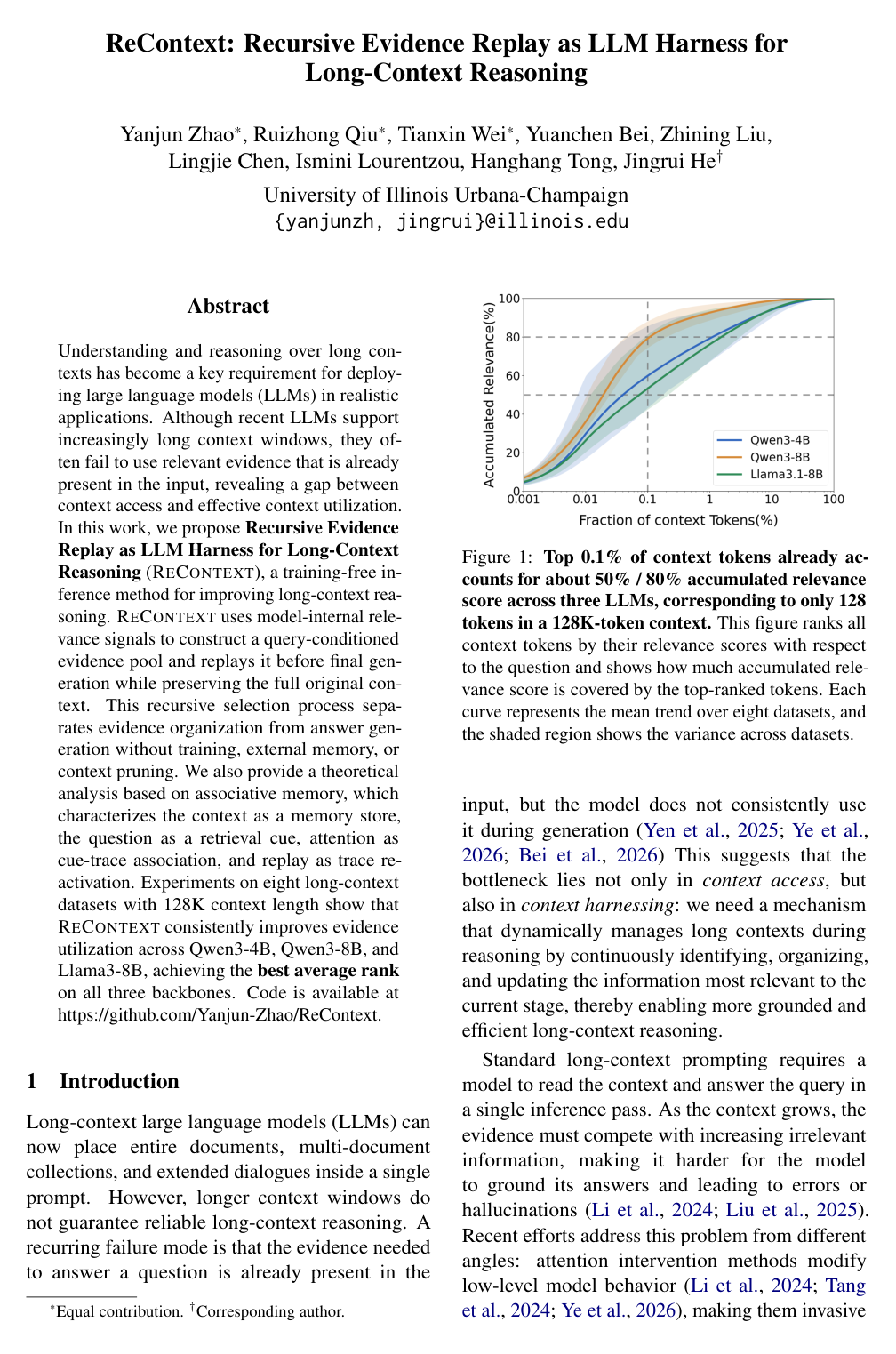
ReContext: Recursive Evidence Replay as LLM Harness for Long-Context Reasoning
Yanjun Zhao, Ruizhong Qiu, Tianxin Wei, Yuanchen Bei, Zhining Liu, Lingjie Chen, Ismini Lourentzou, Hanghang Tong, Jingrui He
Why you should read this
Introduces RECONTEXT, a training-free inference method that dramatically improves long-context reasoning in LLMs by using recursive evidence replay based on model-internal relevance signals, achieving state-of-the-art performance on multiple models and datasets up to 128K context length.
Understanding and reasoning over long contexts has become a key requirement for deploying large language models (LLMs) in realistic applications. Although recent LLMs support increasingly long context windows, they often fail to use relevant evidence that is already present in the input, revealing a gap between context access and effective context utilization. In this work, we propose Recursive Evidence Replay as LLM Harness for Long-Context Reasoning (RECONTEXT), a training-free inference method for improving long-context reasoning. RECONTEXT uses model-internal relevance signals to construct a query-conditioned evidence pool and replays it before final generation while preserving the full original context. This recursive selection process separates evidence organization from answer generation without training, external memory, or context pruning. We also provide a theoretical analysis based on associative memory, which characterizes the context as a memory store, the question as a retrieval cue, attention as cue-trace association, and replay as trace reactivation. Experiments on eight long-context datasets with 128K context length show that RECONTEXT consistently improves evidence utilization across Qwen3-4B, Qwen3-8B, and Llama3-8B, achieving the best average rank on all three backbones. Code is available at this https URL.
Added
2026-07-13
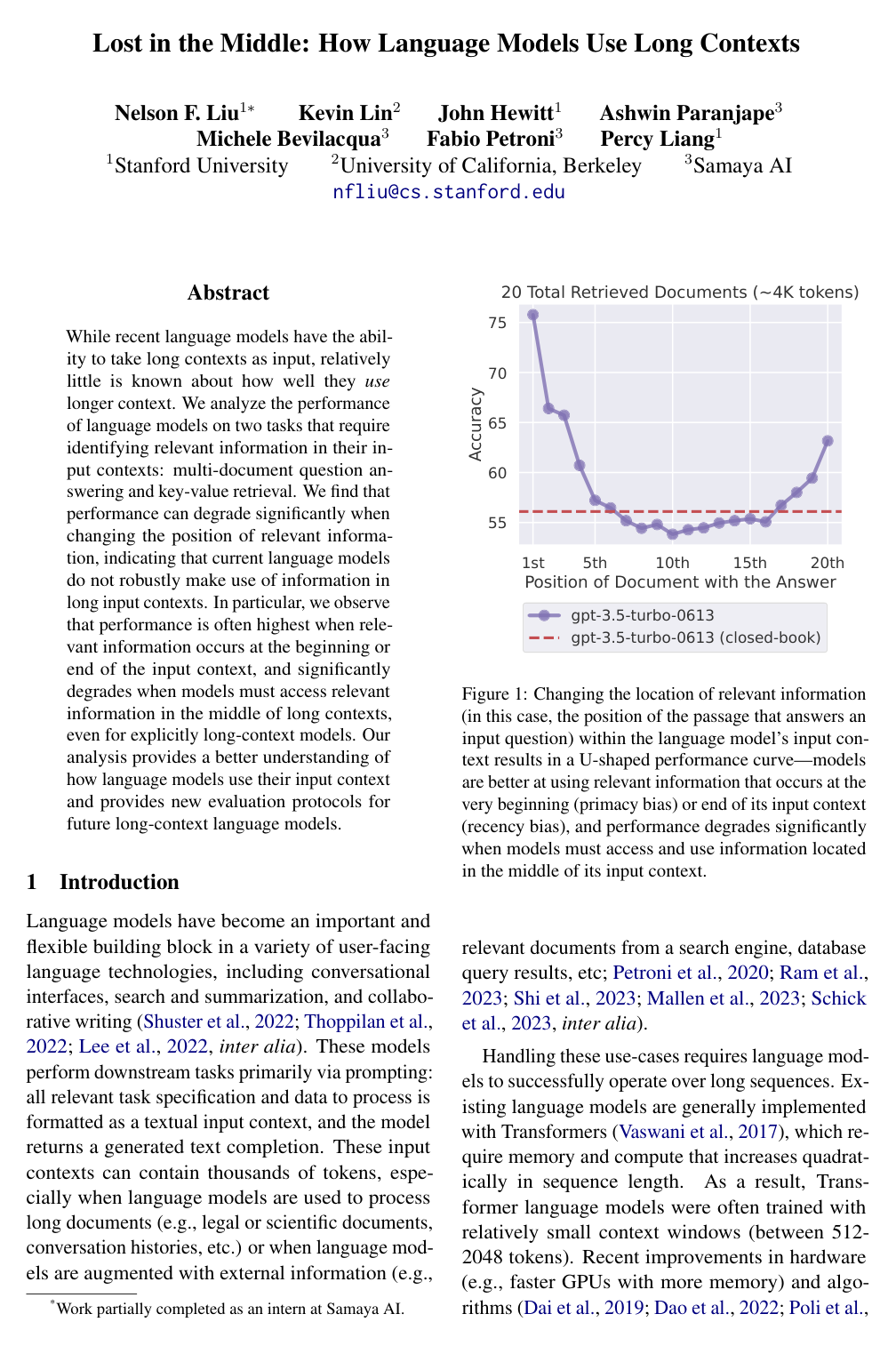
Lost in the Middle: How Language Models Use Long Contexts
Nelson F. Liu, Kevin Lin, John Hewitt, Ashwin Paranjape, Michele Bevilacqua, Fabio Petroni, Percy Liang
Why you should read this
Reveals that large language models often fail to robustly utilize information within long contexts, demonstrating a "lost in the middle" phenomenon where performance degrades significantly when relevant data is not at the beginning or end of the input.
While recent language models have the ability to take long contexts as input, relatively little is known about how well they use longer context. We analyze the performance of language models on two tasks that require identifying relevant information in their input contexts: multi-document question answering and key-value retrieval. We find that performance can degrade significantly when changing the position of relevant information, indicating that current language models do not robustly make use of information in long input contexts. In particular, we observe that performance is often highest when relevant information occurs at the beginning or end of the input context, and significantly degrades when models must access relevant information in the middle of long contexts, even for explicitly long-context models. Our analysis provides a better understanding of how language models use their input context and provides new evaluation protocols for future long-context language models.
Added
2026-06-07