
keyword
LogSparse Transformer
A LogSparse Transformer is a neural network architecture designed for time series forecasting that reduces the computational and memory overhead of standard Transformer models. Unlike canonical Transformers that compute attention across all pairs in a sequence with quadratic complexity, the LogSparse Transformer uses a sparse self-attention pattern where each time step only attends to historical points at exponentially increasing intervals alongside local neighbors. This structured sparsity lowers the memory complexity to a sub-quadratic scale while preserving the network ability to capture long-term dependencies across extended sequences. Additionally, it often incorporates causal convolutions to generate queries and keys, enhancing the model sensitivity to local temporal context and patterns.
2 items
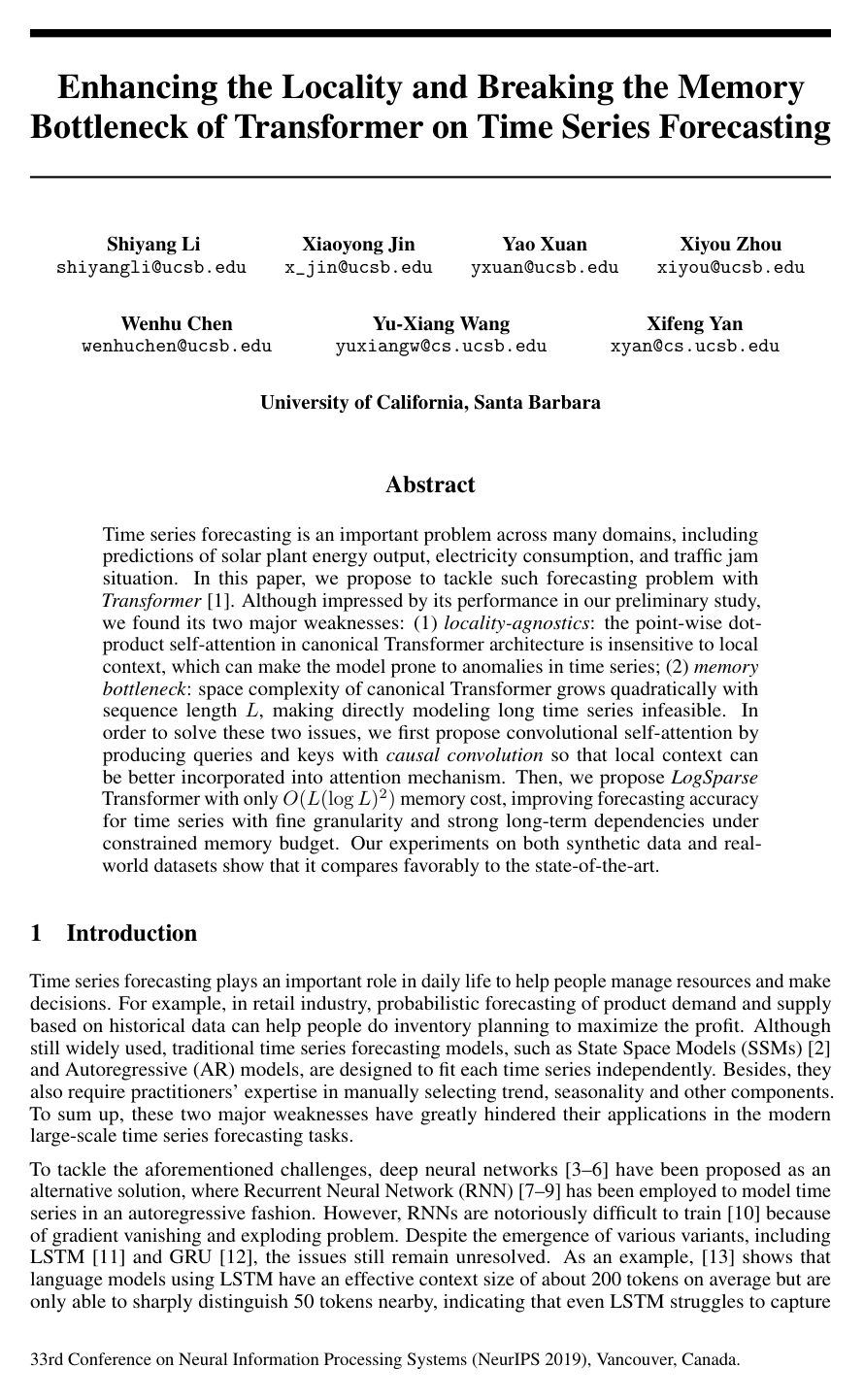
Enhancing the Locality and Breaking the Memory Bottleneck of Transformer on Time Series Forecasting
SHIYANG LI, Xiaoyong Jin, Yao Xuan, Xiyou Zhou, Wenhu Chen, Yu-Xiang Wang, Xifeng Yan
Why you should read this
Proposes convolutional self-attention and a LogSparse Transformer architecture that reduces memory complexity to O(L(log L)^2), solving the key challenges of local context insensitivity and quadratic memory bottlenecks in long-sequence time series forecasting.
Time series forecasting is an important problem across many domains, including predictions of solar plant energy output, electricity consumption, and traffic jam situation. In this paper, we propose to tackle such forecasting problem with Transformer [1]. Although impressed by its performance in our preliminary study, we found its two major weaknesses: (1) locality-agnostics: the point-wise dot-product self-attention in canonical Transformer architecture is insensitive to local context, which can make the model prone to anomalies in time series; (2) memory bottleneck: space complexity of canonical Transformer grows quadratically with sequence length , making directly modeling long time series infeasible. In order to solve these two issues, we first propose convolutional self-attention by producing queries and keys with causal convolution so that local context can be better incorporated into attention mechanism. Then, we propose LogSparse Transformer with only memory cost, improving forecasting accuracy for time series with fine granularity and strong long-term dependencies under constrained memory budget. Our experiments on both synthetic data and real-world datasets show that it compares favorably to the state-of-the-art.
Added
2026-09-17
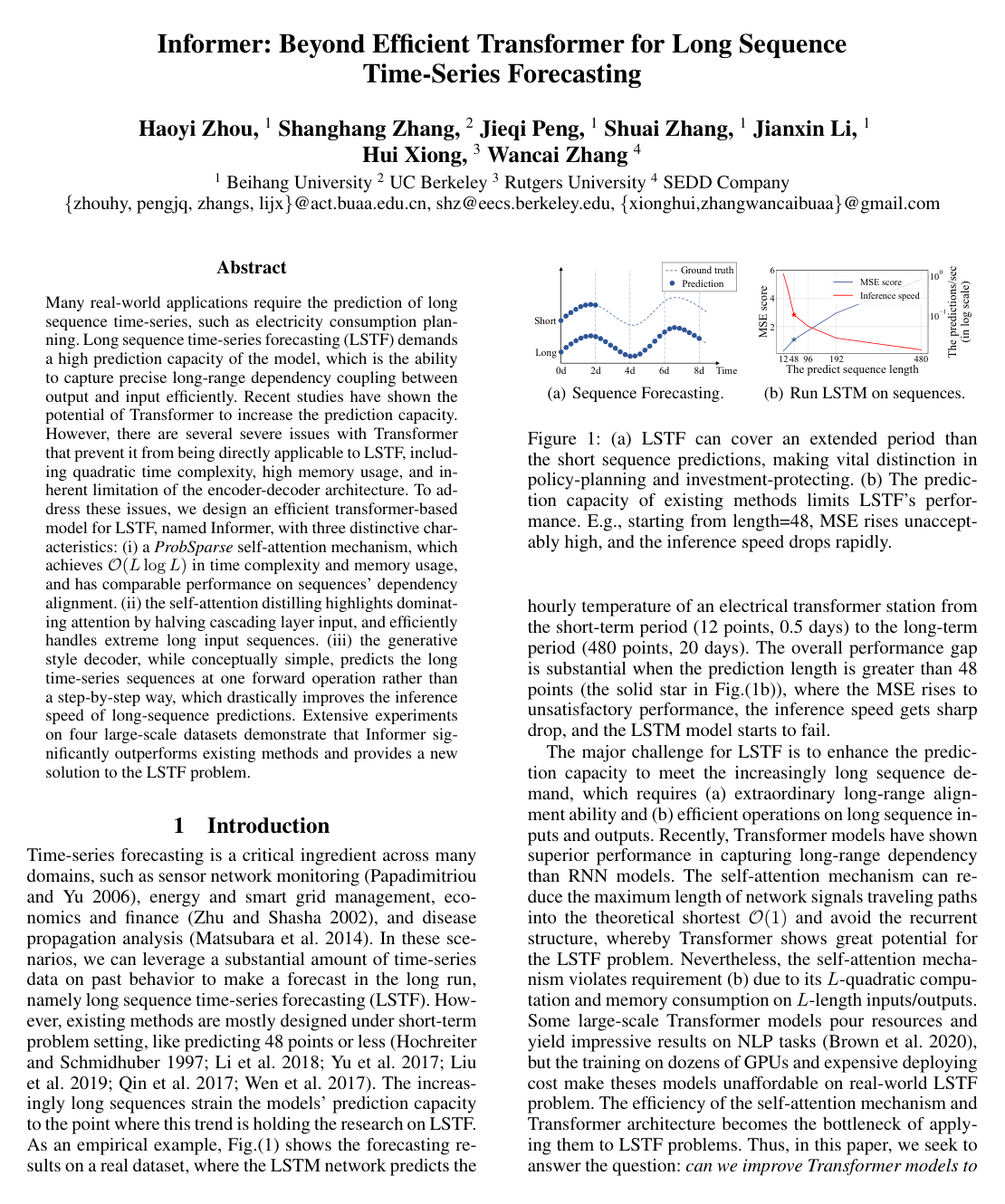
Informer: Beyond Efficient Transformer for Long Sequence Time-Series Forecasting
Haoyi Zhou, Shanghang Zhang, Jieqi Peng, Shuai Zhang, Jianxin Li, Hui Xiong, Wan Zhang
Why you should read this
Proposes Informer, an efficient Transformer architecture for long-sequence time-series forecasting that cuts time and memory complexity to O(L log L) through ProbSparse attention and dramatically speeds up multi-step prediction using a direct generative decoder.
Many real-world applications require the prediction of long sequence time-series, such as electricity consumption planning. Long sequence time-series forecasting (LSTF) demands a high prediction capacity of the model, which is the ability to capture precise long-range dependency coupling between output and input efficiently. Recent studies have shown the potential of Transformer to increase the prediction capacity. However, there are several severe issues with Transformer that prevent it from being directly applicable to LSTF, including quadratic time complexity, high memory usage, and inherent limitation of the encoder-decoder architecture. To address these issues, we design an efficient transformer-based model for LSTF, named Informer, with three distinctive characteristics: (i) a self-attention mechanism, which achieves in time complexity and memory usage, and has comparable performance on sequences' dependency alignment. (ii) the self-attention distilling highlights dominating attention by halving cascading layer input, and efficiently handles extreme long input sequences. (iii) the generative style decoder, while conceptually simple, predicts the long time-series sequences at one forward operation rather than a step-by-step way, which drastically improves the inference speed of long-sequence predictions. Extensive experiments on four large-scale datasets demonstrate that Informer significantly outperforms existing methods and provides a new solution to the LSTF problem.
Added
2026-09-07