
keyword
LLM evaluation
LLM evaluation is the systematic process of assessing the performance, capabilities, output quality, and safety of large language models. It involves testing models across diverse tasks, such as reasoning, question answering, text generation, and instruction following, using standardized benchmarks, curated datasets, and specific scoring rubrics. The evaluation process commonly employs multiple methodologies, including traditional automated metrics, human judgment, and the use of language models themselves as automated evaluators to score open-ended responses against human preferences and multifaceted quality criteria. This practice enables practitioners to measure factual accuracy, identify errors or biases, compare model architectures, and ensure reliability and alignment across various applications.
6 items
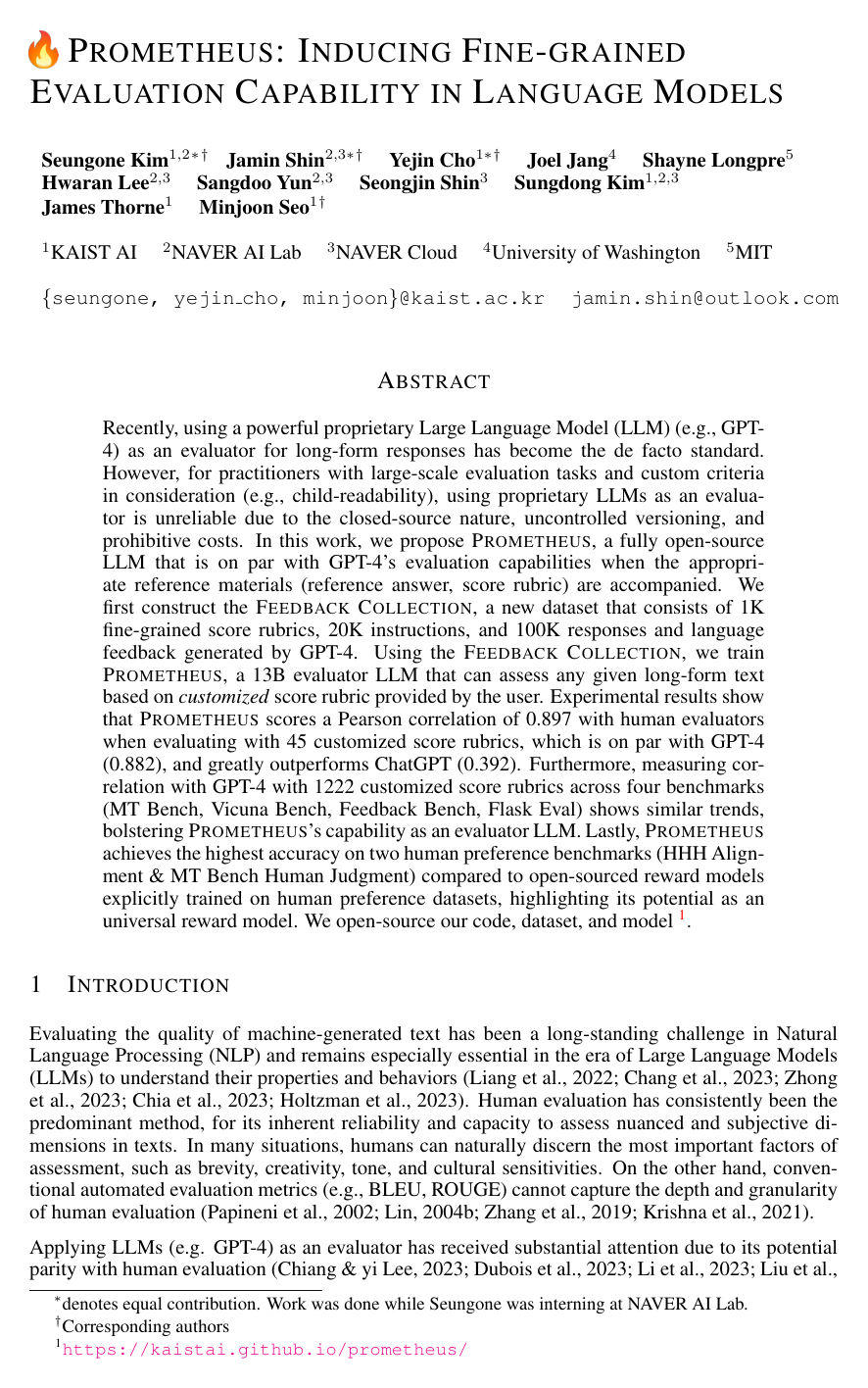
Prometheus: Inducing Fine-grained Evaluation Capability in Language Models
Seungone Kim, Jamin Shin, Yejin Cho, Joel Jang, Shayne Longpre, Hwaran Lee, Sangdoo Yun, Seongjin Shin, Sungdong Kim, James Thorne, Minjoon Seo
Why you should read this
Presents Prometheus, an open-source 13B evaluator model that matches GPT-4 in assessing long-form text across customized score rubrics, providing a reproducible and cost-effective alternative for automated evaluation and reward modeling.
Recently, using a powerful proprietary Large Language Model (LLM) (e.g., GPT-4) as an evaluator for long-form responses has become the de facto standard. However, for practitioners with large-scale evaluation tasks and custom criteria in consideration (e.g., child-readability), using proprietary LLMs as an evaluator is unreliable due to the closed-source nature, uncontrolled versioning, and prohibitive costs. In this work, we propose Prometheus, a fully open-source LLM that is on par with GPT-4's evaluation capabilities when the appropriate reference materials (reference answer, score rubric) are accompanied. We first construct the Feedback Collection, a new dataset that consists of 1K fine-grained score rubrics, 20K instructions, and 100K responses and language feedback generated by GPT-4. Using the Feedback Collection, we train Prometheus, a 13B evaluator LLM that can assess any given long-form text based on customized score rubric provided by the user. Experimental results show that Prometheus scores a Pearson correlation of 0.897 with human evaluators when evaluating with 45 customized score rubrics, which is on par with GPT-4 (0.882), and greatly outperforms ChatGPT (0.392). Furthermore, measuring correlation with GPT-4 with 1222 customized score rubrics across four benchmarks (MT Bench, Vicuna Bench, Feedback Bench, Flask Eval) shows similar trends, bolstering Prometheus's capability as an evaluator LLM. Lastly, Prometheus achieves the highest accuracy on two human preference benchmarks (HHH Alignment & MT Bench Human Judgment) compared to open-sourced reward models explicitly trained on human preference datasets, highlighting its potential as an universal reward model. We open-source our code, dataset, and model at this https URL.
Added
2026-10-05
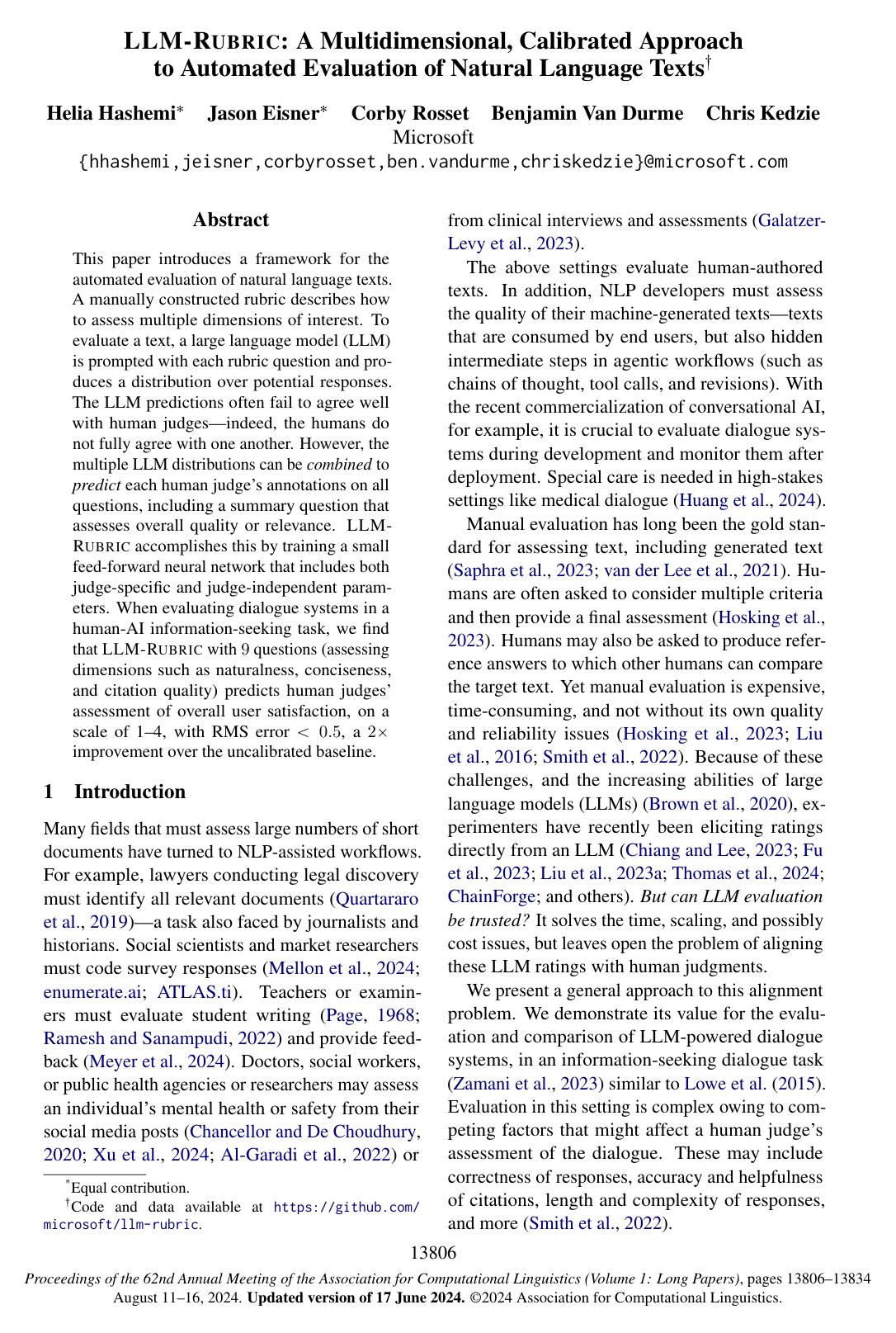
LLM-Rubric: A Multidimensional, Calibrated Approach to Automated Evaluation of Natural Language Texts
Helia Hashemi, Jason Eisner, Corby Rosset, Benjamin Van Durme, Chris Kedzie
Why you should read this
Proposes LLM-RUBRIC, an automated evaluation framework that queries large language models across multidimensional rubric criteria and calibrates their probability outputs with a personalized neural network to predict individual human annotator judgments with double the accuracy of standard models.
This paper introduces a framework for the automated evaluation of natural language texts. A manually constructed rubric describes how to assess multiple dimensions of interest. To evaluate a text, a large language model (LLM) is prompted with each rubric question and produces a distribution over potential responses. The LLM predictions often fail to agree well with human judges—indeed, the humans do not fully agree with one another. However, the multiple LLM distributions can be combined to predict each human judge's annotations on all questions, including a summary question that assesses overall quality or relevance. LLM-RUBRIC accomplishes this by training a small feed-forward neural network that includes both judge-specific and judge-independent parameters. When evaluating dialogue systems in a human-AI information-seeking task, we find that LLM-RUBRIC with 9 questions (assessing dimensions such as naturalness, conciseness, and citation quality) predicts human judges' assessment of overall user satisfaction, on a scale of 1–4, with RMS error < 0.5, a 2× improvement over the uncalibrated baseline.
Added
2026-10-02
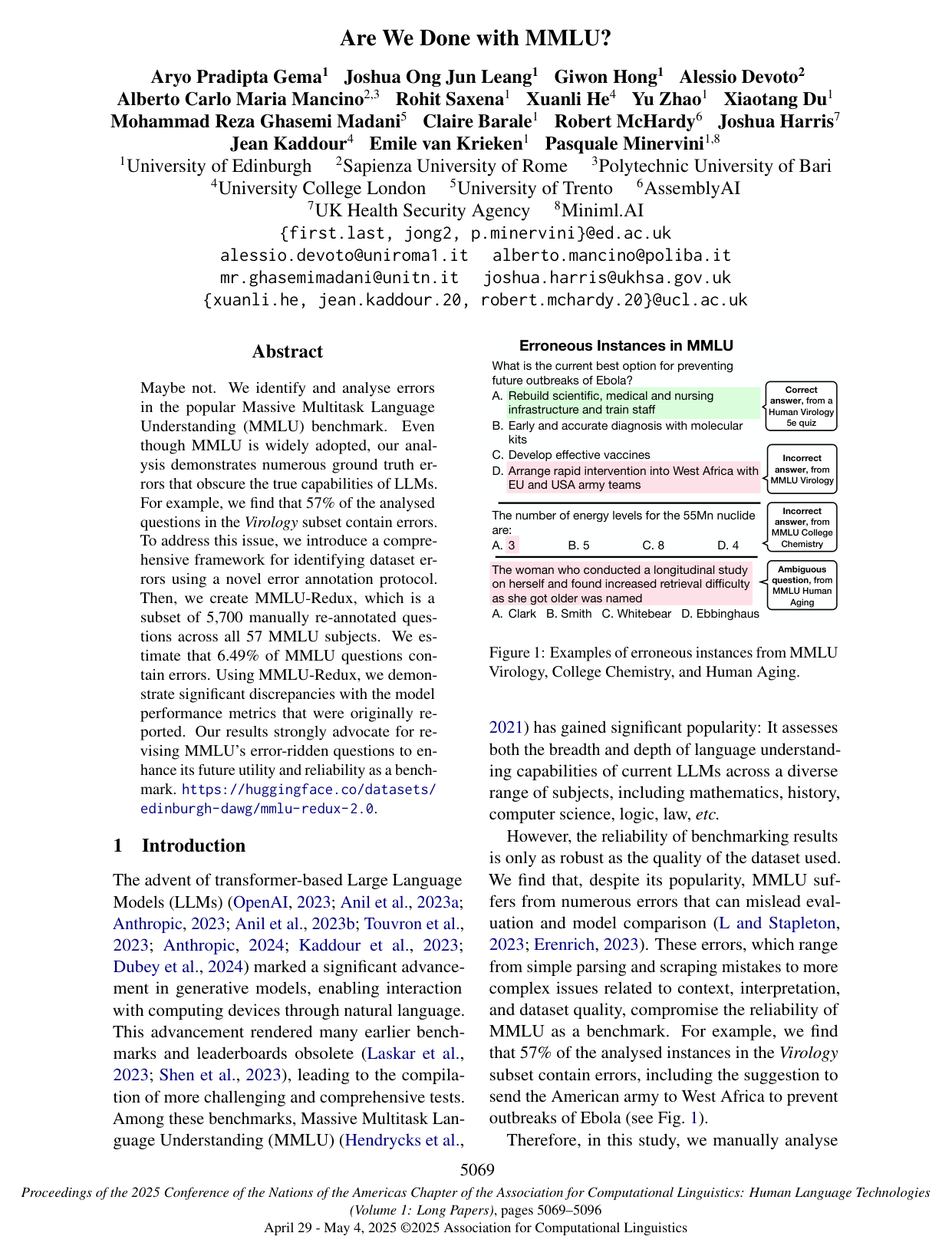
Are We Done with MMLU?
Aryo Pradipta Gema, Joshua Ong Jun Leang, Giwon Hong, Alessio Devoto, Alberto Carlo Maria Mancino, Rohit Saxena, Xuanli He, Yu Zhao, Xiaotang Du, Mohammad Reza Ghasemi Madani, Claire Barale, Robert McHardy, Joshua Harris, Jean Kaddour, Emile van Krieken, Pasquale Minervini
Why you should read this
Reveals widespread ground-truth errors across the MMLU benchmark and provides a corrected 5,700-question dataset that alters established large language model rankings.
Maybe not. We identify and analyse errors in the popular Massive Multitask Language Understanding (MMLU) benchmark. Even though MMLU is widely adopted, our analysis demonstrates numerous ground truth errors that obscure the true capabilities of LLMs. For example, we find that 57% of the analysed questions in the Virology subset contain errors. To address this issue, we introduce a comprehensive framework for identifying dataset errors using a novel error annotation protocol. Then, we create MMLU-Redux, which is a subset of 5,700 manually re-annotated questions across all 57 MMLU subjects. We estimate that 6.49% of MMLU questions contain errors. Using MMLU-Redux, we demonstrate significant discrepancies with the model performance metrics that were originally reported. Our results strongly advocate for revising MMLU's error-ridden questions to enhance its future utility and reliability as a benchmark. https://huggingface.co/datasets/edinburgh-dawg/mmlu-redux-2.0.
Added
2026-09-26
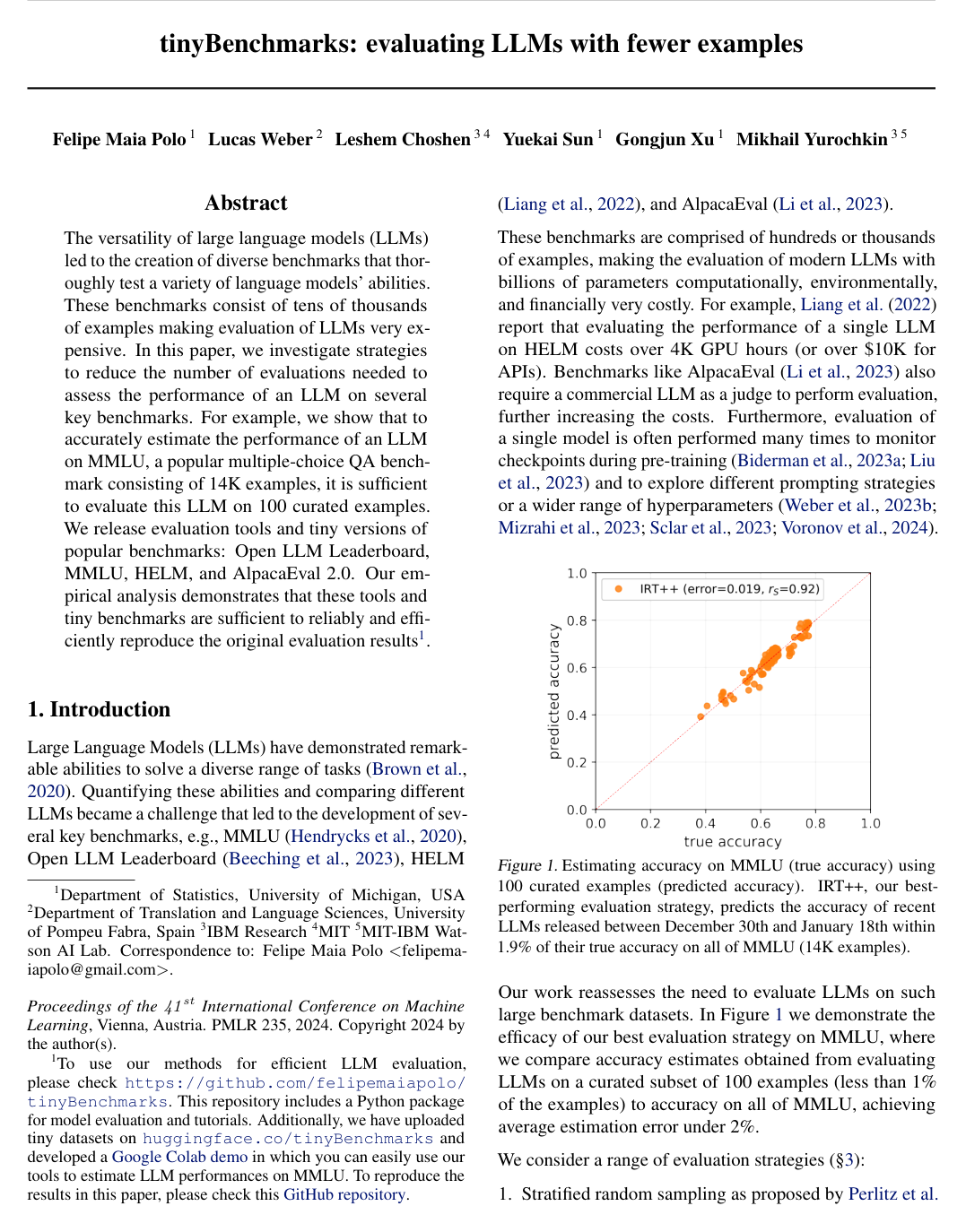
tinyBenchmarks: evaluating LLMs with fewer examples
Felipe Maia Polo, Lucas Weber, Leshem Choshen, Yuekai Sun, Gongjun Xu, Mikhail Yurochkin
Why you should read this
Proposes Item Response Theory and clustering techniques to drastically cut large language model evaluation costs by estimating full benchmark performance on datasets like MMLU and HELM using only 100 representative examples per scenario within an average 2% error margin.
The versatility of large language models (LLMs) led to the creation of diverse benchmarks that thoroughly test a variety of language models’ abilities. These benchmarks consist of tens of thousands of examples making evaluation of LLMs very expensive. In this paper, we investigate strategies to reduce the number of evaluations needed to assess the performance of an LLM on several key benchmarks. For example, we show that to accurately estimate the performance of an LLM on MMLU, a popular multiple-choice QA benchmark consisting of 14K examples, it is sufficient to evaluate this LLM on 100 curated examples. We release evaluation tools and tiny versions of popular benchmarks: Open LLM Leaderboard, MMLU, HELM, and AlpacaEval 2.0. Our empirical analysis demonstrates that these tools and tiny benchmarks are sufficient to reliably and efficiently reproduce the original evaluation results¹.
Added
2026-09-26
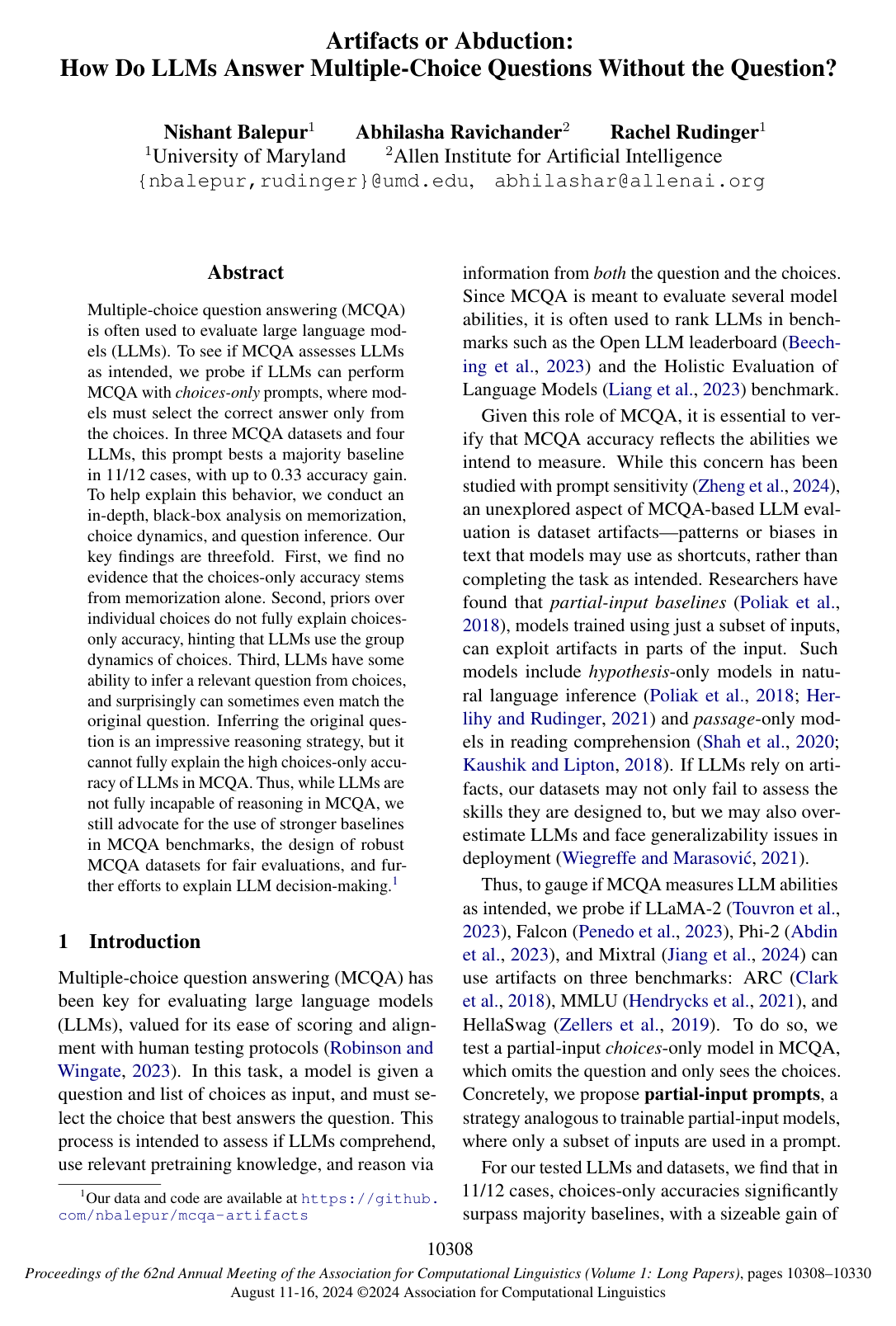
Artifacts or Abduction: How Do LLMs Answer Multiple-Choice Questions Without the Question?
Nishant Balepur, Abhilasha Ravichander, Rachel Rudinger
Why you should read this
Reveals that large language models frequently select the correct answer in multiple-choice benchmarks using only the answer options by abductively inferring missing questions and exploiting choice group dynamics rather than relying on memorization alone.
Multiple-choice question answering (MCQA) is often used to evaluate large language models (LLMs). To see if MCQA assesses LLMs as intended, we probe if LLMs can perform MCQA with choices-only prompts, where models must select the correct answer only from the choices. In three MCQA datasets and four LLMs, this prompt bests a majority baseline in 11/12 cases, with up to 0.33 accuracy gain. To help explain this behavior, we conduct an in-depth, black-box analysis on memorization, choice dynamics, and question inference. Our key findings are threefold. First, we find no evidence that the choices-only accuracy stems from memorization alone. Second, priors over individual choices do not fully explain choices-only accuracy, hinting that LLMs use the group dynamics of choices. Third, LLMs have some ability to infer a relevant question from choices, and surprisingly can sometimes even match the original question. Inferring the original question is an impressive reasoning strategy, but it cannot fully explain the high choices-only accuracy of LLMs in MCQA. Thus, while LLMs are not fully incapable of reasoning in MCQA, we still advocate for the use of stronger baselines in MCQA benchmarks, the design of robust MCQA datasets for fair evaluations, and further efforts to explain LLM decision-making.
Added
2026-09-26
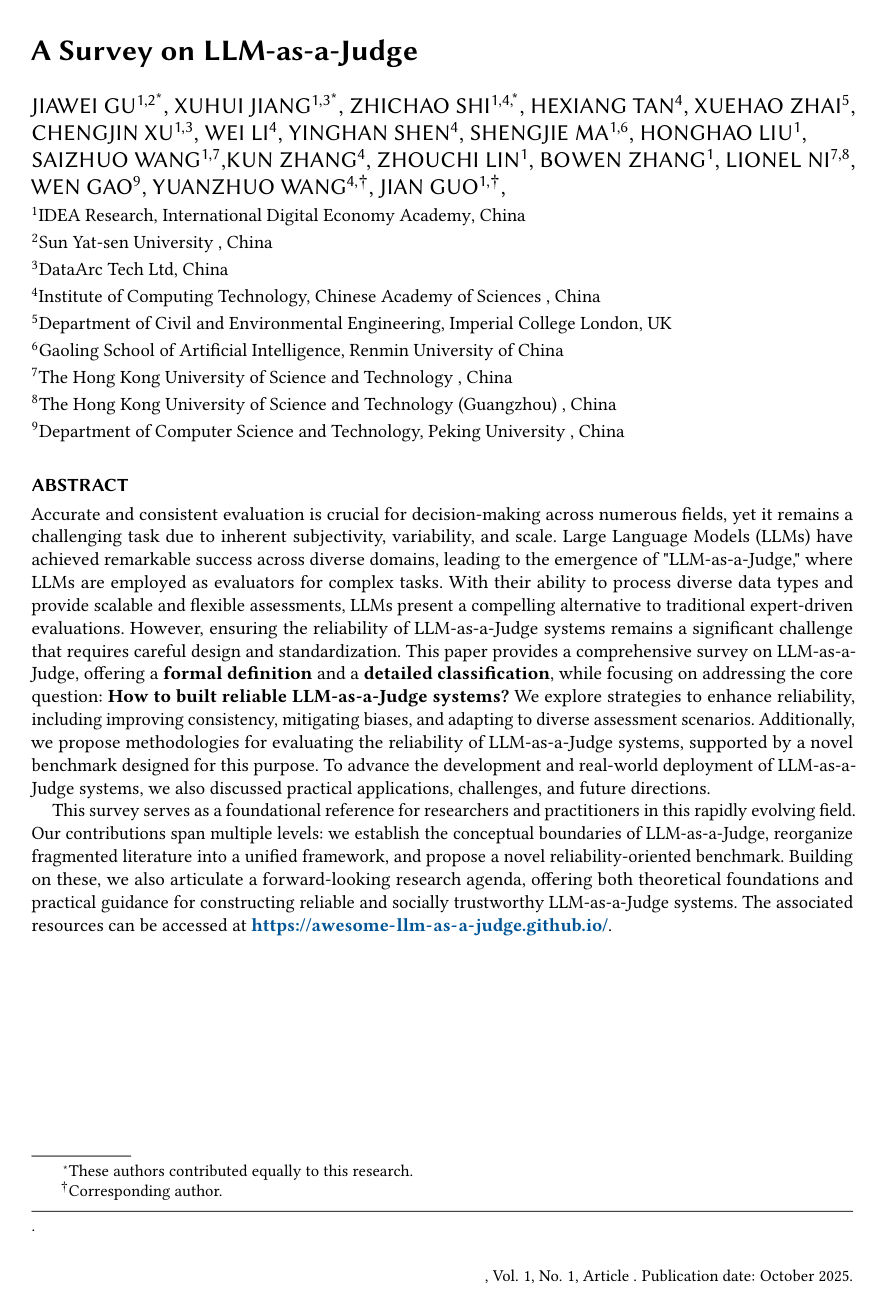
A Survey on LLM-as-a-Judge
Jiawei Gu, Xuhui Jiang, Zhichao Shi, Hexiang Tan, Xuehao Zhai, Chengjin Xu, Wei Li, Yinghan Shen, Shengjie Ma, Honghao Liu, Yuanzhuo Wang, Jian Guo
Why you should read this
Presents a comprehensive guide to building reliable LLM-as-a-judge evaluators, detailing methods to reduce inconsistency and bias, introducing a dedicated reliability benchmark, and providing actionable strategies for automated assessment across diverse tasks.
Accurate and consistent evaluation is crucial for decision-making across numerous fields, yet it remains a challenging task due to inherent subjectivity, variability, and scale. Large Language Models (LLMs) have achieved remarkable success across diverse domains, leading to the emergence of "LLM-as-a-Judge," where LLMs are employed as evaluators for complex tasks. With their ability to process diverse data types and provide scalable, cost-effective, and consistent assessments, LLMs present a compelling alternative to traditional expert-driven evaluations. However, ensuring the reliability of LLM-as-a-Judge systems remains a significant challenge that requires careful design and standardization. This paper provides a comprehensive survey of LLM-as-a-Judge, addressing the core question: How can reliable LLM-as-a-Judge systems be built? We explore strategies to enhance reliability, including improving consistency, mitigating biases, and adapting to diverse assessment scenarios. Additionally, we propose methodologies for evaluating the reliability of LLM-as-a-Judge systems, supported by a novel benchmark designed for this purpose. To advance the development and real-world deployment of LLM-as-a-Judge systems, we also discussed practical applications, challenges, and future directions. This survey serves as a foundational reference for researchers and practitioners in this rapidly evolving field.
Added
2026-09-20
