
Built independently by an author, for readers. Read the story and support ChapterPal

keyword

LLM-Enhanced Table QA Augmentation

LLM-Enhanced Table QA Augmentation is a data augmentation technique that uses large language models to automatically generate diverse or adversarial training examples for tabular question answering systems. In this process, language models synthesize variations and perturbations across table headers, cell values, and natural language questions, simulating complex or manipulated inputs that systems might encounter in real-world scenarios. Incorporating these model-generated samples into training enriches the data distribution, thereby strengthening the robustness, accuracy, and generalization of table question answering models against structural and linguistic perturbations without requiring extensive manual annotation.

1 item
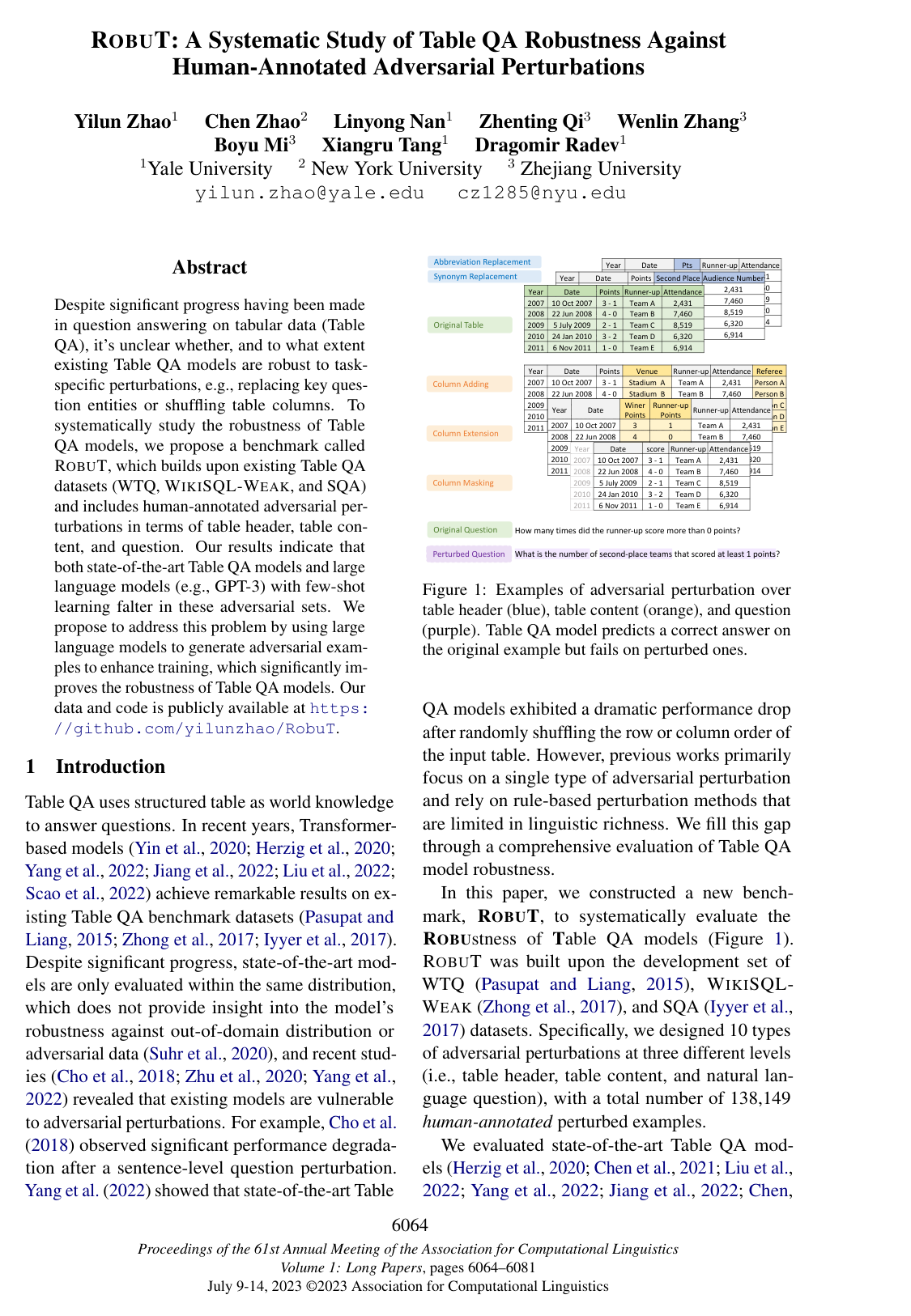
RobuT: A Systematic Study of Table QA Robustness Against Human-Annotated Adversarial Perturbations

RobuT: A Systematic Study of Table QA Robustness Against Human-Annotated Adversarial Perturbations

Yilun Zhao, Chen Zhao, Linyong Nan, Zhenting Qi, Wenlin Zhang, Xiangru Tang, Boyu Mi, Dragomir Radev

OrganizationsNew York UniversityYale UniversityZhejiang University

Why you should read this

Presents RobuT, a human-annotated diagnostic benchmark spanning 138,149 examples, demonstrating that state-of-the-art table question answering models fail under realistic perturbations and providing an LLM-based adversarial training framework to remedy these vulnerabilities.

Despite significant progress having been made in question answering on tabular data (Table QA), it’s unclear whether, and to what extent existing Table QA models are robust to task-specific perturbations, e.g., replacing key question entities or shuffling table columns. To systematically study the robustness of Table QA models, we propose a benchmark called RobuT, which builds upon existing Table QA datasets (WTQ, WikiSQL-Weak, and SQA) and includes human-annotated adversarial perturbations in terms of table header, table content, and question. Our results indicate that both state-of-the-art Table QA models and large language models (e.g., GPT-3) with few-shot learning falter in these adversarial sets. We propose to address this problem by using large language models to generate adversarial examples to enhance training, which significantly improves the robustness of Table QA models. Our data and code is publicly available at https://github.com/yilunzhao/RobuT.

Added

2026-10-03